
Will a 7 1/4 Miter Saw Cut a 4×4? Size and Depth Limits
A 7 1/4-inch miter saw will usually not cut completely through a standard 4×4 in a single pass. Most saws in this compact size class do not have enough vertical cutting capacity to clear the full 3 1/2-inch thickness of a finished 4×4.
If you are wondering will a 7 1/4 miter saw cut a 4×4, the answer depends on the exact saw design and the type of cut. A 7 1/4-inch miter saw may cut most of the way through a 4×4, and some models may handle the material by repositioning it, but you should not assume every saw can make a clean one-pass cut.
The important specifications are maximum vertical cutting capacity, blade diameter, fence design, sliding capacity, and bevel angle. Understanding those limits makes it easier to determine whether a compact miter saw is appropriate for 4×4 posts or whether a larger saw is a better match.
Will a 7 1/4 Miter Saw Cut a 4×4?
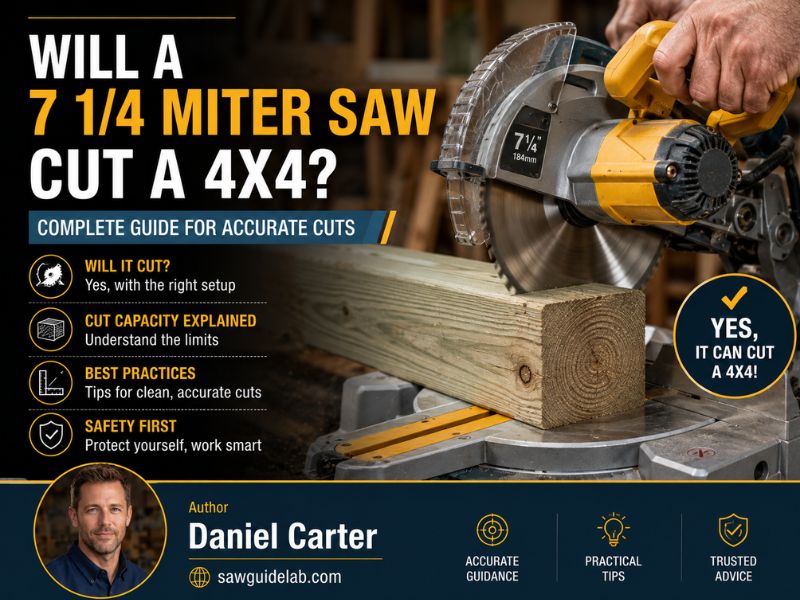
A typical 7 1/4-inch miter saw does not have enough one-pass cutting capacity for a standard 4×4.
A finished 4×4 commonly measures approximately 3 1/2 inches by 3 1/2 inches. A 7 1/4-inch blade is relatively small for a miter saw, and part of that blade remains above the table and inside the saw housing.
As a result, the usable vertical cutting capacity is considerably less than the full blade diameter.
Some compact miter saws may come close to cutting through a 4×4, while others leave a noticeable amount of material uncut. The exact result depends on the machine’s geometry rather than blade diameter alone.
One-Pass Cutting Is the Main Limitation
The important distinction is between being able to cut a 4×4 at all and being able to cut it completely in one pass.
A smaller miter saw may be able to cut deeply into the post, but a section can remain at the bottom or rear of the cut.
That limitation matters because one-pass cutting generally produces better alignment and is more convenient when multiple 4×4 posts need to be cut to the same length.
What Is the Actual Size of a 4×4?
Despite its name, a standard 4×4 does not normally measure a full 4 inches by 4 inches.
Most surfaced dimensional 4×4 lumber sold in the United States measures approximately:
- 3 1/2 inches thick
- 3 1/2 inches wide
The 4×4 designation is a nominal lumber size.
Lumber is initially produced closer to its nominal dimensions, but drying and surfacing reduce the final dimensions.
Why Actual Thickness Matters
Miter saw cutting capacity is based on the real dimensions of the workpiece.
The saw does not need 4 inches of vertical capacity to cut a standard 4×4. It needs slightly more than 3 1/2 inches of usable depth through the material.
Even that reduced measurement can exceed the practical capacity of many 7 1/4-inch miter saws.
| Lumber size | Typical actual size | Typical 7 1/4 miter saw result |
| 2×4 | 1 1/2 x 3 1/2 in. | Usually cuts easily |
| 2×6 | 1 1/2 x 5 1/2 in. | Often possible, depending on crosscut width |
| 4×4 | 3 1/2 x 3 1/2 in. | Often exceeds one-pass vertical capacity |
| 4×6 | 3 1/2 x 5 1/2 in. | Generally exceeds compact saw capacity |
Both the height and width of the material matter on a miter saw because blade travel is limited vertically and horizontally.
How Much Cutting Capacity Does a 7 1/4-Inch Miter Saw Have?
Cutting capacity varies considerably among 7 1/4-inch miter saws.
Unlike a handheld circular saw, where maximum cutting depth is largely determined by how far the blade extends below the shoe, a miter saw’s capacity depends on several parts of the machine working together.
These include:
- Blade diameter
- Arbor position
- Pivot point
- Motor housing
- Fence height
- Table position
- Sliding mechanism
- Blade guard design
Because manufacturers arrange these components differently, two miter saws using the same 7 1/4-inch blade can have different maximum cut capacities.
Vertical Capacity vs. Crosscut Capacity
Miter saw specifications often list more than one type of capacity.
Vertical cutting capacity refers to how tall a board or molding can be when positioned against the fence.
Crosscut capacity refers to how wide a board the saw can cut across.
A sliding 7 1/4-inch miter saw may have impressive crosscut width because the blade carriage moves forward and backward.
However, sliding action does not necessarily provide enough vertical depth to cut through a 3 1/2-inch-tall 4×4.
That is why looking only at crosscut width can be misleading when evaluating a saw for thick posts.
Why Blade Diameter Does Not Equal Cutting Capacity
A common misunderstanding is that a 7 1/4-inch blade should easily cut through a 3 1/2-inch post because half the blade diameter is more than 3 1/2 inches.
In theory, the blade radius is approximately 3 5/8 inches.
In a real miter saw, however, the arbor, table, guard, motor, and pivot mechanism prevent the entire radius from being available below the blade center.
Part of the blade must remain above the material.
This means usable cutting capacity is smaller than the blade radius.
Saw Geometry Makes a Major Difference
Miter saw capacity is not simply a mathematical function of blade size.
The location of the arbor relative to the table can determine whether the blade reaches the bottom rear corner of thick material.
Even small differences in pivot position can change whether a saw clears a 4×4 completely.
For this reason, the manufacturer’s maximum cut specification is more reliable than estimating capacity from blade diameter.
Can a Sliding 7 1/4 Miter Saw Cut a 4×4?
A sliding 7 1/4-inch miter saw may offer better overall capacity than a non-sliding model, but sliding capability does not guarantee that it will cut a 4×4 in one pass.
The primary purpose of a sliding mechanism is to increase crosscut width.
By allowing the saw head to travel horizontally, the blade can cut wider boards such as shelving, decking, or dimensional lumber.
A 4×4 presents a different challenge because it is thick vertically.
Sliding Capacity Helps Width More Than Height
A sliding miter saw may be able to cut a board that is 8, 10, or more inches wide, depending on the model.
That does not mean it can cut a 3 1/2-inch-tall post.
The vertical reach of the blade remains limited by the blade diameter and saw geometry.
Some compact sliding saws provide enough geometry to come very close to a full 4×4 cut, but model-specific specifications should be checked before relying on that capability.
Can You Cut a 4×4 by Repositioning It?
If a 7 1/4-inch miter saw does not cut completely through a 4×4 in one pass, the post may sometimes be repositioned so the remaining material can be cut from another face.
The available blade capacity may be sufficient overall even though it is not enough from one side.
The main issue is alignment.
Why Multiple Cuts Can Leave an Uneven Surface
When a post is turned, the second cut has to meet the first cut accurately.
Even a small difference in position can leave:
- A ridge across the cut face
- A slight step
- An uneven end
- A less accurate final length
For rough outdoor work, minor imperfections may not matter.
For projects requiring square, consistent post ends, a saw capable of making the cut in one pass generally offers a cleaner result.
Can a 7 1/4 Miter Saw Make a 45-Degree Cut Through a 4×4?
A 45-degree cut through a 4×4 is even more demanding than a square 90-degree crosscut.
At an angle, the blade must travel through a longer section of material.
This can exceed the saw’s available cutting envelope even when the saw nearly manages a square cut.
Miter and Bevel Angles Affect Capacity Differently
A miter cut changes the horizontal angle of the blade relative to the board.
A bevel cut tilts the blade away from vertical.
Both can reduce effective cutting capacity, but bevel cuts often have a particularly noticeable effect on vertical clearance.
A compact miter saw that is close to its limit on a square 4×4 cut may have insufficient capacity once the blade is angled.
7 1/4-Inch vs. 10-Inch Miter Saw for Cutting 4x4s
A 10-inch miter saw generally offers greater capacity than a 7 1/4-inch model.
That additional blade diameter provides more reach below the arbor and usually makes a standard 4×4 easier to handle.
| Feature | 7 1/4-inch miter saw | 10-inch miter saw |
| Standard 2×4 | Easily handled | Easily handled |
| Standard 4×4 | Often limited | Commonly within capacity |
| Tool size | Compact | Larger |
| Weight | Usually lighter | Usually heavier |
| Portability | Better | Moderate |
| Thick-material capacity | Limited | Greater |
| Blade cost | Often lower | Usually higher |
For users who mainly work with 1x and 2x lumber, a 7 1/4-inch saw can provide plenty of capacity.
For frequent post, beam, and thicker-stock work, a 10-inch model is generally more versatile.
7 1/4-Inch vs. 12-Inch Miter Saw for 4×4 Lumber
A 12-inch miter saw provides even greater cutting capacity.
The larger blade is particularly useful when cutting:
- 4×4 posts
- 4×6 lumber
- Thick beams
- Large crown molding
- Wide dimensional boards
- Compound bevels in thick stock
A 12-inch saw is not automatically necessary for occasional 4×4 cuts, but it provides more capacity margin.
Larger Is Not Always Better
A larger miter saw also has disadvantages.
Compared with a compact 7 1/4-inch model, a 12-inch saw is generally:
- Heavier
- Larger
- Less convenient to transport
- More expensive to equip with replacement blades
- More demanding of workbench space
For homeowners who mostly cut smaller lumber, those tradeoffs can matter more than maximum capacity.
Is a 7 1/4 Miter Saw Good for Framing?
A 7 1/4-inch miter saw can be useful for many framing tasks.
Common framing materials such as 2x4s, 2x6s, and similar dimensional boards are only about 1 1/2 inches thick.
That thickness is well within the vertical capacity of compact miter saws.
Typical uses can include cutting:
- Wall studs
- Short blocking
- Deck boards
- Fence boards
- Trim lumber
- Smaller dimensional stock
The limitation becomes more noticeable with thicker structural members such as 4×4 posts and larger timbers.
2x Lumber Is Much Easier Than 4x Lumber
A standard 2×4 measures approximately 1 1/2 inches by 3 1/2 inches.
A 4×4 is approximately 3 1/2 inches thick.
That additional 2 inches of thickness creates a major difference in blade reach requirements.
A saw that handles ordinary framing studs easily may therefore struggle with a 4×4 even though both pieces of lumber include “4” in their nominal dimensions.
Does Blade Type Matter for Cutting a 4×4?
Blade type affects cutting quality, speed, and motor load, although it does not increase the saw’s maximum physical capacity.
For construction lumber, a general-purpose or framing-oriented blade is usually appropriate.
Fewer Teeth for Faster Cuts
Blades with fewer teeth generally remove wood chips more quickly.
They are commonly used for:
- Framing lumber
- Construction stock
- Rough crosscuts
- Pressure-treated lumber
The resulting surface may be slightly rougher than a cut produced by a fine-finish blade.
More Teeth for Smoother Cuts
Higher tooth-count blades generally produce cleaner edges but may cut more slowly through thick lumber.
For a 4×4, blade sharpness can be particularly important because more material is being removed than during a typical 2×4 cut.
A dull blade increases resistance but still does not change the saw’s depth limitation.
Can a Cordless 7 1/4 Miter Saw Cut a 4×4?
Power source does not determine whether the blade physically reaches through a 4×4.
Both corded and cordless 7 1/4-inch miter saws can have similar capacity limitations.
A cordless saw may have enough motor power to cut thick lumber while still lacking the necessary blade reach for a complete one-pass cut.
The distinction is between power and capacity.
Power and Cutting Depth Are Separate Specifications
More motor power can help a saw maintain blade speed through dense material.
It does not increase blade diameter or change the location of the arbor.
A high-powered compact saw can therefore still have less cutting capacity than a larger-blade saw with similar motor output.
What Makes a 4×4 More Difficult to Cut?
Dimensions are not the only factor affecting performance.
Different pieces of 4×4 lumber can place different loads on the blade.
Pressure-Treated Lumber
Pressure-treated 4x4s are widely used for decks, fences, and outdoor structures.
They may contain considerable moisture, especially when relatively new.
Moist wood can increase cutting resistance.
Dense Wood Species
A hardwood 4×4 can require more cutting force than a typical softwood construction post.
Knots
Large knots are denser and harder than the surrounding wood.
A blade may noticeably slow when encountering them.
Dull Blades
A dull blade removes material less efficiently and can make a capable saw feel underpowered.
None of these factors increases the thickness of the post, but they can affect how easily the saw completes the portion of the cut that falls within its normal capacity.
What Size Miter Saw Is Better for Regular 4×4 Cutting?
For frequent 4×4 crosscuts, a 10-inch or 12-inch miter saw is generally a better fit than a 7 1/4-inch model.
A larger blade provides more vertical cutting capacity and reduces the need to reposition thick stock.
This becomes particularly useful for projects involving:
- Deck posts
- Fence posts
- Pergolas
- Outdoor framing
- Landscaping structures
- Repeated post cutting
A compact saw remains attractive for portability, but users who regularly work with 4×4 lumber may find the additional capacity of a larger saw more practical.
Safety Considerations When Cutting 4×4 Lumber
Thick lumber should sit securely against the saw table and fence.
A heavy 4×4 can move more easily than small trim stock if it is not properly supported.
Important considerations include:
- Use a blade rated for the saw.
- Keep the workpiece firmly supported.
- Keep the material against the fence.
- Do not exceed the saw’s published cutting capacity.
- Keep hands away from the blade path.
- Allow the blade guard to operate normally.
- Wear suitable eye and hearing protection.
- Disconnect power or remove the battery before changing the blade.
Trying to gain additional cutting capacity by installing an oversized blade is not appropriate.
A miter saw is designed for a specific blade diameter, guard system, arbor, and operating speed.
Frequently Asked Questions
Will a 7 1/4 miter saw cut through a 4×4 in one pass?
Usually not. A standard 4×4 measures approximately 3 1/2 inches thick, and many 7 1/4-inch miter saws do not provide enough vertical cutting capacity to pass through it completely in one cut.
What size miter saw will cut a 4×4?
Many 10-inch and 12-inch miter saws have sufficient capacity to cut a standard 4×4 in one pass. Exact capacity varies by model, so the manufacturer’s maximum cut specification should be checked.
Can a sliding 7 1/4 miter saw cut a 4×4?
Sliding action increases crosscut width but does not necessarily increase vertical cutting capacity enough for a 4×4. Some models may come close, but a sliding mechanism alone does not guarantee a one-pass 4×4 cut.
Can a 7 1/4 miter saw cut a 2×4?
Yes. A standard 2×4 is approximately 1 1/2 inches thick, which is well within the cutting capacity of typical 7 1/4-inch miter saws.
Can a 7 1/4 miter saw cut a 2×6?
Many 7 1/4-inch sliding miter saws can cut a 2×6 because it is only about 1 1/2 inches thick. Whether the saw can crosscut the full 5 1/2-inch width depends on its horizontal capacity.
Is a 10-inch miter saw enough for a 4×4?
Many 10-inch miter saws can cut a standard 4×4 in one pass, although capacity varies between models. Checking the manufacturer’s published crosscut specification is the safest way to confirm compatibility.
Is a 12-inch miter saw better for 4×4 posts?
A 12-inch miter saw provides greater cutting capacity and more margin for 4×4 posts, thick lumber, and angled cuts. It is particularly useful when thick stock is cut regularly.
Conclusion
A 7 1/4 miter saw will cut into a 4×4, but most models should not be expected to cut completely through the post in one pass. A finished 4×4 is approximately 3 1/2 inches thick, while compact 7 1/4-inch miter saws have limited vertical blade reach.
The exact answer depends on the saw’s published cutting capacity rather than blade diameter alone. For occasional 4×4 work, repositioning the post may provide enough total reach. For frequent 4×4 cutting, a 10-inch or 12-inch miter saw generally provides more practical one-pass capacity.