Rear Handle vs Top Handle Circular Saw: Differences and Uses
Choosing between a rear handle vs top handle circular saw is mostly about how you want the saw to feel, balance, and move while cutting. Both designs can handle common circular-saw jobs such as cutting lumber, plywood, framing material, and sheet goods, but their layouts are noticeably different.
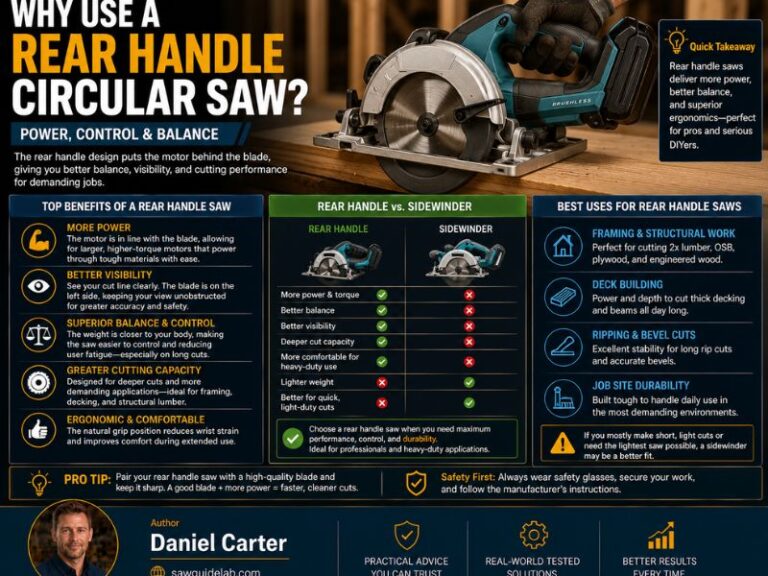
A rear-handle circular saw places the main grip farther behind the motor and blade. This gives the saw a longer body, more reach, and a pushing position that many framing carpenters like for long rip cuts and cutting large pieces of lumber.
A top-handle circular saw, sometimes associated with the more conventional sidewinder-style layout, keeps the main grip closer to the top and rear of the motor housing. The overall saw is usually shorter and more compact, making it easier to maneuver, carry, and use in tighter spaces.
Neither design is automatically better for everyone. A rear-handle saw may feel more stable and natural during heavy framing cuts, while a top-handle model can feel lighter, quicker, and easier to control for general DIY work.
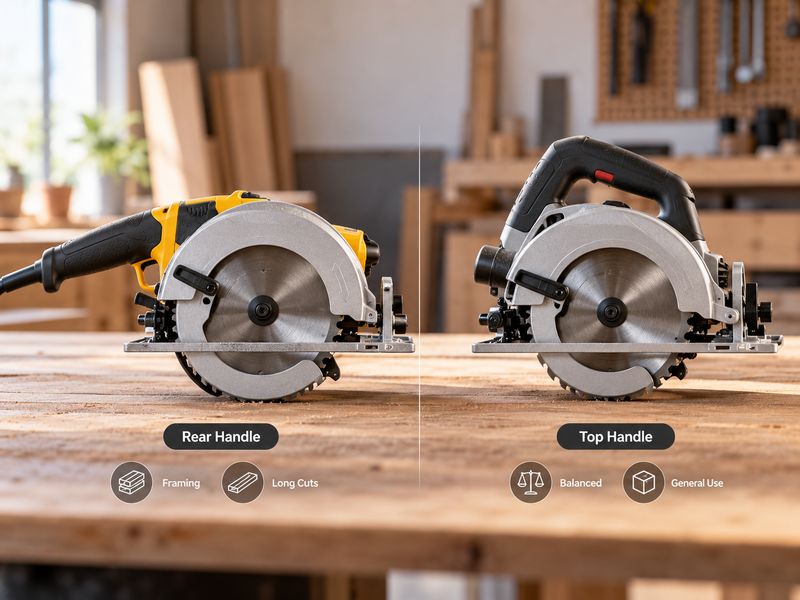
This guide explains the major differences between the two designs, including weight, balance, reach, cutting visibility, power, handling, and typical applications.
Rear Handle vs Top Handle Circular Saw: Quick Comparison
The biggest difference is the physical layout of the saw.
| Feature | Rear Handle Circular Saw | Top Handle Circular Saw |
| Handle position | Behind the motor/blade | Above and slightly behind motor |
| Overall shape | Long and narrow | Shorter and compact |
| Typical weight | Usually heavier | Usually lighter |
| Reach | Better | Shorter |
| Maneuverability | Moderate | Better |
| Long rip cuts | Very good | Good |
| Framing work | Excellent | Very good |
| Tight spaces | Less convenient | Better |
| One-handed repositioning | Harder | Easier |
| Balance feel | Forward, in-line | Compact and centered |
| Beginner friendliness | Good | Usually easier |
The table provides a general comparison. Actual performance depends on the individual saw, blade size, motor design, battery platform, and manufacturer.
What Is a Rear Handle Circular Saw?
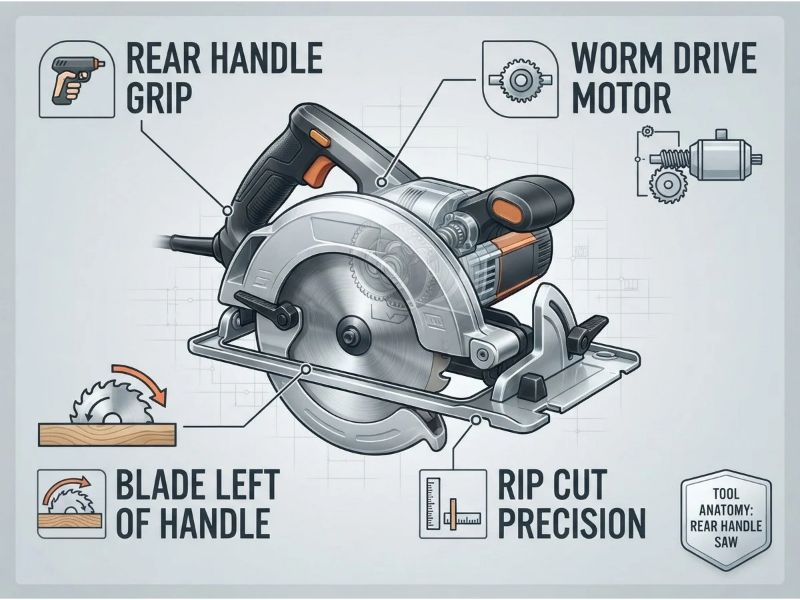
A rear handle circular saw has its main operating handle positioned farther behind the motor and blade.
Instead of holding the saw close to the blade housing, your main hand sits toward the rear of an elongated saw body. Your other hand normally controls the front auxiliary handle.
This layout creates a more in-line pushing position.
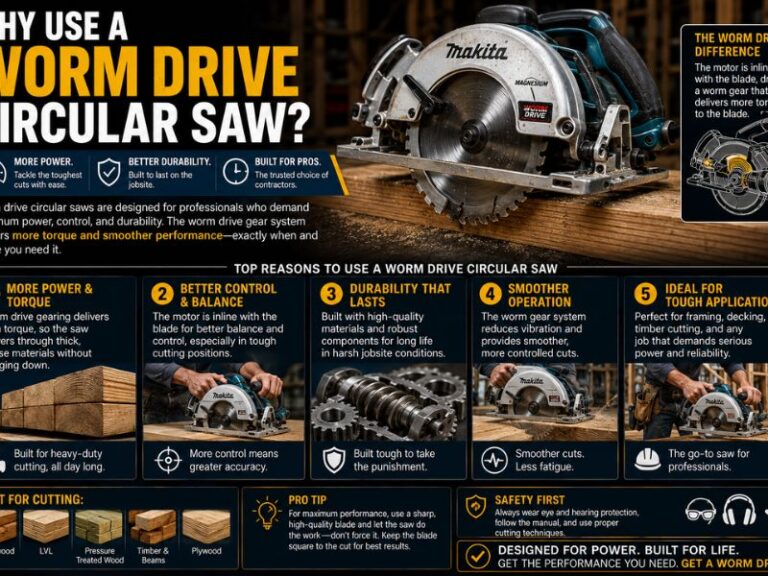
The design has traditionally been associated with worm-drive circular saws, particularly in professional framing. However, it is important not to assume that every modern rear-handle saw uses a traditional worm-drive gear system. Many cordless rear-handle saws use modern brushless motor and drive designs while keeping the familiar elongated form.
Rear-handle saws are especially popular for jobs that involve repeatedly cutting:
Framing lumber, rafters, joists, dimensional lumber, plywood, and other construction materials.
Their longer design also gives the user more reach when cutting across wide boards or sheet material.
What Is a Top Handle Circular Saw?
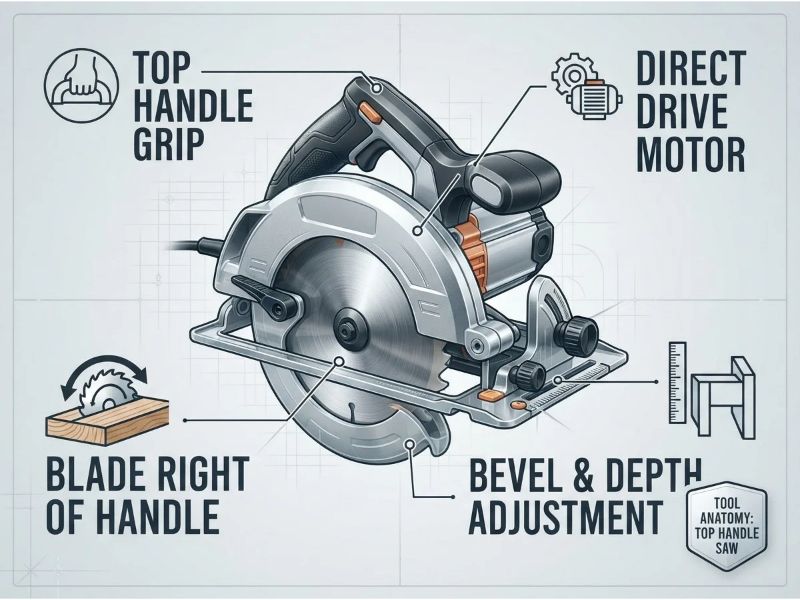
A top handle circular saw uses a more compact layout, with the main grip positioned over or near the rear portion of the motor housing.
This is the design many homeowners picture when they think of a standard circular saw.
The motor and blade assembly are positioned relatively close to the user’s hands, producing a shorter overall tool.
Because of this compact layout, top-handle saws are commonly used for:
General woodworking, DIY projects, plywood cutting, remodeling, framing, deck work, and jobsite cutting.
A top-handle design is usually easier to move between cuts and can feel less tiring when the saw must be frequently lifted and repositioned.
Handle Position and Saw Layout
Handle position is the most obvious difference between the two saws, but it affects almost every part of the cutting experience.
With a rear-handle saw, your pushing hand is farther behind the blade. This gives you more distance between your body and the cutting area and allows you to push the saw forward in a relatively straight line.
A top-handle saw keeps your hand much closer to the center of the tool.
That makes the saw feel more compact and responsive.
Think of it this way:
A rear-handle saw feels more like you are driving the saw forward.
A top-handle saw feels more like you are carrying and guiding the saw directly over the cut.
The better feeling is largely personal.
Which Saw Has Better Balance?
Balance is one of the main reasons users develop strong preferences between these designs.
A rear-handle saw has its weight spread across a longer body. The blade and motor sit farther forward relative to your main hand.
When the saw is resting on the workpiece, this can create a stable feel, particularly during longer cuts.
The saw’s own weight may help keep the base plate, or shoe, planted against the material.
A top-handle saw concentrates more of its mass around the center of the tool.
That makes it easier to lift, reposition, and change cutting direction.
For cuts that require frequent movement, the more compact balance of a top-handle model can be more comfortable.
Rear Handle vs Top Handle Circular Saw Weight
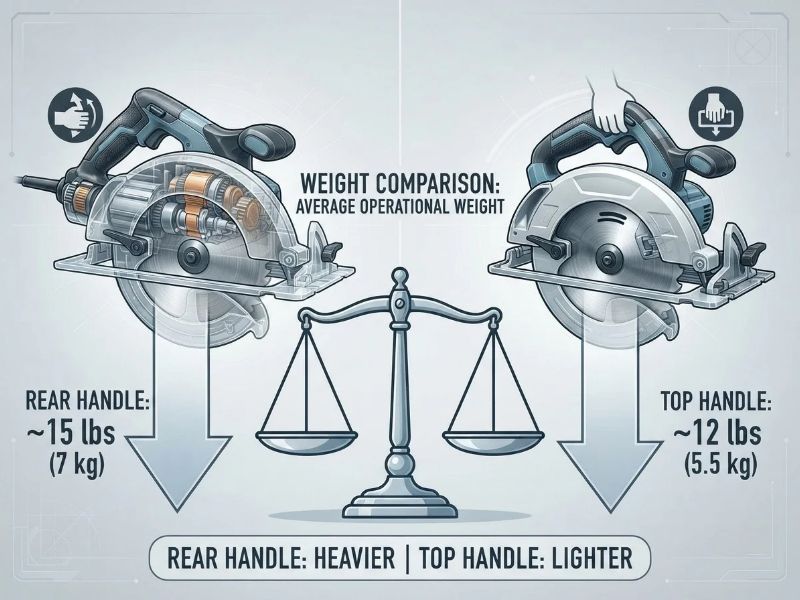
Rear-handle circular saws are generally heavier than comparable top-handle models.
There are several reasons for this.
The rear-handle design is physically longer, and many models are built for demanding construction work. Cordless rear-handle saws may also use relatively large batteries to provide the power and runtime expected from professional framing tools.
The extra weight is not always a disadvantage.
When the saw is supported on lumber, additional mass can make the tool feel stable.
The downside becomes more noticeable when you are:
Carrying the saw around a jobsite, making repeated short cuts, working overhead, or constantly lifting it between cuts.
A lighter top-handle saw may be much less tiring in those situations.
Which Circular Saw Is More Compact?
The top-handle circular saw is usually more compact.
Its shorter overall length makes it easier to:
Store in a tool box, maneuver between framing members, transport around the jobsite, and use where working space is limited.
Rear-handle saws require more room behind and around the workpiece.
That extra length is useful for reach, but not always convenient.
For a homeowner working in a garage or a remodeler cutting in restricted spaces, compactness can be an important advantage.
Which Saw Offers Better Reach?
This is an area where rear-handle circular saws have a clear practical advantage.
Because the handle sits farther behind the blade, the saw gives you greater forward reach.
Suppose you are leaning across a wide sheet or cutting material that is slightly difficult to reach comfortably.
A rear-handle model lets you keep your body farther back while still moving the blade through the cut.
This is one reason rear-handle saws are popular for framing and large construction work.
More reach does not necessarily make the saw more accurate, but it can improve comfort in certain cutting positions.
Rear Handle vs Top Handle for Long Rip Cuts
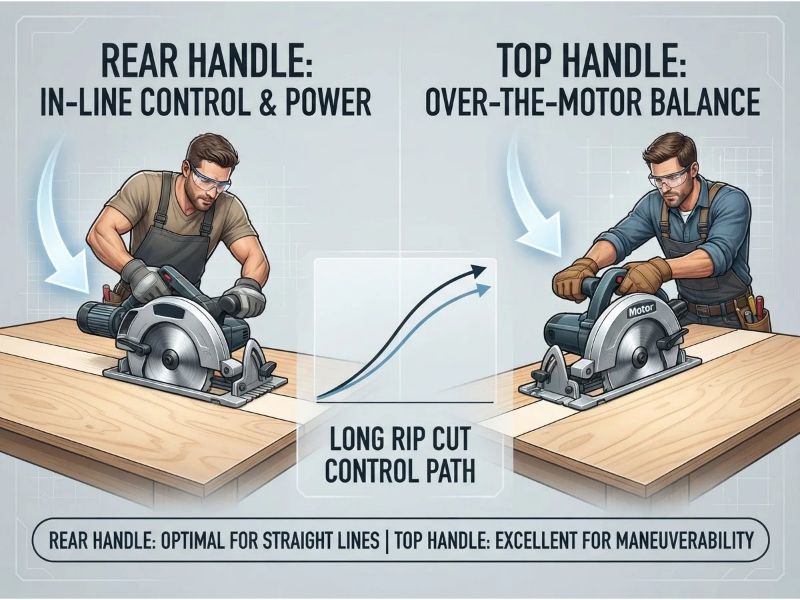
A rear-handle circular saw can feel particularly natural during long rip cuts.
The elongated layout encourages a straight pushing motion, and the additional weight can help the saw remain planted on the workpiece.
When ripping plywood or cutting along long framing members, some users prefer this stable in-line feel.
A top-handle saw can make the same cuts perfectly well.
However, the shorter design tends to feel more maneuverable rather than planted.
If most of your work involves short crosscuts, you may not notice much advantage from the extra length of a rear-handle saw.
Which Saw Is Better for Framing?
A rear-handle circular saw is especially popular for framing, although both types can perform framing work.
Framers frequently cut:
2x4s, 2x6s, joists, rafters, headers, plywood, and other structural materials.
The rear-handle layout works well for repetitive cuts because the saw can be pushed through lumber with both hands aligned naturally behind the cutting direction.
Its reach can also help when working across large framing assemblies.
That said, modern top-handle saws are fully capable of professional framing work.
Your preference for weight, blade visibility, balance, and battery platform may matter more than the handle style alone.
Which Is Better for DIY Projects?
For many homeowners and occasional users, a top-handle circular saw is easier to live with.
The shorter design is convenient for common jobs such as:
Cutting plywood for shelving, trimming boards, building small furniture, making deck repairs, cutting construction lumber, and general home improvement.
A top-handle saw typically takes up less storage space and is easier to move between cuts.
If you only use a circular saw a few times each month, the extra reach and weight of a rear-handle model may provide little practical benefit.
Rear Handle vs Top Handle for Cutting Plywood
Both designs work well for plywood.
A rear-handle saw may feel comfortable when making long cuts across large sheets, especially when additional reach helps.
A top-handle saw may feel easier when making shorter cuts or repeatedly repositioning the tool.
For plywood cutting accuracy, factors such as a sharp blade, straightedge guide, stable support, and correct blade depth are usually more important than the handle position.
Neither design automatically produces a cleaner cut.
The blade has a much larger effect on cut quality.
Power: Is a Rear Handle Saw More Powerful?
Rear-handle saws have a reputation for being powerful, partly because traditional worm-drive circular saws have long been associated with this layout.
However, handle position itself does not determine motor power.
A modern top-handle circular saw can be extremely powerful, especially when using a high-output brushless motor and a capable battery.
Likewise, many cordless rear-handle saws use modern motor systems that differ from traditional corded worm-drive designs.
When comparing power, look at the actual saw specifications and performance rather than assuming that rear handle automatically means more powerful.
Important factors include:
Motor output, blade speed, battery voltage and current capability, gearing, blade quality, and electronic motor control.
Rear Handle vs Top Handle Cutting Speed
Cutting speed depends more on the motor and blade than on the handle position.
A powerful top-handle saw with a sharp construction blade can easily outperform a weaker rear-handle model.
The handle design affects how comfortably you can feed the saw through the material, but it does not determine the cutting rate on its own.
For fast cuts, use the proper blade and allow the motor to maintain speed.
Forcing either type of circular saw too quickly can cause blade slowdown, rough cuts, or binding.
Which Has Better Cutting-Line Visibility?
Cutting-line visibility depends heavily on which side of the saw the blade is located relative to the user.
Some rear-handle saws place the blade on the left side when held conventionally, which can provide an excellent view of the cut line for many right-handed users.
Many conventional top-handle circular saws use a blade-right configuration, although blade-left top-handle models are also available.
Therefore, do not choose only by handle type if visibility is important.
Check the actual blade-side configuration.
A clear sightline can make freehand cutting much easier.
Blade Left vs Blade Right Matters Too
Handle style and blade position are separate characteristics.
A saw can feel completely different depending on whether the blade sits to the left or right of your main hand.
For many right-handed users, a blade-left design offers a direct view of the cutting line.
However, it also places the blade closer to the user’s side of the saw.
A blade-right saw may position the blade farther from the user’s body but can make the cut line less visible from certain angles.
Neither configuration is universally better.
Choose based on what feels comfortable while maintaining safe body positioning.
Which Saw Is Easier to Control?
For a beginner, a top-handle circular saw may feel easier to control because it is usually shorter and lighter.
It responds quickly when you reposition it and places your hands close to the tool’s center of mass.
A rear-handle saw may initially feel large and heavy.
Once it is sitting on the workpiece, however, the longer layout can feel extremely stable.
This means the answer changes depending on what you mean by control.
For maneuverability, top handle has an advantage.
For stable forward cutting, many users prefer rear handle.
Which Is Better in Tight Spaces?
The top-handle design is usually better in tight spaces.
Rear-handle models require more clearance behind the blade because of their elongated body.
This can become inconvenient when cutting near:
Walls, framing corners, cabinets, existing structures, or other restricted spaces.
A compact top-handle saw can fit into situations where a long rear-handle model feels awkward.
If remodeling is your primary work, tool size may matter more than additional reach.
Which Saw Is Better for Overhead Work?
A lighter top-handle circular saw is generally easier to manage when weight becomes a major concern.
Circular saws should always be used with stable footing and proper support, and many overhead or awkward cuts are better approached using a different cutting setup altogether.
However, whenever the saw must be lifted repeatedly or held in an unusual orientation, extra weight becomes tiring quickly.
Rear-handle saws are generally better suited to situations where most of their weight can remain supported by the workpiece.
Rear Handle vs Top Handle Circular Saw Ergonomics
Ergonomics are highly personal.
The rear-handle layout gives you a wide distance between the main and auxiliary handles.
This can provide strong two-handed leverage and a natural forward push.
A top-handle saw places your hands closer together and closer to the center of the saw.
This provides a more compact feeling.
If possible, hold both types before buying.
Pay attention to:
Trigger comfort, front-handle position, battery placement, shoe visibility, weight distribution, and how naturally your wrists align.
A saw that feels comfortable is usually easier to control over a full day of work.
Cordless Rear Handle vs Top Handle Circular Saw
Cordless technology has reduced many of the performance differences that once separated circular-saw designs.
Modern brushless cordless saws can deliver very strong cutting performance in either layout.
The battery plays a major role in how the saw feels.
On a rear-handle model, a large battery positioned toward the rear may help balance the motor and blade at the front.
On a compact top-handle model, the battery can add significant weight to what would otherwise be a relatively light saw.
When comparing cordless models, consider the saw and battery together, not just the bare-tool weight.
Rear Handle Circular Saw Advantages
The rear-handle design makes the most sense when you value reach, stability, and an in-line cutting position.
It can feel excellent for heavy framing work, long cuts, and situations where the saw remains supported on the workpiece.
Its primary disadvantage is that you have to carry and maneuver a longer, heavier tool.
Top Handle Circular Saw Advantages
A top-handle circular saw emphasizes compactness and maneuverability.
It is easier to move around, simpler to store, and often more comfortable for frequent short cuts.
For general woodworking, remodeling, and home projects, the compact layout can be extremely convenient.
Its shorter reach may be noticeable on large framing jobs, but that is not a significant issue for many users.
Rear Handle Circular Saw Disadvantages
The extra size and weight are the main drawbacks.
A rear-handle saw can become tiring if you constantly lift it from cut to cut.
It also needs more working clearance and usually occupies more room in storage.
For users who primarily cut small boards or sheet goods on a workbench, the longer layout may not provide much benefit.
Top Handle Circular Saw Disadvantages
A top-handle saw has less reach and may not provide the same planted, in-line feel that some users prefer for heavy framing cuts.
Depending on the model, balance can also change noticeably when a large battery is installed.
These are not major weaknesses. They simply reflect the more compact design.
Which Circular Saw Should a Beginner Choose?
For most beginners, a top-handle circular saw is a straightforward starting point.
It is familiar, compact, easy to store, and generally lighter.
It can perform almost every standard circular-saw task a homeowner is likely to encounter.
A rear-handle saw becomes especially attractive if you expect to do substantial framing, deck construction, or other heavy building work.
Beginners can use either safely, but the lighter tool is often easier to become comfortable with.
Which One Should You Choose?
Choose a rear-handle circular saw if you frequently work with framing lumber, appreciate extra reach, prefer an elongated two-handed cutting position, and do not mind additional weight.
Choose a top-handle circular saw if you prioritize compact size, easier maneuverability, lower weight, storage convenience, and general-purpose versatility.
For many buyers, the best decision comes down to how the tool feels in the hand rather than a major difference in what it can cut.
Frequently Asked Questions About Rear Handle vs Top Handle Circular Saws
What is the difference between a rear handle and top handle circular saw?
A rear-handle saw positions the main grip farther behind the motor, creating a longer saw with greater reach. A top-handle saw uses a shorter, more compact layout with the grip closer to the motor.
Is a rear handle circular saw better?
It can be better for framing, long cuts, and users who like an in-line pushing position. It is not automatically better for every application.
Are rear handle circular saws more powerful?
Not necessarily. Many are powerful professional tools, but handle position does not determine motor power.
Is a rear handle circular saw the same as a worm drive?
No. Many traditional worm-drive saws use a rear-handle layout, but not every modern rear-handle saw uses a traditional worm-drive mechanism.
Are top handle circular saws lighter?
Generally, yes. Their compact construction usually results in lower overall weight, although individual models vary.
Which circular saw is better for framing?
Rear-handle saws are very popular for framing because of their reach and cutting position, but a powerful top-handle saw can perform the same framing cuts.
Which circular saw is better for plywood?
Both work well. Rear-handle models offer extra reach, while top-handle saws are easier to maneuver. Blade choice and a good cutting guide matter more for plywood cut quality.
Which type is easier for beginners?
A compact top-handle circular saw is usually easier for beginners because it tends to be lighter and easier to reposition.
Which one is better for long rip cuts?
Many users prefer the stability and reach of a rear-handle model for long rip cuts.
Which is better for tight spaces?
A top-handle circular saw is usually easier to use in confined areas because of its shorter overall body.
Final Thoughts
The main difference in rear handle vs top handle circular saw designs is not what they can cut but how they feel while making the cut.
A rear-handle circular saw has a longer body, places your main hand farther behind the blade, and generally provides more reach and a stable in-line cutting position. These characteristics make the design especially popular for framing, long cuts, and heavy construction work.
A top-handle circular saw is shorter, usually lighter, and easier to maneuver. It is a practical choice for DIY projects, remodeling, plywood, general woodworking, and frequent short cuts.
Do not assume that a rear-handle saw is automatically more powerful or that every rear-handle model is a traditional worm-drive saw. Modern circular-saw performance depends much more on the motor, gearing, battery system, blade, and overall design.
For heavy framing and maximum reach, a rear-handle saw may feel more natural. For compactness, maneuverability, and general-purpose use, a top-handle circular saw is often the easier choice.