Can You Cut Drywall With a Saw? Best Saw Types for Cutting Drywall
Drywall is easy to cut compared with wood, metal, or tile, but choosing the wrong tool can still turn a simple job into a dusty, rough, or potentially unsafe mess. That is why homeowners and first-time DIYers often ask questions such as can you cut drywall with a saw, can you use a circular saw, is a jab saw better, or will a regular hand saw work?
The short answer is that many types of saws can physically cut drywall, but that does not mean every saw is a good choice.
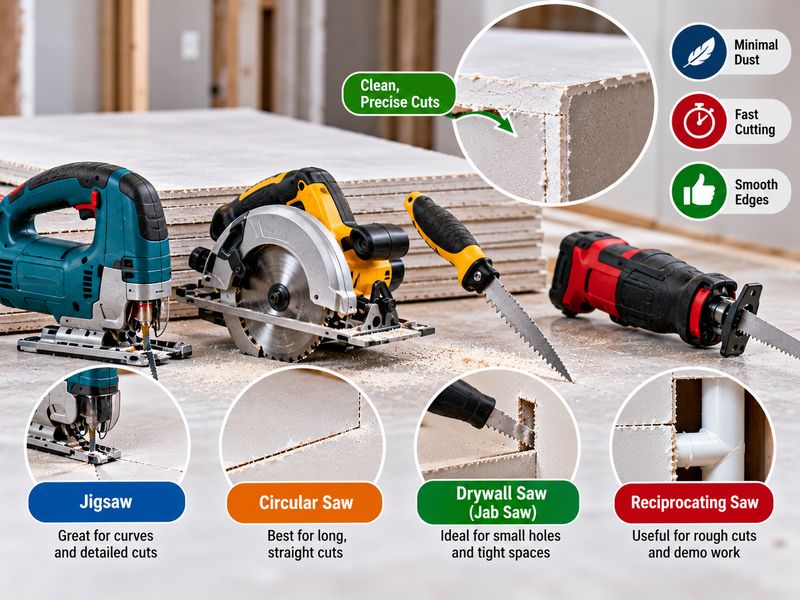
For most small openings in installed drywall, a jab saw or drywall saw is one of the simplest tools to use. A jigsaw can work well for controlled cuts in loose drywall sheets, while a reciprocating saw may be useful in certain demolition situations.
Circular saws and table saws can cut drywall, but they create large amounts of fine gypsum dust and are usually unnecessary for normal drywall work.
For straight cuts across new drywall sheets, you often do not need a saw at all. A utility knife, straightedge, and snap-cut method are usually faster and cleaner.
This guide explains which saws can cut drywall, which ones are actually worth using, when a Dremel or rotary tool makes sense, and how to choose the right cutting tool for different drywall jobs.
Can You Cut Drywall With a Saw?
Yes, you can cut drywall with a saw.
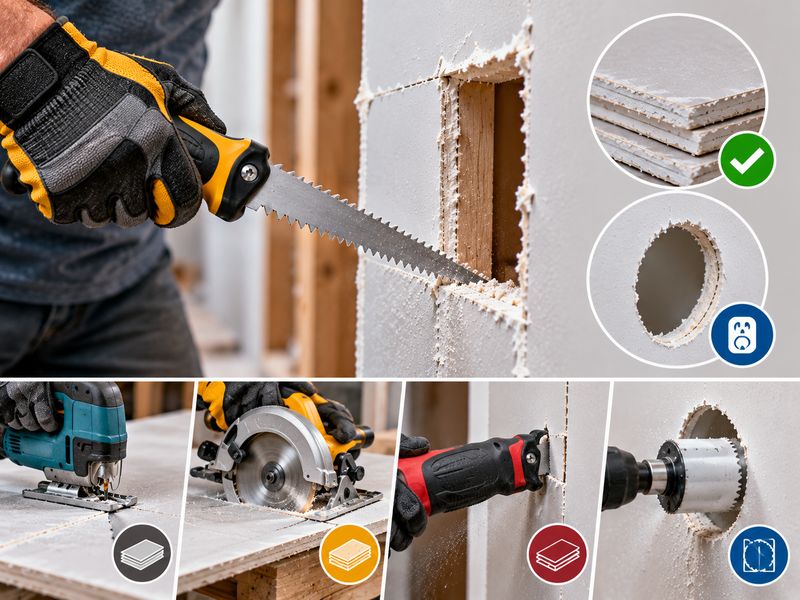
Drywall consists mainly of a gypsum core covered with heavy paper, so it is much softer and easier to cut than lumber or sheet metal. Several hand saws and power saws can pass through it without much difficulty.
However, the better question is not simply whether a saw can cut drywall. It is:
Which tool gives you the safest, cleanest, and easiest cut for the particular job?
For example:
- A jab saw works well for outlet and switch openings.
- A jigsaw can handle curved or shaped cuts.
- A utility knife is usually better for long straight cuts.
- An oscillating multi-tool can be useful for controlled cuts in installed drywall.
- A rotary cut-out tool works well for electrical boxes and fixture openings.
- A reciprocating saw is generally more appropriate for demolition than precision drywall work.
So while many saws can cut drywall, some are much better suited to the material than others.
What Type of Saw Is Best for Cutting Drywall?
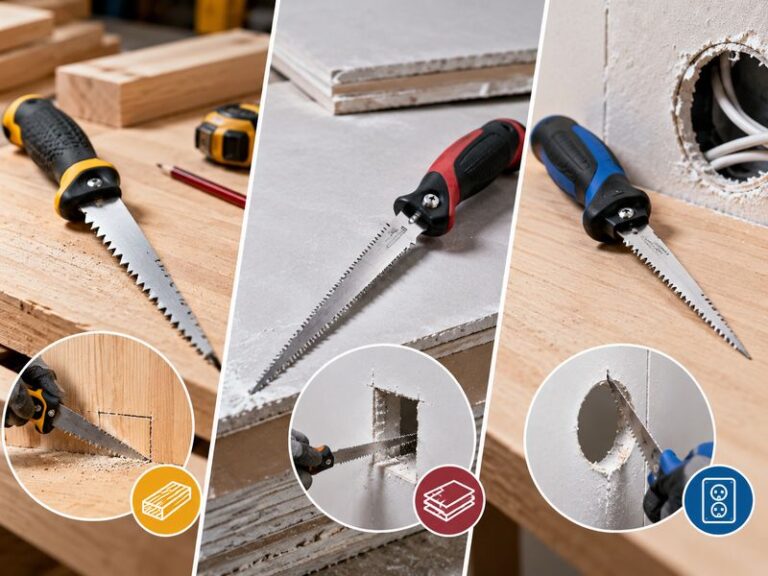
For most small drywall openings, the best saw for cutting drywall is a jab saw, also commonly called a drywall saw.
A jab saw is inexpensive, easy to control, and specifically designed for cutting through gypsum board.
Its narrow blade and pointed tip allow you to start a cut inside the middle of a drywall panel without needing access to an outside edge.
That makes it ideal for:
- Electrical outlet openings
- Light switch boxes
- Plumbing access holes
- Vent openings
- Recessed lighting
- Small repair areas
- Cable pass-through holes
- Speaker openings
- Access panels
However, there is no single best tool for every drywall cut.
Best Tool for Different Drywall Jobs
| Drywall Job | Recommended Tool |
| Small opening in installed drywall | Jab saw / drywall saw |
| Long straight cut on new drywall | Utility knife |
| Curved or irregular cut | Jigsaw or keyhole saw |
| Outlet or switch opening | Jab saw or rotary cut-out tool |
| Precision cut in installed wall | Oscillating multi-tool |
| Large demolition opening | Reciprocating saw with caution |
| Repetitive professional drywall cutouts | Rotary cut-out tool |
The right choice depends on whether the drywall is already installed, how precise the cut needs to be, and what may be hidden behind the wall.
What Type of Saw Is Best for Cutting Into Drywall?
If you need to cut into drywall that is already installed on a wall or ceiling, a jab saw is one of the most practical hand tools.
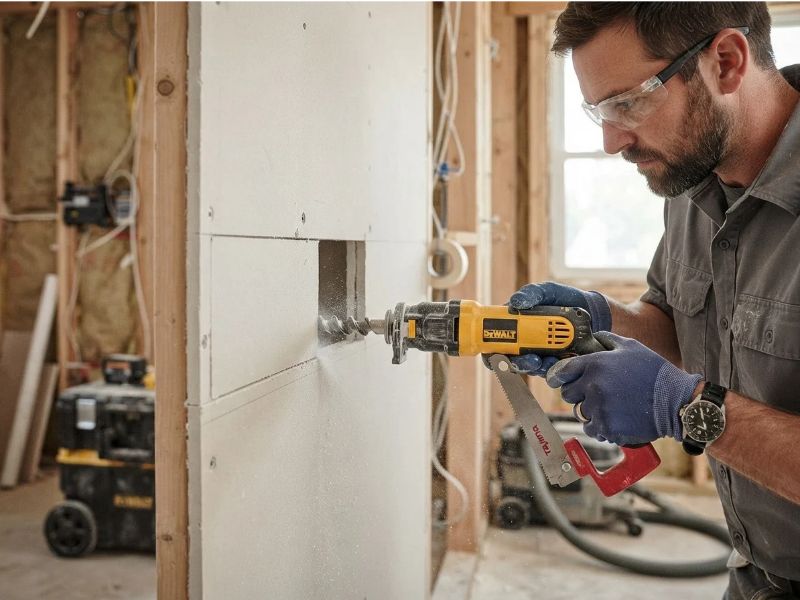
Its pointed end allows you to create a starter opening and begin cutting from inside the panel.
An oscillating multi-tool is another good option when you want more control over cutting depth.
This becomes especially important when working around:
- Electrical wiring
- Plumbing lines
- Wall studs
- Insulation
- Data cables
- Existing fixtures
A long saw blade can reach much farther into the wall cavity than you intend.
For that reason, controlling cutting depth is often more important than cutting speed when opening an existing wall.
Is a Jab Saw Good for Cutting Drywall?
Yes. A jab saw is one of the best hand tools for cutting drywall.
It is often sold under names such as:
- Drywall saw
- Jab saw
- Drywall jab saw
- Wallboard saw
- Plasterboard saw
The blade is usually narrow, rigid, and pointed at the end.
That pointed tip allows the blade to penetrate drywall so that you can begin an internal cut without drilling a large starting hole.
Read More: What More Can You Cut With a Jab Saw?
Why a Jab Saw Works Well
A jab saw is especially useful because it is:
Simple: No electricity or battery is required.
Affordable: Basic models are inexpensive.
Portable: It easily fits into a toolbox or tool bag.
Easy to control: Manual cutting lets you work slowly.
Designed for drywall: Its aggressive teeth cut gypsum board quickly.
Common Jab Saw Uses
A jab saw is commonly used to cut openings for:
- Electrical boxes
- Wall switches
- Recessed lights
- Plumbing pipes
- Air vents
- Access panels
- Low-voltage wiring
- Small drywall repairs
For beginners doing occasional drywall work, a jab saw is often all that is needed for small openings.
Can You Use a Regular Saw to Cut Drywall?
Yes, a regular saw can cut drywall, but it usually is not the best tool.
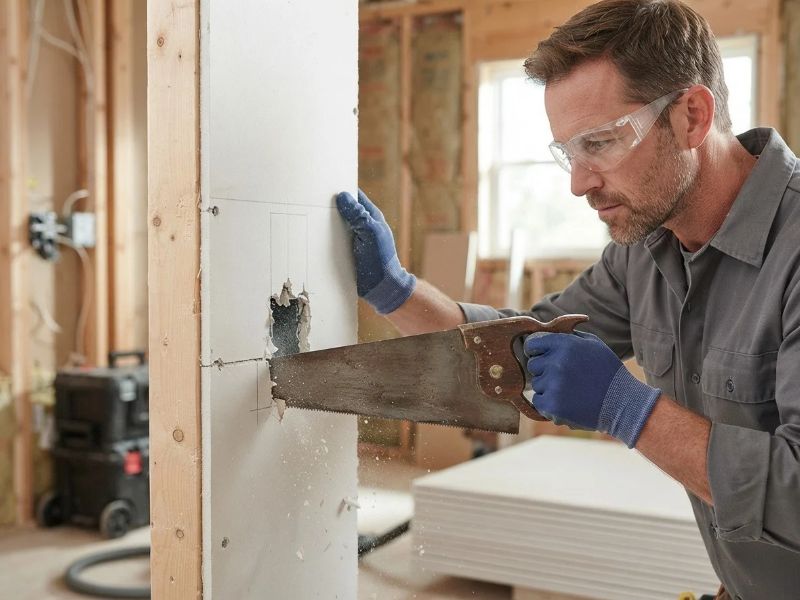
A standard hand saw designed for wood typically has a much longer and wider blade than a drywall saw.
Drywall is soft enough that the teeth will cut through it. However, several problems can occur.
A regular hand saw may be:
- Too large for small openings
- Difficult to turn around corners
- Awkward inside an installed wall
- More likely to create a rough cut
- Harder to control near wires or pipes
A regular saw makes more sense when cutting a drywall sheet from an exposed edge and precision is not critical.
For small interior openings, a jab saw, keyhole saw, or drywall saw is generally much easier to use.
Can You Cut Drywall With a Regular Hand Saw?
Yes. You can cut drywall with a regular hand saw, particularly if the sheet is not yet installed.
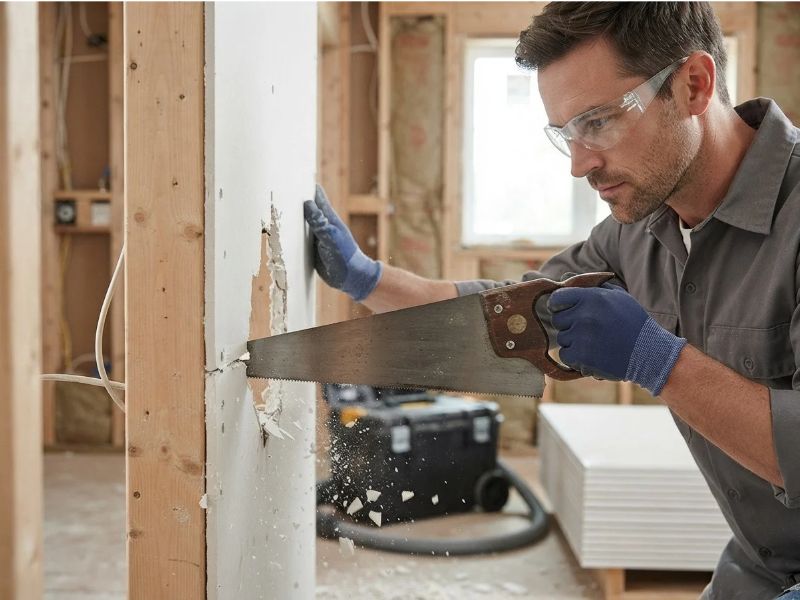
For example, if you have a loose sheet sitting on supports and need to remove a large section, a hand saw can cut through it.
But there is usually a better method.
For long straight cuts, scoring the front paper with a utility knife and snapping the board is normally:
- Faster
- Cleaner
- Less dusty
- Easier
- More accurate
A hand saw also creates more loose gypsum dust because its teeth grind through the core rather than simply scoring and snapping the board.
Use a regular hand saw only when the cut or situation makes it practical.
Can I Use a Circular Saw to Cut Drywall?
Technically, yes, a circular saw can cut drywall.
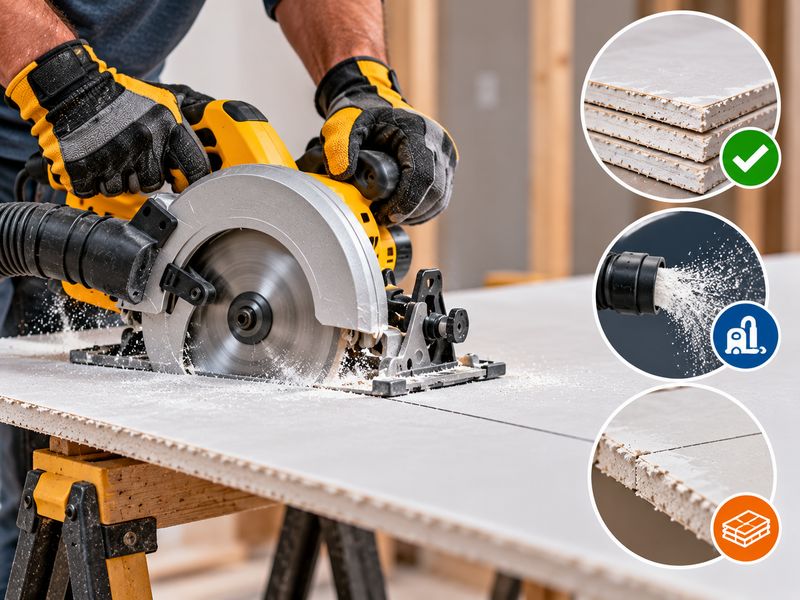
However, a circular saw is usually not recommended for normal drywall cutting.
The biggest problem is dust.
A circular saw spins at high speed. When its blade passes through drywall, it can turn gypsum into a large amount of fine airborne dust almost instantly.
That dust can spread through:
- The room
- The saw
- Nearby equipment
- Air vents
- Clothing
- Floors and furniture
Drywall dust can also be irritating to your eyes and respiratory system.
Why a Circular Saw Is Usually Unnecessary
Drywall is already easy to cut using simple hand tools.
For a long straight cut, you can usually score and snap drywall much faster than setting up a circular saw.
Using a circular saw introduces:
- More dust
- More noise
- More cleanup
- Greater blade exposure
- A higher chance of damaging the drywall surface
For most homeowners, there is very little advantage.
When Might a Circular Saw Be Used?
Professionals may occasionally use specialized cutting methods for stacked boards or unusual construction situations.
That is different from using a conventional circular saw for ordinary home drywall work.
For a typical DIY project, choose a utility knife, jab saw, drywall saw, or appropriate drywall cutting tool instead.
Can You Cut Drywall With a Jigsaw?
Yes. A jigsaw can cut drywall, and it can be useful for certain types of cuts.
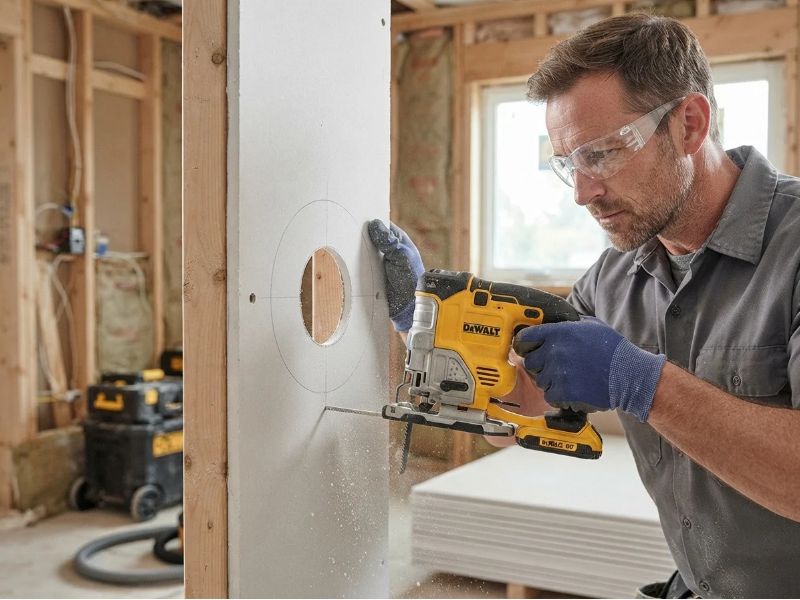
A jigsaw uses a narrow blade that moves rapidly up and down.
Because the blade is narrow, the tool is good at:
- Curved cuts
- Irregular openings
- Large cutouts
- Following marked shapes
If you need to cut an unusual shape in a loose drywall sheet, a jigsaw may be easier to control than a circular saw.
Advantages of Using a Jigsaw
A jigsaw can provide:
- Better curve control
- Faster cutting than a hand saw
- Good visibility of the cutting line
- Easier handling than some larger power saws
Disadvantages
A jigsaw still creates more dust than scoring drywall with a knife.
It can also damage the paper face around the cut if the wrong blade or aggressive cutting technique is used.
The blade extends below the drywall, which is another concern when cutting an existing wall.
Hidden wires, plumbing pipes, or structural components could be damaged.
Is a Jigsaw Good for Installed Drywall?
It can work, but extra caution is necessary.
For installed drywall, a jab saw or oscillating multi-tool usually provides better depth control.
For loose sheets where you can see what is behind the board, a jigsaw becomes more practical.
Can You Cut Drywall With a Reciprocating Saw?
Yes. A reciprocating saw can cut drywall very quickly, but it is usually too aggressive for precise drywall work.
A reciprocating saw uses a long blade that moves rapidly backward and forward.
It is excellent for:
- Demolition
- Remodeling
- Removing damaged wall sections
- Cutting through mixed construction materials with the correct blade
But it is not usually the tool you want for a neat electrical outlet opening.
The Main Problem: Blade Depth
Reciprocating saw blades can extend several inches beyond the drywall.
Behind the drywall may be:
- Electrical cables
- Water pipes
- Drain lines
- Gas piping
- Insulation
- Structural framing
A long reciprocating saw blade can reach those components very easily.
When a Reciprocating Saw Makes Sense
A reciprocating saw may be useful when:
- The wall is being demolished
- Utilities have been identified or disconnected
- Precision is not important
- A large section of wallboard needs to be removed
For small repair openings or finish work, choose something more controlled.
Can You Cut Drywall With a Table Saw?
A table saw can physically cut drywall, but using a table saw for ordinary drywall cutting is generally a poor choice.
A table saw is primarily designed for cutting:
- Lumber
- Plywood
- Sheet goods
- Wood-based materials
Drywall behaves very differently.
Running drywall through a table saw can generate a tremendous amount of fine gypsum dust.
That dust can contaminate:
- The saw table
- Motor vents
- Internal components
- Dust collection equipment
- The surrounding workshop
Drywall sheets are also large and relatively fragile. Supporting and controlling a full sheet on a table saw can be awkward.
Better Alternative
If you need to shorten a full sheet of drywall, use:
- A straightedge
- A sharp utility knife
- The score-and-snap method
This requires far less equipment and creates much less dust.
So while the answer to can you cut drywall with a table saw is technically yes, it is generally not the practical method for standard drywall work.
Can You Cut Drywall With a Wet Saw?
A wet saw is not normally the right tool for cutting drywall.
Wet saws are primarily associated with cutting materials such as:
- Ceramic tile
- Porcelain tile
- Stone
- Masonry products
They use water to cool the blade and reduce dust.
Drywall, however, has a paper facing and a gypsum core that are not intended to become saturated during normal cutting.
Introducing water can soften and damage the drywall.
Why a Wet Saw Is a Poor Match
Using a wet saw on drywall can:
- Soak the paper covering
- Soften the gypsum core
- Make the board difficult to handle
- Create messy slurry
- Damage the finished edges
There is little reason to use a wet saw because drywall can be cut much more easily with basic hand tools.
For drywall, choose a utility knife, jab saw, keyhole saw, jigsaw, or drywall-specific power tool instead.
Is a Dremel Good for Cutting Drywall?
A Dremel or similar rotary tool can cut drywall, provided you use the appropriate cutting attachment.
Rotary tools spin small bits at high speed and can be useful for:
- Electrical box openings
- Small fixture cutouts
- Irregular shapes
- Detail work
- Trimming small areas
However, a general-purpose Dremel is not always the most efficient choice for large drywall projects.
Dremel vs Drywall Cut-Out Tool
A dedicated drywall rotary cut-out tool uses a similar concept but is designed specifically for drywall installation.
Drywall professionals often use rotary cut-out tools around electrical boxes because the bit can follow the outside edge of the box.
A Dremel can perform similar work on a smaller scale.
Advantages of a Dremel
A rotary tool provides:
- Good maneuverability
- Precise small cuts
- Easy curve cutting
- Compact size
Disadvantages
It can create a significant amount of fine dust.
Small bits may also break or wear quickly if pushed too hard.
For one or two simple openings, a manual jab saw may actually be faster because there is almost no setup.
Can You Cut Drywall With a Keyhole Saw?
Yes. A keyhole saw can cut drywall very effectively.
A keyhole saw has a narrow blade designed for:
- Small openings
- Interior cuts
- Curved cuts
- Irregular shapes
Some keyhole saws look nearly identical to jab saws.
The main distinction is that keyhole saws may also be designed to cut materials such as:
- Thin wood
- Paneling
- Plastic
- Fiberboard
If the blade has aggressive teeth suitable for gypsum board, it can work well as a drywall saw.
Jab Saw vs Keyhole Saw for Drywall
These tools overlap significantly.
A jab saw is usually marketed specifically for drywall and wallboard.
A keyhole saw is often more general purpose.
For a homeowner who mainly needs to cut drywall, a jab saw is usually the simplest choice.
For someone who wants a narrow hand saw that can also handle thin wood or plastic, a keyhole saw may offer greater versatility.
Utility Knife vs Saw for Cutting Drywall
One of the most important things for beginners to understand is that a saw is not always the best drywall cutting tool.
A utility knife is usually better for long, straight cuts.
How the Score-and-Snap Method Works
For a straight cut on a loose drywall sheet:
- Measure the required width.
- Mark the cut line.
- Place a straightedge along the line.
- Score the front paper with a sharp utility knife.
- Bend the board backward.
- Snap the gypsum along the score.
- Cut through the backing paper.
This method creates much less dust than sawing through the entire gypsum core.
When to Use a Saw Instead
Use a saw when making:
- Internal openings
- Irregular shapes
- Curved cuts
- Electrical box cutouts
- Plumbing openings
- Repairs in installed drywall
The utility knife and jab saw complement each other rather than replacing one another.
What Is the Best Tool for Cutting an Electrical Box Opening?
For a small number of outlet or switch openings, a jab saw works very well.
Mark the dimensions of the electrical box and cut carefully around the outline.
For larger drywall installation projects, a rotary cut-out tool can be much faster.
Professionals often use a drywall router-style cut-out tool because the bit can follow the edge of the electrical box.
However, rotary tools require practice.
If you move the bit in the wrong direction or lose contact with the box edge, you can easily make the opening too large.
For beginners, a manual jab saw offers more control.
What Is the Best Tool for Cutting Drywall Around Pipes?
A jab saw, keyhole saw, or hole saw can work depending on the size and shape of the opening.
For a round pipe opening in a loose drywall sheet, a correctly sized hole saw can create a neat circular hole.
For an irregular pipe opening, a jab saw may be easier.
Always leave enough clearance for installation without making the opening unnecessarily large.
What Is the Best Tool for Cutting Drywall on a Ceiling?
Ceiling drywall can be cut with the same basic tools used on walls.
A jab saw can create openings for:
- Recessed lights
- Ceiling speakers
- Air vents
- Electrical fixtures
However, ceiling work creates an additional issue: debris falls directly downward.
Wear appropriate eye protection, and keep your face away from the cutting path.
If cutting an installed ceiling, identifying electrical wires and plumbing above the drywall is equally important.
What Is the Best Saw for Drywall Demolition?
For controlled demolition, an oscillating multi-tool or reciprocating saw may be useful.
The correct choice depends on what you know about the wall.
An oscillating tool generally provides better control because the blade movement is small and the cutting depth can be managed more easily.
A reciprocating saw is much faster but also much more aggressive.
Before using either tool, identify hidden services and determine whether there are:
- Live electrical circuits
- Water lines
- Gas lines
- HVAC components
- Data cables
Speed is not worth damaging something behind the wall.
Which Saws Should You Avoid for Drywall?
There are saws that can cut drywall but generally provide little advantage.
Table Saw
A table saw creates excessive gypsum dust and is unnecessarily complicated for normal drywall cutting.
Circular Saw
A circular saw also produces large amounts of airborne dust and is usually unnecessary for standard sheet cutting.
Wet Saw
Water can damage drywall’s paper covering and gypsum core.
Large Wood Hand Saw
It works but is cumbersome for small openings.
None of these tools is automatically incapable of cutting drywall. They simply have disadvantages that make other tools more practical.
How to Cut Drywall With a Jab Saw
For beginners, the process is relatively simple.
Step 1: Mark the Cut
Measure carefully and draw the outline using a pencil.
Double-check the dimensions before removing material.
Step 2: Determine What Is Behind the Drywall
Before cutting installed drywall, think about where electrical wiring, pipes, framing, and other services may run.
Never assume the cavity is empty.
Step 3: Create a Starter Hole
Place the pointed tip inside the waste area.
Apply controlled pressure until the tip penetrates the surface.
Avoid forcefully driving the entire blade deep into the wall.
Step 4: Start Sawing
Use short, controlled strokes.
Let the teeth do the work rather than forcing the blade.
Step 5: Follow the Marked Line
Keep the saw aligned with the outline.
Slow down at corners.
Step 6: Remove the Waste Piece
Once the perimeter is complete, gently remove the cut section.
Inspect the edge before installing the fixture or patch.
How Deep Should You Cut Into Installed Drywall?
Standard drywall is commonly available in several thicknesses, so you should not assume every wall uses the same board.
The important principle is to cut only as deeply as necessary to penetrate the drywall.
You generally do not need several inches of blade inside the cavity.
Keeping the blade shallow reduces the chance of contacting:
- Wiring
- Pipes
- Insulation
- Ductwork
This is one reason manual saws and oscillating tools can be advantageous.
Why Does Drywall Create So Much Dust When Sawed?
The center of drywall contains gypsum, a soft mineral material.
When a saw blade repeatedly moves through the gypsum core, it breaks the material into fine particles.
Power saws create more dust because their blades operate at much higher speeds.
A utility knife creates less airborne dust because the drywall is scored and snapped rather than completely ground through.
When possible, choosing a low-dust cutting method makes cleanup much easier.
How to Reduce Dust When Cutting Drywall
Drywall cutting will usually create some debris, but you can reduce it.
Use a utility knife for straight cuts whenever possible.
For saw cuts:
- Use slower, controlled strokes
- Keep a vacuum nearby
- Protect furniture and flooring
- Close nearby HVAC registers where appropriate
- Avoid unnecessary power-saw use
- Clean dust with appropriate methods after cutting
Wear suitable eye and respiratory protection when the work creates significant airborne dust.
What Blade Should You Use for Cutting Drywall?
For a manual saw, choose a blade specifically designed for drywall, gypsum board, or wallboard.
These usually have relatively aggressive teeth.
For a jigsaw, use a blade recommended by the blade manufacturer for drywall, plasterboard, or similar materials.
For an oscillating multi-tool, drywall or general-purpose blades can work depending on the application.
Avoid assuming that any blade that physically fits a tool is suitable for drywall.
Blade design affects:
- Cutting speed
- Edge quality
- Dust
- Control
- Tool wear
Can You Cut Drywall Without a Saw?
Yes, and in many situations you should.
For long straight cuts, the standard technique is the score-and-snap method using a utility knife.
You may also use specialized drywall tools such as:
- Drywall circle cutters
- Rotary cut-out tools
- Oscillating multi-tools
- Hole saws
- Drywall rasps
A saw is most useful when the shape or location of the cut makes scoring and snapping impractical.
Saw vs Oscillating Multi-Tool for Drywall
An oscillating multi-tool uses a blade that moves through a very small arc at high speed.
It can be excellent for installed drywall because the user can maintain good control.
Advantages
- Good depth control
- Precise cuts
- Useful near trim and fixtures
- Handles multiple building materials with different blades
Disadvantages
- More expensive than a jab saw
- Requires power or a battery
- Creates dust
- Can still damage hidden utilities if used carelessly
For occasional drywall work, a jab saw may be sufficient.
For renovation work involving multiple materials, an oscillating tool can be extremely useful.
Saw vs Rotary Cut-Out Tool for Drywall
A rotary cut-out tool is commonly associated with professional drywall installation.
It uses a fast-spinning bit to cut around:
- Outlet boxes
- Light fixtures
- Openings
- Installed hardware
It is much faster than a manual saw when making many repetitive cutouts.
However, it has a learning curve.
A beginner can accidentally:
- Cut outside the marked area
- Damage an electrical box
- Enlarge the opening
- Break bits
A jab saw is slower but often easier to control for occasional DIY work.
Common Mistakes When Cutting Drywall
Drywall is forgiving, but several simple mistakes can make the job harder.
Cutting Before Checking Measurements
An oversized outlet opening may be difficult to hide behind the cover plate.
Measure twice before cutting.
Using Too Much Force
A sharp drywall saw does not need to be forced aggressively.
Heavy pressure reduces control.
Pushing the Blade Too Deep
This increases the risk of contacting hidden wiring or plumbing.
Choosing a Large Power Saw for a Small Job
Using a circular saw for one small drywall opening adds unnecessary dust and complexity.
Ignoring the Material Behind the Drywall
The wall cavity matters as much as the drywall itself.
Using a Dull Blade
A dull blade makes the saw harder to control and can tear the paper facing.
Drywall Cutting Safety Tips
Cutting drywall is usually straightforward, but installed walls deserve careful attention.
Keep these safety practices in mind:
- Wear safety glasses
- Use respiratory protection when significant dust is generated
- Keep fingers away from the blade path
- Use sharp, undamaged tools
- Avoid blindly inserting long blades into walls
- Identify likely electrical and plumbing routes
- Use appropriate electrical precautions around outlets and switches
- Support loose drywall sheets properly
- Keep the work area clear
When you do not know what is behind a wall, investigate before making a deep cut.
Frequently Asked Questions About Cutting Drywall With a Saw
Can you cut drywall with a saw?
Yes. Drywall can be cut with several types of saws, including jab saws, keyhole saws, jigsaws, reciprocating saws, and regular hand saws. The best tool depends on the type of cut.
What type of saw is best for cutting drywall?
For small openings, a jab saw or drywall saw is usually the best manual saw. For straight cuts across a new sheet, a utility knife is generally better than a saw.
What type of saw is best for cutting into drywall?
For installed drywall, a jab saw is simple and effective. An oscillating multi-tool can be useful when controlled cutting depth is important.
Can you use a regular saw to cut drywall?
Yes, but a regular wood hand saw is larger and less convenient than a drywall saw. It works best on loose sheets rather than small openings in installed walls.
Can I use a circular saw to cut drywall?
A circular saw can cut drywall, but it creates large amounts of fine dust and is normally unnecessary for household drywall work.
Can you cut drywall with a table saw?
Technically yes, but a table saw is generally not recommended because drywall creates significant dust and full sheets are awkward to handle.
Can you cut drywall with a reciprocating saw?
Yes, especially during demolition. However, the long blade can damage wires, pipes, or other materials behind the wall.
Can you cut drywall with a jigsaw?
Yes. A jigsaw works well for curved and irregular cuts, particularly when the drywall sheet is not yet installed.
Can you cut drywall with a wet saw?
A wet saw is not recommended. Water can damage the drywall paper and gypsum core.
Can you cut drywall with a regular hand saw?
Yes, but it is usually less convenient than a jab saw. A utility knife is also better for most long straight cuts.
Is a jab saw good for cutting drywall?
Yes. A jab saw is specifically suited to drywall openings and is one of the most useful manual tools for the job.
Is a Dremel good for cutting drywall?
A Dremel can work well for small openings and detail cuts when used with an appropriate cutting attachment. For repeated drywall cutouts, a dedicated rotary cut-out tool is usually more efficient.
Is a drywall saw the same as a jab saw?
In many cases, yes. Manufacturers commonly use the terms drywall saw, jab saw, drywall jab saw, and wallboard saw for very similar tools.
Do you need a special saw to cut drywall?
No. Drywall does not require an expensive specialized saw. A basic drywall jab saw is sufficient for many small openings, while a utility knife handles most straight cuts.
What is the easiest way to cut drywall?
For a straight cut on a loose sheet, the score-and-snap method with a utility knife is usually the easiest. For an interior opening, a jab saw is one of the simplest choices.
What tool makes the least dust when cutting drywall?
A utility knife generally creates less airborne dust because it scores the surface rather than sawing through the entire gypsum core.
Final Thoughts
So, can you cut drywall with a saw? Absolutely. Drywall is soft enough that many different saws can cut through it.
The important part is choosing a tool that matches the job.
For small openings in installed drywall, a jab saw or drywall saw is usually the simplest and most beginner-friendly choice. It is inexpensive, easy to control, and specifically designed for wallboard.
A jigsaw can be useful for curved or irregular cuts, especially when working with loose drywall sheets. A reciprocating saw can cut drywall very quickly, but it is better suited to demolition than precision work because its long blade can reach deep into a wall cavity.
A circular saw and table saw can physically cut drywall, but both create unnecessary amounts of fine gypsum dust and usually offer little benefit for normal drywall work. A wet saw is an even poorer choice because drywall should not be intentionally saturated with water during cutting.
A Dremel or rotary tool can be useful for small detailed openings, while dedicated rotary cut-out tools are especially effective when making many electrical box or fixture cutouts.
And for long straight cuts, remember that a saw may not be needed at all. A sharp utility knife, straightedge, and score-and-snap technique remain among the fastest, cleanest, and easiest ways to cut a new drywall sheet.
For most beginners, a simple toolkit containing a utility knife, jab saw, straightedge, measuring tape, and pencil is enough to handle the majority of everyday drywall cutting jobs.