Why Use a Zero Clearance Table Saw Insert? 8 Key Benefits
A table saw is already capable of making accurate cuts, but the standard throat plate around the blade leaves a relatively large opening. For many woodworking projects, that gap is perfectly fine. However, when you need cleaner cuts or are working with small pieces, a smaller opening can provide important advantages.
This is where a zero clearance table saw insert comes in.
A zero clearance insert has an opening that closely matches the width of the saw blade’s kerf. This provides more support around the blade and can help reduce tear-out, especially when cutting plywood, veneers, and other materials where a clean edge matters.
If you are wondering why use a zero clearance table saw insert, the main reasons are improved cut quality, better support for small workpieces, and reduced material falling into the blade opening.
Why Use a Zero Clearance Table Saw Insert?
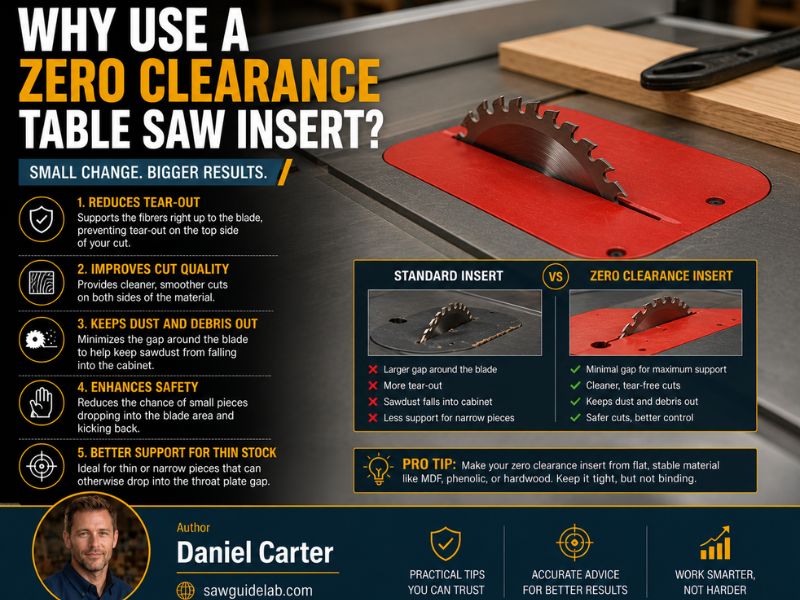
A zero clearance insert replaces the standard throat plate on a table saw and provides a much narrower opening around the blade.
A standard insert needs enough clearance to accommodate different blade angles and sometimes different blade types. A zero clearance insert is designed for a more specific setup.
The smaller opening can provide several benefits:
- Better support around the blade
- Reduced tear-out
- Cleaner cuts
- Better support for narrow workpieces
- Fewer small offcuts falling into the saw
- Potentially improved dust containment
- A more precise setup for specialized woodworking
However, a zero clearance insert is not automatically better for every operation. You need to choose an insert that matches your blade, cutting angle, and table saw.
8 Benefits of Using a Zero Clearance Table Saw Insert
1. Reduces Tear-Out and Chipping
One of the biggest reasons woodworkers use a zero clearance insert is to reduce tear-out.
When a blade exits the bottom of a workpiece, unsupported wood fibers can break away. The standard throat plate leaves a larger gap around the blade, which provides less support immediately next to the cut.
A zero clearance insert supports the material much closer to the blade.
This can be especially helpful when cutting:
- Plywood
- Veneered panels
- Melamine
- Solid hardwood
- Other materials where edge quality matters
The insert does not eliminate tear-out completely, but it can significantly improve support around the cut.
2. Provides Better Support for Small Pieces
Small workpieces can be difficult to cut safely on a table saw because they can partially enter the throat opening.
A zero clearance insert reduces the size of that opening.
This provides a more continuous surface beneath the workpiece and can be particularly useful when cutting:
- Narrow strips
- Small blocks
- Thin stock
- Small trim pieces
The additional support can make the cut more controlled and predictable.
3. Improves Safety Around the Blade
A smaller opening around the blade can reduce the amount of space into which small pieces or offcuts can fall.
This can help prevent small scraps from dropping directly into the blade area.
However, a zero clearance insert should not be considered a substitute for proper table saw safety practices.
Always use appropriate guards, a riving knife when compatible, push sticks, and other safety equipment recommended for your operation.
4. Helps Prevent Small Offcuts From Falling Into the Saw
A standard throat plate can leave enough space for small cutoffs to fall through.
Once a piece enters the opening, retrieving it can be inconvenient and potentially unsafe.
A zero clearance insert significantly reduces the size of the gap, making it less likely that small offcuts will disappear beneath the table.
This can make cleanup easier and reduce the temptation to reach underneath the saw while the blade is installed.
5. Improves Cut Quality
The additional support provided by a zero clearance insert can help produce cleaner edges.
This is especially noticeable when working with materials that are prone to chipping.
For precision woodworking, the difference can be valuable because a cleaner cut may require less sanding or additional finishing.
A zero clearance setup is particularly useful when the appearance of the cut edge matters.
6. Can Improve Dust Collection
A smaller opening around the blade can potentially reduce the amount of air escaping through the throat plate.
In some table saw setups, this may help direct more dust toward the saw’s internal dust collection system.
However, dust collection performance depends on the entire system, including:
- Saw design
- Dust port
- Hose size
- Dust collector
- Blade configuration
- Insert design
A zero clearance insert alone is not guaranteed to dramatically improve dust collection.
7. Useful for Specialized Cuts
Zero clearance inserts can be particularly useful when making specific types of cuts.
For example, woodworkers may use dedicated inserts for:
- Standard ripping
- Crosscutting
- Thin stock
- Specialized blade setups
- Certain dado operations
Because the opening is closely matched to a particular blade configuration, you may need different inserts for different setups.
8. Allows a Custom-Fit Blade Opening
One of the most useful characteristics of a zero clearance insert is its precise blade opening.
The opening can be matched closely to the blade’s kerf.
This creates a more controlled cutting environment and provides support very close to the blade.
Some woodworkers purchase ready-made inserts, while others make custom inserts for their specific table saw.
Zero Clearance Insert vs. Standard Table Saw Insert
The two types of inserts serve different purposes.
| Feature | Zero Clearance Insert | Standard Insert |
| Blade opening | Very small | Larger |
| Tear-out control | Excellent | Good |
| Small-piece support | Excellent | Limited |
| Dust control | Can improve | Good |
| Blade compatibility | More specific | More flexible |
| Dado compatibility | Requires specific insert | Often easier |
A standard insert is more versatile because its larger opening can accommodate blade movement and different cutting configurations.
A zero clearance insert is more specialized and is generally preferred when cut quality and material support are priorities.
What Are the Disadvantages of a Zero Clearance Insert?
Despite its benefits, a zero clearance insert has some limitations.
Limited Blade Bevel Range
Because the opening is designed closely around the blade, it may not provide enough clearance for every bevel angle.
If you frequently tilt your blade, you may need an insert specifically designed for that range.
Not Suitable for Every Blade or Cut
A zero clearance insert made for one blade may not work with another blade that has a different kerf or configuration.
For example, a standard blade and a dado blade generally require different openings.
Requires a Separate Insert for Some Setups
You may need multiple inserts for:
- Different blade widths
- Dado stacks
- Different bevel angles
- Specialized cutting operations
This adds cost and requires additional setup.
Can Be Difficult to Install on Some Saws
Table saw designs vary.
Some saws make it easy to replace the throat plate, while others may require careful adjustment to achieve a flush fit.
Homemade Inserts Require Careful Setup
A homemade insert can work well, but it must be properly fitted and supported.
An incorrectly sized insert can create a safety hazard.
When Should You Use a Zero Clearance Table Saw Insert?
A zero clearance insert is particularly useful when cut quality and small-piece support are important.
Cutting Plywood and Veneered Panels
Plywood and veneered materials can chip easily.
The additional support around the blade can help produce a cleaner bottom edge.
Crosscutting Solid Wood
Crosscutting can produce significant tear-out depending on the blade and material.
A zero clearance insert can help support the fibers near the blade.
Cutting Narrow Strips
Narrow workpieces benefit from having more continuous support around the blade.
This can make them easier to control.
Working With Small Pieces
When a small workpiece is close to the blade opening, a smaller throat opening can provide useful additional support.
Making Precision Cuts
For furniture making and other precision woodworking projects, reducing tear-out and improving edge quality can save time during finishing.
How to Use a Zero Clearance Insert Safely
Installing the insert correctly is important.
Check Insert Compatibility
Make sure the insert is designed for your exact table saw or is properly fitted to it.
It should sit securely and flush with the surrounding table surface.
Make Sure the Insert Is Properly Supported
The insert should not move, tilt, or drop when pressure is applied.
Never operate the saw with a loose or improperly seated insert.
Check Blade Clearance
Before turning on the saw, make sure the blade can rotate freely without contacting the insert.
Raise the Blade Slowly When Creating the Opening
If you are making a custom zero clearance opening, follow an appropriate setup procedure and use proper safety precautions.
The blade should create the opening gradually rather than being forced through an improperly positioned insert.
Check for Binding Before Cutting
After installation, verify that the blade and insert do not interfere with each other.
Also confirm that the blade can move through the intended bevel range when required.
Can You Make Your Own Zero Clearance Insert?
Yes, many woodworkers make their own zero clearance inserts.
A custom insert can be useful because it allows you to create an opening specifically matched to your blade and table saw.
Common considerations include:
- Correct material thickness
- Proper fit
- Level surface
- Secure support
- Correct blade opening
- Compatibility with the blade guard and riving knife
The insert should be strong enough to remain stable during use.
If you are not comfortable making one yourself, a commercially manufactured insert designed for your saw can be a simpler option.
Do You Need a Zero Clearance Insert?
Not necessarily.
A standard throat plate is sufficient for many everyday table saw operations.
You may benefit from a zero clearance insert if you:
- Do precision woodworking
- Frequently cut plywood
- Work with veneers
- Cut narrow strips
- Want better support around the blade
- Regularly deal with tear-out
For basic construction work, rough lumber, and general ripping, a standard insert may be perfectly adequate.
The value of a zero clearance insert becomes more apparent when cut quality and material support are important.
Frequently Asked Questions
What does a zero clearance insert do?
A zero clearance insert reduces the opening around the table saw blade. This provides additional support for the material close to the blade and can help reduce tear-out and prevent small pieces from falling through the throat opening.
Does a zero clearance insert make cuts safer?
It can improve material support and reduce the chance of small pieces falling into the blade opening, but it does not make a table saw automatically safe. Proper blade guards, riving knives, push sticks, and safe operating techniques remain essential.
Does a zero clearance insert reduce tear-out?
Yes, it can reduce tear-out by supporting the wood fibers immediately next to the blade. The amount of improvement depends on the material, blade, cutting direction, and overall setup.
Can you use a zero clearance insert with a dado blade?
A standard zero clearance insert usually cannot accommodate a dado stack because the opening is too narrow. A dedicated dado insert with a wider opening is normally required.
Can you use a zero clearance insert with a riving knife?
It can be used with a riving knife if the insert is specifically designed to provide the required clearance and the riving knife remains properly positioned. Always verify compatibility with your table saw.
Is a zero clearance insert worth it?
For precision woodworking, it often is. The improved material support, reduced tear-out, and better handling of small pieces can make it a worthwhile upgrade. For basic cutting, however, a standard insert may be sufficient.
Final Thoughts on Why Use a Zero Clearance Table Saw Insert
So, why use a zero clearance table saw insert? The main reason is to create better support immediately around the blade.
By reducing the size of the throat opening, a zero clearance insert can help reduce tear-out, improve support for narrow or small workpieces, keep small offcuts from falling into the saw, and potentially improve dust containment.
It is particularly valuable for precision woodworking, plywood, veneers, and projects where clean edges matter.
However, it is not the right insert for every cutting operation. Different blades, dado stacks, and bevel angles may require different throat plates.
If you frequently care about clean, accurate cuts, a properly fitted zero clearance insert can be one of the simplest and most useful upgrades for a table saw.