
How Thick Wood Can a Panel Saw Cut? Capacity Guide
If you are wondering how thick wood can a panel saw cut, many woodworking panel saws can handle material around 1-1/2 to 2 inches thick, while larger industrial models may cut roughly 3 inches or more depending on blade diameter and machine design. The exact maximum cutting depth varies considerably between vertical panel saws, sliding table panel saws, beam saws, and specific models.
A panel saw is usually designed primarily for sheet goods rather than extremely thick solid lumber. Typical materials include 1/4-inch plywood, 1/2-inch MDF, 3/4-inch cabinet plywood, particleboard, melamine panels, and similar products. Because those materials are generally much thinner than the saw’s maximum cutting capacity, thickness is rarely a limitation in ordinary cabinet or furniture work.
The machine’s blade diameter is one of the biggest factors determining how deep it can cut, but it is not the only one. Arbor position, blade guard design, scoring systems, carriage construction, motor power, cutting direction, and manufacturer limits can all reduce usable depth.
For that reason, two panel saws using blades of the same diameter may still have different maximum cutting capacities.
In this guide, I’ll explain how thick wood a panel saw can cut, typical capacities for different panel saw types, how blade diameter affects depth, whether panel saws can cut 2-inch or 3-inch lumber, what happens when material is too thick, and how to determine the exact capacity of your machine.
How Thick Wood Can a Panel Saw Cut?
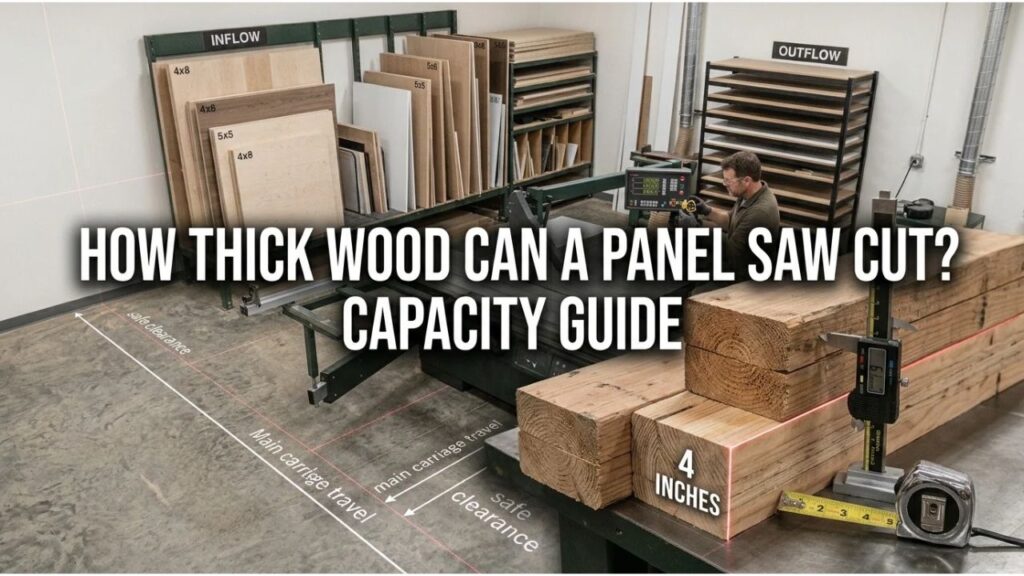
Most panel saws used in woodworking are designed to cut standard sheet goods comfortably.
For many vertical panel saws, maximum cutting depth is commonly somewhere around 1-1/2 to 2 inches.
Larger sliding table panel saws can often cut thicker material, with capacities around 2-1/2 to 3-1/2 inches depending on blade diameter and blade position.
Heavy industrial panel or beam saws may handle even thicker stacks or materials, although their capacity depends on the machine’s specific design.
These numbers are general ranges rather than universal specifications.
Typical Panel Saw Cutting Capacities
| Panel Saw Type | Common Approximate Capacity |
| Light-duty vertical panel saw | 1-1/2 in. or less |
| Professional vertical panel saw | About 1-1/2 to 2 in. |
| Sliding table panel saw | About 2-1/2 to 3-1/2 in. |
| Industrial beam saw | Varies widely; often several inches or stacked panels |
Always confirm the maximum depth specified for the exact model.
Key Takeaways:
- Many vertical panel saws cut roughly 1-1/2 to 2 inches deep.
- Larger sliding table saws often offer around 2-1/2 to 3-1/2 inches of cutting depth.
- The machine’s rated capacity matters more than blade diameter alone.
Why Panel Saws Usually Don’t Need Extreme Cutting Depth
Panel saws are primarily designed for sheet materials.
Most common sheet goods are relatively thin.
Standard cabinet plywood is frequently around 3/4 inch thick.
MDF and particleboard panels also commonly fall within similar thickness ranges.
Even doubled 3/4-inch panels total only about 1-1/2 inches.
This means a saw with a 1-3/4-inch cutting capacity can already handle most typical panel-processing work.
Panel Saw vs. Thick-Lumber Saw
If you regularly need to rip 4-inch-thick hardwood beams, a panel saw is usually not the right machine.
A large table saw, band saw, resaw machine, or industrial rip saw may be better suited to that type of work.
A panel saw’s advantage is not extreme depth.
Its advantage is supporting and cutting large, awkward sheets accurately.
How Blade Diameter Affects Cutting Depth
A larger blade generally allows a deeper cut because more of the blade can extend beyond the table or carriage.
However, only part of the blade diameter is available for cutting.
The blade has to rotate around an arbor located below or behind the cutting surface.
Part of the blade remains inside the machine.
A 10-Inch Blade Does Not Cut 5 Inches Deep
It might seem that a 10-inch blade could cut almost half its diameter, but the arbor and machine structure prevent that.
A typical woodworking machine using a 10-inch blade may provide cutting depth somewhere near 3 inches, depending on design.
The exact number varies.
Common Blade Sizes
Panel saws may use blades around:
8 inches, 10 inches, 12 inches, 14 inches, or larger.
Industrial machines may use substantially larger blades.
Larger blades can increase cutting depth, but the saw must be designed to accept them.
Never install an oversized blade simply to gain more depth.
The guard, arbor speed, motor, scoring system, and internal clearances are designed around approved blade sizes.
How Thick Can a Vertical Panel Saw Cut?
A vertical panel saw commonly has less cutting depth than a large sliding table saw.
Many vertical machines are optimized for full sheets of plywood, MDF, plastic, and composite panels.
A cutting depth around 1-1/2 to 2 inches is enough for most of those applications.
Why Vertical Saws Often Have Shallower Capacity
The saw carriage must move freely along a vertical frame.
The blade housing, guide mechanism, and guard system all need to remain relatively compact.
The machine is optimized for large panel dimensions rather than thick material.
Can a Vertical Panel Saw Cut 2-Inch Wood?
Some can.
If the manufacturer’s rated capacity is 2 inches or greater, then properly supported 2-inch material may be cut.
If the saw is rated for only 1-3/4 inches, however, a nominal 2-inch board may exceed its capacity.
Remember that nominal lumber dimensions do not always equal actual thickness.
For example, a common finished “2-inch” board is often about 1-1/2 inches thick.
That may fit easily within a saw rated for 1-3/4 inches.
How Thick Can a Sliding Table Panel Saw Cut?
Sliding table panel saws often provide significantly greater cutting depth.
Many professional machines use 10-, 12-, or 14-inch-class blades and can cut material from roughly 3 inches to more than 4 inches thick depending on configuration.
The blade may also rise and lower through the table.
Why Sliding Saws Can Cut Deeper
The machine has a large stationary saw unit built into a heavy base.
This allows a larger blade, more powerful motor, and deeper blade projection.
The sliding carriage then moves the panel past the blade.
For shops that work with both sheet goods and thicker solid wood, a sliding table saw can therefore be more versatile than a vertical panel saw.
How Thick Can a Beam Saw Cut?
Beam saws are often rated for stack height rather than just single-sheet thickness.
An industrial beam saw may cut a stack several inches thick in one cycle.
For example, instead of cutting one 3/4-inch particleboard sheet, the machine may cut several sheets stacked together.
Stack Cutting
This is one of the major advantages of industrial beam saws.
A pressure beam clamps the entire stack securely.
The saw carriage then travels through all the layers at once.
This allows factories to produce many identical components quickly.
However, stacking capability depends on the saw’s rated cutting height, blade size, motor power, clamping system, and material.
Can a Panel Saw Cut 1-Inch Wood?
Yes, almost any woodworking panel saw capable of standard sheet processing can handle 1-inch material, provided that material is suitable for the machine.
This includes:
1-inch plywood, laminated panels, MDF, or solid lumber where permitted.
The important question is not only thickness but also whether the blade and machine are suitable for the material.
Can a Panel Saw Cut 1-1/2-Inch Wood?
Many can.
A 1-1/2-inch-thick panel falls within the capacity of numerous vertical and horizontal panel saws.
This thickness may represent:
Two 3/4-inch sheets stacked together, thick butcher-block-style panels, laminated assemblies, or nominal 2-by lumber with an actual thickness near 1-1/2 inches.
Before stack cutting, make sure your saw is designed for it.
A machine being deep enough to reach through two sheets does not automatically mean loose stacked sheets are safe to cut together.
Can a Panel Saw Cut 2-Inch-Thick Wood?
Some can, and some cannot.
A professional sliding panel saw often handles 2-inch material easily.
A smaller vertical saw may be right at its maximum capacity.
Check Actual Thickness
If you are referring to dimensional lumber such as a 2×4, the actual thickness is typically around 1-1/2 inches rather than a full 2 inches.
That means a saw rated for 1-3/4 inches can often cut through a 2×4 thickness-wise.
If the workpiece is a true 2 inches thick, verify the saw’s rated depth.
Can a Panel Saw Cut 3-Inch Wood?
A large sliding table panel saw may be able to cut 3-inch-thick wood.
A typical vertical panel saw often cannot.
This is where knowing your machine type matters.
If a sliding saw has a maximum 90-degree cutting depth around 3-1/8 or 3-1/2 inches, a true 3-inch workpiece may fit.
However, there should still be enough blade projection to clear the material completely.
I would not operate continually at the absolute maximum unless the machine and blade are intended for that type of workload.
Can a Panel Saw Cut 4-Inch Wood?
Only certain large machines can.
A standard vertical panel saw generally is not intended for 4-inch stock.
Some heavy sliding table or industrial saws equipped with large blades may approach or exceed that depth.
For frequent 4-inch-thick cutting, another machine is often more appropriate.
A band saw or industrial table saw may provide better performance depending on the cut.
Can You Cut Material Thicker Than the Blade Capacity From Both Sides?
Technically, some woodworkers use this method on other saw types: cut partway through one side, flip the workpiece, align it, and complete the cut from the opposite side.
I generally do not recommend using this as a routine workaround on a panel saw.
Large panels are difficult to flip and realign perfectly.
The second cut can leave a visible step if alignment is even slightly off.
More importantly, the machine may not be designed to support or safely position such thick stock.
Use a machine with adequate cutting depth when possible.
Key Takeaways:
- A 2-inch cut is common territory for many larger panel saws but may exceed some vertical models.
- Three-inch and thicker cuts usually require a larger sliding or industrial machine.
- Avoid using repeated two-sided cuts simply to exceed the saw’s rated capacity.
Does Cutting at a Bevel Reduce Maximum Thickness?
Usually, yes.
When the blade tilts away from 90 degrees, the effective vertical cutting depth decreases.
A saw that cuts 3-1/8 inches deep at 90 degrees may have significantly less capacity at 45 degrees.
This is normal geometry.
Why Capacity Drops
At 90 degrees, the blade radius extends vertically through the workpiece.
When tilted, some of that blade radius is now traveling sideways rather than vertically.
The thicker the bevel angle, the less vertical depth remains.
If you need to bevel-cut thick stock, check the machine’s specified capacity at that angle rather than relying on its 90-degree rating.
Does a Scoring Blade Affect Maximum Cutting Thickness?
The scoring blade does not normally determine the main saw’s maximum cutting depth.
Its job is to make a shallow preliminary cut in the bottom surface of laminated material.
The main blade still performs almost the entire cut.
However, scoring-equipped machines have specific blade combinations and setup requirements.
Do not install a larger main blade than approved simply because the scoring blade appears to have clearance.
Both systems need to align correctly.
Does Motor Power Affect How Thick a Panel Saw Can Cut?
Yes, but in a different way from blade diameter.
Blade diameter largely determines whether the saw can physically reach through the material.
Motor power affects how easily it can maintain blade speed under load.
A saw may technically have enough blade depth to cut 3-inch hardwood while lacking enough power to do it efficiently.
Thick Material Requires More Power
A deeper cut means more blade teeth are engaged in wood at the same time.
That increases resistance.
Dense hardwood adds even more load.
If the feed rate is too aggressive, the motor can slow and the blade may overheat.
Sheet Goods vs. Solid Hardwood
Cutting 2 inches of soft plywood is not necessarily the same challenge as cutting 2 inches of dense maple.
Material density, glue layers, moisture content, and blade choice all affect load.
What Blade Should You Use for Thick Wood?
Blade selection should match both material and cut type.
A very high-tooth-count blade may produce beautiful cuts in thin melamine, but it can struggle to remove chips during a deep rip in solid wood.
For thick solid material, fewer teeth and larger gullets can improve chip removal.
For laminated panels, clean edge quality may require more teeth or a scoring system.
Use the Machine Manufacturer’s Blade Range
Never choose a blade only according to tooth count.
It must also match:
Diameter, arbor size, kerf, maximum RPM, riving-knife compatibility where applicable, and the saw’s approved blade range.
Can a Panel Saw Cut Multiple Sheets at Once?
Some can.
Industrial beam saws are specifically designed for stack cutting.
Certain other panel saws may also permit limited stacked sheets.
However, a vertical or manual sliding panel saw should not automatically be used this way just because its blade is deep enough.
Why Loose Stacks Can Be Risky
Individual sheets can shift relative to one another.
If they are not properly clamped, the cut can become inaccurate or unstable.
A beam saw solves this with a pressure beam that clamps the stack firmly.
For a manually operated saw, follow the machine manufacturer’s guidance.
How Thick Can a Panel Saw Cut Plywood?
Plywood thickness is rarely a limitation for most panel saws.
Standard sheets typically range from very thin veneer plywood to around 3/4 inch or thicker specialty panels.
Even a relatively modest panel saw can usually cut normal plywood in one pass.
Very thick laminated plywood assemblies are a different matter.
Once total thickness reaches 1-1/2, 2, or 3 inches, you need to compare the actual thickness with your machine’s rated cutting depth.
How Thick MDF Can a Panel Saw Cut?
Again, the maximum is determined by the machine.
A saw rated for 2-inch cutting depth can physically cut an MDF assembly within that range.
However, thick MDF creates considerable cutting resistance and an enormous amount of fine dust.
Good dust extraction becomes especially important.
MDF Is Hard on Tooling
The fine fibers, resins, and additives in MDF can dull blades faster than many natural woods.
For frequent MDF processing, use a high-quality carbide blade intended for composite materials.
How Thick Melamine Can a Panel Saw Cut?
The main cutting-depth rule is the same.
However, edge quality becomes more important.
If the saw has a scoring blade, it can produce much cleaner cuts on melamine-faced panels.
When cutting thicker laminated assemblies, make sure the scoring cut and main blade remain correctly aligned.
Can a Panel Saw Cut a 2×4?
It depends on the machine.
A standard finished 2×4 is approximately 1-1/2 inches thick and 3-1/2 inches wide.
A panel saw with more than 1-1/2 inches of blade depth can technically cut through its thickness.
However, that does not mean the machine is the best choice for routine 2×4 cutting.
Vertical Panel Saws Are Primarily for Sheets
A 2×4 is narrow compared with the large sheet goods a vertical saw is designed to support.
Holding narrow pieces securely may be awkward or prohibited depending on the machine.
A miter saw or table saw is usually a better tool for dimensional lumber.
Sliding Table Saw
A sliding table panel saw is much more versatile and can often handle dimensional lumber comfortably when used according to its operating instructions.
Can a Panel Saw Cut a 4×4?
Usually not a standard vertical panel saw.
A 4×4 is approximately 3-1/2 inches thick in typical finished dimensional lumber.
Only larger sliding or industrial saws with sufficient blade capacity could cut that thickness in one pass.
Even if the saw has enough depth, the workpiece needs appropriate support and clamping.
For ordinary 4×4 crosscuts, a suitable miter saw or other dedicated machine is generally more practical.
What Happens If the Wood Is Too Thick?
If the blade cannot extend completely through the material, the workpiece will not be fully separated.
You may end up with an uncut ridge at the far side.
Trying to compensate by raising the blade beyond its designed limit is unsafe.
Never Modify the Guard for Extra Depth
Do not remove or grind away blade guards, housings, riving components, or machine structure to gain another fraction of an inch.
Those limits are part of the machine’s design.
If the material exceeds capacity, use another saw.
How to Check Your Panel Saw’s Maximum Cutting Depth
The safest answer comes from the machine’s specification plate or manual.
Look for terms such as:
Maximum depth of cut, maximum cutting height, cutting capacity at 90 degrees, or maximum panel thickness.
You may also see a separate specification for 45-degree cuts.
Don’t Measure Only the Exposed Blade
Physically measuring how far the blade appears to project can give a rough idea, but it should not replace the rated specification.
The machine may impose a lower official limit because of guarding, carriage geometry, or structural considerations.
Why Your Actual Cutting Depth May Be Slightly Less
Even if the machine is rated for a certain depth, several factors can reduce usable capacity.
A blade that has been sharpened many times may have a slightly smaller effective diameter.
A thick zero-clearance insert, unusual mounting arrangement, or different blade style can also change projection.
Sawdust buildup or carriage misalignment can affect performance.
Give Yourself Some Margin
If your saw is rated for exactly 2 inches and your material is exactly 2 inches thick, confirm that the blade fully clears the top surface through the entire cut.
Operating with no margin can leave fibers uncut.
How Cutting Depth Affects Safety
Thicker cuts expose more blade to the workpiece and place more load on the motor.
Feed the panel smoothly rather than forcing it.
Use proper support so the material does not twist during the cut.
Make sure the blade guard is functioning correctly.
If the machine has hold-downs or clamps, use them as intended.
Avoid Excessive Feed Pressure
If the motor slows noticeably, reduce your feed rate.
Forcing thick material through the blade can increase heat, blade deflection, and kickback risk.
A sharp blade should cut without excessive pressure.
Key Takeaways:
- Maximum cutting depth is only one part of safe thick-material cutting.
- Dense wood, dull blades, and high feed rates can overload the saw even within its rated depth.
- Never modify guards or blade-height limits to squeeze in thicker material.
Panel Saw vs. Table Saw for Thick Wood
If thick solid wood is your main material, a conventional cabinet table saw may offer more practical versatility than a vertical panel saw.
A 10-inch table saw often cuts around 3 inches thick at 90 degrees, depending on the model.
A 12-inch machine can usually cut deeper.
Panel saws excel when material is large in width and length.
Table saws are often more convenient for smaller thick stock.
Panel Saw vs. Band Saw for Thick Wood
A band saw can cut far thicker material than most panel saws.
A woodworking band saw may have 6, 12, 14, or more inches of vertical resaw capacity.
That makes it ideal for resawing thick boards.
However, a band saw does not provide the same large-sheet support or perfectly straight repetitive panel sizing as a dedicated panel saw.
Use each tool for the task it handles best.
Panel Saw vs. Track Saw for Thick Material
Track saws are also limited by blade diameter.
Many common models cut somewhere around 2 inches or slightly more at 90 degrees.
A large panel saw may therefore have greater capacity.
But a track saw can be very convenient for oversized thick panels because the saw moves across the stationary sheet.
If the material is too heavy to lift onto a sliding saw, that can be an advantage.
Should You Buy a Larger Panel Saw for More Cutting Depth?
Only if thicker material is a regular part of your workflow.
If you mostly cut 3/4-inch plywood and melamine, paying for a machine with 4-inch cutting capacity may provide little benefit.
Instead, prioritize carriage length, accuracy, scoring capability, dust extraction, fence quality, and motor reliability.
If you frequently process thick solid wood as well as panels, a larger sliding table saw can be worthwhile.
FAQs about how thick wood can a panel saw cut
How thick wood can a panel saw cut?
Many vertical panel saws cut roughly 1-1/2 to 2 inches thick, while larger sliding table panel saws may cut around 3 inches or more.
What determines panel saw cutting depth?
Blade diameter, arbor position, machine geometry, blade-height adjustment, guarding, and manufacturer design all affect maximum depth.
Can a panel saw cut 1-inch plywood?
Yes.
One-inch plywood is within the capacity of most woodworking panel saws.
Can a panel saw cut 1-1/2-inch wood?
Many can.
Always compare actual material thickness with the saw’s rated capacity.
Can a panel saw cut 2-inch-thick wood?
Some can.
Professional vertical or sliding saws may handle 2 inches, but smaller machines may not.
Can a panel saw cut 3-inch wood?
Large sliding table saws often can, depending on their blade size and rated cutting depth.
Most smaller vertical saws cannot.
Can a panel saw cut 4-inch wood?
Only some heavy-duty sliding or industrial models have enough cutting depth.
Can a panel saw cut a 2×4?
If it has at least about 1-1/2 inches of cutting depth, it may physically cut through a typical 2×4 thickness. A panel saw may not be the best tool for narrow lumber, though.
Can a panel saw cut a 4×4?
Most vertical panel saws cannot cut through a 3-1/2-inch 4×4 in one pass.
Large sliding saws may have enough capacity.
How deep can a 10-inch panel saw blade cut?
The exact depth depends on machine geometry, but it is substantially less than half the blade diameter. Check the machine’s official specification.
Does a 12-inch blade cut deeper than a 10-inch blade?
Generally yes, when used in a machine designed for that blade size.
Can I put a larger blade on my panel saw?
Only if the manufacturer specifically approves that diameter.
Do not install an oversized blade to increase cutting depth.
Does bevel cutting reduce depth?
Yes.
Maximum cutting depth generally decreases when the blade is tilted away from 90 degrees.
Can panel saws cut stacked plywood?
Some machines can, particularly industrial beam saws. Manual panel saws should only stack-cut when the manufacturer permits it and the sheets can be controlled safely.
How thick can a vertical panel saw cut?
A common range is roughly 1-1/2 to 2 inches, although exact capacity varies significantly.
How thick can a sliding panel saw cut?
Many professional machines offer around 2-1/2 to 3-1/2 inches or more at 90 degrees.
How thick can a beam saw cut?
Industrial beam saws often cut stacks several inches high, but capacity is machine-specific.
Can a panel saw cut thick hardwood?
Yes if the material fits within capacity and the machine is approved for solid wood, but dense hardwood requires adequate motor power and an appropriate blade.
Does thicker wood require a different blade?
Often.
Deep ripping in solid wood generally benefits from blade geometry and tooth count designed for chip removal rather than an extremely fine panel blade.
Can I cut from both sides if the wood is too thick?
It may be technically possible in some situations, but I do not recommend it as a routine way to exceed a panel saw’s rated capacity.
How do I find my exact panel saw cutting depth?
Check the manufacturer’s manual or specification plate for maximum cutting height or depth at 90 degrees and, if relevant, at 45 degrees.
Conclusion
If you are asking how thick wood can a panel saw cut, a useful general expectation is around 1-1/2 to 2 inches for many vertical panel saws and roughly 2-1/2 to 3-1/2 inches or more for larger sliding table panel saws.
Industrial beam saws may handle stacks several inches thick, while compact or light-duty vertical saws may have noticeably less capacity.
The exact number depends on much more than blade diameter. Arbor placement, guarding, blade-height adjustment, scoring systems, motor power, and machine construction all determine usable cutting depth.
For ordinary cabinetmaking, maximum thickness is rarely a problem. Standard 3/4-inch plywood, MDF, melamine, and particleboard fall comfortably within the capacity of most panel saws.
If you want to cut 2-inch, 3-inch, or thicker solid lumber regularly, pay much closer attention to the machine specification. A large sliding table saw may handle that work well, while a vertical panel saw may not.
My recommendation is to use the panel saw’s rated maximum cutting depth, not the amount of blade that appears to be exposed, as your limit. Never install an oversized blade, remove guards, or alter the saw simply to gain additional depth.
A panel saw is at its best when doing what it was designed for: supporting large sheets and cutting them accurately, cleanly, and repeatedly—not necessarily making the deepest possible cut.