What Width Can a Panel Saw Cut? Capacity Guide
If you are wondering what width can a panel saw cut, a full-size vertical panel saw commonly handles crosscuts around 60–64 inches wide, while some larger machines reach approximately 74 inches or more. Since a standard 4 × 8-foot sheet is only 48 inches wide, a 64-inch crosscut capacity is more than enough for ordinary plywood, MDF, OSB, and cabinet panels. Rip-cut length on many full-size vertical panel saws is effectively unlimited because material moves horizontally through the machine.
Sliding table panel saws measure capacity differently. Instead of a vertical crosscut height, manufacturers usually specify sliding-table stroke, squaring capacity, and rip-fence capacity. A professional slider may have approximately 3,200 mm, or 126 inches, of carriage travel and roughly 1,000–1,500 mm, or 39–59 inches, of rip capacity.
This can make panel-saw specifications confusing. A machine advertised as having a “64-inch capacity” may not mean it can cut only a 64-inch-long sheet. It may mean the saw carriage can crosscut through a panel up to 64 inches in one direction while allowing much longer material to pass horizontally.
In this guide, I’ll explain panel saw width capacity, the difference between crosscut and rip capacity, how much capacity you need for a 4 × 8 sheet, and how vertical and sliding table panel saw measurements differ.
What Width Can a Panel Saw Cut?
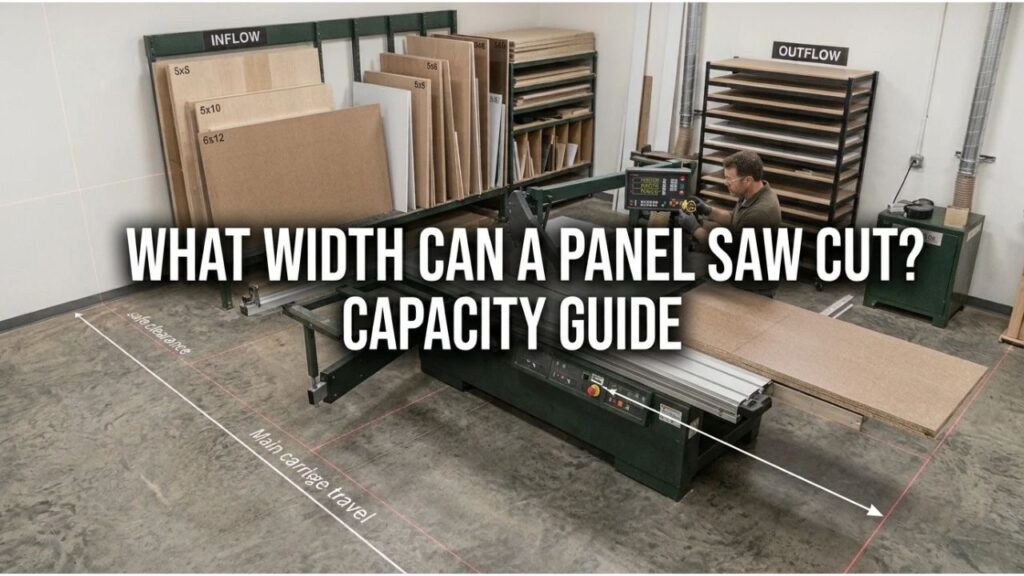
For a vertical panel saw, approximately 48–64 inches of crosscut capacity is common, while larger professional models may provide around 74 inches or more.
A 64-inch machine is particularly common among full-size commercial vertical panel saws.
For example, several professional Safety Speed vertical saws provide a maximum crosscut of approximately 64 inches, combined with a 10-foot frame and effectively unlimited rip length.
A compact machine can still offer a 64-inch crosscut but may limit horizontal rip length because its frame is shorter.
For a sliding table panel saw, there is no single equivalent width number.
Professional machines commonly offer approximately:
| Panel Saw Capacity | Typical Range |
| Vertical saw crosscut | 48–64 in. common |
| Large vertical saw crosscut | Around 74 in. or more |
| Standard 4 × 8 sheet width | 48 in. |
| Sliding saw rip capacity | About 39–59 in. |
| Sliding table stroke | About 100–150 in. |
| Full-format slider carriage | Around 126 in. common |
| Vertical saw rip length | Often unlimited on full-size machines |
These figures are general examples rather than universal standards. Always check the specification of the particular model.
Key Takeaways:
- A 64-inch vertical crosscut capacity easily handles the 48-inch width of a standard plywood sheet.
- Full-size vertical panel saws often have effectively unlimited rip length.
- Sliding table saw capacity is usually described by carriage stroke and rip-fence width rather than one maximum panel width.
What Does Panel Saw Cutting Width Mean?
Before comparing machines, you need to understand what manufacturers mean by “cutting width.”
A panel has two major dimensions.
Consider a standard sheet measuring:
4 feet × 8 feet, or 48 × 96 inches.
A panel saw can cut that sheet in two basic directions.
A crosscut travels across the shorter or vertical dimension.
A rip cut travels along the longer dimension.
On a vertical saw, these two operations are performed differently, so they have different capacity limitations.
Vertical Crosscut Capacity
When making a vertical crosscut, the sheet sits on the lower rollers while the saw carriage moves down through it.
The saw carriage can only travel within the height of the machine’s vertical guide system.
That creates a maximum crosscut dimension.
If the machine has a 64-inch maximum crosscut, the saw can travel through up to approximately 64 inches of panel height.
A standard 48-inch-wide sheet fits comfortably within this capacity.
Horizontal Rip Capacity
For a rip cut, the saw head is typically rotated 90 degrees and locked at the desired height.
The workpiece then moves horizontally past the blade.
On many large vertical saws, the material can extend beyond the frame and continue moving through it.
That is why manufacturers may list the maximum rip length as unlimited.
The actual practical limit becomes available shop space, material handling, and adequate panel support.
Can a Panel Saw Cut a 4 × 8 Sheet?
Yes. Cutting standard 4 × 8-foot sheet goods is one of the main reasons panel saws exist.
A sheet measuring 48 × 96 inches is well within the capabilities of a typical full-size professional panel saw.
A vertical panel saw with a 64-inch crosscut can cut completely across the sheet’s 48-inch width with roughly 16 inches of additional crosscut capacity available.
The 96-inch length is supported along the machine frame and rollers.
When ripping, the sheet travels horizontally through the saw.
Why 64-Inch Capacity Is Useful if Plywood Is Only 48 Inches Wide
You may wonder why manufacturers build a 64-inch crosscut machine when ordinary plywood is only 48 inches wide.
There are several reasons.
Not every panel is a standard 4 × 8 sheet.
Cabinet, sign-making, plastics, commercial display, architectural, and specialty panel industries may use materials wider than 48 inches.
A larger crosscut capacity also gives the operator more flexibility for positioning material.
For a shop cutting only conventional 4 × 8 plywood, however, a 50-inch or larger crosscut capacity can already be sufficient.
Can a 64-Inch Panel Saw Cut a 5-Foot-Wide Sheet?
Yes.
A 5-foot-wide panel measures 60 inches.
A vertical saw with a genuine 64-inch crosscut capacity can therefore cut completely across its 60-inch dimension.
You still need to confirm that the machine frame provides adequate support for the sheet’s length.
If you regularly process 5 × 10-foot panels, both crosscut capacity and frame/support length should be considered.
A machine can have enough vertical travel to cut across the sheet while still being inconvenient for supporting an exceptionally long panel.
Can a Panel Saw Cut 5 × 10 Sheets?
Many professional models can, but you need to look carefully at the specifications.
A 5 × 10 sheet measures 60 × 120 inches.
For a vertical saw to crosscut across the 60-inch dimension, it needs at least 60 inches of usable crosscut capacity.
A 64-inch machine therefore has enough vertical travel.
The 120-inch sheet length is more challenging.
A 10-foot machine frame may support it reasonably well, particularly with appropriate extensions and rollers.
When ripping horizontally, the machine must also have enough surrounding shop space for the sheet to enter and leave the cutting area.
Support Matters as Much as Blade Travel
A theoretical cutting capacity does not always mean the material will be convenient to handle.
Large MDF and particleboard sheets can be extremely heavy.
The frame, rollers, extensions, and operator position should adequately support the entire workpiece.
Do not select a saw solely because one dimension on the specification sheet barely exceeds your panel size.
Can a Panel Saw Cut 4 × 10 or 4 × 12 Sheets?
Full-size vertical panel saws can often rip very long material because the sheet passes horizontally across the rollers.
A 4 × 10 or 4 × 12 sheet still has a width of only 48 inches, so a 64-inch crosscut machine has sufficient vertical capacity.
The bigger issue is horizontal support.
Long stock may extend substantially beyond the standard machine frame.
Extension rollers or additional material supports may therefore be necessary.
You also need sufficient clear space on both sides of the machine.
A 12-foot panel can require a surprisingly large operating area even though the saw itself is mounted vertically.
Why Some Panel Saws Say “Unlimited Rip Cut”
“Unlimited” does not mean the machine can magically support a panel of infinite length.
It means the saw design does not impose a fixed mechanical stop on the horizontal length of material that can pass through.
The panel rolls across the support system and can extend beyond either side of the frame.
In theory, you could rip a very long piece as long as you have enough support and open space.
In practice, your limits are:
the size of your shop, available roller supports, workpiece rigidity, material weight, and safe handling.
A full-size vertical panel saw therefore has an enormous practical advantage when cutting long materials.
Key Takeaways:
- “Unlimited rip” refers to the absence of a fixed horizontal machine limit.
- Shop space and material support still create practical limits.
- Long sheets may require frame extensions or auxiliary rollers even when the saw can technically cut them.
What Is the Maximum Crosscut on a Vertical Panel Saw?
Crosscut capacity depends on frame height and saw-carriage travel.
Full-size commercial models frequently offer approximately 60–64 inches.
Some larger models extend this to approximately 74 inches.
Compact machines may offer less, although some compact frames are cleverly designed to preserve a relatively large crosscut while limiting horizontal rip length.
For example, a compact vertical panel saw might still provide 64 inches of vertical crosscut travel but only around 96 inches of rip capacity because the frame itself is shorter.
This illustrates why you need to check both specifications independently.
50-Inch vs 64-Inch Capacity
For ordinary 4 × 8 plywood, both can work.
A 48-inch sheet fits within a 50-inch crosscut.
However, 64 inches provides greater flexibility for oversized panels and commercial work.
If you run a cabinet shop, sign shop, or fabrication business where different sheet sizes regularly arrive, I would generally favor the extra capacity if floor space and budget permit.
What Does Cutting Height Mean on a Vertical Panel Saw?
Manufacturers sometimes describe crosscut capacity as cutting height.
For example, a saw may be marketed as a “64-inch cutting height” model.
This usually means the saw carriage can travel far enough to cut through material up to approximately 64 inches tall while the sheet is standing vertically on the support rollers.
It does not describe the thickness of the material.
Material thickness is controlled by the machine’s depth of cut.
Those are completely different specifications.
Cutting Width vs Depth of Cut
Do not confuse cutting width with cutting depth.
A vertical saw might have:
64-inch crosscut capacity
and
1¾-inch depth of cut.
The first figure describes the panel dimension the saw can travel across.
The second describes how thick the material can be.
A 64-inch-wide sheet that is only 3/4 inch thick is therefore well within both specifications.
A narrow piece of material that is 2½ inches thick may exceed the saw’s depth capacity even though its width is tiny.
Typical Panel Saw Depth
Many commercial vertical panel saws cut around 1¾ inches deep.
Heavier industrial models may offer around 2 inches or slightly more.
That means the machine can potentially cut several thin sheets simultaneously if the manufacturer permits stack cutting and the total thickness remains within the rated capacity.
Always follow the specific machine instructions before stacking sheets.
How Wide Can a Sliding Table Panel Saw Cut?
A sliding table panel saw uses a completely different arrangement.
The sheet lies horizontally on a sliding carriage.
The carriage moves past a stationary circular blade.
Manufacturers therefore tend to describe two separate dimensions:
squaring/crosscut stroke and rip-fence capacity.
Sliding Table Length
A professional full-format machine commonly uses a carriage approximately 3,200 mm, which is about 126 inches, long.
Some machines provide approximately 3,800 mm, or around 150 inches, of squaring capacity.
This makes it possible to cut full-length 8- or 10-foot panels accurately.
Rip-Fence Width
The distance from the blade to the fully extended rip fence is often approximately 1,000–1,500 mm, or roughly 39–59 inches, on professional machines.
For example, a high-capacity slider with a 1,500 mm rip capacity gives you approximately 59 inches to the right of the blade.
This is enough to rip a standard 48-inch-wide sheet without difficulty.
What About Wider Pieces?
Depending on the cut and machine layout, the sliding carriage and crosscut system can process panels larger than the nominal rip-fence capacity.
Therefore, you should not interpret a 1,000 mm rip capacity as meaning the machine cannot handle a panel wider than 1,000 mm at all.
It means that particular rip-fence setup has that maximum distance between the fence and blade.
Sliding Table vs Vertical Panel Saw Capacity
Both machines can handle standard sheet goods extremely well, but their capacity is expressed differently.
A vertical machine commonly advertises:
maximum crosscut height + horizontal rip length.
A sliding table saw commonly advertises:
sliding carriage length + squaring capacity + rip-fence capacity.
Practical Example
Suppose you need to process a standard 48 × 96-inch plywood sheet.
A vertical saw with a 64-inch crosscut easily cuts the 48-inch width.
A full-format sliding saw with a 3,200 mm carriage easily handles the 96-inch length and commonly has enough rip-fence width for the 48-inch dimension.
Both machines can therefore handle the same sheet, even though their specification sheets look completely different.
How Much Capacity Do You Need for Cabinet Making?
For normal cabinet work using 4 × 8 sheet goods, you want at least enough vertical crosscut capacity to clear the 48-inch panel width.
A 50-inch or greater crosscut can technically do that.
A 60- or 64-inch machine provides additional flexibility.
If you regularly work with 5 × 10 panels, a 64-inch vertical crosscut becomes much more valuable because the 60-inch width fits within its travel.
For a sliding saw, a roughly 3,200 mm full-format carriage is extremely convenient for professional cabinet production.
It allows you to square and size standard sheets without awkward repositioning.
What Width Panel Saw Is Best for a Small Shop?
A smaller saw can make sense if your material is almost always standard 4 × 8 plywood.
There is no reason to buy an enormous industrial frame merely to gain capacity you will never use.
However, measure the complete operating footprint rather than machine width alone.
Vertical saws are attractive for small shops because material stands upright during cutting.
They can require much less floor area than a full sliding table panel saw.
You still need clear space horizontally for moving long sheets through the frame.
Garage Workshop
For a garage, a compact vertical saw can be appealing if you process sheet goods frequently.
If panel cutting is only occasional, a track saw may consume far less permanent space.
A full-format sliding table panel saw is much harder to accommodate because its carriage and outrigger require a large open operating area.
What Width Panel Saw Is Best for a Professional Shop?
For professional cabinet or panel work, I would look beyond the minimum sheet dimension.
Production flexibility matters.
A 64-inch vertical crosscut capacity is a strong general-purpose size because it comfortably handles standard 4 × 8 material and 60-inch-wide 5 × 10 sheets.
For a sliding table machine, approximately 3,200 mm of carriage travel is a common professional full-format choice.
Rip capacity should be selected according to your normal finished component width.
A 1,250- or 1,500-mm rip fence provides greater flexibility than a narrow configuration.
The machine should also have adequate support, repeatable stops, dust extraction, and—if you process laminated board—a scoring blade.
Key Takeaways:
- Around 50 inches can handle ordinary 4 × 8 sheet width, while 64 inches gives much more flexibility.
- Shops processing 5 × 10 panels benefit strongly from a 60-inch-plus crosscut capacity.
- Full-format sliding table saws commonly use roughly 3,200 mm of carriage travel for production sheet work.
Does Blade Diameter Affect Panel Width?
Not directly.
Blade diameter primarily affects depth of cut, not how wide a panel the machine can crosscut.
A larger blade can generally cut thicker material.
The maximum panel width on a vertical saw comes from carriage travel.
On a sliding table saw, width capacity comes from carriage travel and fence positioning.
Therefore, installing a larger blade does not convert a 50-inch crosscut machine into a 64-inch machine.
Use only blade sizes approved by the saw manufacturer.
Does the Frame Length Affect Cutting Capacity?
Yes, particularly for horizontal ripping on vertical panel saws.
A longer frame provides more support for long sheet goods and can allow unrestricted material movement.
A shorter portable machine may have a stated maximum rip length because the workpiece cannot travel indefinitely while remaining adequately guided.
Frame length also affects convenience.
Even when the nominal rip is unlimited, a longer frame can support a greater portion of a long sheet and reduce how much material hangs beyond the machine.
Can You Cut a Panel Wider Than the Rated Crosscut Capacity?
Not in one normal vertical crosscut.
If the machine is rated for 64 inches, you should not expect the saw carriage to travel through a 70-inch vertical panel.
The guide simply does not provide enough movement.
It may be possible to reposition or rotate certain workpieces and approach the job differently, but attempting improvised partial cuts from opposite directions can create alignment and safety problems.
If oversized material is a routine requirement, buy a machine with adequate rated capacity.
A track saw or CNC panel-processing system may also be more appropriate for exceptionally large panels.
What Happens if Your Panel Is Too Large?
You have several alternatives.
A track saw can break oversized material down into manageable pieces before the panel reaches the stationary saw.
This is a common technique even in well-equipped shops.
A CNC router can also process large material if the table size is sufficient.
Some businesses use horizontal beam saws for high-volume large-sheet production.
The right solution depends on how frequently oversized panels appear.
Buying a larger panel saw solely for one unusual project may not be economical.
How to Measure the Capacity You Actually Need
Look at the largest material you regularly purchase—not merely the smallest standard panel.
If everything you use is 48 × 96 inches, your requirements are relatively straightforward.
If your supplier commonly stocks 60 × 120-inch panels, you should plan around that size.
Also think about finished component dimensions.
A panel saw that can accept the raw sheet must still be able to position the fence or stops for the components you produce.
Production requirements should determine the machine rather than choosing based solely on the biggest number in the brochure.
Can a Panel Saw Cut Multiple Sheets at Once?
Some industrial panel saws can stack-cut thin sheet goods as long as the total thickness stays within their rated cutting depth and the material can be secured safely.
However, this is highly machine-specific.
A saw with a 1¾-inch depth of cut may physically have enough blade projection to cut two 3/4-inch sheets, for example, but that does not automatically mean the manufacturer approves the process for every material.
Stacked sheets can move relative to each other, particularly if their surfaces are smooth.
Follow the machine’s operating instructions and use appropriate material restraints.
Panel Saw Capacity vs Accuracy
A bigger machine is not automatically more accurate.
Accuracy depends on frame rigidity, carriage alignment, blade quality, fence calibration, bearings or guides, and proper setup.
A professional 64-inch saw can produce extremely accurate cuts when correctly adjusted.
But increasing the maximum crosscut dimension does not inherently improve cut precision.
Choose enough capacity for your material, then evaluate machine construction and accuracy separately.
FAQs about What Width Can a Panel Saw Cut
What width can a panel saw cut?
A full-size vertical panel saw commonly provides approximately 48–64 inches of crosscut capacity, with 64 inches being common among professional models.
Larger machines can reach approximately 74 inches or more.
Can a panel saw cut a 4 × 8 sheet?
Yes.
A standard 4 × 8 sheet measures 48 × 96 inches and is one of the primary materials panel saws are designed to process.
Is a 50-inch panel saw enough for plywood?
Yes, for standard 48-inch-wide plywood.
The approximately 50-inch crosscut provides enough travel to pass completely through the sheet width.
Is a 64-inch panel saw better?
It provides greater flexibility.
A 64-inch machine can handle standard 4 × 8 sheets as well as many 60-inch-wide panels such as 5 × 10 material.
Can a 64-inch panel saw cut a 5 × 10 sheet?
Yes, provided the overall machine has adequate support.
A 5 × 10 sheet is 60 inches wide, so it fits within a 64-inch crosscut capacity.
How long can a vertical panel saw rip?
Many full-size machines list rip length as unlimited because the workpiece can move horizontally through the saw.
Available shop space and support become the practical limitations.
What does 64-inch cutting height mean?
It usually means the vertical saw carriage can crosscut through a panel up to approximately 64 inches tall.
It does not refer to material thickness.
How thick can a panel saw cut?
Many vertical panel saws have approximately 1¾ inches of cutting depth, while some industrial models provide around 2 inches or more.
Check the exact model specification.
How wide can a sliding table saw rip?
Professional sliding table saws often provide roughly 1,000–1,500 mm, or approximately 39–59 inches, of rip-fence capacity.
What is a 3,200 mm sliding table?
It is a sliding carriage approximately 126 inches long.
This is a common full-format size for professional panel processing.
Can a panel saw cut 10-foot sheets?
Many professional machines can.
A vertical saw needs adequate support along its frame, while a full-format sliding table machine needs sufficient carriage travel or squaring capacity.
Can a panel saw cut a 12-foot sheet?
A full-size vertical saw may be able to rip a 12-foot sheet because horizontal rip length can be unrestricted.
Additional roller or frame support may be necessary.
Does blade size determine maximum panel width?
No.
Blade diameter mainly determines cutting depth.
Frame dimensions, carriage travel, and fence capacity determine maximum panel dimensions.
Can I cut a sheet wider than the saw’s crosscut rating?
Not normally in a single proper crosscut.
Use a machine with adequate capacity or break the material down first with another suitable tool.
What size panel saw is best for cabinet making?
For standard 4 × 8 cabinet sheets, approximately 50 inches or more of vertical crosscut capacity works.
A 64-inch machine provides greater commercial flexibility.
Conclusion
So, what width can a panel saw cut? For a typical full-size vertical panel saw, approximately 48–64 inches of crosscut capacity is common, with 64 inches being a particularly popular professional size. Larger machines may offer approximately 74 inches or more.
A standard 4 × 8-foot plywood sheet is only 48 inches wide, so even a machine with roughly 50 inches of usable crosscut travel can process ordinary sheet goods.
A 64-inch machine provides considerably more flexibility because it can also crosscut a 60-inch-wide 5 × 10 panel.
Rip capacity works differently.
On many full-size vertical panel saws, the horizontal rip length is effectively unlimited because the panel moves through the machine rather than being confined inside a fixed cutting area. Your practical limits become shop space and adequate material support.
Sliding table panel saws use different measurements. Professional full-format machines commonly have approximately 3,200 mm, or 126 inches, of sliding carriage travel, while rip-fence capacities may be around 1,000–1,500 mm, or approximately 39–59 inches.
My recommendation is to choose capacity based on the largest sheets you regularly process.
For standard 4 × 8 plywood, MDF, or OSB, you do not need enormous crosscut capacity. For cabinet shops, sign shops, or fabrication businesses that regularly process 5 × 10 sheets and other oversized materials, approximately 64 inches or more provides much greater flexibility.
And remember that maximum width is only one part of panel saw capacity. Crosscut travel, rip length, cutting depth, frame length, carriage travel, and material support all need to match your work.
A panel saw with the right combination of these capacities can handle full sheets safely and accurately without forcing you to wrestle oversized material through a machine that is simply too small.