What Hand Saw to Cut Wood Panels? Best Types for Clean Cuts
If you are wondering what hand saw to cut wood panels, a fine-tooth panel saw or crosscut hand saw is usually the best all-around choice. For plywood and veneered panels, choose a saw with relatively fine teeth so it slices the surface fibers cleanly instead of tearing them. Japanese pull saws can also work extremely well when you want a thin kerf and smooth cut.
The best hand saw depends on the panel material, thickness, cut direction, and how clean the finished edge needs to be. A coarse construction saw can cut plywood quickly, but it may leave significant splintering. A fine-tooth saw takes longer but generally gives you much better control and finish quality.
For MDF and particleboard, tooth durability and dust control become important. These engineered boards are abrasive and can dull inexpensive saw teeth faster than ordinary softwood.
Large sheet goods also present a handling challenge. A full 4 × 8-foot sheet should be well supported before you begin cutting so the waste side cannot fall and pinch the blade.
In this guide, I’ll explain what hand saw to cut wood panels, which tooth patterns work best for plywood and MDF, how to make straight cuts by hand, and when a power saw may be the better option.
What Hand Saw to Cut Wood Panels?

For most wood panels, I would choose a fine-tooth panel saw or crosscut hand saw.
A panel saw is essentially a shorter traditional hand saw designed for controlled woodworking cuts. Its compact length makes it easier to handle than a long full-size saw, especially when working with sheet goods on a bench or pair of sawhorses.
A fine crosscut saw is another strong option because its tooth geometry is designed to sever wood fibers cleanly across the grain.
Plywood has alternating layers of grain, so a fine crosscut-style tooth pattern generally works better than a coarse rip saw for clean panel cuts.
Best General-Purpose Choice
For plywood, MDF-faced panels, and ordinary wood sheet goods, look for a saw with:
- Relatively fine teeth
- A stiff, straight blade
- Comfortable handle
- Enough blade length to maintain a smooth rhythm
- Hardened teeth if you frequently cut engineered sheet goods
You do not need the finest saw available. Extremely fine teeth can make a long panel cut unnecessarily slow.
The goal is a balance between cutting speed and edge quality.
Key Takeaways:
- A fine-tooth panel saw is the best general hand saw for wood panels.
- A crosscut saw also works very well for plywood and sheet goods.
- Fine teeth produce cleaner edges than coarse construction teeth.
- Japanese pull saws are excellent when you want a narrow, controlled kerf.
What Is a Panel Saw Hand Saw?
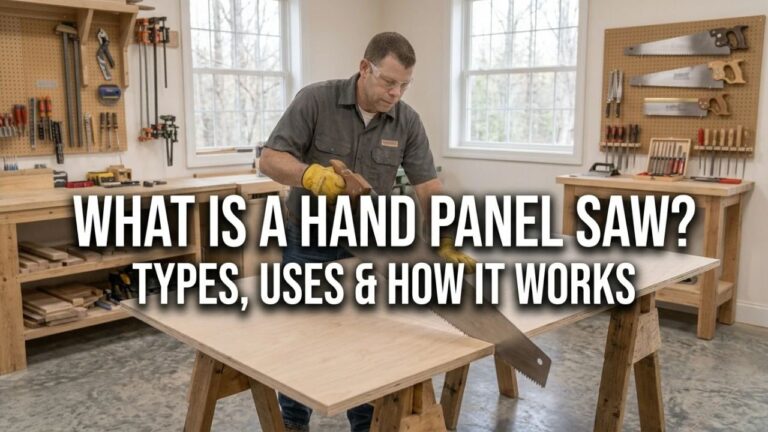
A hand panel saw is a relatively short traditional saw used for cutting boards and panels.
It usually looks similar to an ordinary carpenter’s hand saw but has a shorter blade, making it more convenient for bench work.
Historically, panel saws were designed for sheet-like workpieces and finer cabinetmaking tasks where a long handsaw was unnecessary.
Why the Shorter Blade Helps
A shorter blade is easier to control.
It is less likely to flex or wander if your sawing technique is good.
You can also use it comfortably when the workpiece is supported on a bench, portable work table, or sawhorses.
For DIY sheet cutting, that compact size can be very convenient.
Is a Crosscut Saw Good for Wood Panels?
Yes.
A crosscut hand saw is one of the best conventional saws for wood panels.
Its teeth are shaped to slice across wood fibers rather than split along them.
Because plywood contains alternating grain directions, crosscut-style teeth tend to produce a cleaner cut than an aggressive rip saw.
Tooth Count Matters
A coarse crosscut saw removes material quickly but can leave a rough edge.
A finer saw produces less tear-out but cuts more slowly.
For cabinet-grade plywood or veneered panels, lean toward a fine-tooth saw.
For rough construction sheathing, a faster, coarser crosscut saw may be perfectly adequate.
Can You Use a Rip Saw to Cut Wood Panels?
You can, but it is usually not the best choice for plywood or veneered panels.
A traditional rip saw has teeth shaped more like tiny chisels.
It is optimized for cutting parallel with the grain of solid wood.
Plywood does not have one consistent grain direction because each veneer layer alternates.
That means rip teeth do not offer the same advantage they do on a solid board.
When a Rip Saw Might Make Sense
If you are cutting a solid edge-glued panel lengthwise with the grain, a rip saw can be effective.
For example, a wide pine panel made from glued boards behaves more like solid lumber than plywood.
In that case, the grain direction matters.
For engineered sheet goods, a fine crosscut or hybrid tooth pattern is generally easier to use.
Are Japanese Saws Good for Cutting Wood Panels?
Yes.
Japanese pull saws can produce extremely clean panel cuts.
Unlike most Western saws, which cut primarily on the push stroke, Japanese saws cut on the pull stroke.
This allows the blade to be thinner because it is pulled into tension during the cut.
Advantages of a Japanese Pull Saw
The thin blade creates a narrow kerf.
That means less material is removed.
The saw usually requires less effort and can leave a very smooth edge.
The biggest limitation is that long straight cuts across large panels require good technique because the blade can be flexible.
Ryoba Saw
A ryoba has two cutting edges.
One side generally has rip teeth and the other crosscut teeth.
This makes it versatile if you also work with solid wood.
For plywood, use the finer crosscut edge.
Dozuki Saw
A dozuki has a reinforced spine and very fine teeth.
It produces highly accurate cuts.
However, the rigid spine limits how deep the saw can cut into a large sheet.
A dozuki is therefore excellent for smaller panel parts but less practical for long unrestricted cuts across a full sheet.
What Hand Saw Is Best for Plywood?
A fine-tooth panel saw, fine crosscut saw, or Japanese pull saw is usually best.
Plywood’s thin face veneer can splinter easily, especially on the exit side of the cut.
A saw with finer teeth reduces the amount of material each tooth removes and generally produces less breakout.
Cabinet-Grade Plywood
For cabinet-grade or furniture plywood, prioritize finish quality.
Use a fine saw and take your time.
Applying painter’s tape over the cut line or lightly scoring the veneer with a sharp utility knife can further reduce splintering.
Construction Plywood
For sheathing or subfloor material, perfect edges may not matter.
A slightly coarser hand saw will cut faster.
The best saw depends on whether speed or surface finish matters more.
What Hand Saw Is Best for MDF?
A fine-tooth saw works well on MDF.
MDF contains compressed wood fibers and resin rather than natural grain.
It cuts consistently in all directions.
However, it is abrasive and produces extremely fine dust.
Hardened Teeth Are Useful
If you regularly cut MDF by hand, a saw with hardened teeth can maintain sharpness longer.
MDF can dull cutting edges faster than ordinary softwood.
Dust Control Matters
Hand sawing creates less airborne dust than some high-speed power tools, but MDF dust is still very fine.
Work in a ventilated area, use suitable respiratory protection, and clean dust with appropriate extraction rather than blowing it around the shop.
What Hand Saw Is Best for Particleboard?
Use a fine-tooth carbide-style hand saw if available, or a durable fine-tooth panel saw.
Particleboard is made from wood particles bonded with resin.
It can crumble or chip around the edge if you use a coarse saw.
A sharp fine-tooth blade reduces breakout.
Support the Cut
Particleboard is not very strong when unsupported.
If the offcut drops before you finish sawing, the board can break unevenly.
Support both sides of the cut.
What Hand Saw Is Best for Melamine Panels?
Melamine is one of the most difficult sheet materials to cut cleanly with a hand saw because the surface coating is brittle.
A fine-tooth saw is essential.
A Japanese pull saw or very fine panel saw can give good results.
Score the Surface First
Use a straightedge and sharp knife to score the melamine surface along the cut line.
Then saw just on the waste side of the score.
The scored line helps prevent the brittle surface from breaking beyond the intended edge.
Painter’s tape over the cut line can provide additional support.
What Hand Saw Is Best for OSB?
OSB does not usually require a fine finish.
A medium-tooth or general-purpose hand saw is usually sufficient.
Because OSB contains oriented wood strands and adhesive, it can be somewhat abrasive.
A hardened-tooth saw is useful if you cut it frequently.
A fine cabinetmaking saw would work but would probably be unnecessarily slow.
How Many Teeth Should a Hand Saw Have for Wood Panels?
Hand saw tooth count is often expressed as teeth per inch, or TPI.
Higher TPI generally gives a smoother cut.
Lower TPI cuts faster.
For wood panels, a medium-fine to fine tooth count is usually ideal.
Rough Panel Cutting
Around 7–9 TPI can work for rough plywood or construction panels.
The cut is relatively fast but may show visible splintering.
General-Purpose Clean Cutting
Around 10–12 TPI offers a useful balance of speed and finish for many panel materials.
Fine Veneered Panels
Around 12–15 TPI or finer can provide cleaner edges, though the cut becomes slower.
These are general ranges rather than strict rules because tooth geometry matters as much as tooth count.
Key Takeaways:
- More teeth generally mean a cleaner panel edge.
- Fewer teeth make faster but rougher cuts.
- Around 10–12 TPI works well for general panel cutting.
- Fine veneer and melamine often benefit from even finer teeth.
How to Cut a Wood Panel Straight With a Hand Saw
A good saw can still wander if the cut is not started correctly.
Begin by marking the line accurately.
Use a long straightedge or framing square.
Mark both ends of the panel and connect them with a pencil line.
Support the Panel Properly
Place the panel on stable sawhorses or a bench.
Support both sides of the cut.
The waste piece should not sag or break away as you approach the end.
Position the cut so you have enough clearance below the sheet for the saw blade.
Start With Short Strokes
Place the saw teeth on the waste side of the line.
Use a few light strokes to establish a shallow kerf.
Do not press heavily.
Once the blade has a track, lengthen your strokes.
Watch the Line
Keep your eyes on the blade near the cut line rather than only watching the handle.
If the saw begins to drift, make a gradual correction.
Do not twist the blade aggressively because that can widen the kerf or bind the saw.
Should You Cut on the Line or Beside It?
Cut on the waste side of the line.
The saw kerf removes material.
If you cut directly down the center of your measurement line, part of the finished dimension is removed.
For accurate woodworking, mark which side is waste before starting.
Leave the line visible on the finished piece and trim or sand to final dimensions if necessary.
How Do You Prevent Splintering When Hand Sawing Panels?
Use a sharp fine-tooth saw.
That is the most important step.
You can also score the cut line with a knife.
Painter’s Tape
Apply painter’s tape across the intended cut line.
Mark the line over the tape and saw through it.
The tape can help hold fragile surface fibers in place.
It is particularly useful on thin plywood veneers.
Score Both Faces
If both sides must look clean, transfer the line to both faces.
Lightly score each face with a knife before sawing.
This can significantly reduce breakout where the teeth exit.
Which Side Should Face Up When Hand Sawing Plywood?
It depends partly on the saw’s tooth direction.
Traditional Western push saws generally cut most aggressively on the push stroke.
The teeth enter one face and exit the opposite face, where more splintering may occur.
Japanese saws cut on the pull stroke, so their tear-out pattern can differ.
Rather than relying only on face orientation, use a fine saw and score the finish surface.
If appearance is critical, test your particular saw on a scrap piece first.
How to Make a 90-Degree Cut Across a Panel
Use a framing square or large carpenter’s square to mark the cut.
The edge you use as the reference must itself be straight.
If the starting edge is not square, your marked cut will not produce a true rectangle.
After marking, saw carefully along the waste side.
For high accuracy, leave a small amount of material and plane or sand to the final line.
Can You Use a Miter Box for Wood Panels?
Only for narrow panel pieces.
A conventional miter box is too small for full-width sheet goods.
It can be useful after you have cut a large sheet into strips.
For example, a narrow plywood shelf can be crosscut in a large miter box with a fine backsaw.
But a 24- or 48-inch-wide panel needs another method.
Can You Cut a 4 × 8 Sheet With a Hand Saw?
Yes, but it takes patience and good support.
The saw can physically cut the material.
The main challenge is maintaining a straight line across several feet.
Support the full sheet flat on sawhorses, a workbench, or sacrificial foam.
Make sure the waste side cannot drop.
Long Cuts Require More Time
A hand saw becomes increasingly tiring over a 4- or 8-foot cut.
If you have several full sheets to process, a circular saw, track saw, or panel saw is usually much more efficient.
For one or two cuts where power is unavailable, hand sawing is completely practical.
Is a Hand Saw Better Than a Circular Saw for Panels?
For speed, no.
A circular saw is far faster.
But a hand saw has several advantages.
It is quiet.
It creates less airborne dust.
It needs no electricity.
It is inexpensive.
For a small project, a hand saw may be all you need.
Circular Saw Advantages
A circular saw with a straightedge guide makes long sheet cuts quickly and accurately.
For large flooring, cabinet, or construction projects, it is usually the more practical choice.
Hand Saw vs. Jigsaw for Wood Panels
A jigsaw is better for curves, notches, and internal cutouts.
A hand panel saw is generally easier to keep straight on a long simple cut.
If you need to cut around pipes, corners, or unusual shapes, the jigsaw has the advantage.
For a long straight plywood cut without electricity, use the hand saw.
Hand Saw vs. Track Saw for Wood Panels
A track saw is specifically designed for clean straight sheet cuts.
It gives you excellent accuracy, speed, and low tear-out.
However, it is much more expensive than a hand saw.
If you only occasionally cut panels, a fine-tooth hand saw may make more economic sense.
For frequent cabinet or sheet work, a track saw is much more efficient.
Hand Saw vs. Table Saw for Panels
A table saw is excellent for repeatable rips and dimensioning smaller panels.
A full sheet can be difficult to handle on a small table saw.
A hand saw allows the sheet to remain stationary.
That can actually make a one-off rough cut easier if you do not have adequate table-saw support.
However, for repeated identical strips, the table saw is far more efficient.
How to Cut a Panel When You Do Not Have a Workbench
Use stable sawhorses.
Place two or more supports under the panel.
For thin or flexible material, add sacrificial boards underneath to keep it from sagging.
You can also place rigid foam insulation on the floor and lay the panel on top.
Make sure your hand saw will not hit concrete beneath the cut.
Clamp the Workpiece
If possible, clamp the panel to the supports.
Movement makes it much harder to follow a straight line.
Do not place clamps where they interfere with the saw path.
Should You Use a Guide Block With a Hand Saw?
A guide block can help start a straight 90-degree cut.
Clamp a straight scrap board next to the cut line.
Use its edge as a visual and physical reference.
However, most hand saw blades have some set to the teeth, meaning the teeth project slightly wider than the blade plate.
Do not press the teeth hard against a precision guide because you can damage the guide or change the cut.
A guide is mainly useful for establishing the starting angle.
How Do You Keep a Hand Saw From Wandering?
Do not force it.
Let the teeth cut.
Heavy downward pressure can bend the blade and cause the cut to wander.
Keep your wrist aligned with your forearm.
Use long, smooth strokes once the kerf is established.
Watch the line several inches ahead of the blade.
Correct Small Errors Early
If you see the blade moving off line, change the handle angle slightly.
Do not twist the blade sharply inside the kerf.
If the error becomes large, stop and restart the kerf from the correct position rather than fighting the saw.
Why Does My Hand Saw Bind in a Panel?
Binding occurs when the kerf closes around the blade.
This often happens because the panel is unsupported and sags as the cut progresses.
Move your supports so both sides remain stable.
You can also insert a small wedge into the completed kerf behind the saw to keep it open on long cuts.
Do not place the wedge so close that it contacts the saw teeth.
How Long Does It Take to Cut a Panel by Hand?
It depends on panel thickness, saw sharpness, cut length, and material.
A short plywood crosscut may take only a few minutes.
An 8-foot rip in 3/4-inch plywood can take considerably longer.
MDF and particleboard may also feel slower because they are dense and abrasive.
For a few cuts, the extra time may be acceptable.
For production work, use a power saw.
Can a Hacksaw Cut Wood Panels?
Technically, but it is usually a poor choice.
Hacksaw blades have fine teeth designed primarily for metal and often have limited cutting depth due to the frame.
They clog easily in wood.
A proper woodworking panel saw or crosscut saw will cut much faster and straighter.
Can a Coping Saw Cut Wood Panels?
A coping saw is useful for curved and intricate cuts in thin wood.
It is not intended for long straight cuts across large panels.
Use it for small notches or interior shapes after the main panel has been cut to size.
Can a Tenon Saw Cut Wood Panels?
A tenon saw can make clean straight cuts in small panel pieces.
Its stiff back improves accuracy.
However, the reinforced spine limits cut depth.
You cannot use it conveniently for an unrestricted long cut through the middle of a large sheet.
It is better for shelves, small plywood parts, or short crosscuts.
What Saw Would I Choose for Different Panel Materials?
For ordinary plywood, I would use a fine-tooth panel saw.
For delicate veneer or melamine, I would choose a very fine panel saw or Japanese pull saw and score the surface first.
For MDF, I would use a hardened fine-tooth saw and prioritize dust protection.
For OSB or rough construction sheathing, a medium-tooth general-purpose hand saw is faster and usually sufficient.
For a solid edge-glued wood panel, the best tooth pattern depends on whether you are cutting across or along the grain.
Key Takeaways:
- Plywood: fine panel or crosscut saw.
- Veneer or melamine: very fine saw plus scoring.
- MDF: durable fine-tooth saw with good dust precautions.
- Rough OSB: medium-tooth general-purpose saw is usually enough.
Safety Tips for Cutting Wood Panels by Hand
Secure the panel before cutting.
A moving sheet makes both accuracy and safety worse.
Keep your free hand away from the projected saw path.
Wear eye protection, especially when cutting brittle laminates or particleboard.
Use appropriate respiratory protection when cutting MDF, particleboard, or other dusty engineered products.
Protect the Saw Teeth
Do not finish the cut directly onto concrete, screws, or metal supports.
Hardened hand-saw teeth can be damaged if they strike metal.
Use sacrificial wooden supports or foam underneath the panel when appropriate.
Common Mistakes When Hand Sawing Wood Panels
One common mistake is choosing a saw with teeth that are far too coarse.
It cuts quickly but tears the face veneer badly.
Another is letting the waste section hang unsupported.
The panel can split before the saw reaches the end.
Some people also begin with aggressive full strokes before establishing a kerf.
That makes the saw more likely to jump away from the line.
Another mistake is forcing the blade when it starts to bind.
Fix the support instead.
Finally, do not assume a dull saw simply needs more pressure. A sharp saw requires less effort and tracks more accurately.
FAQs About What Hand Saw to Cut Wood Panels
What hand saw should I use to cut wood panels?
A fine-tooth panel saw or crosscut hand saw is the best general-purpose choice for most wood panels.
What hand saw is best for plywood?
Use a fine-tooth panel saw, crosscut saw, or Japanese pull saw to minimize splintering.
What saw is best for MDF by hand?
A sharp fine-tooth saw with hardened teeth works well because MDF is dense and abrasive.
Can you cut plywood with a normal hand saw?
Yes. A normal crosscut saw works well, although a finer tooth count gives a cleaner edge.
Can you cut a 4 × 8 panel with a hand saw?
Yes. Support the full sheet well and use a long straight marked line. It is practical for occasional cuts but slower than power tools.
How many TPI should a panel hand saw have?
Around 10–12 TPI is a good general range, while finer veneered materials may benefit from 12–15 TPI or more.
Is a Japanese saw good for plywood?
Yes. Japanese pull saws have thin blades and can produce very clean cuts.
Is a rip saw good for plywood?
It can cut plywood, but a crosscut or fine hybrid tooth pattern generally provides better results.
How do you stop plywood from splintering?
Use a fine sharp saw, score the cut line, and consider painter’s tape over the veneer.
Should the good side of plywood face up?
It depends on tooth direction and saw type. For the cleanest result, test your saw on scrap and score the finished face before cutting.
Can a hacksaw cut wood panels?
It can, but it is inefficient and usually limited by its frame. A woodworking hand saw is much better.
Can a coping saw cut plywood panels?
Only for short curves and notches. It is not practical for long straight panel cuts.
Can a tenon saw cut plywood?
Yes, for smaller parts and short cuts. Its reinforced spine limits cutting depth on large panels.
How do I make a straight hand-saw cut?
Mark carefully, establish the kerf with light strokes, support the panel well, and keep the blade aligned with the waste side of the line.
Is it better to use a circular saw for large panels?
For several long cuts or full sheets, yes. A circular or track saw is faster and easier, while a hand saw is excellent for occasional cuts or when power is unavailable.
Conclusion
If you are asking what hand saw to cut wood panels, a fine-tooth panel saw or crosscut hand saw is the best general-purpose answer.
These saws give you enough cutting speed for plywood and engineered boards while producing a cleaner edge than an aggressive coarse-tooth construction saw.
For veneered plywood, cabinet panels, or melamine, choose finer teeth and take additional steps to reduce splintering. Scoring the surface and applying painter’s tape along the cut line can make a noticeable difference.
A Japanese pull saw is another excellent option. Its thin blade creates a narrow kerf and can produce extremely smooth cuts, especially on smaller panels and precision woodworking parts.
For MDF and particleboard, use a sharp, durable saw because these materials can be abrasive. Support them carefully and take dust precautions, particularly with MDF.
No matter which hand saw you choose, panel support matters almost as much as tooth design. Support both sides of the cut so the waste piece cannot fall, split, or pinch the blade.
Start the kerf with light controlled strokes, cut on the waste side of your line, and let the teeth do the work instead of forcing the saw.
For an occasional plywood cut, a good hand saw can be accurate, inexpensive, and surprisingly effective.
For repeated cuts across full 4 × 8 sheets, however, a circular saw, track saw, table saw, or dedicated panel saw will usually save substantial time.
The practical recommendation is simple: use a fine-tooth panel or crosscut saw for most wood panels, choose an even finer saw for delicate surfaces, and prioritize sharp teeth, good support, and careful technique over simply buying the largest saw available.