What Saw to Cut Insulated Panels?
If you are wondering what saw to cut insulated panels, a circular saw is usually the best all-around choice for straight cuts, but the correct blade depends on the panel construction. For insulated metal panels with steel or aluminum skins, use a metal-cutting circular saw blade rated for the facing material. For wood-faced structural insulated panels, or SIPs, a circular saw, beam saw, reciprocating saw, or specialized SIP cutting tool may be needed depending on panel thickness. Thin foam insulation boards often do not need a power saw at all.
The term insulated panel covers several very different products. A metal-skinned sandwich panel with a rigid foam core should not be cut using exactly the same setup as an OSB-faced SIP or a simple rigid foam board.
Choosing the wrong saw or blade can create rough edges, delaminate the skins, melt the insulation, throw dangerous metal chips, or damage protective coatings.
For most job-site work, the key is to identify the panel first and then match the blade to the outer facing—not simply to the foam in the middle.
In this guide, I’ll explain the best saws for insulated metal panels, SIPs, foam-core sandwich panels, and rigid insulation, along with blade selection, cutting direction, dust and chip control, and the most common mistakes to avoid.
What Type of Insulated Panel Are You Cutting?
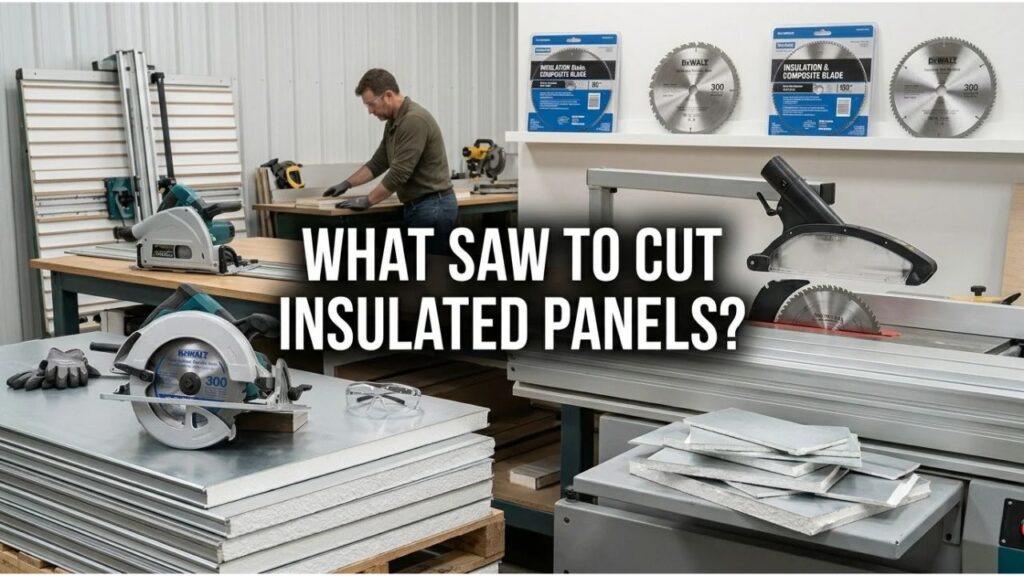
Before choosing a saw, determine what the panel is made from.
Many insulated building panels are sandwich structures consisting of two strong outer skins bonded to an insulating core.
The outer material generally determines which blade you need.
Common panel types include:
- Steel-faced insulated metal panels
- Aluminum-faced sandwich panels
- OSB-faced structural insulated panels
- Plywood-faced insulated panels
- Fiberglass-faced panels
- Rigid foam insulation boards
The insulation core may be polyurethane, polyisocyanurate, EPS, XPS, mineral wool, or another material.
A saw blade may pass through the foam very easily while struggling with the outer skins.
That is why selecting a blade based only on the insulation is a mistake.
Best Saw for Insulated Metal Panels
For most insulated metal panels, a circular saw equipped with the correct metal-cutting blade is the most practical choice.
It is portable, easy to guide with a straightedge, and capable of cutting through both metal skins and the foam core in one pass when the panel thickness and saw depth allow it.
This setup works particularly well for roofing and wall panels that need straight crosscuts or lengthwise trimming.
Why a Circular Saw Works Well
An insulated metal panel can be awkward because it may be several feet long and relatively thick.
Moving the panel through a stationary saw is not always convenient.
A circular saw lets you keep the panel supported while moving the tool across it.
When used with a clamped guide rail or straightedge, it can also produce a much straighter cut than freehand sawing.
The important part is using a blade made for the metal facing.
A standard framing blade designed for wood is usually not the correct choice for steel-faced panels.
What Blade Should You Use for Insulated Metal Panels?
For steel-faced insulated panels, use a carbide-tipped metal-cutting blade specifically rated for ferrous metal and compatible with your saw’s speed.
For aluminum-faced panels, use a blade designed for non-ferrous metals.
The tooth geometry and carbide grade differ between woodworking and metal-cutting blades.
A proper metal-cutting blade can produce a cleaner edge with less heat and fewer burrs.
Do Not Choose by Tooth Count Alone
People often ask whether they need a 40-tooth, 60-tooth, or 80-tooth blade.
Tooth count matters, but it is not the only consideration.
Blade diameter, panel-skin thickness, metal type, tooth geometry, kerf, carbide grade, and maximum RPM all matter.
Use a blade whose manufacturer specifically lists the material you are cutting.
Avoid Using an Abrasive Cut-Off Blade Unless Approved
An abrasive wheel can cut steel, but it generates a lot of heat and sparks.
That can be undesirable on coated insulated panels.
Hot metal particles can burn into painted or coated surfaces and become corrosion points later.
Heat can also damage the foam core or protective finish close to the cut.
For this reason, a cold-cutting carbide metal blade is generally a better choice when the panel manufacturer permits it.
Key Takeaways:
- A circular saw is usually the most versatile saw for insulated metal panels.
- Match the blade to the metal skin, not just the insulation core.
- A carbide metal-cutting blade is generally preferable to a high-heat abrasive wheel.
Can You Cut Insulated Panels With a Circular Saw?
Yes.
In fact, this is one of the most common ways to cut many types of insulated building panels.
The main limitations are cutting depth and blade suitability.
Suppose the panel is 2 inches thick.
A conventional 7-1/4-inch circular saw may have enough depth capacity to cut through it in one pass.
A very thick sandwich panel may exceed the saw’s maximum cutting depth.
In that case, you may need to cut from both sides or use a deeper-cut saw designed for thick panels.
Always check the actual saw capacity rather than assuming the blade diameter tells you the complete cutting depth.
Can You Cut Insulated Panels With a Track Saw?
Yes, if the track saw and blade are rated for the panel material.
A track saw can be excellent when you need long, straight, finish-quality cuts.
The guide rail prevents wandering and helps reduce surface scratching because you are not trying to steer the tool along a hand-drawn line.
Track saws are particularly useful for wood-faced insulated panels.
For steel-faced panels, however, verify that the saw itself is approved for metal cutting and that a compatible metal-cutting blade is available.
Many woodworking track saws are not intended for cutting steel.
Do not assume that changing the blade alone makes every track saw suitable for metal.
Can You Use a Jigsaw to Cut Insulated Panels?
Yes, particularly for short cuts, cutouts, penetrations, and curved shapes.
A jigsaw is not usually my first choice for long straight cuts across large panels.
The blade is narrow and flexible.
On a thick sandwich panel, the lower end of the blade can wander away from the upper cut line, leaving an edge that is not square through the panel thickness.
However, a jigsaw becomes useful when you need to cut around:
Windows.
Doors.
Electrical openings.
Pipe penetrations.
Corners.
Irregular shapes.
Choose the blade according to the facing material.
A bi-metal or carbide metal-cutting jigsaw blade may be appropriate for thin steel skins.
For wood-faced panels, use a suitable wood or composite-material blade.
Can You Use a Reciprocating Saw?
A reciprocating saw can cut insulated panels, but it is generally better for rough work than finished straight cuts.
It is useful when:
The panel is already installed.
Access is limited.
You need a plunge-style opening.
The panel is thicker than your circular saw can handle.
You are cutting demolition material.
The downside is edge quality.
A reciprocating saw blade can vibrate the panel and leave a rough or irregular edge.
On metal sandwich panels, aggressive vibration may also distort thin sheet-metal skins.
Use a long enough blade so the tip never disappears into the material and strikes the panel internally.
For finished construction, a circular saw usually produces a more controlled result.
What Saw Should You Use for Structural Insulated Panels?
Structural insulated panels, commonly called SIPs, usually consist of an insulating foam core bonded between structural skins such as OSB.
These panels can be much thicker than ordinary sheet goods.
A typical circular saw may cut partway through but may not reach the full depth.
Circular Saw for SIPs
For thinner SIPs, a circular saw can make the initial cut very effectively.
Use a straightedge guide to keep the cut accurate.
If the blade cannot reach all the way through, you may need to complete the cut from the opposite face.
Careful layout is essential so the two cuts meet accurately.
Beam Saw for Thick SIPs
A large portable beam saw is one of the better choices for thick structural insulated panels.
Beam saws resemble oversized circular saws with very large blades and greater cutting depth.
They can sometimes cut an entire thick SIP in one pass.
This produces a straighter, more consistent edge than trying to align multiple shallow cuts.
The disadvantages are cost, weight, and availability.
For contractors who cut SIPs frequently, the greater depth can justify the investment.
Can You Use a Chainsaw for SIPs?
Specialized SIP cutting systems sometimes use chainsaw-style cutting tools because a long bar can pass through very thick panels.
However, a normal general-purpose chainsaw should not automatically be treated as a precision panel saw.
A chainsaw can create a rough edge and significant debris.
It also requires careful control and suitable guarding.
If you regularly construct SIP buildings, a purpose-built panel-cutting system designed for thick foam-core structural panels is much better than improvising with an ordinary chainsaw.
What Saw to Use for Foam Insulation Panels
Rigid foam insulation is much easier to cut than metal- or wood-faced sandwich panels.
In many cases, you do not need a saw.
Thin foam boards can often be scored with a sharp utility knife and snapped cleanly.
A long insulation knife or hot-wire cutter may also work depending on foam type.
For thick rigid foam, a fine-tooth handsaw can produce a controlled cut.
A power saw is faster but creates a great deal of foam dust and debris.
EPS and XPS Foam
Expanded polystyrene and extruded polystyrene are relatively easy to cut.
A knife, handsaw, hot-wire tool, or power saw can work.
Hot-wire tools can produce extremely clean cuts on compatible polystyrene foams, but they should only be used in appropriate ventilated conditions and on materials for which the tool is designed.
Polyiso Boards
Foil-faced polyisocyanurate boards can often be cut with a utility knife for thinner panels.
Thicker boards may be easier with a fine handsaw.
Again, if the panel has structural outer skins, treat it differently from ordinary insulation board.
How to Cut Insulated Metal Panels With a Circular Saw
A clean setup makes an enormous difference.
Step 1: Check the Manufacturer’s Cutting Instructions
Before cutting, review the panel manufacturer’s guidance.
Some coated panels have specific requirements for blades, cut orientation, and removal of metal filings.
Following those instructions also helps protect product warranties.
Step 2: Support the Entire Panel
Place the panel on stable supports.
Do not let the cut area sag.
A long insulated panel can flex significantly if supported only at its ends.
Support both the finished part and the offcut so neither drops as the cut finishes.
Step 3: Measure and Mark the Cut
Measure at both edges.
Use a square or long straightedge to connect the marks.
A chalk line can help on very long panels, but for precision work a rigid straightedge is usually better.
Remember to account for the blade kerf.
Step 4: Protect the Finished Surface
Metal panel coatings can scratch easily.
Keep the saw base and support surfaces clean.
Remove metal chips before sliding tools across the panel.
If the protective film is intended to remain in place during cutting, follow the manufacturer’s instructions about when to remove it.
Step 5: Clamp a Straightedge
For a long cut, clamp a guide securely to the panel.
Measure the offset between the saw blade and the edge of the saw base.
Position the straightedge accordingly.
A guide dramatically reduces the chance of a wandering cut.
Step 6: Set the Cutting Depth
Set the saw deep enough to clear the entire panel when possible.
Do not expose dramatically more blade than necessary.
If the panel exceeds the saw’s capacity, use a procedure appropriate for the material rather than forcing an undersized saw through it.
Step 7: Cut at a Controlled Feed Rate
Start the saw clear of the panel and allow it to reach full speed.
Guide it smoothly along the straightedge.
Do not force the saw.
If the blade slows dramatically, stop and check whether the blade is suitable or the panel is binding.
Step 8: Remove Metal Chips Immediately
This is especially important on painted or coated steel panels.
Do not leave hot or sharp metal filings sitting on the surface.
They can scratch the coating, stain the finish, or contribute to corrosion.
Use a soft brush or appropriate vacuum rather than dragging chips across the panel.
Should You Cut Insulated Metal Panels Face Up or Face Down?
There is no universal orientation that applies to every saw and panel.
The cleanest side depends on blade rotation, saw design, panel coating, and manufacturer instructions.
With many handheld circular saws, the blade teeth move upward through the material at the front of the cut, which can place different chipping forces on the two surfaces.
For coated metal panels, there are additional concerns about chips landing on the finished face.
Follow the panel manufacturer’s recommended orientation whenever possible.
If instructions are unavailable, make a test cut on scrap before cutting an expensive finished panel.
How to Prevent Insulated Panels From Delaminating
Sandwich panels rely on a strong bond between the skins and foam core.
A dull or inappropriate blade can pull aggressively on the facing and stress that bond.
For cleaner cuts:
Use a sharp blade.
Support the panel close to the cut.
Avoid excessive feed force.
Do not let the offcut fall away before the cut is complete.
Choose a blade with suitable tooth geometry.
Avoid overheating the edge.
If the skin begins separating from the foam while cutting, stop and correct the setup rather than continuing through the entire panel.
How to Get a Straight Cut
The simplest solution is a straightedge guide.
Trying to freehand a long circular-saw cut across a large panel is difficult.
Even a small steering error can produce a visibly wavy joint.
For production work, a rail-guided saw or dedicated panel-cutting system provides even better consistency.
Measure both ends of the finished piece after your first test cut.
If they differ, investigate the guide setup before cutting additional panels.
How to Cut Door and Window Openings in Insulated Panels
Openings require a different approach from simple edge cuts.
Mark the complete opening carefully.
Check that it is square.
For metal-faced panels, you may use a circular saw for accessible straight sections and a jigsaw or reciprocating saw to complete corners.
Avoid overcutting far beyond the corners because those extra slots may weaken or expose the panel unnecessarily.
The exposed foam and skins around openings may need flashing, framing, sealant, or closure pieces according to the building system.
Cutting the hole is only part of the installation.
Is a Panel Saw Good for Insulated Panels?
Sometimes.
A dedicated vertical or horizontal panel saw can be useful for factory-style processing of large insulated sheets, particularly if it is specifically designed for sandwich panels and equipped with an appropriate blade.
However, a standard woodworking panel saw should not automatically be used for steel-faced insulation panels.
The blade speed, guards, chip collection, and motor may be intended only for wood products.
For job-site metal sandwich panels, a suitable portable circular saw is often more practical.
Can a Table Saw Cut Insulated Panels?
It can cut some types, but it is usually not my first recommendation for large insulated panels.
A full sandwich panel can be long, bulky, and difficult to keep flat against a table-saw fence.
Moving the tool across the panel is often easier than moving the panel across the tool.
A table saw can make sense for smaller wood-faced insulated pieces when the machine and blade are appropriate.
For large construction panels, a guided circular saw usually offers better handling.
Can a Miter Saw Cut Insulated Panels?
A miter saw may work for narrow insulated panels that fit completely within its cutting capacity.
It is not suitable for large wall or roof panels that are wider than the saw’s crosscut capacity.
Do not try to partially cut a wide panel and flip it repeatedly unless the work can be accurately supported and the tool manufacturer allows the operation.
For large panels, use a circular saw or an appropriate panel-cutting machine.
What About an Angle Grinder?
An angle grinder can cut metal, but it is generally not the best tool for making long finished cuts through insulated metal panels.
Abrasive discs generate heat, sparks, and metal particles.
The cut can also be harder to keep straight.
For small notches or installation adjustments, a grinder may have a role when permitted by the panel manufacturer.
For full-width cuts, a proper metal-cutting circular saw is usually cleaner and easier to control.
Important Safety Considerations
Cutting insulated panels combines several hazards.
Metal skins can create razor-sharp edges.
Power saws produce flying chips.
Foam and composite cores can generate fine dust.
Some panels are large enough to become difficult to control in wind.
Wear eye protection and hearing protection.
Use gloves for handling sharp-edged panels, while keeping gloves and hands well away from moving blades.
Use appropriate respiratory protection and dust extraction for foam, MDF, fiberglass, or composite materials.
When cutting steel, control hot chips and keep flammable materials away.
Never remove the saw guard to gain additional cutting depth.
If the panel is too thick for the tool, use a different tool.
Key Takeaways:
- Insulated-panel cutting can involve both sharp metal and fine insulation dust.
- Support large panels securely before cutting.
- Never defeat saw guards simply to reach through a thicker panel.
Common Mistakes When Cutting Insulated Panels
One of the most common mistakes is using an ordinary wood blade on a steel-faced panel.
Another is using an abrasive wheel that overheats and damages the coated surface.
Freehanding long cuts is another frequent problem.
Even experienced operators can wander on a long panel.
A guide is faster than trying to correct a crooked cut later.
Poor support is also a major issue.
If the offcut drops before the blade exits, it can tear the final section of metal skin or foam.
Finally, do not leave metal filings on the panel after cutting.
Cleaning immediately is part of the cutting process, not an optional cosmetic step.
FAQs About What Saw to Cut Insulated Panels
What saw is best for cutting insulated panels?
A circular saw is usually the best general-purpose option, provided you use a blade appropriate for the panel’s outer facing.
What saw should I use for insulated metal panels?
Use a circular saw equipped with a carbide-tipped metal-cutting blade rated for the steel or aluminum skin.
What blade cuts insulated metal panels?
For steel skins, use an appropriate ferrous-metal carbide blade. For aluminum, use a non-ferrous metal-cutting blade.
Can you use a wood blade on insulated metal panels?
Not if the panel has steel skins unless the blade manufacturer specifically rates it for that metal.
Use a blade intended for the actual facing material.
Can you cut insulated panels with a circular saw?
Yes. A guided circular saw is one of the most practical methods for straight cuts.
Can you cut insulated panels with a jigsaw?
Yes, especially for cutouts and irregular openings, although it is usually slower and less straight on long cuts.
Can you cut insulated panels with a reciprocating saw?
Yes, but it is better suited to rough cuts, installed panels, and difficult access than finish-quality straight cuts.
Can you cut insulated panels with an angle grinder?
It is possible on metal skins, but grinders generate more heat and sparks and are generally not ideal for long clean cuts.
Can you use an abrasive saw?
Only if the panel manufacturer allows it. Hot metal particles can damage coatings and insulation.
What saw is best for SIP panels?
A circular saw works for thinner SIPs, while thick structural insulated panels may require a beam saw or specialized SIP cutting system.
Can you cut SIPs with a circular saw?
Yes, but a standard circular saw may not cut through very thick SIPs in one pass.
What saw cuts thick SIPs in one pass?
A large beam saw or purpose-built SIP cutting tool may provide enough cutting depth.
Can you use a chainsaw on SIPs?
Specialized chainsaw-style SIP cutters exist, but an ordinary chainsaw is not my first choice for accurate finished panel cuts.
What should I use to cut rigid foam insulation?
Thin rigid foam can often be scored with a utility knife. Thick foam can be cut with an insulation knife, handsaw, or suitable powered tool.
Can you use a track saw?
Yes for compatible panel materials, especially wood-faced panels. Verify that the saw is approved before using it on metal-faced panels.
Can you cut insulated panels with a table saw?
Some panels can be cut on a table saw, but large sandwich panels are often easier and safer to handle with a guided circular saw.
Can you cut insulated panels with a panel saw?
Yes if the machine is specifically compatible with the panel material and appropriate blade.
How do you make a straight cut?
Clamp a straightedge or guide rail to the panel and run the saw along it.
Should you remove the protective film before cutting?
Follow the panel manufacturer’s instructions. Some systems are intended to be cut with protective film still in place.
How do you stop metal panels from rusting after cutting?
Remove metal filings immediately and follow the panel manufacturer’s instructions for treating exposed cut edges.
How do you keep foam from melting?
Use a sharp appropriate blade and maintain a steady feed rate rather than creating excessive friction and heat.
Why is my insulated panel edge rough?
Likely causes include a dull blade, incorrect blade type, excessive vibration, poor support, or feeding too quickly.
Can insulated panels delaminate while cutting?
Yes. A dull blade, poor support, or excessive cutting force can pull the skins away from the insulation core.
Do you need respiratory protection?
It may be appropriate when cutting foam, fiberglass, MDF, mineral-fiber products, or other materials that generate fine airborne particles.
Conclusion
So, what saw to cut insulated panels? For most large construction panels, a guided circular saw is the best all-around choice—but the blade must match the material on the outside of the panel.
For steel-faced insulated metal panels, use a carbide-tipped blade specifically designed for cutting ferrous metal.
For aluminum-faced panels, choose a non-ferrous metal-cutting blade.
For wood-faced structural insulated panels, a circular saw works well when the panel is within its cutting capacity. Very thick SIPs may require a beam saw, a second carefully aligned cut from the opposite side, or a specialized deep-cut panel tool.
For plain rigid foam insulation, a power saw may not be necessary at all. A utility knife, insulation knife, fine handsaw, or hot-wire cutter can often make the job cleaner and with much less debris.
A jigsaw is useful for windows, doors, and irregular openings, while a reciprocating saw is better reserved for rough cutting or situations where access is difficult.
Whatever tool you choose, prioritize the blade, panel support, and cut guidance.
Use a clamped straightedge for long cuts, support both sides of the panel, keep the cutting edge cool, and clean metal chips from coated surfaces immediately.
Most importantly, do not assume every insulated panel can be cut with the same saw.
Identify the panel facing first, then choose a saw and blade specifically rated for that material. That is the safest way to get a straight cut without damaging the panel, insulation core, or protective finish.