Will a 12-Inch Miter Saw Cut a 4×4? Capacity and Cutting Tips
A 4×4 is a common size of lumber used for posts, supports, fencing, decks, and other construction projects. If you already have a large miter saw, you may wonder whether it has enough cutting capacity to handle this relatively thick piece of wood.
So, will a 12-inch miter saw cut a 4×4? In most cases, yes. A 12-inch miter saw generally has enough cutting capacity to cut a standard 4×4 at a 90-degree angle, and many models can complete the cut in a single pass.
However, cutting capacity varies between models. Sliding and non-sliding designs can have different capabilities, and angled or bevel cuts may require more clearance than a straight crosscut.
Will a 12-Inch Miter Saw Cut a 4×4?
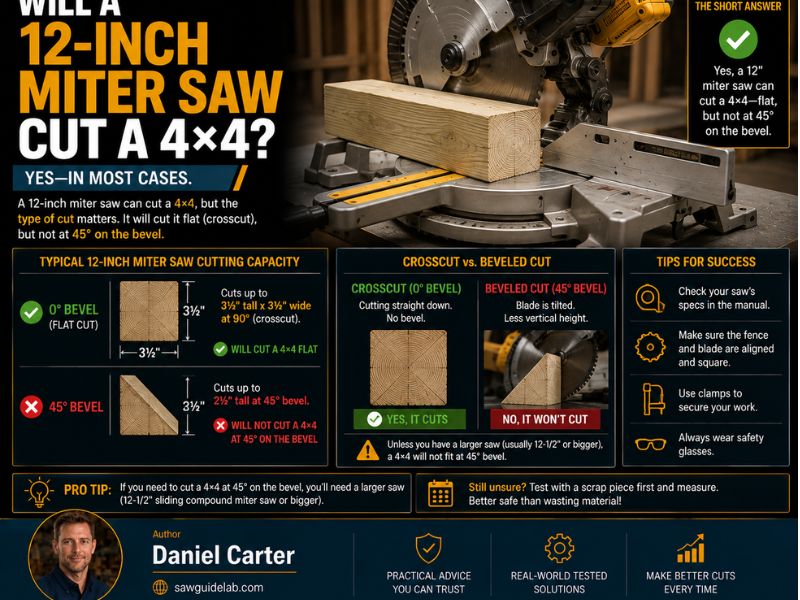
Yes, most 12-inch miter saws can cut a standard 4×4.
The important detail is that a nominal 4×4 is not actually four inches by four inches. A typical finished 4×4 measures approximately 3.5 × 3.5 inches.
This makes the actual cutting requirement smaller than the name suggests.
At a 90-degree crosscut, many 12-inch miter saws have enough cutting capacity to pass through the entire 3.5-inch thickness in one cut.
However, you should always check the specifications for your particular saw before attempting the cut.
What Size Is a 4×4 Actually?
The term 4×4 refers to the lumber’s nominal dimensions.
A typical finished 4×4 is approximately:
3.5 inches × 3.5 inches
This difference occurs because lumber is cut and then dried and surfaced during manufacturing.
Knowing the actual dimensions is important when determining whether your miter saw can cut the material.
For example, a saw that has a maximum vertical cutting capacity greater than 3.5 inches at 90 degrees can potentially cut a standard 4×4 in one pass.
Can a 12-Inch Miter Saw Cut a 4×4 in One Pass?
In many cases, yes.
A 12-inch miter saw typically has a larger blade and greater cutting capacity than smaller models.
For a standard 4×4 crosscut at 90 degrees, many 12-inch saws can cut through the entire piece without requiring you to rotate it.
However, there is no universal cutting capacity for every 12-inch model.
Factors that can affect the result include:
- Saw design
- Blade diameter
- Vertical cutting capacity
- Sliding mechanism
- Fence design
- Miter angle
- Bevel angle
Always check the manufacturer’s published cutting capacity for the exact model.
Can You Cut a 4×4 at an Angle With a 12-Inch Miter Saw?
A 12-inch miter saw can often cut a 4×4 at an angle, but the required cutting capacity changes as the angle changes.
45-Degree Miter Cuts
A 45-degree miter cut creates a longer cutting path through the material than a straight 90-degree cut.
Because of this, a saw that easily cuts a 4×4 straight across may have less capacity when cutting at an angle.
The exact capability depends on the saw’s specifications.
Bevel Cuts
A bevel cut tilts the blade relative to the workpiece.
When you combine a bevel with a miter angle, the cut becomes a compound cut.
These cuts can require considerably more clearance, so you should check the manufacturer’s capacity chart before attempting them.
How to Cut a 4×4 With a 12-Inch Miter Saw
If your saw is rated for the size and type of cut you need, follow a careful setup.
1. Check the Saw’s Cutting Capacity
Before placing the lumber on the saw, verify the maximum cutting capacity at your intended angle.
Do not rely solely on the fact that the saw has a 12-inch blade.
Different 12-inch models can have different capacities.
2. Use the Correct Blade
Use a blade appropriate for the type of wood and cut you are making.
A quality carbide-tipped blade designed for construction lumber can provide clean and efficient cuts.
Make sure the blade diameter, arbor size, and RPM rating are compatible with the saw.
3. Support the 4×4 Properly
A 4×4 is much heavier and larger than a small piece of trim.
Support the lumber on both sides of the saw when necessary.
Proper support helps prevent the material from shifting during the cut.
4. Mark the Cut Line
Measure the required length carefully and mark the exact location where the blade should cut.
For repeated cuts, a stop block can help maintain consistent lengths.
5. Position the Lumber Correctly
Place the 4×4 firmly against the fence and base of the miter saw.
Make sure the material is stable and does not rock.
If necessary, use the saw’s clamp to secure it.
6. Start the Saw Before Contacting the Wood
Allow the blade to reach full operating speed before lowering it into the lumber.
Do not start the blade while it is already pressed against the workpiece.
7. Make the Cut Smoothly
Lower the blade in a controlled motion.
Avoid forcing the saw through the 4×4.
Let the blade do the work and maintain steady pressure throughout the cut.
8. Let the Blade Stop Completely
After finishing the cut, keep the saw down until the blade has stopped rotating.
Then raise the blade and remove the cut pieces safely.
What If the 12-Inch Miter Saw Cannot Cut the 4×4 in One Pass?
Not every 12-inch miter saw has the same vertical cutting capacity.
If your particular model cannot pass completely through a 4×4 in one motion, you may be able to rotate the lumber and complete the cut from another side, provided the manufacturer’s instructions allow that technique.
The basic process is:
- Make the first cut as far as the saw allows.
- Stop the blade completely.
- Remove and reposition the lumber.
- Rotate it carefully.
- Align the existing cut with the blade.
- Secure the workpiece.
- Complete the cut.
Accuracy is important when using this method. If the two cuts do not align properly, the finished end may be uneven.
If the saw is not designed to handle the material safely, use a different tool rather than forcing the cut.
Can a 10-Inch Miter Saw Cut a 4×4?
Some 10-inch miter saws can cut a standard 4×4, while others may not be able to complete the cut in one pass.
The answer depends heavily on the model’s vertical cutting capacity.
A 10-inch blade is smaller than a 12-inch blade, so it generally has less maximum cutting depth. A sliding 10-inch model may have greater capacity in certain directions than a non-sliding model.
Therefore, don’t choose a saw based only on blade diameter.
Check the manufacturer’s specifications for:
- Maximum 90-degree crosscut
- Maximum vertical capacity
- Miter capacity
- Bevel capacity
- Compound cutting capacity
12-Inch Miter Saw vs. Other Tools for Cutting 4×4
A miter saw is not the only tool capable of cutting a 4×4.
| Tool | Can Cut 4×4? | Best Use |
| 12-inch miter saw | Usually yes | Fast, accurate crosscuts |
| 10-inch miter saw | Model dependent | General woodworking |
| Circular saw | Yes | Portable cuts |
| Table saw | Yes, with proper setup | Straight cuts |
| Reciprocating saw | Yes | Rough cuts |
| Hand saw | Yes | Manual cutting |
For clean, repeatable crosscuts, a properly sized miter saw is often one of the most convenient options.
A circular saw can be more portable, while a reciprocating saw may be useful when precision is less important.
Safety Tips for Cutting a 4×4
A 4×4 is a substantial workpiece, so proper setup is important.
Secure the Workpiece
Keep the lumber firmly against the fence and use the appropriate clamp when needed.
Never hold the material in a position that places your hand near the blade.
Use Eye Protection
A miter saw can produce wood chips and sawdust.
Wear appropriate eye protection whenever operating the saw.
Keep Hands Away From the Blade
Maintain a safe hand position and follow the manufacturer’s recommended minimum distance from the blade.
Support Long Lumber
Long pieces can tip or move if they are not properly supported.
Use appropriate extensions, stands, or other support systems.
Avoid Forcing the Blade
If the saw struggles to cut the material, stop and determine why.
A dull or inappropriate blade can make cutting more difficult.
Wait for the Blade to Stop
Never reach for the cut piece while the blade is still rotating.
Allow the blade to stop completely before moving the material.
Follow Manufacturer Instructions
Your saw’s manual provides the specific cutting capacities and operating procedures for that model.
Those specifications should take priority over general recommendations.
Frequently Asked Questions
Can a 12-inch miter saw cut a 4×4 in one pass?
Most 12-inch miter saws can cut a standard 4×4 at 90 degrees in one pass, but the exact capability depends on the model’s vertical cutting capacity.
Can a 12-inch sliding miter saw cut a 4×4?
Yes, many 12-inch sliding miter saws can cut a standard 4×4. The sliding mechanism can provide additional cutting capacity, but you should still check the manufacturer’s specifications.
Can a 12-inch miter saw cut a 4×4 at 45 degrees?
Many can, but a 45-degree cut changes the cutting path through the lumber. Check the saw’s miter cutting capacity before attempting the cut.
What is the actual size of a 4×4?
A typical finished 4×4 measures approximately 3.5 × 3.5 inches, rather than the full four inches suggested by its nominal size.
Is a 12-inch miter saw better than a 10-inch for 4×4?
A 12-inch saw generally provides greater cutting capacity, making it more likely to cut a 4×4 in one pass. However, the exact capacity depends on the specific model.
Final Thoughts on Cutting a 4×4 With a 12-Inch Miter Saw
So, will a 12-inch miter saw cut a 4×4? In most cases, yes. A standard 4×4 is approximately 3.5 × 3.5 inches, and many 12-inch miter saws have enough capacity to make a 90-degree crosscut in one pass.
However, blade size alone does not guarantee cutting capacity. Different saws have different specifications, particularly when making 45-degree miter cuts, bevel cuts, or compound cuts.
Before cutting, check your saw’s rated capacity, use an appropriate blade, support the lumber properly, and keep your hands safely away from the blade.
For most standard 4×4 crosscuts, a properly sized 12-inch miter saw is a convenient and capable tool.