How Accurate Are Radial Arm Saws? Accuracy & Setup Guide
Radial arm saws can be very accurate when they are rigid, properly aligned, fitted with the correct blade, and kept in good mechanical condition. A well-tuned radial arm saw can produce furniture-quality square crosscuts and highly repeatable lengths, while a worn or poorly adjusted machine may struggle to make two identical cuts in a row.
The large difference in accuracy is one reason opinions about radial arm saws vary so much.
Heavy older DeWalt, Delta, Rockwell, and industrial radial arm saws often have substantial cast components and precise carriage systems that can hold alignment extremely well. Some lighter homeowner machines use less rigid arms, bases, or indexing mechanisms and may require more frequent adjustment.
For general woodworking, achieving repeatability somewhere around 1/32 inch is realistic for many properly maintained shop saws. A high-quality industrial machine with an accurate stop system can do even better. However, there is no universal accuracy specification for all radial arm saws, and promising a specific tolerance without knowing the machine would be misleading.
The greatest strength of a properly set-up radial arm saw is usually crosscutting. Once the blade travel is exactly perpendicular to a straight fence, a fixed radial arm saw can make fast, consistent square cuts across wide lumber.
In this guide, I’ll explain how accurate are radial arm saws, what determines their accuracy, why some machines lose alignment, how they compare with miter and table saws, and how to tune a radial arm saw for more precise and repeatable cuts.
How Accurate Can a Radial Arm Saw Be?
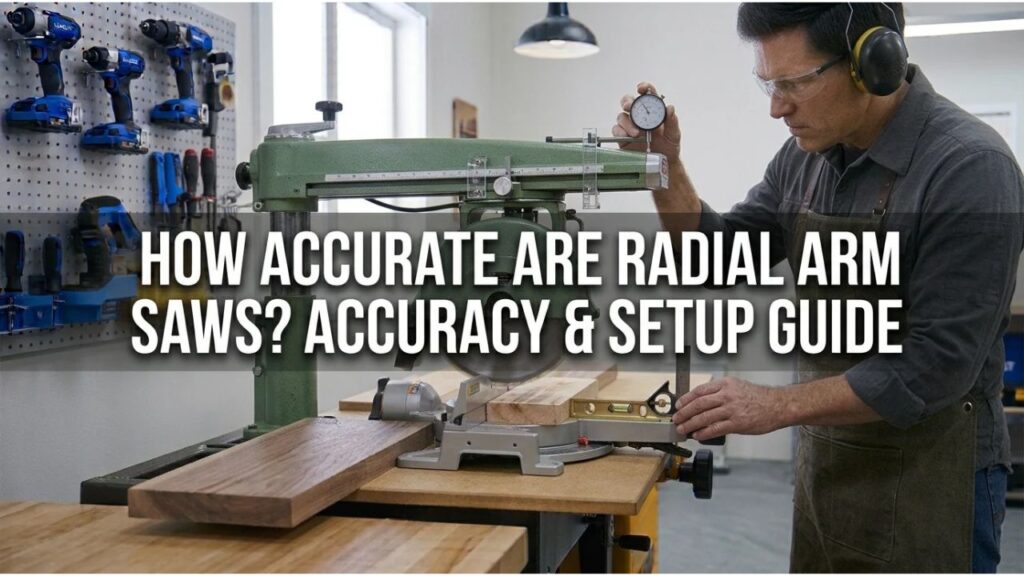
A good radial arm saw can be extremely accurate for crosscutting.
There are really two different types of accuracy to consider:
Dimensional accuracy describes whether the finished board is the intended length.
Angular accuracy describes whether the cut is truly square or at the intended miter or bevel angle.
A properly aligned saw with a reliable stop can perform very well in both categories.
Real-World Dimensional Accuracy
For ordinary cabinetmaking, furniture construction, framing components, and shop projects, being within approximately 1/32 inch across repeated cuts is generally achievable with a decent radial arm saw that has been properly tuned.
Heavy industrial machines with precision stops and rigid cast components can provide even tighter repeatability.
However, a number such as 1/32 inch should be treated as a practical reference—not as a guaranteed specification for every radial arm saw.
A worn homeowner machine with loose bearings may not hold that level of accuracy.
Square-Cut Accuracy
An accurate radial arm saw should be capable of making a crosscut that remains square across the full cutting width.
If a 12-inch-wide board shows a measurable gap when checked with a reliable square, something needs adjustment.
The most common causes are the radial arm not being perpendicular to the fence or the carriage having mechanical play.
Repeatability Is Often More Important
Suppose you need twelve cabinet parts that are 24 inches long.
If every piece is actually 23 31/32 inches but all twelve are identical, assembly may still go smoothly.
If some measure 24 inches, others 23 7/8, and others 24 1/16, the machine has a repeatability problem.
A correctly installed stop block can make a radial arm saw exceptionally good at producing identical parts.
Key Takeaways:
- A properly tuned radial arm saw can make precise, furniture-quality crosscuts.
- Around 1/32-inch repeatability is a reasonable practical target for many good shop machines, but it is not a universal specification.
- For production work, consistent repeatability can matter as much as absolute dimension.
Why Are Some Radial Arm Saws Extremely Accurate?
The basic machine design has several advantages for crosscutting.
The workpiece remains stationary against the fence.
Instead of pushing a long board through a saw, you move the cutting carriage across it.
That means you can establish a fixed fence and stop system that stays in one location.
Long Boards Are Easy to Reference
Imagine crosscutting a 10-foot board.
On a table saw, handling that board while maintaining precise control can be difficult.
On a radial arm saw, the board simply rests against a long fence.
Once properly supported, it does not move during the cut.
This arrangement is ideal for repetitive woodworking.
The Cutting Path Is Mechanically Defined
The radial arm controls the path of the carriage.
Once that arm is adjusted exactly perpendicular to the fence, the blade follows the same path every time.
A heavy, rigid radial arm with good bearings can maintain that geometry for a long period.
Dedicated Crosscut Stations Can Be Particularly Accurate
A radial arm saw often stays most accurate when it is left permanently set at 90 degrees and used primarily for square crosscuts.
Each time you swing the arm to make a miter and then return it to zero, you depend on the indexing system to locate exactly the same position again.
Leaving the arm fixed eliminates that variable.
Many experienced shops historically used radial arm saws almost exclusively as dedicated crosscut machines for this reason.
Why Do Radial Arm Saws Have a Reputation for Being Inaccurate?
Because they have many adjustable components.
A radial arm saw can usually adjust in more directions than a basic chop saw.
The arm rotates.
The blade tilts.
The motor yoke rotates.
The carriage moves.
The table can be adjusted.
The fence can move.
The column raises and lowers.
Every one of these relationships can influence the final cut.
Small Errors Add Together
Imagine the arm is slightly out of square.
The fence is also slightly bowed.
Then the blade has a little heel.
Finally, one carriage bearing is loose.
No single problem may look severe, but together they can produce an obviously inaccurate cut.
This is why manufacturer alignment procedures usually specify a particular sequence.
Correcting later adjustments before earlier ones can waste time because one adjustment may affect another.
Homeowner Models Vary in Rigidity
Not every radial arm saw was built to the same standard.
Heavy industrial machines may use substantial cast-iron columns, rigid arms, and precision roller heads.
Some inexpensive homeowner saws relied more heavily on stamped metal parts and lighter adjustment systems.
A less rigid machine may be perfectly adequate for general woodworking but require more frequent verification.
The Radial Arm Is Critical to Accuracy
For a square crosscut, the carriage must travel at exactly 90 degrees to the fence.
If the radial arm points slightly left or right, every crosscut contains a small miter angle.
The wider the board, the easier that error becomes to see.
Small Angular Errors Become Larger Across Wide Boards
An error that is nearly invisible across a 2-inch board may become obvious across a 12-inch shelf.
This is why testing accuracy with a reasonably wide board gives you more useful information than cutting narrow strips.
A framing square is commonly used during initial alignment.
For even finer verification, a test cut followed by checking the cut face can reveal small errors more clearly.
Carriage Bearings Have a Major Effect
The carriage rides along the radial arm on bearings or rollers.
These components need to move smoothly without unwanted play.
Too Loose
If the bearings are loose, the motor can shift slightly as you pull the carriage.
That changes the blade path.
You may notice:
Inconsistent square cuts.
Blade marks.
Wandering kerfs.
Different results depending on how much pressure you apply to the handle.
Too Tight
Overtightened bearings create their own problem.
The carriage may bind or require excessive force to move.
That can encourage jerky feed and make smooth cutting difficult.
The ideal setup allows the carriage to travel freely while eliminating noticeable play.
Blade Heel Can Reduce Accuracy
Blade heel means the blade is not perfectly parallel with the direction of carriage travel.
Imagine looking down at the blade from above.
The front of the blade points along one line while the carriage itself travels along a slightly different line.
As a result, the rear teeth rub against the cut.
Symptoms of Blade Heel
You may notice:
Burn marks.
Rough cut surfaces.
Excessive cutting resistance.
Wider kerfs.
Wood being pushed sideways.
Increased splintering.
Poor rip performance.
Correcting heel improves both accuracy and cut quality.
The Blade Must Be Square to the Table
For a standard 90-degree crosscut, the blade needs to be perpendicular to the work surface.
If it leans slightly, the top edge of the board may appear properly positioned while the bottom of the cut ends up somewhere else.
This is particularly noticeable on thick lumber.
Check the Blade Plate, Not the Teeth
Carbide teeth project beyond the body of the blade.
When checking with a square, reference the flat blade plate between teeth.
Otherwise, a carbide tip can create a false gap.
Also rotate the blade and check at more than one position because not every blade plate is perfectly flat.
Key Takeaways:
- The arm must travel square to the fence, and the blade must be square to the table.
- Loose carriage bearings and blade heel can destroy otherwise good alignment.
- Radial arm saw accuracy depends on several adjustments working together.
The Fence Can Make an Accurate Saw Look Inaccurate
A perfect machine cannot make consistently square cuts if the workpiece rests against a crooked fence.
Radial arm saw fences are commonly made from replaceable wood or MDF.
Over time they can warp, loosen, or become heavily cut.
Check Fence Straightness
Place a reliable straightedge along the fence.
If there are obvious gaps, replace or straighten it.
Also make sure the fence remains tightly clamped between the table sections.
Long Fences Need Careful Alignment
Many radial arm saw stations use extended fences several feet long on each side.
This is excellent for supporting long stock and using stop blocks.
However, the extension fence should remain in the same straight plane as the saw’s central fence.
If one wing angles forward or backward, a long board may not sit properly at the cutting area.
Table Flatness Matters
Traditional radial arm saws usually use a replaceable wood table.
The table is not simply a convenient surface—it is part of the alignment system.
If one side is high or low, the workpiece may not rest consistently.
Old Tables Can Sag
Particleboard and MDF can change shape with moisture and age.
A table that has supported heavy objects for years may sag.
Replacing the work surface and realigning the supports can make an old radial arm saw feel like a completely different machine.
Support Wings Should Not Be Higher
If you add long side tables, set them flush with or very slightly below the main saw table.
A wing that is too high lifts the stock away from the central reference surface and can introduce cutting errors.
Blade Choice Affects Apparent Accuracy
A dull blade can deflect, burn, and leave a rough surface that makes precise measurement difficult.
An inappropriate blade can also make the carriage self-feed.
For a radial arm saw used primarily for crosscutting, a blade intended for radial arm or sliding-miter-saw use is usually preferable.
Hook Angle Matters
A strongly positive hook angle makes the teeth enter the wood aggressively.
Because you are pulling a radial arm saw toward yourself during a conventional crosscut, that aggressive tooth geometry can encourage the carriage to accelerate.
A neutral or slightly negative hook angle generally provides better control.
Better control usually produces a more consistent cut.
How Accurate Are Radial Arm Saws for Crosscuts?
Crosscutting is where a good radial arm saw can excel.
A properly tuned machine provides:
Excellent support for long lumber.
Wide crosscut capacity.
Easy repetitive length stops.
Clear measurement systems.
No need to push the stock through the blade.
For square production cuts, a heavy radial arm saw can be exceptionally effective.
Wide Crosscuts Are a Major Advantage
Some radial arm saws can crosscut considerably wider boards than ordinary non-sliding miter saws.
Because the cutting carriage follows an overhead track, that wide capacity does not necessarily compromise the support available for long boards.
How Accurate Are Radial Arm Saws for Miter Cuts?
They can produce accurate miters, but this depends more heavily on the quality of the arm indexing system.
Every time the arm rotates, it must return precisely to the selected angle.
Older Heavy Saws Can Be Very Good
High-quality radial arm saws often have substantial detents and locking mechanisms.
When clean and correctly adjusted, these can produce very repeatable common angles.
Worn Indexing Systems Can Introduce Play
If the 0-degree or 45-degree detent feels loose, your final angle may depend on exactly where you hold the arm while tightening the lock.
That makes repeatability harder.
A user who primarily needs perfect square crosscuts may therefore choose to leave the radial arm locked at zero and make angle cuts with another tool.
How Accurate Are Radial Arm Saws for Bevel Cuts?
A properly adjusted radial arm saw can make accurate bevel cuts.
The limiting factors are typically the bevel indexing system, yoke rigidity, and operator setup.
Before precision bevel work, verify the angle with a reliable gauge rather than trusting an old printed scale.
Mechanical scales on decades-old equipment may not indicate the exact angle after years of use and adjustment.
How Accurate Are Radial Arm Saws for Dados?
Radial arm saws can be particularly useful for repeated cross-grain dados on models designed to accept approved dado equipment.
Because the cutter travels over the workpiece, the operator can see where the dado is being made.
Once a fence and stop system are established, repeated dado locations can be highly consistent.
However, cutter compatibility and guarding are model-specific.
Do not install a dado stack simply because it fits on the arbor.
How Accurate Are Radial Arm Saws for Ripping?
Ripping is where I would place less emphasis on the radial arm saw’s precision advantage.
Many traditional machines can rip, but a table saw is often more intuitive and convenient for the operation.
A radial arm saw used for ripping requires careful blade-to-fence alignment, correct feed direction, proper guarding, and functioning anti-kickback devices.
Even a tiny blade heel can affect rip quality.
For a modern shop, using the radial arm saw as a dedicated precision crosscut station and a table saw or track saw for ripping is often an effective combination.
Radial Arm Saw vs. Miter Saw Accuracy
A quality modern sliding compound miter saw is easy to set up and generally retains its basic settings well.
For many contractors and homeowners, it is the more convenient choice.
However, a properly tuned radial arm saw can match or exceed a miter saw for repeated square crosscuts, particularly when installed in a long permanent fence system.
Why the Miter Saw Is Easier
A miter saw has fewer major adjustment relationships.
It is compact and generally designed around crosscuts and angle cuts.
A radial arm saw offers greater versatility but demands more setup knowledge.
Why the Radial Arm Saw Can Win in a Dedicated Station
Once permanently adjusted at 90 degrees, a radial arm saw can offer excellent capacity and repeatability.
Long stock remains supported against a continuous fence, and fixed stop systems can be integrated across a large workstation.
Radial Arm Saw vs. Table Saw Accuracy
For ripping, the table saw usually has the advantage.
A quality table saw with a well-adjusted fence can repeatedly produce extremely consistent widths.
For crosscutting long boards, a radial arm saw can be more convenient.
A table saw crosscut sled can also be exceptionally precise, but its capacity is limited by sled size and the ability to support long workpieces.
They Complement Each Other
A traditional professional shop might use:
Radial arm saw for crosscutting.
Table saw for ripping.
This specialization allows each machine to operate where its design works best.
Heavy Industrial vs. Consumer Radial Arm Saw Accuracy
Construction quality matters enormously.
A large industrial radial arm saw can weigh several hundred pounds and use substantial cast components.
That mass and rigidity reduce deflection.
Industrial Machines
Advantages often include:
Rigid columns.
Heavy arms.
Precision bearing systems.
Strong yoke locks.
More durable indexing mechanisms.
Large tables.
Long-term parts support on some current models.
These features help the machine maintain alignment under production use.
Consumer Machines
A lighter homeowner saw may still cut accurately when tuned.
However, worn stamped components, lightweight tables, loose locks, and decades of use can make maintaining alignment harder.
Judge the individual machine rather than assuming every radial arm saw behaves the same way.
How to Check Your Radial Arm Saw’s Accuracy
You do not need expensive metrology equipment for a basic test.
Start with a quality square and a straight, reasonably wide scrap board.
Check the Fence
Confirm the fence is straight.
Make a Fresh Crosscut
Use the correct crosscut procedure and cut several inches from the end of a wide board.
Check the Cut
Place a reliable square against the freshly cut end.
Look for light between the square and the wood.
Flip the square or board as appropriate to make sure your measuring tool itself is not causing the apparent error.
Use a Wider Test Piece
A small angular error is easier to detect across a 10- or 12-inch-wide board than across a narrow strip.
Test Repetitive Lengths
Install a stop and cut several identical pieces.
Stack their ends together.
If the ends line up perfectly, your repeatability is good.
If the lengths vary noticeably, inspect the stop system, fence, and cutting technique.
How to Improve Radial Arm Saw Accuracy
Start with stability.
The stand should be rigid and firmly supported.
A moving machine cannot maintain precision.
Then follow the manufacturer’s alignment sequence rather than making random adjustments.
A sensible process typically involves checking the column and arm for play, leveling or aligning the table, squaring carriage travel to the fence, squaring the blade to the table, setting blade heel, and adjusting carriage bearings.
Replace a Worn Fence
This is inexpensive and can produce an immediate improvement.
Replace a Damaged Table
A fresh table provides a more reliable reference surface.
Use a Good Blade
A sharp, properly selected blade produces cleaner, more predictable cuts.
Eliminate Mechanical Play
A lock that moves after tightening is an accuracy problem.
A bearing that allows carriage movement is an accuracy problem.
A loose column is an accuracy problem.
Alignment cannot compensate for worn mechanical parts indefinitely.
Use a Stop System
For repetitive work, measure once and let a physical stop establish every subsequent piece.
That removes repeated tape-measure error from the process.
Key Takeaways:
- Test accuracy with a wide board and a trustworthy square.
- Mechanical looseness must be repaired before fine alignment is worthwhile.
- A long fence and solid stop system can make a radial arm saw exceptionally repeatable for production crosscuts.
Why Does My Radial Arm Saw Keep Going Out of Square?
If you carefully align the saw but it quickly loses accuracy, something is probably moving mechanically.
Possible causes include a loose column, worn arm indexing components, loose carriage bearings, an unstable stand, a shifting fence, or a yoke lock that does not clamp securely.
Moving the Saw Can Affect Alignment
If the machine is on casters and your shop floor is uneven, moving it can twist the stand slightly.
That may alter the table or arm relationship.
Recheck alignment after relocating a mobile radial arm saw.
Constant Angle Changes Can Affect Repeatability
If you frequently rotate the radial arm between square and miter settings, wear or play in the indexing mechanism becomes more important.
A saw that is permanently dedicated to 90-degree crosscuts avoids that repeated repositioning.
Does an Old Radial Arm Saw Become Less Accurate With Age?
Age itself is not the problem.
Wear is.
A 50-year-old industrial saw with excellent bearings and rigid cast components can remain remarkably precise.
A much newer lightweight saw with a damaged carriage or loose indexing mechanism may be significantly worse.
Inspect condition rather than using manufacturing year as your only criterion.
When Is a Radial Arm Saw Not Accurate Enough?
If you repeatedly align the machine but cannot produce consistent square cuts, determine whether the error comes from adjustment or mechanical wear.
Watch for:
Visible carriage play.
Loose column movement.
Arm movement after locking.
Yoke rotation after locking.
A warped table.
A bent fence.
Damaged tracks.
Worn bearings.
If replacement components are unavailable or the structure itself is damaged, using another machine for precision work may be more practical.
FAQs about How Accurate Are Radial Arm Saws
How accurate are radial arm saws?
A properly aligned radial arm saw can be highly accurate, particularly for square crosscuts and repeated-length cuts. Many good shop machines can realistically work around 1/32-inch repeatability, while high-quality industrial equipment may perform better.
Are radial arm saws precision tools?
They can be.
Their precision depends heavily on machine construction, alignment, mechanical condition, blade selection, table flatness, and fence setup.
Are old radial arm saws accurate?
Many are extremely accurate.
Older heavy-duty DeWalt, Delta, Rockwell, and similar industrial machines can hold alignment very well when they remain in good mechanical condition.
Are Craftsman radial arm saws accurate?
Some Craftsman models can cut very accurately when carefully adjusted.
However, construction quality varied across generations, and certain lighter or heavily worn machines may require frequent realignment.
How close can a radial arm saw cut?
There is no universal tolerance. Roughly 1/32 inch is a reasonable real-world goal for many properly adjusted woodworking machines, but actual capability depends on the saw and setup.
Can a radial arm saw cut perfectly square?
Yes.
The carriage path must be perpendicular to a straight fence, the blade must be square to the table, and mechanical play must be controlled.
Why won’t my radial arm saw cut square?
Common causes include incorrect arm alignment, a crooked fence, blade heel, loose carriage bearings, column movement, or a blade that is not square to the table.
Why does my radial arm saw lose alignment?
Something may be mechanically loose or worn. Check the arm lock, column, carriage bearings, yoke lock, stand, table, and fence.
Is a radial arm saw more accurate than a miter saw?
Either can be highly accurate.
A radial arm saw can be exceptional for wide, repetitive crosscuts in a permanent station, while a modern miter saw is generally simpler to adjust and transport.
Is a radial arm saw more accurate than a table saw?
For repeated long-board crosscuts, it can be extremely convenient and accurate.
For precision ripping, a good table saw generally has the advantage.
Can radial arm saws make accurate miters?
Yes, provided the arm indexing and locking mechanisms are in good condition.
A worn detent system can reduce repeatability.
Can they make accurate bevel cuts?
Yes.
Check the bevel angle with a reliable square or digital gauge rather than relying only on an old scale.
Are radial arm saws good for cabinetmaking?
Yes, particularly as dedicated crosscut stations.
They can accurately cut cabinet components, face-frame parts, shelves, and other pieces to repeated lengths.
Are radial arm saws good for furniture making?
A properly tuned saw can provide furniture-quality crosscuts, miters, and repeated components.
How often should I check alignment?
There is no fixed interval.
Check whenever cut quality changes, after moving the saw, after replacing the table, after mechanical repairs, or whenever a test cut indicates an error.
Does changing the blade affect alignment?
Potentially.
Different blades can vary slightly in flatness and kerf. After installing a new blade, check its condition and make a test cut before precision work.
Does blade hook angle affect accuracy?
It can affect control.
An aggressive positive-hook blade may encourage self-feeding during crosscuts, while a neutral or slightly negative hook blade generally gives better carriage control.
How do I make repeated cuts more accurate?
Install a long, straight fence and use a rigid stop block rather than measuring every board individually.
Should I permanently leave the radial arm at 90 degrees?
If your main goal is maximum repeatability for square crosscuts, leaving the arm at 90 degrees can reduce one source of alignment variation.
Can loose carriage bearings affect accuracy?
Yes.
Carriage movement can allow the blade path to change as the saw travels through the workpiece.
Does the radial arm saw table affect accuracy?
Absolutely.
A warped, uneven, or poorly aligned table can cause the workpiece to sit incorrectly and change cutting geometry.
Conclusion
How accurate are radial arm saws? A good radial arm saw can be extremely accurate, particularly when it is used as a dedicated crosscut machine. Properly adjusted equipment can produce square, repeatable cuts suitable for cabinetmaking, furniture building, trim work, and production woodworking.
For many well-maintained shop machines, repeatability around 1/32 inch is a reasonable practical expectation, while high-quality industrial saws and carefully designed stop systems may perform even better. However, accuracy should never be judged by one universal tolerance because machine construction and condition vary dramatically.
The radial arm saw’s reputation for inaccuracy usually comes from its many adjustment points and the large number of aging homeowner machines still in circulation.
For accurate crosscuts, the radial arm must travel perpendicular to the fence. The blade must remain square to the table. Blade heel must be minimized. Carriage bearings must move smoothly without play. The table must be flat, and the fence must be straight.
Any looseness in those relationships can appear in the finished work.
Heavy cast industrial machines tend to maintain alignment better than lightweight saws with worn adjustment mechanisms, but a carefully tuned homeowner saw can still deliver excellent results.
If maximum repeatability is your goal, one of the best setups is to leave the radial arm permanently locked at 90 degrees, install a fresh straight fence, add level side-support tables, and use an accurate stop system for repeated lengths.
Use a sharp radial-arm-compatible blade and periodically verify alignment with a reliable square and a wide test board.
The practical answer is that radial arm saws are not inherently inaccurate—they are alignment-sensitive. A loose, poorly maintained saw can be frustratingly inconsistent, while a rigid, correctly tuned machine can remain one of the most accurate and productive crosscutting tools in a woodworking shop.