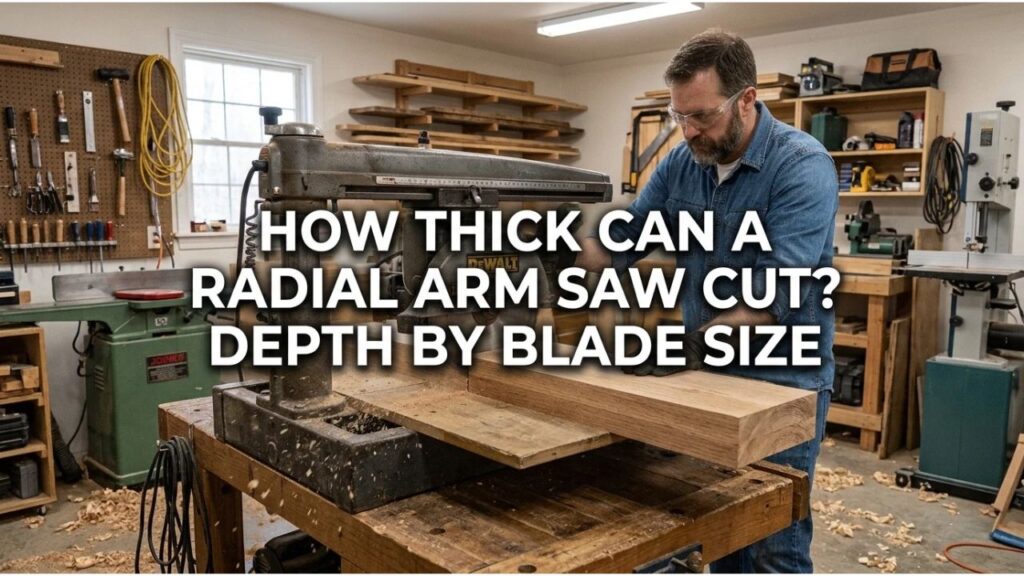
How Thick Can a Radial Arm Saw Cut? Depth by Blade Size
If you are wondering how thick can a radial arm saw cut, a typical 10-inch radial arm saw can often crosscut material around 3 inches thick at 90 degrees, while larger 12- and 14-inch machines can usually cut thicker stock. The exact capacity depends on blade diameter, arbor position, motor and guard clearance, table height, and the design of the specific saw, so you should always verify the manufacturer’s rated maximum before attempting a deep cut.
Blade size gives you a useful starting point, but you cannot simply divide the blade diameter by two and assume that number is the cutting depth. Part of the blade is occupied by the arbor and motor assembly, and the guard and table geometry also limit how far the blade can enter the workpiece.
A bevel cut reduces usable thickness even further because the blade passes through the material at an angle.
It is also important to distinguish cutting thickness from crosscut width. A radial arm saw might cut a board roughly 3 inches thick while also crosscutting a board more than a foot wide, depending on arm length and carriage travel.
In this guide, I’ll explain how thick can a radial arm saw cut, typical capacities for common blade sizes, what limits cutting depth, and how to determine the safe capacity of your own machine.
How Thick Can a Radial Arm Saw Cut?
For many common shop-size radial arm saws, maximum 90-degree cutting depth is approximately in the following general range:
| Blade Diameter | Typical Approximate Maximum Cut Depth |
| 8–9 inch | Around 2 to 2-1/2 inches |
| 10 inch | Around 2-3/4 to 3-1/4 inches |
| 12 inch | Around 3-1/2 to 4 inches |
| 14 inch | Around 4 to 5 inches |
These are general examples, not universal specifications.
Two 10-inch radial arm saws can have different maximum cutting depths even when they use the same blade diameter.
The exact machine specification is what matters.
Why a 10-Inch Blade Does Not Cut 5 Inches Deep
A 10-inch blade has a 5-inch radius, but the arbor passes through its center.
The motor, guard, arbor flange, and carriage geometry prevent the full radius from extending below the machine.
As a result, only part of the blade radius is available for cutting.
That is why a 10-inch saw commonly cuts somewhere around 3 inches thick rather than 5 inches.
Key Takeaways:
- A typical 10-inch radial arm saw cuts roughly 3 inches thick at 90 degrees.
- Larger blades generally provide greater cutting depth.
- Actual capacity depends on machine geometry, not blade diameter alone.
- Check the exact model specification before cutting maximum-thickness stock.
How Thick Can a 10-Inch Radial Arm Saw Cut?
A 10-inch radial arm saw commonly has a maximum cutting depth close to 3 inches at 90 degrees.
Some models may offer slightly less.
Others may provide slightly more.
That capacity is enough to cut many common lumber sizes in a single pass.
Can It Cut a 2×4?
Yes, in most cases.
A standard dimensional 2×4 is approximately 1-1/2 inches thick, so a 10-inch radial arm saw normally has more than enough depth.
Can It Cut a 4×4?
This is different.
A nominal 4×4 is approximately 3-1/2 inches thick.
Many 10-inch radial arm saws cannot cut completely through a 4×4 in one pass.
Some may come close, but close is not enough for a safe, clean through-cut.
If your machine is rated for less than the stock thickness, use a larger-capacity saw or another cutting method.
How Thick Can a 12-Inch Radial Arm Saw Cut?
A 12-inch radial arm saw typically provides noticeably greater cutting depth than a 10-inch machine.
Around 3-1/2 to 4 inches is common for many designs.
That can make a 12-inch saw capable of cutting through a nominal 4×4 at 90 degrees, provided the specific model has sufficient rated capacity.
Verify Before Cutting
Do not assume every 12-inch saw cuts a full 4 inches.
Guard design, motor position, and table configuration vary.
Look up the model’s actual maximum depth.
How Thick Can a 14-Inch Radial Arm Saw Cut?
Large 14-inch industrial radial arm saws can often cut somewhere in the 4- to 5-inch range.
These machines are frequently much heavier and more powerful than homeowner 10-inch saws.
They may be used for timber, framing lumber, industrial woodworking, and production crosscutting.
Larger Does Not Mean Unlimited
Even a 14-inch blade has limits.
Very thick timbers may still require a larger industrial crosscut saw, bandsaw, chainsaw, or other machine designed for heavy stock.
What Determines Radial Arm Saw Cutting Depth?
Several factors determine how much material the blade can actually cut.
Blade Diameter
Blade diameter is the most obvious factor.
A larger blade has a greater radius, which generally allows a deeper cut.
However, you must use only blade diameters approved for your saw.
Do not install a larger blade simply to increase cutting depth.
Why Oversized Blades Are Dangerous
A blade larger than the saw was designed for may contact the guard, motor housing, table, or other structural components.
It may also exceed the machine’s safe blade-tip speed or guarding geometry.
Use only approved blade sizes.
Arbor Position
The location of the motor shaft and arbor relative to the work surface directly affects usable depth.
If the arbor sits relatively high above the table, more blade extends below it.
If the arbor is lower, usable depth may decrease.
This geometry varies by machine.
Blade Guard Clearance
The guard must clear the workpiece.
A thick board may physically fit under the blade but interfere with the guard.
That still makes the cut unsuitable.
Never remove required guarding simply to gain additional cutting depth.
Motor Housing Clearance
On deep cuts, the motor body may approach the top of the workpiece.
The motor housing itself can therefore become the limiting factor.
This is especially relevant during bevel cuts.
Table Height
Radial arm saw tables are often adjustable in relation to the arm.
If a replacement table is unusually thick or installed incorrectly, effective blade depth can change.
Use the table arrangement intended for the machine.
How Does Bevel Angle Affect Cutting Thickness?
Beveling reduces usable vertical cutting capacity.
At 90 degrees, the blade passes straight down through the material.
At a 45-degree bevel, the blade passes diagonally.
That requires more blade diameter to cut through the same vertical thickness.
Why the Capacity Drops
Imagine cutting through a 3-inch-thick board with the blade tilted.
The blade must travel farther through the material than it would at 90 degrees.
Motor and guard clearance can also become more restrictive.
For this reason, a saw that cuts nearly 3 inches at 90 degrees may cut significantly less at a 45-degree bevel.
Always check the model’s bevel-capacity specification separately.
Does Miter Angle Reduce Cutting Thickness?
Usually, miter angle affects width capacity more than thickness capacity.
When the arm rotates left or right, the blade remains vertical if bevel remains at zero.
So the depth through the material may stay similar.
However, machine geometry and guard clearance can still affect capacity at extreme angles.
The main loss is typically how wide a board can be crosscut.
Cutting Thickness vs. Crosscut Width
These are two different specifications.
Cutting Thickness
This describes how thick the workpiece can be from top to bottom.
For example, approximately 3 inches on a typical 10-inch machine.
Crosscut Width
This describes how wide a board the carriage can travel across.
Depending on arm length, a radial arm saw may crosscut roughly 12 inches, 14 inches, 16 inches, or more.
Some industrial machines have much greater capacity.
A saw can therefore have:
3 inches of depth capacity
and
14 inches of crosscut width.
Those numbers describe different dimensions.
Key Takeaways:
- Depth capacity is limited mainly by blade and machine geometry.
- Crosscut width is determined primarily by arm and carriage travel.
- Bevel cuts reduce usable thickness.
- Miter cuts usually reduce width capacity more than depth.
Can a Radial Arm Saw Cut a 2×6?
Yes, most common radial arm saws can crosscut a 2×6 easily.
A nominal 2×6 is approximately 1-1/2 inches thick.
Its width is approximately 5-1/2 inches.
Both dimensions fall well within the capacity of most typical 10-inch machines.
Can a Radial Arm Saw Cut a 2×8?
Usually, yes.
Thickness remains approximately 1-1/2 inches.
The only additional requirement is enough carriage travel to cross the approximately 7-1/4-inch width.
Most radial arm saws can do that easily.
Can a Radial Arm Saw Cut a 2×12?
Many can.
Again, the thickness is only approximately 1-1/2 inches.
The question becomes crosscut width.
A 2×12 is approximately 11-1/4 inches wide.
Many radial arm saws have enough travel, but compact machines may have less capacity.
Check your saw’s crosscut specification.
Can a 10-Inch Radial Arm Saw Cut a 4×4?
Usually not completely in a single pass unless the particular machine has unusually high depth capacity.
A nominal 4×4 is approximately 3-1/2 inches thick.
Many 10-inch radial arm saws cut closer to 3 inches.
Can You Flip the 4×4 and Finish the Cut?
It may be physically possible to cut from one side, turn the workpiece, and finish from the opposite side.
However, alignment must be exact, and the setup must remain stable.
For routine 4×4 cutting, a saw with sufficient one-pass capacity is preferable.
A 12-inch miter saw, suitable radial arm saw, bandsaw, or other appropriate tool may be easier.
Can a Radial Arm Saw Cut a 6×6?
Most common homeowner radial arm saws cannot cut a 6×6 in one pass.
A nominal 6×6 is approximately 5-1/2 inches thick.
Even many 14-inch radial arm saws do not provide that much through-cut capacity.
Heavy timber should be cut with equipment appropriately sized for the material.
Can You Raise the Blade to Cut Thicker Wood?
The arm can usually be raised or lowered to position the blade correctly.
However, raising or lowering the machine does not change the blade’s fundamental maximum depth.
Once the arbor, guard, or motor reaches its geometric limit, additional adjustment cannot make the blade radius larger.
Can You Remove the Blade Guard to Gain More Cutting Depth?
No.
Do not remove required guarding to force thicker material under the blade.
If the workpiece does not fit safely with the normal guard installed, it exceeds the practical setup for that operation.
Use a more appropriate saw.
Can You Install a Larger Blade to Cut Deeper?
Only if that blade size is explicitly approved for the machine.
For example, do not install a 12-inch blade on a radial arm saw designed only for a 10-inch blade just because the arbor diameter matches.
The motor, guard, bearings, arbor, and blade-speed rating are all designed around specific blade dimensions.
How to Measure Your Radial Arm Saw’s Actual Cutting Depth
The safest approach is to use the manufacturer’s specification.
If you are checking a restored vintage machine and no obvious capacity marking is available, you can also inspect the physical setup with the saw unplugged.
Install the correct approved blade.
Set the arm to normal crosscut position.
Set bevel to zero.
Lower the blade to its normal through-cut position relative to the table.
Measure from the top of the table to the maximum usable cutting point.
Account for the Sacrificial Table
The blade normally enters the table surface slightly.
Do not calculate capacity based on lowering the blade excessively deep into the table.
What matters is the maximum stock thickness that can be cut with normal blade and guard clearance.
Why Manufacturer Capacity Is Better Than Measuring
A physical measurement may suggest that a slightly thicker board fits.
But the manufacturer’s rating also accounts for guard clearance, motor clearance, structural geometry, and safe adjustment range.
A board fitting under the blade does not automatically mean the operation is rated or safe.
How Deep Should the Blade Enter the Table?
For a normal through crosscut, the blade only needs to pass completely through the workpiece and enter the sacrificial table surface slightly.
There is no benefit to cutting a deep trench into the table.
Excessive blade depth can expose more blade and damage the tabletop unnecessarily.
Does Blade Kerf Affect Maximum Thickness?
Not significantly.
Kerf describes the width of material removed by the blade.
A thin-kerf blade can reduce motor load, but it does not meaningfully increase vertical cutting depth.
Blade diameter, not kerf width, controls depth much more strongly.
Does Tooth Height Affect Capacity?
Only slightly.
Carbide teeth project beyond the blade plate, so actual cutting radius is measured to the tooth tips.
However, you should never select a blade based on gaining a tiny amount of extra depth.
Use a blade designed and approved for the machine.
Can a Dado Blade Cut as Deep as a Regular Blade?
Usually not.
A dado stack may have a smaller diameter than the saw’s normal blade.
For example, a machine using a 10-inch crosscut blade may use a smaller approved dado set.
That reduces maximum groove depth.
Dado cuts also should not normally pass completely through the workpiece.
Check Dado Capacity
Your saw may specify a maximum dado diameter and width.
Do not install an oversized stack just to obtain a deeper groove.
Can a Radial Arm Saw Cut Thick Hardwood?
Yes, within its rated capacity.
However, thick hardwood puts more load on the motor than softwood of the same dimensions.
Use a sharp blade.
Feed the carriage smoothly.
Do not force the saw.
If the motor slows noticeably, reduce feed rate.
Dense Wood Can Increase Binding
Hardwood with internal stress can close around the blade.
Make sure the workpiece is stable and supported.
Stop if the cut begins pinching severely.
Can a Radial Arm Saw Cut Thick Pressure-Treated Lumber?
Yes, within capacity, but wet pressure-treated lumber can be heavy and may contain significant internal stress.
A board can move as the cut releases that stress.
Support it properly and keep it firmly against the fence.
Use a blade suitable for construction lumber.
Can a Radial Arm Saw Cut Plywood Stacks?
Technically, multiple sheets can sometimes be stacked if their combined thickness remains within machine capacity and the stack is securely controlled.
However, stacking changes how stable the workpiece is.
Sheets can shift relative to one another.
For precision work, cutting sheets individually is often easier.
If production stacking is intended, follow the machine’s approved workholding procedure.
Does Motor Power Affect How Thick It Can Cut?
Motor power affects how easily the saw can cut thick material, but it does not determine geometric capacity.
A powerful motor cannot make a 10-inch blade reach through a workpiece thicker than its physical cutting depth.
However, a weak motor may struggle near maximum capacity.
Thick Cuts Need More Power
A 3-inch-thick hardwood cut removes far more material than a cut through 3/4-inch plywood.
The blade remains engaged longer and encounters more resistance.
Use a sharp blade and controlled feed.
Does Blade Tooth Count Matter for Thick Cuts?
Yes.
A very high-tooth-count blade can create a clean crosscut, but its smaller gullets clear chips more slowly.
When cutting very thick material, a blade with too many teeth may heat up or load excessively.
A suitable crosscut blade should balance finish quality with chip clearance.
What Blade Hook Angle Is Best?
Radial arm saw crosscut blades often use a low or negative hook angle.
This reduces the tendency for the blade to pull the carriage aggressively toward the operator.
A highly positive-hook ripping blade can make a radial arm saw self-feed strongly.
For thick cuts, maintaining carriage control remains more important than choosing an aggressive blade merely for speed.
Why Is My Radial Arm Saw Not Cutting All the Way Through?
Several things may be responsible.
The workpiece may exceed rated thickness.
The arm may be set too high.
The table may have been replaced with an unusually thick surface.
The blade diameter may be smaller than specified.
The motor may be tilted for a bevel.
The guard or motor housing may also be limiting travel.
Check Blade Diameter
A previous owner may have installed an undersized blade.
For example, a saw designed for a 10-inch blade may have an 8-1/4-inch blade installed.
That reduces cutting depth.
Use only the correct approved diameter.
What If the Blade Barely Reaches Through?
Do not rely on a marginal setup.
A blade should have enough normal travel to cut through the full thickness without forcing the motor, guard, or carriage beyond its intended position.
If only the tooth tips barely emerge through the bottom, verify the machine setup and rated capacity.
Is Cutting Maximum Thickness Safe?
It can be if the machine is rated for it and properly set up.
However, cutting at maximum capacity places more demand on the blade and motor.
Make sure the blade is sharp.
Support the stock well.
Hold it firmly against the fence.
Use a controlled carriage feed.
Do Not Rush
A maximum-depth cut is not the time to pull the carriage aggressively.
Let the blade do the work.
If the motor slows significantly, reduce feed pressure.
Key Takeaways:
- Maximum-depth cuts increase motor and blade load.
- Use a sharp blade and smooth feed.
- Support thick stock firmly against the fence.
- Do not exceed the machine’s rated depth just because the material almost fits.
What Saw Is Better for Very Thick Wood?
For stock beyond radial arm saw capacity, use a machine designed for greater depth.
A 12-inch or larger miter saw may handle thicker construction lumber.
A bandsaw is useful for very thick stock.
A circular saw can cut from opposite faces for certain construction work.
A chainsaw or timber saw may be appropriate for large beams.
The best tool depends on the required accuracy and material size.
Radial Arm Saw vs. Miter Saw Cutting Depth
Comparable blade diameters often produce broadly similar depth capacities.
A 10-inch miter saw and 10-inch radial arm saw may both cut roughly 3-inch-thick material, though exact geometry differs.
A 12-inch miter saw generally provides more depth.
The radial arm saw’s major advantage is often its long crosscut travel rather than extraordinary depth.
Radial Arm Saw vs. Table Saw Cutting Depth
A typical 10-inch table saw also cuts a little over 3 inches deep at 90 degrees.
So cutting-depth capacity can be similar.
The fundamental difference is operation.
On a table saw, the workpiece moves through the blade.
On a radial arm saw crosscut, the blade moves through the workpiece.
Radial Arm Saw vs. Circular Saw Cutting Depth
A standard 7-1/4-inch circular saw often cuts a little over 2 inches deep at 90 degrees.
A 10-inch radial arm saw generally provides more depth.
However, circular saws can sometimes cut very thick posts by making accurately aligned cuts from multiple sides.
Common Mistakes When Cutting Thick Stock
One mistake is assuming blade radius equals cutting depth.
It does not.
Another is installing an oversized blade.
This can create serious clearance and speed problems.
Some users remove the blade guard to gain a little extra room.
That is not an acceptable way to increase capacity.
Another mistake is forcing the carriage through a thick hardwood cut.
This increases self-feeding, binding, and motor load.
Finally, do not forget that bevel capacity is lower than 90-degree capacity.
FAQs About How Thick Can a Radial Arm Saw Cut
How thick can a radial arm saw cut?
A common 10-inch radial arm saw typically cuts around 3 inches thick at 90 degrees, while larger 12- and 14-inch saws generally cut deeper.
How deep can a 10-inch radial arm saw cut?
Many cut roughly 2-3/4 to 3-1/4 inches deep, but exact capacity depends on the model.
How deep can a 12-inch radial arm saw cut?
Around 3-1/2 to 4 inches is common for many models, although specifications vary.
How deep can a 14-inch radial arm saw cut?
Many large machines cut roughly 4 to 5 inches thick, depending on design.
Can a 10-inch radial arm saw cut a 4×4?
Many cannot cut a nominal 4×4 completely in one pass because a 4×4 is approximately 3-1/2 inches thick.
Can a 12-inch radial arm saw cut a 4×4?
Many can at 90 degrees, but verify the model’s rated capacity.
Can a radial arm saw cut a 6×6?
Most common shop models cannot cut a 5-1/2-inch-thick 6×6 in one pass.
Can a radial arm saw cut a 2×12?
Usually yes, provided its crosscut travel is wide enough for the approximately 11-1/4-inch board width.
Does a bevel reduce cutting depth?
Yes. Tilting the blade reduces the maximum vertical thickness that can be cut.
Does a miter reduce cutting depth?
Usually the bigger effect is reduced crosscut width, although exact clearance varies.
Can I install a larger blade for more depth?
Only if the manufacturer specifically approves that blade diameter.
Can I remove the guard to cut thicker wood?
No. Do not remove required guards to exceed the saw’s normal capacity.
Why won’t my blade cut all the way through?
Possible causes include an undersized blade, incorrect arm height, thick replacement table, bevel setting, or stock exceeding rated capacity.
Does more motor power increase cutting depth?
No. Motor power affects cutting performance, while physical blade and machine geometry determine maximum depth.
Should the blade cut deeply into the table?
No. It only needs to pass through the workpiece and slightly enter the sacrificial table surface.
Conclusion
So, how thick can a radial arm saw cut? For a common 10-inch model, approximately 3 inches at a 90-degree crosscut is a reasonable general expectation, while 12- and 14-inch machines usually offer greater depth.
However, blade diameter alone does not determine the exact capacity.
The arbor location, motor housing, guard, carriage design, and table position all affect how much of the blade can actually pass through a workpiece.
That is why two radial arm saws using the same blade diameter can have different maximum depths.
A 10-inch machine can easily handle standard 2x dimensional lumber because those boards are only about 1-1/2 inches thick.
A nominal 4×4 is approximately 3-1/2 inches thick, however, which exceeds the one-pass capacity of many 10-inch radial arm saws.
Larger 12-inch machines are more likely to handle a 4×4 in one pass.
Remember that beveling the blade reduces usable cutting depth. A saw that cuts around 3 inches at 90 degrees will not necessarily cut the same thickness at 45 degrees.
Also distinguish between depth capacity and crosscut width. A radial arm saw may only cut around 3 inches deep but still crosscut a board 12 inches or more wide because the carriage travels along the arm.
Never install an oversized blade or remove the guard simply to gain additional depth.
Use only blade diameters approved for the machine, and rely on the manufacturer’s rated capacity whenever possible.
The practical rule is simple: a typical 10-inch radial arm saw cuts about 3 inches thick, larger machines cut deeper, and the exact safe capacity always depends on the design of the specific saw rather than blade diameter alone.