Will a 12-Inch Miter Saw Cut a 6×6? Capacity and Cutting Tips
A 6×6 is substantially larger than the 4×4 lumber commonly handled by a miter saw. These large posts are frequently used for decks, pergolas, structural supports, landscaping projects, and other outdoor construction.
If you own a 12-inch miter saw, you may wonder whether its larger blade has enough capacity to handle a 6×6.
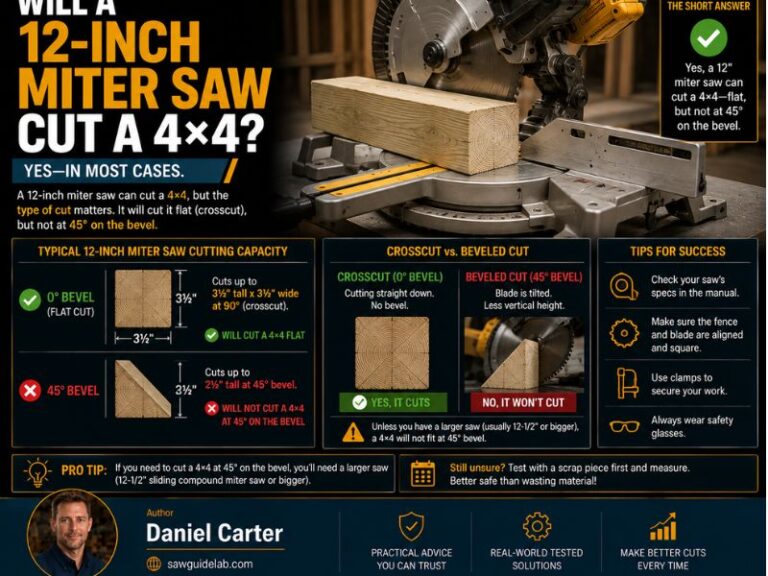
So, will a 12-inch miter saw cut a 6×6? In most cases, not in a single pass. A typical finished 6×6 measures approximately 5.5 × 5.5 inches, which is deeper than the vertical cutting capacity of many 12-inch miter saws.
However, depending on the saw’s design and manufacturer specifications, you may be able to cut a 6×6 by making a cut from multiple sides. The exact method depends on the saw and the type of cut you need.
Will a 12-Inch Miter Saw Cut a 6×6?

A 12-inch miter saw can potentially cut a 6×6, but most models cannot cut completely through a standard 6×6 in one pass at 90 degrees.
The reason is simple: a 12-inch blade does not provide 12 inches of cutting depth.
The actual cutting capacity depends on:
- Blade diameter
- Blade position
- Saw design
- Fence height
- Vertical cutting capacity
- Sliding mechanism
- Miter angle
- Bevel angle
A standard finished 6×6 is about 5.5 inches thick. Many 12-inch miter saws have a vertical cutting capacity below this measurement.
Therefore, you should check your specific saw’s specifications before attempting the cut.
What Size Is a 6×6 Actually?
A nominal 6×6 does not normally measure exactly six inches by six inches.
A typical finished 6×6 measures approximately:
5.5 × 5.5 inches
The difference comes from the lumber manufacturing process. The wood is initially cut to rough dimensions and then dried and surfaced, reducing its final size.
This distinction matters because you need to compare the actual thickness of the post with your saw’s maximum cutting capacity.
A saw that cannot cut 5.5 inches vertically will not be able to complete a 6×6 in one straight pass.
Can a 12-Inch Miter Saw Cut a 6×6 in One Pass?
For most 12-inch miter saws, the answer is no.
Many 12-inch models are designed for cutting common lumber sizes such as 2×4, 2×6, 4×4, and similar materials. A 6×6 exceeds the vertical capacity of many of these saws.
Typical 12-Inch Miter Saw Vertical Capacity
The exact capacity varies considerably by model.
Some sliding miter saws offer greater crosscut capacity than non-sliding models, but sliding capacity and vertical capacity are not the same thing.
A saw might be capable of making a wide crosscut while still being unable to cut deeply enough through a 6×6.
Why Blade Diameter Doesn’t Equal Cutting Depth
A common misconception is that a 12-inch blade should be able to cut approximately 6 inches deep.
The blade’s diameter alone does not determine the maximum cutting depth.
The saw’s arbor position, blade guard, table, fence, and overall geometry all affect how much material the blade can actually pass through.
Non-Sliding vs. Sliding Models
A sliding miter saw can move the blade forward and backward, increasing its capacity for certain types of cuts.
However, that does not automatically mean it can cut a 6×6 vertically in one pass.
Always check the manufacturer’s specifications for the exact model.
How to Cut a 6×6 With a 12-Inch Miter Saw
If your saw cannot cut through the entire 6×6 in one pass, a multi-side cutting method may be possible.
Only use this approach if it is consistent with the manufacturer’s instructions and the saw can safely accommodate the material.
1. Check the Saw’s Maximum Cutting Capacity
Before doing anything else, determine the maximum thickness your saw can safely cut.
Check the owner’s manual or manufacturer’s specifications.
Do not guess based only on the 12-inch blade size.
2. Use a Suitable Blade
A sharp, appropriate carbide-tipped blade can make cutting large construction lumber easier.
The blade should be compatible with:
- Your saw
- The material
- The required RPM
- The type of cut
A dull blade can increase resistance and make the cut more difficult.
3. Support the 6×6 Properly
A 6×6 is heavy and awkward compared with smaller lumber.
Use appropriate supports on both sides of the saw where necessary.
The post should remain stable and should not roll or shift during cutting.
4. Make the First Cut
Position the 6×6 firmly against the fence.
Align the blade with your marked cut line and make the first cut as far as the saw safely allows.
Do not force the blade beyond its rated capacity.
5. Rotate the Lumber
After completing the first cut, turn off the saw and wait for the blade to stop completely.
Then carefully rotate the 6×6 to expose another side.
Because the post is heavy, take care when repositioning it.
6. Align the Blade With the Existing Cut
Use the first kerf as a reference point.
Carefully align the blade with the existing cut so the next pass continues along the same line.
Accurate alignment is important for producing a clean, straight finished cut.
7. Complete the Cut
Make the next cut from the newly positioned side.
Depending on the saw’s cutting depth, you may need to repeat the process from additional sides.
Do not attempt to force the blade deeper than its intended capacity.
8. Check the Finished Cut
Once the cut is complete, inspect the end of the post.
If the cut is uneven or the pieces do not separate cleanly, do not force them apart.
Use an appropriate finishing tool if necessary.
Can You Cut a 6×6 at 45 Degrees With a 12-Inch Miter Saw?
A 45-degree cut can be considerably more challenging than a straight 90-degree cut.
When the blade is angled, its path through the material becomes longer.
This means a saw that can cut a particular thickness at 90 degrees may not have enough capacity to make the same cut at 45 degrees.
A compound cut involving both a miter and bevel angle can be even more demanding.
Before attempting an angled cut on a 6×6, check the saw’s specifications for the exact miter and bevel combination.
If the required cut exceeds the manufacturer’s capacity, use a different tool or cutting method.
What If Your 12-Inch Miter Saw Cannot Cut a 6×6?
If your miter saw cannot safely handle the 6×6, you have several alternatives.
Flip-and-Cut Method
If permitted by the saw manufacturer, you may be able to make multiple cuts by rotating the lumber.
This method requires careful alignment and secure workholding.
Using a Circular Saw
A large circular saw can be used to cut through a 6×6 from multiple sides.
This can be a practical option when portability is important.
Reciprocating Saw
A reciprocating saw can cut through large lumber without requiring the same cutting depth as a miter saw.
The trade-off is that the finished cut may not be as clean or precise.
Hand Saw
A large hand saw can also cut a 6×6, although it requires considerably more physical effort.
Dedicated Large-Capacity Saw
If you regularly cut large posts, a larger-capacity miter saw or another tool specifically suited to heavy lumber may be a better long-term solution.
Can a 14-Inch or Larger Miter Saw Cut a 6×6?
A larger miter saw can provide greater cutting capacity, but blade diameter alone still does not guarantee that it can cut a 6×6 in one pass.
A 14-inch or larger model may have enough capacity depending on its design.
Before buying or using one, check:
- Maximum vertical cutting depth
- Maximum crosscut width
- Miter capacity
- Bevel capacity
- Blade diameter
- Manufacturer’s recommended materials
The actual specifications are more important than the blade diameter by itself.
Best Tools for Cutting a 6×6
Different tools make sense for different situations.
| Tool | 6×6 Cutting Ability | Best Use |
| 12-inch miter saw | Usually multi-side cut | Accurate crosscuts |
| 14-inch+ miter saw | Model dependent | Large lumber |
| Circular saw | Yes, multiple sides | Portable cutting |
| Reciprocating saw | Yes | Rough cuts |
| Chainsaw | Yes | Large rough cuts |
| Hand saw | Yes | Manual cutting |
For a clean and accurate crosscut, a properly sized miter saw is usually preferable.
For occasional large-post cutting, a circular saw can offer more flexibility.
A reciprocating saw or chainsaw may be suitable when precision is less important.
Safety Tips for Cutting a 6×6
Large lumber requires more attention than small boards because of its weight and size.
Secure the Workpiece
Keep the 6×6 firmly against the saw’s fence and use appropriate clamping when possible.
Prevent the lumber from rolling or shifting during the cut.
Use Eye Protection
Wear appropriate eye protection to protect against wood chips and sawdust.
Properly Support Heavy Lumber
A 6×6 can place significant weight on the saw table.
Use suitable supports so the material remains stable and level.
Keep Hands Away From the Blade Path
Never place your hands close to the blade or attempt to hold the workpiece in an unsafe position.
Avoid Forcing the Saw
If the blade stops cutting efficiently, stop and investigate the problem.
A dull blade, incorrect blade, or excessive material thickness may be responsible.
Check Blade Condition
A sharp blade reduces unnecessary resistance and can make large cuts easier.
Let the Blade Stop Completely
After completing a cut, keep the saw down until the blade has stopped rotating before moving the material.
Frequently Asked Questions
Can a 12-inch miter saw cut a 6×6 in one pass?
Most 12-inch miter saws cannot cut a standard 6×6 completely through in one 90-degree pass. A typical finished 6×6 is about 5.5 inches thick, which exceeds the vertical capacity of many models.
Can a 12-inch sliding miter saw cut a 6×6?
A sliding mechanism can increase cutting capacity for certain cuts, but it does not guarantee enough vertical capacity for a 6×6. Check the specific model’s specifications before attempting the cut.
Can you cut a 6×6 with a miter saw by flipping it?
Depending on the saw and manufacturer’s instructions, you may be able to make multiple cuts by rotating the lumber. Careful alignment and secure support are essential.
What is the actual size of a 6×6?
A typical finished 6×6 measures approximately 5.5 × 5.5 inches.
What size miter saw do I need to cut a 6×6?
There is no universal blade size that guarantees a one-pass 6×6 cut. You should choose a saw based on its published vertical cutting capacity rather than blade diameter alone.
Can a circular saw cut a 6×6?
Yes. A circular saw can cut a 6×6 by making cuts from multiple sides, depending on its blade size and cutting depth.
Final Thoughts on Cutting a 6×6 With a 12-Inch Miter Saw
So, will a 12-inch miter saw cut a 6×6? In most cases, it will not cut a standard 6×6 completely through in one pass. A typical finished 6×6 measures about 5.5 × 5.5 inches, which is deeper than the vertical capacity of many 12-inch miter saws.
However, some 12-inch saws may allow you to make the cut from multiple sides, provided the technique is safe and permitted by the manufacturer.
For occasional 6×6 cuts, a properly supported multi-side cut or a circular saw may be practical. If you frequently work with large posts, consider a tool with greater cutting capacity.
Most importantly, don’t judge the saw by its 12-inch blade alone. Check the manufacturer’s actual cutting capacity, use an appropriate blade, properly support the lumber, and follow safe operating procedures.