Are Radial Arm Saws Dangerous? Risks, Safety, and Alternatives
Yes, radial arm saws can be dangerous, particularly when they are poorly maintained, missing guards, incorrectly configured, or used for operations the operator does not fully understand. Their moving motor carriage, exposed rotating blade, potential for self-feeding during crosscuts, and complicated rip-cut setup can create hazards that are less intuitive than those of many modern saws.
That does not mean every radial arm saw is inherently unsafe or that one cannot be used responsibly. A properly maintained machine with the correct blade, complete guarding, secure locks, accurate alignment, solid work support, and an experienced operator can make controlled crosscuts very effectively.
The problem is that many radial arm saws still in service are decades old. They may have worn carriage bearings, missing guards, damaged tables, questionable wiring, incorrect blades, or safety components removed by previous owners. Some older Craftsman machines were also involved in a major blade-guard recall, making inspection particularly important before using a secondhand saw.
Compared with a modern miter saw, a radial arm saw also requires the operator to understand more machine adjustments. The arm can rotate, the carriage moves toward the operator, the motor assembly may rotate for ripping, and the blade can bevel. Every adjustable mechanism must be correctly positioned and locked before the saw is started.
In this guide, I’ll explain why radial arm saws can be dangerous, what causes self-feeding and kickback, which operations carry the most risk, how older saws differ from modern machines, and what you should inspect before deciding whether to keep using one.
Why Do Radial Arm Saws Have a Dangerous Reputation?
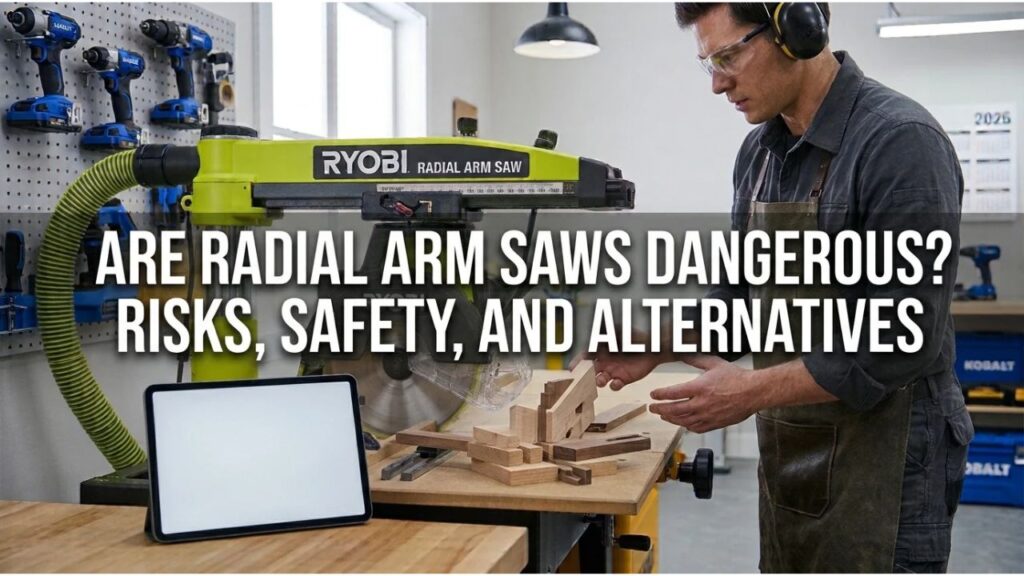
The radial arm saw was once one of the most versatile machines in a home workshop.
It could crosscut wide boards and, depending on the model and accessories, perform ripping, beveling, dadoing, sanding, molding, and other operations.
That versatility came with complexity.
A modern compound miter saw largely keeps the motor and blade in a predictable orientation. The user lowers the blade through the work or slides the head along dedicated rails.
A radial arm saw instead suspends the motor from an overhead arm. During a conventional crosscut, the carriage travels along that arm.
The rotating blade can create a force that encourages the carriage to move in the same direction as the cut.
If the operator pulls too aggressively or the blade grabs the workpiece, the saw may accelerate toward the operator rather than simply waiting for the operator to push it.
This behavior is one of the major reasons radial arm saws require careful technique.
The Machine Has Many Adjustment Points
A radial arm saw may include separate controls for:
the carriage, miter arm, yoke, bevel, column height, rip position, and blade guard.
If even one mechanism is not locked properly, blade alignment can change during operation.
That is very different from using a simple fixed circular saw or conventional chop saw.
Older Machines May No Longer Be Complete
A radial arm saw that left the factory with proper safety equipment may no longer have it.
Previous owners sometimes remove guards because they interfere with certain cuts.
Tables get rebuilt incorrectly.
Anti-kickback components disappear.
Switches and cords are modified.
A used saw should therefore be evaluated based on its present condition, not merely on what the original manufacturer supplied.
Key Takeaways:
- Radial arm saws are more mechanically complex than many modern crosscut saws.
- The moving carriage can create self-feeding behavior if the blade grabs the wood.
- Missing guards, worn parts, and poor modifications significantly increase risk.
What Is Self-Feeding on a Radial Arm Saw?
Self-feeding is one of the most important radial arm saw hazards to understand.
During a normal crosscut, the saw carriage moves along the arm while the blade rotates through the wood.
Because of the direction of blade rotation and the way the teeth contact the workpiece, the saw may naturally try to pull itself through the material.
If the blade takes too large a bite, becomes misaligned, or catches the wood, the carriage can accelerate.
Instead of you controlling how quickly the saw moves, the blade begins controlling the movement.
Why This Can Be Dangerous
A rapidly advancing carriage reduces your reaction time.
It can also pull the blade through the workpiece faster than intended.
If the operator’s free hand is positioned poorly, that sudden movement can bring the blade toward the hand.
The solution is not to fight the saw with brute force.
The machine must be correctly aligned and fitted with an appropriate blade, and the operator must maintain controlled carriage movement.
Are Radial Arm Saws More Dangerous Than Miter Saws?
Generally, radial arm saws require more knowledge and discipline to operate safely.
A modern miter saw is more specialized.
Its blade travels through a relatively predictable path.
Guarding is usually integrated into the machine.
The head generally returns upward automatically.
A radial arm saw offers more versatility but also more possible configurations.
Crosscut Comparison
For ordinary 90° crosscuts, both tools can perform the job.
A modern miter saw is usually simpler.
The radial arm saw may offer greater crosscut width depending on the model, but the operator must control the moving carriage.
Rip-Cut Comparison
Most miter saws are not designed for ripping at all.
Many traditional radial arm saws were designed to rip, but rip-cut configuration requires particular attention to blade direction, guard position, anti-kickback devices, and feed direction.
For routine ripping, a properly set up table saw is usually the more intuitive machine.
Overall
If someone only needs to cut framing lumber, trim, and boards to length, a modern miter saw is normally easier to recommend.
A radial arm saw makes more sense for someone who specifically values its large crosscut capacity and understands how to maintain and align it.
Is the Blade More Exposed on a Radial Arm Saw?
It can be, especially on older machines.
Modern saws generally surround more of the blade with fixed and moving guards.
Some vintage radial arm saw guard designs left a significant portion of the blade accessible.
This is why blade-guard condition deserves close attention.
A missing or damaged guard should not be treated as a minor inconvenience.
Never Remove the Guard for Convenience
If the guard interferes with an operation, that does not automatically mean the correct solution is to remove it.
The operation may require a different guard configuration, specific accessory, or another machine entirely.
A bare radial arm saw blade moving toward the operator represents a serious contact hazard.
Are Old Craftsman Radial Arm Saws Dangerous?
Some deserve particular caution.
A large number of older Craftsman radial arm saws were included in a major safety recall related to inadequate blade guarding.
That does not mean every Craftsman radial arm saw is unsafe, but it means owners of older models should identify the exact model and determine whether the saw was affected and whether the appropriate remedy or updated guarding was installed.
Even if a particular saw was not recalled, its age still matters.
Electrical insulation, carriage bearings, switches, blade guards, locking mechanisms, and tables can deteriorate over decades.
An old machine should be inspected thoroughly before being placed back into service.
What Makes a Radial Arm Saw Kick Back?
Kickback happens when the blade grabs the workpiece and causes sudden uncontrolled movement.
Several conditions can contribute.
Misalignment
If the blade does not travel perfectly parallel to its cutting path, the rear teeth may rub or push sideways against the kerf.
This condition is sometimes called heeling.
It increases friction and can make the workpiece behave unpredictably.
Loose Workpiece
The board should sit firmly against a straight fence.
If it shifts while the blade is engaged, the kerf can close or the blade can grab the material.
Warped Lumber
Twisted, bowed, or heavily cupped stock may not remain stable against the table and fence.
As internal stresses release during the cut, the wood can move.
Dull or Inappropriate Blade
A dull blade requires more force.
A blade with an aggressive hook angle may also make the saw feel more eager to pull through the wood.
Using a blade appropriate for radial arm saw operation helps reduce unwanted feeding behavior.
Excessive Feed Rate
Pulling the carriage too quickly gives the blade less time to cut cleanly.
A controlled, steady movement is safer than trying to force the machine through the board.
Does Blade Hook Angle Matter?
Yes.
Hook angle describes how aggressively the teeth lean relative to the center of the blade.
A strongly positive hook angle tends to pull into the wood more aggressively.
That can be desirable on certain machines but is not always ideal on a radial arm saw.
A blade intended for radial arm saws or sliding miter saws often uses a low or negative hook angle to reduce the tendency to self-feed.
This does not eliminate the need for good technique, but it can make carriage movement more controllable.
Do Not Choose a Blade by Diameter Alone
A 10-inch blade that physically fits is not automatically appropriate.
Check:
arbor size, maximum RPM, blade diameter, tooth count, kerf, and hook angle.
Use the blade type recommended for the machine and operation.
Key Takeaways:
- Self-feeding and kickback are strongly influenced by blade geometry, alignment, and feed technique.
- Low- or negative-hook blades are often preferred for controlled crosscutting on radial arm saws.
- A blade that merely fits the arbor is not necessarily suitable.
Are Rip Cuts Dangerous on a Radial Arm Saw?
Rip cutting deserves special caution.
Traditional radial arm saws often allow the motor and yoke to rotate so the blade becomes parallel to the fence.
The workpiece is then fed past the stationary carriage.
This configuration changes the way the blade interacts with the board.
If feed direction is wrong or anti-kickback protection is missing, the machine can propel the workpiece forcefully.
Feed Direction Is Critical
Radial arm saw rip cutting must follow the machine’s intended direction of rotation and feed.
This is not something to guess.
If the original instructions are unavailable, I would not recommend experimenting with the rip configuration.
A table saw or track saw is usually a simpler option for ripping boards and sheet goods.
Anti-Kickback Devices Matter
Many radial arm saws use anti-kickback pawls or similar hardware during ripping.
If those components are missing, the saw should not simply be used without them.
Why Many Owners Use Radial Arm Saws Only for Crosscuts
Because crosscutting is where the radial arm saw offers a clear advantage.
Once a good table saw, track saw, and miter saw are available, many of the radial arm saw’s more complicated operations are no longer necessary.
Limiting an older machine to properly guarded crosscuts can simplify its role considerably.
Can the Carriage Come Toward You Too Fast?
Yes.
That is the practical effect of self-feeding.
You should maintain positive control of the carriage handle throughout the cut.
The carriage should move smoothly, without excessive bearing looseness or binding.
If the bearings are too loose, the motor assembly can shift.
If they are too tight or corroded, the saw may move unevenly and then release suddenly.
A properly adjusted carriage is therefore both an accuracy issue and a safety issue.
Are Radial Arm Saws Safe for Beginners?
They would not be my first recommendation for someone who has never used stationary woodworking equipment.
A beginner is usually better served by learning basic crosscutting on a modern miter saw and ripping on an appropriately guarded table saw or track saw.
A radial arm saw requires understanding:
carriage movement, arm locks, yoke locks, blade alignment, fence position, blade selection, and safe workpiece support.
An experienced woodworker can learn those systems, but there is more to remember.
Used Machines Make the Learning Curve Harder
A new tool normally comes with a current manual and complete safety equipment.
A 40-year-old radial arm saw may have neither.
That puts more responsibility on the owner to identify missing components and restore the machine correctly.
Can a Radial Arm Saw Be Safe for Crosscutting?
Yes.
Crosscutting is arguably the operation radial arm saws perform best.
A well-maintained saw with a good fence, flat table, suitable blade, complete guard, tight carriage, and secure arm lock can make accurate crosscuts.
The key is controlled operation.
Keep the Work Against the Fence
The workpiece should remain firmly supported against the fence.
Do not hold a short offcut close to the blade.
Use adequate stock length and appropriate support.
Keep Hands Out of the Cutting Path
Know where the blade will travel before the saw is started.
Your hands should never enter that path.
Marking the cut line does not justify placing fingers near the blade to hold a small piece.
Return the Carriage Under Control
Do not release the handle and allow the carriage to move unpredictably.
Maintain control until the blade has cleared the work and the saw is back in its intended position.
What Safety Features Should a Radial Arm Saw Have?
A complete, functional blade guard is essential.
Locks for the miter arm, bevel, yoke, and carriage must hold securely.
The table and fence should be solid.
The power switch should operate reliably.
The cord and grounding system should be intact.
If the saw is configured for ripping, all required anti-kickback and guarding components should be present.
A Stop Should Prevent the Carriage From Leaving the Arm
The carriage should not be capable of accidentally rolling off the end of its guide.
Inspect travel stops and retaining components.
If any are missing, repair the saw before use.
Why Alignment Is a Safety Issue
Radial arm saw alignment is often discussed as though it only affects precision.
It also affects control.
If the blade heels against the wood, resistance increases.
If the arm is not square to the fence, the cut may push the work sideways.
If the yoke is loose, the blade angle can change unexpectedly.
A properly aligned machine requires less force and behaves more predictably.
How Often Should You Check Alignment?
Any time the saw has been moved, repaired, disassembled, or adjusted significantly, check alignment.
You should also investigate if the saw begins:
burning wood, pulling harder than usual, producing wider kerfs, leaving rough edges, or requiring more effort to move the carriage.
These can indicate blade or alignment problems.
Is a Radial Arm Saw Dangerous With a Dull Blade?
Yes, potentially more so than with a sharp blade.
A dull blade requires greater feed force.
That extra force reduces control.
A dull blade can also generate excessive heat and increase the likelihood of the wood shifting or binding.
Replace or professionally sharpen damaged blades rather than compensating by pulling harder.
What About Cracked or Missing Carbide Teeth?
Stop using the blade.
A missing carbide tooth can create vibration and imbalance.
Loose carbide fragments can become projectiles at high blade speed.
Inspect the blade before use, especially if it has struck a nail, screw, or other metal object.
Can a Radial Arm Saw Cut Metal?
Most woodworking radial arm saws should not be assumed suitable for metal cutting.
Installing an abrasive wheel or metal-cutting blade can change the machine’s guarding requirements, speed compatibility, spark exposure, and fire risk.
Unless the manufacturer specifically approved a metal-cutting configuration, use a tool designed for that material.
Is It Dangerous to Use Dado Blades?
Dadoing was historically an advertised radial arm saw capability on some models.
However, compatibility varies.
The arbor must accommodate the dado stack correctly, the guard must support the operation, and the manufacturer must allow the blade width.
Do not install a dado stack simply because it fits.
Older attachments and wide cutter heads can expose substantially more cutting edge than a standard blade.
For many users, a table saw or router is a simpler choice.
Are Radial Arm Saw Accessories Dangerous?
They can be if used incorrectly.
Vintage radial arm saws sometimes came with or accepted molding heads, sanding drums, planer attachments, drill chucks, and other accessories.
These accessories may have been designed under older safety standards.
Some also require guards that are now missing.
An accessory being “original” does not mean it is automatically appropriate to use today in incomplete condition.
How to Inspect an Old Radial Arm Saw Before Using It
Start with the electrical system.
Look for cracked cords, improvised splices, damaged plugs, and loose switches.
Then inspect the mechanical structure.
The arm, yoke, column, carriage, and motor housing should not be cracked.
The carriage should slide smoothly.
All locks should hold securely.
Check the table and fence.
The workpiece needs a stable reference surface.
Finally, inspect the blade and guard.
If significant safety components are missing, resolve that before running the motor.
Should You Use an Old Saw Without a Manual?
I would strongly prefer not to.
Radial arm saw controls vary significantly among manufacturers and even among models from the same brand.
The manual explains:
lock functions, blade installation, proper feed direction, rip setup, guard adjustment, lubrication, and alignment procedures.
Without that information, it is easy to misidentify an adjustment or use an unsafe configuration.
If the manual cannot be found, consider limiting the machine’s use or replacing it with a tool whose operation you can verify.
Key Takeaways:
- Alignment, bearing condition, and locking mechanisms affect safety as well as accuracy.
- Old attachments should not be used casually just because they fit the saw.
- An unidentified or incomplete radial arm saw is not a good machine to learn by trial and error.
Radial Arm Saw vs. Table Saw Safety
Neither machine is automatically safe.
They present different hazards.
A table saw commonly creates kickback when a board twists or becomes trapped between the blade and fence.
A radial arm saw introduces a moving blade carriage that can self-feed toward the operator.
For crosscuts, a radial arm saw can be very effective.
For routine ripping, many users find a modern table saw with a proper riving knife, blade guard, and anti-kickback features easier to configure predictably.
Radial Arm Saw vs. Track Saw Safety
A track saw is often easier for breaking down plywood and other large panels.
The saw rides on a track while the material remains supported.
The blade is largely enclosed by the saw body except during cutting.
A radial arm saw can also crosscut panels, but handling very large sheet goods around a fixed station may require substantial support.
For occasional panel cutting, a track saw is often the simpler solution.
Radial Arm Saw vs. Miter Saw Safety
A miter saw is more specialized and usually easier to understand.
A radial arm saw can offer greater versatility and sometimes greater crosscut capacity, but those benefits come with additional adjustment mechanisms.
If you primarily cut boards to length, a modern sliding compound miter saw is typically the more straightforward choice.
Should You Get Rid of Your Radial Arm Saw?
Not automatically.
If you own a quality machine that is complete, mechanically sound, properly guarded, accurately aligned, and familiar to you, it may remain a useful workshop tool.
But keeping it only makes sense if you are willing to maintain it properly.
Consider Replacing It If:
The saw has missing safety components that cannot be replaced.
Structural castings are cracked.
Locks do not hold.
The carriage or arbor has excessive play.
Electrical repairs are extensive.
You cannot identify the model or find reliable operating information.
Or you simply do not need the operations that make a radial arm saw useful.
A modern miter saw, table saw, and track saw can collectively replace most common radial arm saw tasks.
Common Radial Arm Saw Safety Mistakes
One common mistake is pulling the carriage as fast as possible.
Another is using an aggressive general-purpose blade without considering hook angle.
Some operators remove the guard to improve visibility.
Others leave the arm or yoke only partially locked.
Poor workpiece support is another frequent problem.
A long board can lift or rotate during the cut if the table is too small.
Finally, do not assume familiarity eliminates risk.
Someone who has used the same machine for 30 years can still be injured if a bearing, lock, blade, or workpiece behaves differently than expected.
FAQs about Are Radial Arm Saws Dangerous
Are radial arm saws dangerous?
Yes, they can be dangerous because of their moving blade carriage, self-feeding tendency, kickback potential, and multiple adjustment mechanisms. Proper guarding and setup significantly reduce risk.
Why are radial arm saws considered dangerous?
The blade moves toward the operator during crosscuts and can sometimes self-feed if it grabs the workpiece.
Are radial arm saws more dangerous than miter saws?
They generally require more knowledge and adjustment. A modern miter saw is typically simpler for ordinary crosscutting.
Can a radial arm saw kick back?
Yes. Misalignment, wrong rip feed direction, loose stock, dull blades, and poor setup can contribute to kickback.
What is radial arm saw self-feeding?
It occurs when blade rotation pulls the carriage through the material faster than the operator intends.
Can a radial arm saw pull itself toward you?
Yes. That is why carriage control, blade selection, and proper alignment are important.
What blade is safest for a radial arm saw?
Use a blade specifically appropriate for the machine and operation. Low- or negative-hook blades are often preferred for controlled crosscutting.
Is a positive-hook blade dangerous on a radial arm saw?
A strongly positive hook angle can increase the tendency to self-feed, so it may be less suitable than a blade designed for radial arm or sliding-saw use.
Are Craftsman radial arm saws dangerous?
Some older Craftsman radial arm saws were involved in a major blade-guard recall. Exact model and recall status should be checked before use.
Can I use a radial arm saw without the guard?
I do not recommend it. A missing guard significantly increases access to the rotating blade.
Are radial arm saws safe for beginners?
They are not my first recommendation for beginners because they require more setup knowledge than many modern saws.
Is ripping safe on a radial arm saw?
It can only be considered when the saw is specifically designed and correctly configured for ripping, including the correct feed direction, guarding, and anti-kickback equipment.
Can a radial arm saw replace a table saw?
It can perform some similar cuts, but a properly equipped table saw is generally more intuitive for regular ripping.
Should I use an old radial arm saw from an estate sale?
Only after identifying it and thoroughly inspecting its electrical system, guard, locks, carriage, bearings, blade, and recall status where applicable.
Is blade alignment important for safety?
Yes. Misalignment can increase friction, burning, binding, and unpredictable workpiece movement.
Should I keep my radial arm saw?
Keep it only if it is complete, properly guarded, mechanically sound, and useful for the work you do.
Conclusion
So, are radial arm saws dangerous? They can be, and they generally demand more operator knowledge than a modern miter saw or track saw.
The biggest concerns include self-feeding, kickback, exposed blade areas, incorrect rip-cut configuration, worn carriage components, poor alignment, and missing guards.
Their age also matters.
Many radial arm saws in garages and workshops today were manufactured decades ago. Some have been modified by previous owners, and certain older Craftsman models were affected by a major blade-guard recall.
That said, a radial arm saw is not automatically unsafe simply because of its design.
A complete, well-maintained machine with secure locks, a flat table, straight fence, smooth carriage, suitable low- or negative-hook blade, proper guarding, and correct alignment can still be an effective crosscutting tool.
My recommendation is to be selective about how you use one. Crosscutting with a properly configured machine is where the radial arm saw makes the most sense. For routine ripping, large-sheet breakdown, or work that requires improvised accessories, a modern table saw, track saw, miter saw, router, or planer will often provide a simpler solution.
If you own an older radial arm saw and are unsure about its guards, recall status, alignment, blade, locks, or previous modifications, do not treat those concerns as minor. Inspect and correct them before using the machine.
A radial arm saw can be useful, but it deserves careful setup and respect every time the motor is switched on.