How Heavy Is a Radial Arm Saw? Weight by Size & Type
How heavy is a radial arm saw? A typical 10-inch home-shop radial arm saw can weigh roughly 130–250 pounds, depending on the stand, table, motor, and construction. Larger 12- to 16-inch commercial machines commonly weigh about 400–600 pounds, while industrial radial arm saws can weigh 900–1,100 pounds or more.
That is a much wider weight range than you see with most modern miter saws because “radial arm saw” covers everything from relatively compact vintage Craftsman machines to enormous industrial saws built for cutting timbers and production materials.
For example, a current 12-inch industrial-style contractor radial arm saw can weigh around 440 pounds, while current 14- and 16-inch heavy-duty models can weigh around 580 pounds. Large 20- and 22.5-inch industrial machines can approach or exceed 1,000 pounds.
Older homeowner models are usually much lighter. Many vintage 10-inch Craftsman, DeWalt, Delta, and similar machines are within a range that two or more people can potentially move after careful disassembly, although you should never assume a specific machine is safe to lift based on blade size alone.
Cabinet bases, cast-iron components, oversized motors, long arms, and custom tables can add substantial weight.
In this guide, I’ll explain how heavy a radial arm saw is, typical weight ranges by blade size, why two seemingly similar machines can differ by hundreds of pounds, and how to move one safely without damaging the saw or yourself.
How Much Does a Radial Arm Saw Weigh?
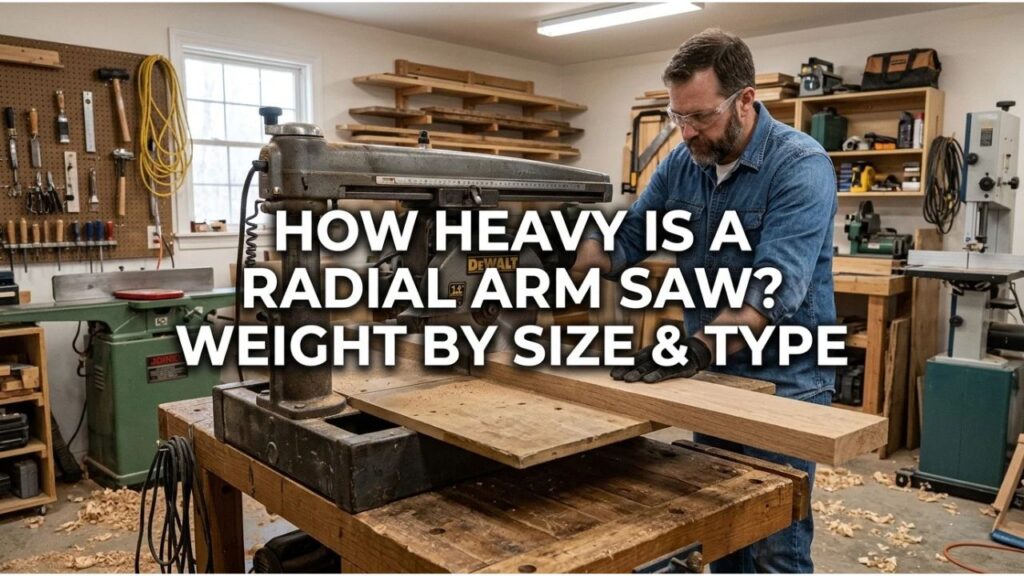
A useful general estimate is:
| Radial Arm Saw Type | Approximate Weight |
| Small/light vintage radial arm saw | 100–150 lb |
| Typical 10-inch home-shop saw | 130–250 lb |
| 10-inch saw with large cabinet/stand | 200–300+ lb |
| 12-inch commercial saw | 350–450+ lb |
| 14-inch heavy-duty saw | Around 500–600 lb |
| 16-inch heavy-duty saw | Around 500–600+ lb |
| Large industrial 16-inch saw | 600–1,000+ lb depending on design |
| 20-inch industrial saw | Around 900–1,100+ lb |
| 22.5-inch industrial saw | Around 1,000–1,100+ lb |
These are general ranges rather than specifications for every machine.
The exact model number is the only reliable way to determine the actual weight.
Current Radial Arm Saw Examples
Modern industrial radial arm saws demonstrate how heavy these machines can become.
A current 12-inch contractor-duty radial arm saw from Original Saw Company weighs approximately 440 pounds.
Its 14-inch heavy-duty model is approximately 580 pounds.
The 16-inch heavy-duty version is also approximately 580 pounds.
Certain industrial metal-cutting or super-duty machines are dramatically heavier, reaching approximately 1,000–1,100 pounds.
That is closer to the weight of serious industrial equipment than a portable power saw.
Key Takeaways:
- Home-shop radial arm saws often weigh roughly 130–250 pounds.
- Commercial 12- to 16-inch machines commonly reach approximately 400–600 pounds.
- Large industrial models can weigh 1,000 pounds or more.
Why Are Radial Arm Saws So Heavy?
A radial arm saw needs mass and rigidity because its motor and blade travel along an overhead arm.
The machine must resist deflection while the saw head is extended away from the column.
If the arm, column, or base flexes significantly, cutting accuracy deteriorates.
Manufacturers therefore traditionally used substantial amounts of steel, cast iron, and cast aluminum.
Heavy Column and Base
The column supports the entire radial arm assembly.
It needs enough rigidity to hold the arm accurately while the motor carriage moves forward and backward.
Larger industrial saws use exceptionally strong columns and bases because their motors and blades are much heavier.
Radial Arm
The overhead arm itself is a precision structural component.
The carriage travels along tracks machined or mounted on this arm.
It must remain straight and rigid.
A thin stamped-metal arm would flex too much for accurate cutting.
Motor and Carriage
Unlike a miter saw where the motor assembly is relatively compact, a traditional radial arm saw frequently has a substantial motor mounted inside or directly to a heavy carriage/yoke assembly.
Older motors can be particularly heavy.
Large professional models may use 3-, 5-, or 7.5-horsepower motors.
Stand and Cabinet
The saw head itself is only part of the machine.
A steel pedestal or four-leg stand can add dozens of pounds.
A full steel storage cabinet adds considerably more.
Some Craftsman radial arm saws were sold in several versions of the same basic machine:
saw only, saw with legs, or saw with cabinet.
Each configuration could have a significantly different total weight.
How Heavy Is a 10-Inch Radial Arm Saw?
For a typical older 10-inch homeowner radial arm saw, roughly 130–250 pounds is a reasonable working estimate.
Some stripped-down machines can be lighter.
Large cabinet-equipped models may be considerably heavier.
A commercial used-equipment listing for one Craftsman 10-inch machine, for example, places it around 135 pounds, while other complete Craftsman configurations with substantial stands, tables, or cabinets can exceed 200 pounds.
That difference is why simply saying “10-inch radial arm saw” does not tell you enough.
Typical 10-Inch Craftsman Radial Arm Saw Weight
Older Craftsman 10-inch radial arm saws were popular home-workshop machines.
They often have:
a cast base, steel column, substantial radial arm, direct-drive motor, wooden table, and steel leg or cabinet stand.
A complete machine can therefore easily require two or more people to move safely.
If yours has a large factory cabinet, drawers, long extension tables, or aftermarket casters, total weight can increase considerably.
Does the Blade Add Much Weight?
Not compared with the rest of the machine.
A 10-inch blade weighs only a few pounds.
The motor, arm, column, base, and stand account for nearly all of the saw’s weight.
Removing the blade is still sensible before transportation because it eliminates an exposed sharp component and protects the arbor.
How Heavy Is a Craftsman Radial Arm Saw?
Craftsman made radial arm saws for decades, so there is no single Craftsman weight.
Compact and homeowner-oriented machines can fall in roughly the 130–200-pound area.
Machines with larger steel cabinets or more substantial frames can reach roughly 200–300 pounds or more.
Older commercial-style Craftsman machines can also be heavier than that.
If you are moving a Craftsman saw, find the complete model number—often beginning with 113 on Emerson-built machines—and look up the specific manual or catalog specifications.
Remember the Craftsman Recall
If you own an older Craftsman radial arm saw, weight is not the only specification worth checking.
Certain 8-, 8¼-, 9-, and 10-inch Craftsman radial arm saws manufactured by Emerson and carrying 113-series model numbers were included in a major U.S. safety recall.
If you are buying or moving one of these machines into a new workshop, it is a good opportunity to check its exact model and recall status before putting it into service.
How Heavy Is a DeWalt Radial Arm Saw?
Vintage DeWalt machines also vary enormously.
A homeowner-oriented 10-inch DeWalt can be relatively manageable compared with a commercial machine.
Large older DeWalt industrial radial arm saws can weigh several hundred pounds.
A heavy 16-inch commercial DeWalt machine, for example, can reach the neighborhood of 500 pounds once configured for use or shipping.
Industrial DeWalt designs were predecessors to many of the machines still supported by Original Saw Company today.
Old DeWalt Does Not Mean Lightweight
Vintage DeWalt radial arm saws are often praised precisely because they were heavily built.
Cast components, large motors, substantial arms, and rigid columns add weight.
If you encounter an older commercial DeWalt at an auction, do not plan to load it like a portable woodworking tool.
Treat it as machinery.
How Heavy Is a 12-Inch Radial Arm Saw?
A 12-inch radial arm saw is normally heavier than a homeowner-grade 10-inch model.
A practical range for commercial machines is roughly 300–450 pounds or more, although individual vintage models can fall outside this range.
A current 12-inch contractor-duty Original Saw machine weighs approximately 440 pounds.
Its weight reflects its commercial construction, substantial frame, motor, large table, and safety equipment.
At this size, moving the saw intact manually becomes considerably more difficult.
Mechanical lifting equipment is often the safer approach.
How Heavy Is a 14-Inch Radial Arm Saw?
A commercial 14-inch radial arm saw can weigh around 500–600 pounds.
A current heavy-duty 14-inch Original Saw Company machine is listed around 580 pounds.
At nearly 600 pounds, this is no longer something two people should simply grab and carry.
A pallet jack, machinery dolly, forklift, hydraulic lift table, engine hoist, or other appropriate material-handling equipment may be required depending on how the machine is configured.
How Heavy Is a 16-Inch Radial Arm Saw?
A 16-inch radial arm saw can vary greatly depending on whether it is a standard woodworking machine or a super-duty industrial model.
Current heavy-duty woodcutting models can weigh approximately 580 pounds.
Specialized industrial 16-inch metal-cutting machines can reach approximately 1,000 pounds.
That enormous difference comes from heavier frames, motors, clamps, electrical controls, and components designed for continuous commercial operation.
Never estimate moving requirements from blade diameter alone.
Key Takeaways:
- A 10-inch saw might weigh under 200 pounds, while another configuration can exceed 250 pounds.
- Current 12-inch commercial machines can weigh around 440 pounds.
- Heavy-duty 14- and 16-inch woodworking saws can be approximately 580 pounds.
How Heavy Is a 20-Inch Radial Arm Saw?
Large 20-inch industrial radial arm saws are extremely heavy.
Depending on configuration, machines in this category can approach 900–1,100 pounds.
A current 20-inch industrial metal-cutting radial arm saw is listed at approximately 1,100 pounds.
These machines may use 7.5-horsepower three-phase motors and have enormous cutting capacities.
They are designed for factories, timber operations, metal fabrication, truss plants, lumber yards, and similar commercial environments.
Moving one requires proper industrial handling equipment.
How Heavy Is a 22.5-Inch Radial Arm Saw?
Current 22.5-inch super-duty machines can weigh approximately 1,100 pounds.
These saws can cut material many inches thick and are built for multiple-shift industrial operation.
At that size, the machine should be treated like industrial machinery.
Transport commonly involves a freight pallet or skid, forklift access, rigging, and suitable floor-loading capacity.
A residential workshop floor may also need to be evaluated before installing extremely heavy equipment.
Why Blade Size Does Not Tell You Exact Weight
Blade diameter is useful for estimating the general class of the saw, but it cannot predict exact mass.
Two 16-inch machines might differ by hundreds of pounds.
Why?
One could be a relatively conventional woodcutting saw.
Another could be an industrial metal-cutting model with:
a heavier frame, larger motor, magnetic starter, pneumatic clamps, thick guarding, reinforced carriage, and additional electrical equipment.
Similarly, two vintage 10-inch Craftsman machines may share similar cutting capacities while one sits on thin stamped-steel legs and the other uses a large steel storage cabinet.
Always check the actual model.
Does the Table Count in Radial Arm Saw Weight?
Sometimes.
Published weights are not always directly comparable.
One manufacturer might list the assembled machine including:
stand, table, guard, and electrical controls.
Another specification may describe only the saw assembly.
A used seller might quote a shipping weight that includes:
pallet, packaging, accessories, extension tables, and fences.
Machine Weight vs Shipping Weight
Shipping weight is normally higher.
For example, a machine weighing 400 pounds may be listed as a 450-pound shipment after the skid, packaging, and accessories are included.
When planning to move a used radial arm saw, assume published information could differ from its real installed configuration.
If safety depends on knowing the exact weight, weigh the machine or obtain official model specifications.
How Much Does a Radial Arm Saw Motor Weigh?
The motor/carriage assembly can represent a substantial portion of the total mass, particularly on older saws.
A homeowner 10-inch motor assembly may weigh several dozen pounds.
Industrial motors are much heavier.
This matters during disassembly.
Removing the carriage and motor can make the base easier to move, but the assembly itself may still be too heavy and awkward for one person.
It also changes the machine’s center of gravity.
Support everything securely before loosening structural components.
Can One Person Move a Radial Arm Saw?
I would not recommend trying to manually carry most complete radial arm saws alone.
Even a 130-pound machine is awkward rather than simply heavy.
The tall column, projecting arm, wide table, and uneven center of gravity make it difficult to hold safely.
A 200-pound radial arm saw is very different from lifting a compact 200-pound object.
Why Shape Matters
The arm extends away from the column.
The table makes the machine wide.
A motor and carriage mounted above table height create a high center of gravity.
Steel legs can flex or twist when the machine is lifted incorrectly.
The result is a machine that can tip suddenly.
Even when the raw weight sounds manageable, use equipment or additional helpers.
Can Two People Move a Radial Arm Saw?
Two capable adults may be able to move some smaller 10-inch saws after sensible disassembly, but that does not mean every two-person lift is safe.
A 200-pound saw still represents roughly 100 pounds per person before accounting for awkward geometry.
Stairs make the situation substantially more dangerous.
If the machine is over roughly 250–300 pounds, mechanical equipment becomes increasingly important.
For 400–600-pound commercial saws, plan the move as a machinery-moving task rather than a furniture-moving task.
How to Make a Radial Arm Saw Lighter for Moving
If you need to transport a smaller vintage saw, removable parts can often be taken off first.
Unplug the saw before disassembly.
Photograph everything before removing components and label hardware.
Depending on the model, removable items may include:
the blade, blade guard, fence, wooden tabletop sections, extension tables, drawers, cabinet accessories, and sometimes the motor/carriage assembly.
Remove the Blade
This does little to reduce weight but significantly improves handling safety.
Protect the arbor and store the blade separately.
Remove the Table
The wood table can be bulky even if it is not particularly heavy.
Taking it off may make the machine narrow enough to pass through a doorway.
Mark its original position if you intend to reinstall it.
Expect to check alignment afterward.
Remove Accessories and Drawers
Take loose accessories out of the cabinet.
Remove extension wings and other components that can swing, bend, or fall.
Be Careful With the Motor/Carriage
Removing the motor and carriage can significantly reduce upper weight on some models.
However, this is a more advanced disassembly step.
The carriage can be heavy and may come off the arm unexpectedly if stops are removed.
Use the service manual and support the assembly properly.
Never simply remove an end stop and allow the carriage to slide into your hands.
Should You Remove the Radial Arm From the Column?
Only when necessary and when you understand the specific machine.
Separating the arm and column can make a large saw easier to transport, but these are heavy precision components.
Incorrect disassembly can damage bearing surfaces, elevation mechanisms, cables, or indexing components.
You will also need to perform a thorough alignment after reassembly.
For a small move across a level workshop, it may be better to leave the machine assembled and use an appropriate machinery dolly.
For stairs or transportation through narrow doors, further disassembly may be unavoidable.
Safe Ways to Move a Heavy Radial Arm Saw
The right method depends on the saw’s weight and the route.
Machinery Dolly
A low machinery dolly can work well on smooth, level floors.
Secure the saw to prevent tipping.
Do not simply place a tall saw on loose furniture dollies and hope it remains balanced.
Pallet Jack
If the saw can be safely secured to a strong pallet or skid, a pallet jack is excellent for shop-floor movement.
Engine Hoist
An engine hoist may be useful for lifting or removing heavy upper assemblies, provided suitable lifting points are identified.
Never attach lifting straps to an unsupported radial arm or other component that was not designed to carry the entire machine weight.
Forklift
For industrial saws weighing several hundred to more than 1,000 pounds, a forklift is often the practical solution.
The machine must be lifted from suitable structural points or its shipping skid.
Professional Machinery Movers
For a 600- to 1,100-pound machine involving stairs, loading docks, difficult access, or delicate floors, professional machinery movers can be worth the cost.
Dropping a large radial arm saw can destroy the machine and cause severe injuries.
Key Takeaways:
- Even a lighter radial arm saw is awkward because its weight sits high and off-center.
- Disassembling removable parts can make a home-shop saw safer to transport.
- Large commercial machines should be moved with proper mechanical equipment rather than manual lifting.
Can You Put Casters on a Radial Arm Saw?
Yes, provided the mobile base is designed to support the machine’s full weight and remain rigid during cutting.
A poorly designed caster setup can make the saw unstable and affect alignment.
For a 150-pound home-shop saw, a quality mobile base may be practical.
For a 500-pound commercial machine, you need industrial-rated casters and a properly engineered frame.
Locking Casters Are Not Always Enough
A caster brake may prevent a wheel from rolling but still allow some swivel or movement.
For a precision radial arm saw station, leveling feet that lift the machine off the casters during use can provide better rigidity.
The machine should not rock when you pull the carriage forward.
Does a Heavy Radial Arm Saw Cut Better?
Weight by itself does not guarantee accuracy, but a rigid heavy frame has benefits.
Greater mass can reduce vibration.
Heavy columns and arms resist deflection.
Industrial machines can maintain alignment while handling powerful motors and thick stock.
That said, a badly worn 500-pound saw may cut less accurately than a properly aligned 150-pound home machine.
Carriage bearings, arm tracks, blade alignment, table setup, and overall mechanical condition matter more than weight alone.
Do You Need to Bolt a Radial Arm Saw to the Floor?
Not necessarily for every machine.
Many home-shop models were designed for freestanding steel legs or cabinet bases.
However, the machine must be stable enough that pulling the carriage through a cut cannot shift or tip it.
Large industrial machines may have manufacturer-specified anchoring requirements.
Follow the installation instructions for the exact saw.
If a light home-shop stand feels unstable, correcting its base is better than assuming the machine’s own weight will keep it in place.
Can a Garage Floor Support a Radial Arm Saw?
An ordinary concrete garage slab can typically support common home-shop radial arm saws without concern.
A 150–250-pound machine distributes its weight over several feet or a cabinet base.
Even a heavier commercial woodworking machine may be acceptable on a sound concrete slab.
Wood-framed floors deserve more consideration, especially for 600–1,100-pound industrial equipment.
The load from the machine, workpieces, operator, and other tools can become significant.
For extremely heavy machines on suspended wooden floors, consider having the structure evaluated.
Why Weight Matters When Buying a Used Radial Arm Saw
Used radial arm saw advertisements often say things such as:
“Bring help.”
That warning should be taken seriously.
Before traveling to collect one, ask the seller for:
the model number, stand type, approximate dimensions, whether the machine can be disassembled, whether loading equipment is available, and whether stairs or narrow doorways are involved.
A 10-inch Craftsman in a garage with driveway access is a very different pickup from a 16-inch industrial DeWalt located in a basement.
Check Your Vehicle Payload
The saw may physically fit in a pickup truck while still creating loading problems.
Remember to include:
the machine, pallet, accessories, helpers, other cargo, and trailer tongue weight when applicable.
An industrial radial arm saw can exceed the payload capacity of some light vehicles.
Should You Transport a Radial Arm Saw Standing Up?
For a small machine properly secured to a pallet, upright transport can sometimes be appropriate.
However, its high center of gravity makes secure tie-down essential.
Never rely on the steel legs alone to keep a tall machine upright in a moving trailer.
Some machines are safer when partially disassembled and secured to a low skid.
Follow manufacturer shipping guidance whenever available.
Do not lay a precision machine on its radial arm, carriage tracks, motor controls, or guards.
Will Moving a Radial Arm Saw Affect Alignment?
Very possibly.
Even if nothing is damaged, vibration, disassembly, reassembly, and floor changes can affect setup.
After moving the machine, inspect and align it before precision use.
At minimum check:
the table, fence, carriage bearings, arm-to-fence squareness, blade-to-table squareness, blade heel, miter indexing, and all mechanical locks.
Never assume that because the saw cut square before transport it still cuts square afterward.
FAQs about How Heavy Is a Radial Arm Saw
How heavy is a radial arm saw on average?
A typical home-shop radial arm saw often weighs approximately 130–250 pounds.
Commercial and industrial machines can weigh several hundred to more than 1,000 pounds.
How heavy is a 10-inch radial arm saw?
Many 10-inch homeowner models fall roughly within the 130–250-pound range depending on the stand and cabinet.
How heavy is a Craftsman 10-inch radial arm saw?
It varies significantly by model.
Some simpler Craftsman machines can be around 130–150 pounds, while cabinet-equipped models can exceed 200 pounds.
How heavy is a 12-inch radial arm saw?
Commercial 12-inch models may weigh roughly 350–450 pounds or more.
A current Original Saw Company 12-inch contractor model weighs about 440 pounds.
How heavy is a 14-inch radial arm saw?
A modern heavy-duty 14-inch machine can weigh approximately 580 pounds.
How heavy is a 16-inch radial arm saw?
A heavy-duty woodworking machine can be around 580 pounds, while specialized industrial 16-inch machines can approach approximately 1,000 pounds.
How heavy is a 20-inch radial arm saw?
Large industrial models commonly reach approximately 900–1,100 pounds, depending on construction and application.
How heavy is a 22.5-inch radial arm saw?
A current super-duty industrial 22.5-inch machine can weigh around 1,100 pounds.
Why are radial arm saws so heavy?
They need rigid arms, columns, carriages, motors, bases, and stands to maintain accurate blade travel while the motor moves across the workpiece.
Can one person move a radial arm saw?
A complete radial arm saw is generally too heavy and awkward for safe one-person manual carrying.
Use helpers or mechanical lifting equipment.
Can two people lift a Craftsman radial arm saw?
Some lighter models can potentially be moved by two capable people after disassembly, but total weight and awkward shape need to be considered.
Mechanical assistance is safer whenever possible.
Can I remove the motor before moving the saw?
Many models allow the carriage/motor assembly to be removed, but it is heavy and must be supported correctly.
Follow the service manual.
Can I remove the table before moving it?
Usually yes.
Removing the wooden table and extensions can reduce bulk, but the saw will need to be checked and realigned after reassembly.
Can I put my radial arm saw on wheels?
Yes, with a properly rated rigid mobile base.
The saw must remain stable and level during operation.
Do radial arm saws need to be bolted down?
Some industrial machines may require anchoring. Home-shop machines often use freestanding stands, but they must remain stable during cutting.
Will moving the saw ruin its alignment?
It may alter alignment even if no damage occurs.
Always inspect and recalibrate the saw after transportation.
Is shipping weight the same as actual saw weight?
Not necessarily.
Shipping weight can include the pallet, packaging, accessories, and other components.
Conclusion
So, how heavy is a radial arm saw? For a typical 10-inch home-workshop machine, a reasonable estimate is roughly 130–250 pounds, although the exact weight depends strongly on model, motor, stand, cabinet, and table configuration.
Once you move into commercial equipment, weight climbs rapidly.
A current 12-inch contractor radial arm saw can weigh approximately 440 pounds, while modern 14- and 16-inch heavy-duty woodworking models can weigh around 580 pounds.
At the industrial end of the range, 20- and 22.5-inch radial arm saws can approach or exceed 1,000–1,100 pounds.
That enormous range is why blade diameter alone should never be used to plan a move.
Find the machine’s complete model number and look up its actual specification whenever possible.
If you are moving a vintage Craftsman or DeWalt, remember that the saw’s shape makes it more difficult to handle than its raw weight suggests. The motor and arm sit high above the base, creating an awkward center of gravity.
For a smaller home-shop machine, removing the blade, table, extensions, accessories, and—when the service manual permits it—the carriage assembly can make transportation easier.
For commercial machines weighing 400 pounds or more, I would plan on proper machinery-moving equipment such as a heavy-duty dolly, pallet jack, hoist, or forklift rather than relying on people to lift it.
And after any move, check the radial arm saw’s alignment before putting it back into service.
A heavy radial arm saw is designed to stay rigid once installed. Treating it as precision machinery during transportation will protect both the machine and the people moving it.