How Many Amps Does a Radial Arm Saw Use? Power Guide
If you are wondering how many amps does a radial arm saw use, many common 120-volt homeowner and shop models draw roughly 10 to 15 amps at rated load, while larger industrial saws may use higher-voltage motors with different amperage ratings. The exact number depends on motor size, voltage, blade diameter, saw design, and whether you are looking at normal running current or the much higher current drawn briefly when the motor starts.
A typical 10-inch radial arm saw operating from a standard 120-volt circuit is often in the same general electrical range as a table saw, miter saw, or other stationary woodworking machine with a similar motor.
However, you should never choose a circuit, extension cord, or replacement switch based only on a generic amp estimate.
The correct number is printed on the motor or machine nameplate.
Older Craftsman, DeWalt, Delta, Rockwell, and other radial arm saws can have very different motor specifications even when they use the same blade diameter.
In this guide, I’ll explain how many amps does a radial arm saw use, why startup amperage is higher than running amperage, how 120V and 240V saws differ, what causes a saw to draw excessive current, and how to determine the correct electrical requirements for your machine.
How Many Amps Does a Radial Arm Saw Use?
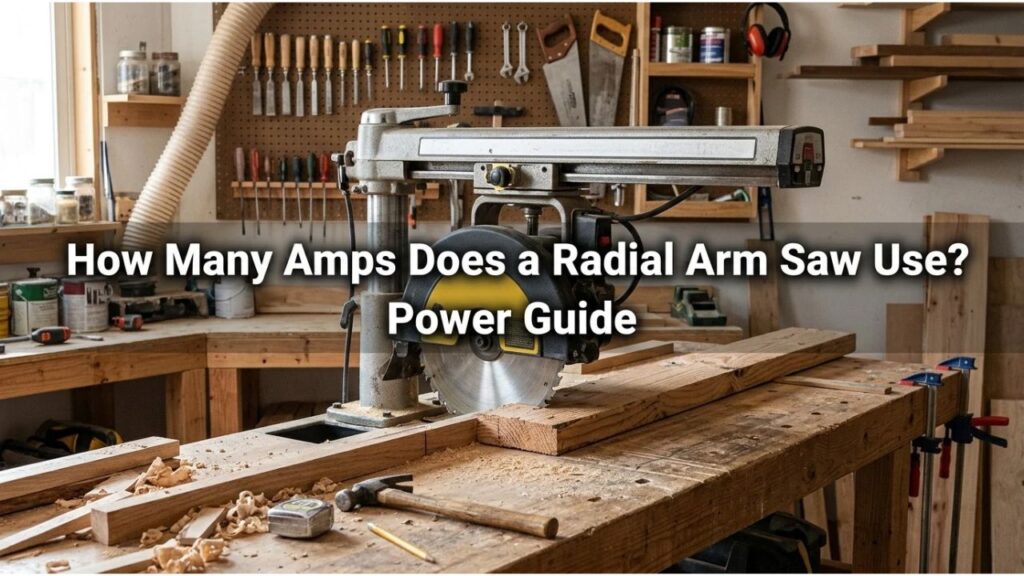
Many common 120V radial arm saws are rated somewhere around 10 to 15 amps.
A compact or lower-powered saw may use less.
A larger 120V motor may approach the practical limit of a typical household branch circuit.
Heavy commercial and industrial radial arm saws may use 240V or other higher-voltage motor configurations.
Their amp ratings cannot be directly compared with 120V models because increasing voltage generally allows the same approximate power to be delivered with less current.
Typical General Ranges
| Radial Arm Saw Type | Voltage | General Amp Range |
| Smaller homeowner saw | 120V | Around 8–12 amps |
| Common 10-inch saw | 120V | Around 10–15 amps |
| Larger 12-inch saw | 120V or 240V | Varies widely |
| Industrial radial arm saw | Often 208–240V or higher | Depends heavily on motor |
These ranges are only general examples.
Your saw’s nameplate is the correct source for its actual rating.
Key Takeaways:
- Many 120V radial arm saws use roughly 10–15 amps.
- Larger saws may use 240V motors with different current ratings.
- Starting amperage is temporarily much higher than normal running current.
- Always check the motor nameplate for the exact electrical requirement.
Where Can You Find the Amp Rating on a Radial Arm Saw?
Look for the motor identification plate.
It is commonly attached to the motor housing or another visible part of the machine.
The plate may show information such as:
Voltage.
Amperage.
Frequency.
Horsepower.
Phase.
RPM.
Motor model number.
Look for “A” or “AMP”
The current rating may be marked with an “A” after the number.
For example, a nameplate might say something similar to:
120 V
60 Hz
13 A
That would indicate a rated current of approximately 13 amps under the conditions specified by the manufacturer.
Dual-Voltage Motors
Some radial arm saw motors can be configured for either 120V or 240V.
A dual-voltage nameplate might list two amperage values.
The higher amp number generally corresponds to the lower voltage.
Do not change voltage connections unless the motor is specifically designed for it and the wiring is configured correctly.
Does a 10-Inch Radial Arm Saw Use More Amps Than a 12-Inch Saw?
Not necessarily.
Blade diameter does not directly determine electrical current.
A 12-inch saw usually has a more powerful motor than a small 10-inch saw, but voltage and motor design also matter.
For example, a large 12-inch machine running at 240V could have a lower nameplate amp number than a smaller 120V machine while still producing more power.
Compare Power, Not Just Amps
Amperage is only one part of the electrical picture.
Voltage matters too.
A simple electrical relationship is:
Watts = Volts × Amps
However, AC induction motors are more complicated than a basic resistive load because efficiency and power factor also affect actual motor power.
So this formula is useful for rough comparison, but it should not be used to calculate exact motor horsepower from nameplate amps.
How Many Amps Does a 120V Radial Arm Saw Use?
A common 120V radial arm saw may be rated around 10–15 amps.
This is a normal range for many stationary woodworking tools intended for household or small-shop power.
A saw near 15 amps places a substantial load on a standard branch circuit.
If other tools, lights, heaters, or a dust collector are running on the same circuit, the breaker may trip.
Why Shared Circuits Can Be a Problem
Suppose the saw is already drawing a significant portion of the circuit’s available current.
When the motor starts, current briefly increases.
If a shop vacuum or compressor is also running, the combined load may be enough to trip the breaker.
A dedicated circuit can improve reliability for a high-draw saw.
How Many Amps Does a 240V Radial Arm Saw Use?
There is no universal number.
For a motor producing roughly the same power, operating at 240V generally requires less current than operating at 120V.
A dual-voltage motor might draw approximately half as many amps when wired for 240V, although actual nameplate values should always be used.
Why Shops Use Higher Voltage
Higher voltage can reduce current through the branch wiring for a given motor power.
This can be useful for larger stationary tools.
It can also reduce voltage drop over longer wiring runs.
However, converting a saw to 240V is only possible if the motor is specifically designed for that voltage and the electrical installation supports it.
Does a Radial Arm Saw Draw More Amps When Starting?
Yes.
Electric motors normally draw a brief surge of current when starting.
This is called inrush current or starting current.
For a fraction of a second, the motor may draw several times its normal running current.
Once it accelerates to operating speed, current drops significantly.
Why the Breaker Does Not Normally Trip
Circuit breakers are designed to tolerate brief motor-starting surges within normal limits.
A healthy saw on the correct circuit should usually start without immediately tripping the breaker.
If the breaker trips repeatedly at startup, something may be wrong with the circuit or machine.
How Much Startup Current Does a Radial Arm Saw Draw?
There is no fixed multiplier that applies to every motor.
Starting current depends on motor type, size, winding design, mechanical load, supply voltage, and other factors.
It can be several times the normal running current for a short period.
Do not size wiring or electrical components by guessing at startup current.
Use the saw manufacturer’s electrical requirements and applicable electrical rules.
Does the Saw Draw Full Amps All the Time?
Not necessarily.
A motor’s nameplate current usually represents a rated operating condition, not what it consumes every second.
With the blade spinning freely and no wood being cut, current may be lower.
As cutting load increases, the motor draws more current.
Heavy Cuts Increase Current
Thick hardwood.
Wet lumber.
A dull blade.
Aggressive feed pressure.
Blade binding.
All of these can cause the motor to work harder.
As motor load increases, current generally increases.
If the motor becomes overloaded, a thermal protector or circuit breaker may trip.
Why Does My Radial Arm Saw Keep Tripping the Breaker?
Repeated breaker trips should not be treated as normal.
Several causes are possible.
Too Much Load on the Same Circuit
A dust collector, shop vacuum, heater, air compressor, or other high-current tool may share the circuit.
The combined current can exceed the circuit’s capacity.
Dull Blade
A dull blade increases cutting resistance.
The motor has to work harder, causing current to rise.
Blade Binding
Poor alignment can cause the blade to rub heavily in the kerf.
This increases motor load quickly.
Feeding Too Aggressively
Pulling the blade through thick material too fast can overload the motor.
Use a smooth feed rate.
Low Voltage
Excessively long or undersized extension cords can create voltage drop.
A motor operating at low voltage may draw excessive current and overheat.
Motor Problems
Worn bearings, damaged windings, a faulty start capacitor where applicable, or other internal motor problems can also cause excessive current.
Key Takeaways:
- Current increases as cutting load increases.
- Repeated breaker trips are not normal.
- A dull or binding blade can overload the motor.
- Low voltage from poor wiring or extension cords can make the problem worse.
What Size Breaker Does a Radial Arm Saw Need?
The correct branch circuit depends on the saw’s nameplate, wiring configuration, manufacturer instructions, and applicable electrical requirements.
Many 120V saws are used on 15-amp or 20-amp circuits, but you should not assume either is appropriate simply because the plug fits.
A higher-rated breaker must never be installed just to stop nuisance trips unless the wiring and circuit are actually rated for it.
Do Not Replace a 15-Amp Breaker With a 20-Amp Breaker Without Checking the Wiring
The breaker protects the wiring.
Increasing breaker size without verifying conductor size and circuit design can create an overheating and fire hazard.
If a saw repeatedly trips a correctly sized circuit, diagnose the cause instead.
Can You Run a Radial Arm Saw on a 15-Amp Circuit?
Some saws can.
Others may perform better on a dedicated higher-capacity circuit if their nameplate current approaches the circuit limit.
The actual answer depends on the saw.
If your machine is rated well below 15 amps and no other significant loads share the circuit, it may work normally.
A saw with a higher current rating should be connected according to its stated electrical requirements.
Can You Run a Radial Arm Saw on a 20-Amp Circuit?
Many 120V woodworking shops use 20-amp circuits for stationary tools, provided the wiring, receptacles, and installation are correctly rated.
A 20-amp circuit can provide more headroom for a high-draw saw than a heavily loaded 15-amp circuit.
But the saw itself must still be compatible with the supply.
Use proper electrical installation rather than relying on adapters or improvised wiring.
Should a Radial Arm Saw Have a Dedicated Circuit?
It is often beneficial, especially for a large saw.
A dedicated circuit reduces the chance that another appliance or shop tool will push the total load over the breaker rating.
It also reduces interactions with equipment such as:
Air compressors.
Space heaters.
Dust collectors.
Shop vacuums.
Other power saws.
Whether a dedicated circuit is required depends on the machine and electrical installation.
How Many Watts Does a Radial Arm Saw Use?
You can estimate apparent electrical power from voltage and current.
For example, a saw rated 120V and 15A has:
120 × 15 = 1,800 volt-amperes of apparent electrical input at that rated condition.
That does not mean it produces 1,800 watts of mechanical output at the blade.
Motor efficiency and power factor matter.
Why Horsepower Labels Can Be Confusing
Some consumer power tools historically used marketing terms such as “peak horsepower.”
Those numbers do not always correspond directly to continuous mechanical output.
For electrical planning, use the actual voltage and amp ratings on the nameplate.
How Many Amps Does a 1-HP Radial Arm Saw Use?
There is no single answer because motor efficiency, voltage, and design vary.
A true 1-horsepower motor operating at 120V does not simply equal one fixed amp number.
Two motors with the same horsepower may have different nameplate amperages.
Use the motor’s own rating rather than estimating from horsepower.
How Many Amps Does a 2-HP Radial Arm Saw Use?
Again, the answer depends heavily on voltage and motor design.
A larger motor may require 240V service rather than a standard household outlet.
Do not calculate circuit requirements from advertised horsepower alone.
The motor nameplate and manual provide the useful numbers.
Does Blade Size Affect Amp Draw?
Indirectly.
A larger blade has more mass and requires more torque to accelerate.
It may also be used on a larger saw that cuts thicker material.
However, blade diameter itself does not determine the amp rating.
Wrong Blades Can Increase Load
A blade with excessive tooth count for a thick rip or a dull blade can increase resistance.
Pitch buildup can also create friction.
Keep blades clean and sharp.
Does Cutting Thick Wood Increase Amperage?
Yes.
As the blade encounters more resistance, the motor must produce more torque.
That requires greater electrical input.
A 3-inch hardwood crosscut can place far more load on the motor than a cut through 1/2-inch plywood.
Listen to Motor Speed
If the motor slows significantly during a cut, reduce feed pressure.
Persistent bogging indicates the saw is overloaded or something is wrong with the blade or alignment.
Does Hardwood Use More Amps Than Softwood?
Often, under otherwise similar conditions.
Dense hardwood typically requires more cutting force.
But wood species is only one variable.
Thickness, moisture, grain direction, blade sharpness, and feed rate all affect motor load.
Can a Dirty Motor Draw Too Many Amps?
Potentially.
Sawdust can block ventilation openings.
A hot motor may become less efficient and trip its thermal protection.
Dust can also contaminate moving components and increase mechanical resistance.
Keep cooling vents clean.
Do not blow compressed air aggressively into motor windings unless the manufacturer recommends that method.
Can Bad Bearings Increase Amp Draw?
Yes.
Worn or seized bearings create mechanical drag.
The motor needs more torque just to spin.
Symptoms may include:
Unusual noise.
Slow startup.
Excess heat.
Vibration.
Repeated overload trips.
A saw that draws high current even when running without a cutting load should be inspected.
Can an Extension Cord Make the Saw Draw More Amps?
A poor extension cord can contribute to motor problems.
Long, undersized cords create voltage drop.
The motor receives less voltage and may draw more current while producing less effective torque.
This can cause overheating.
Use a Heavy Enough Cord
The correct extension-cord gauge depends on:
Saw amperage.
Cord length.
Supply voltage.
Manufacturer recommendations.
In general, higher-current tools need heavier conductors, especially as cord length increases.
Whenever possible, stationary machines should be connected directly to a properly installed receptacle rather than routinely operated through a long extension cord.
Can You Use a Power Strip With a Radial Arm Saw?
A heavy stationary saw should generally be connected according to the manufacturer’s instructions rather than through an ordinary household power strip.
Many consumer power strips are not intended for high-startup-current woodworking machinery.
Use a properly rated receptacle and circuit.
Does a Radial Arm Saw Need GFCI Protection?
Electrical protection requirements depend on where the saw is installed and current local electrical rules.
Garages, workshops, basements, outdoor areas, and other locations may have specific GFCI requirements.
Because these requirements can change and vary by jurisdiction, follow local electrical code and professional guidance for your installation.
What Does It Mean if the Plug Gets Hot?
A hot plug or receptacle is a warning sign.
Possible causes include:
Loose receptacle contacts.
Corrosion.
Damaged plug blades.
Undersized wiring.
Overloaded circuits.
Poor connections.
Stop using the saw until the cause is corrected.
Do not continue operating a high-current motor through a visibly overheated receptacle.
What Does It Mean if the Cord Gets Hot?
Some slight warmth may occur under heavy load, but a noticeably hot cord deserves attention.
The cord may be undersized.
Connections may be poor.
The machine may be overloaded.
Inspect both the saw cord and any extension cord.
Replace damaged cords.
How to Measure Radial Arm Saw Amp Draw
A clamp meter can measure current without disconnecting the circuit conductors when used correctly.
However, measuring current on mains-powered equipment involves electrical hazards.
If you are not familiar with safe electrical testing, use the nameplate rating or have a qualified technician perform the measurement.
Nameplate Amps vs. Measured Amps
Measured current can change from moment to moment.
You may see:
Low current at idle.
Higher current during a cut.
A brief spike at startup.
This does not mean the nameplate is wrong.
The nameplate represents the manufacturer’s rated operating information.
Can High Amp Draw Damage the Motor?
Yes.
If excessive current continues long enough, motor windings can overheat.
Insulation can deteriorate.
A thermal protector may shut the motor off first, but you should not rely on repeated overload protection as a normal operating method.
If the saw consistently operates near overload, find the cause.
What If the Saw Has a Reset Button?
Some radial arm saw motors include manual overload protection.
If the motor overheats, the protector opens the circuit.
After the motor cools, you may need to press the reset button.
Do not immediately keep resetting it.
Repeated trips indicate a problem.
Does 240V Make a Radial Arm Saw More Powerful?
Not automatically.
If a dual-voltage motor is designed to operate on either 120V or 240V, changing voltage does not necessarily increase its rated horsepower.
The main advantage is lower current at the higher voltage.
A motor specifically designed with greater horsepower may also use 240V, but that is a different issue.
Can You Convert a 120V Radial Arm Saw to 240V?
Only if the motor nameplate and wiring diagram explicitly show that the motor is dual-voltage.
Some motors can be rewired internally for 240V.
Others cannot.
Never assume a motor is convertible.
Incorrect wiring can destroy the motor or create a shock and fire hazard.
Do Older Craftsman Radial Arm Saws Use a Lot of Amps?
Many older Craftsman saws use 120V motors with ratings broadly similar to other homeowner woodworking tools.
Some may be around 10–15 amps, while others differ.
Craftsman produced many models, so the model number and motor plate matter.
Do not use a rating from another Craftsman saw just because it has the same blade diameter.
Do Older DeWalt Radial Arm Saws Use More Amps?
Vintage DeWalt saws range from relatively small shop machines to large industrial models.
Many heavy machines use higher-voltage motors.
Current draw depends on the exact motor.
Large cast-iron DeWalt saws should not be assumed to work on an ordinary 120V outlet without checking the nameplate.
Common Mistakes When Estimating Radial Arm Saw Amperage
One common mistake is assuming every 10-inch radial arm saw is 15 amps.
They are not.
Another is using advertised horsepower to calculate circuit requirements.
A third is assuming a 240V saw must draw more amps because it is more powerful.
Often the opposite is true for similar power levels.
Some users also install a larger breaker because their saw keeps tripping the existing one.
That can be dangerous if the wiring is not rated for the larger breaker.
Finally, do not ignore hot plugs, damaged cords, or repeated motor overload trips.
Key Takeaways:
- Nameplate amperage is more useful than horsepower advertising.
- A 240V motor may draw less current than a comparable 120V motor.
- Do not increase breaker size to mask an overload problem.
- Hot cords or plugs require investigation.
FAQs About How Many Amps Does a Radial Arm Saw Use
How many amps does a radial arm saw use?
Many common 120V radial arm saws use roughly 10–15 amps, but exact current depends on the motor and model.
How many amps does a 10-inch radial arm saw use?
Many 10-inch 120V saws fall around 10–15 amps, although some use less or more.
How many amps does a 12-inch radial arm saw use?
There is no universal rating. Larger 12-inch machines may use 120V or 240V motors with widely varying amperage.
Does a radial arm saw draw more amps when starting?
Yes. Electric motors briefly draw substantially more current during startup.
Does the saw use full amps all the time?
No. Current usually varies with motor load.
Does cutting thick wood increase amp draw?
Yes. Heavy cuts require more motor torque and generally increase current.
Can a dull blade make the saw draw more amps?
Yes. A dull blade increases cutting resistance and motor load.
Can a radial arm saw run on a 15-amp circuit?
Some can, depending on the saw’s actual rating and other circuit loads.
Can it run on a 20-amp circuit?
Many 120V stationary saws operate well on properly wired 20-amp circuits, but follow the machine’s electrical requirements.
Should a radial arm saw have a dedicated circuit?
It can be beneficial for higher-draw models, especially if other shop equipment would otherwise share the circuit.
Why does my radial arm saw trip the breaker?
Possible causes include circuit overload, a dull or binding blade, low voltage, excessive feed pressure, or a motor problem.
Can a long extension cord cause breaker problems?
Yes. An undersized or excessively long cord can create voltage drop and increase motor stress.
How can I find my saw’s exact amp rating?
Look at the motor or machine nameplate for a number marked “A” or “AMP.”
Does 240V mean the saw uses more amps?
No. For similar power, higher voltage generally allows lower current.
Can I install a bigger breaker if the saw keeps tripping?
Not unless the entire circuit, including the wiring, is rated for it. Diagnose the actual problem first.
Conclusion
So, how many amps does a radial arm saw use? Many common 120V homeowner and small-shop models draw approximately 10 to 15 amps, but there is no single amperage that applies to every radial arm saw.
Motor size, supply voltage, saw design, and operating load all matter.
A large industrial saw may use a 240V motor with an amp rating that looks lower than a smaller 120V machine even though the larger saw produces more mechanical power.
The most reliable answer is always found on the motor or machine nameplate.
Look for the voltage rating and a current value marked in amps.
Also remember that startup current is briefly much higher than normal running current. This is normal for electric motors, but a correctly installed circuit should accommodate the normal starting surge.
If the breaker repeatedly trips, do not automatically install a larger breaker.
Check for overloaded circuits, dull blades, binding, excessive feed pressure, voltage drop, dirty motor vents, worn bearings, or electrical problems.
Extension cords deserve attention as well. A long, undersized cord can reduce the voltage reaching the motor and increase heat and electrical stress.
For a stationary radial arm saw, a properly installed receptacle and appropriately sized circuit are much better than routinely depending on a lightweight extension cord.
The practical answer is simple: expect many 120V radial arm saws to be somewhere around 10–15 amps, but use the exact nameplate rating on your saw when choosing circuits, cords, switches, or other electrical components.