Will a DeWalt Miter Saw Fit on a Ridgid Stand? Mounting Guide
Yes, many DeWalt miter saws will fit on a RIDGID universal miter saw stand, provided the saw can be secured to the stand’s mounting brackets and stays within the stand’s intended capacity. RIDGID currently describes its AC9946 Universal Mobile Miter Saw Stand as compatible with most standard or common miter saws, rather than limiting it to RIDGID saws.
So, will a DeWalt miter saw fit on a Ridgid stand? For the commonly used RIDGID AC9946 stand, the answer is generally yes. The important detail is that the DeWalt saw does not need to share the RIDGID brand name. What matters is whether the saw’s base can be securely attached to the RIDGID mounting brackets with an acceptable bolt arrangement.
Compatibility can still vary with the exact DeWalt saw and RIDGID stand model. A compact 7 1/4-inch DeWalt saw, a 10-inch compound saw, and a large 12-inch sliding compound saw have very different footprints and weights. Checking the mounting system is more useful than assuming that every combination will fit simply because both products are miter-saw equipment.
Will a DeWalt Miter Saw Fit on a Ridgid Stand?
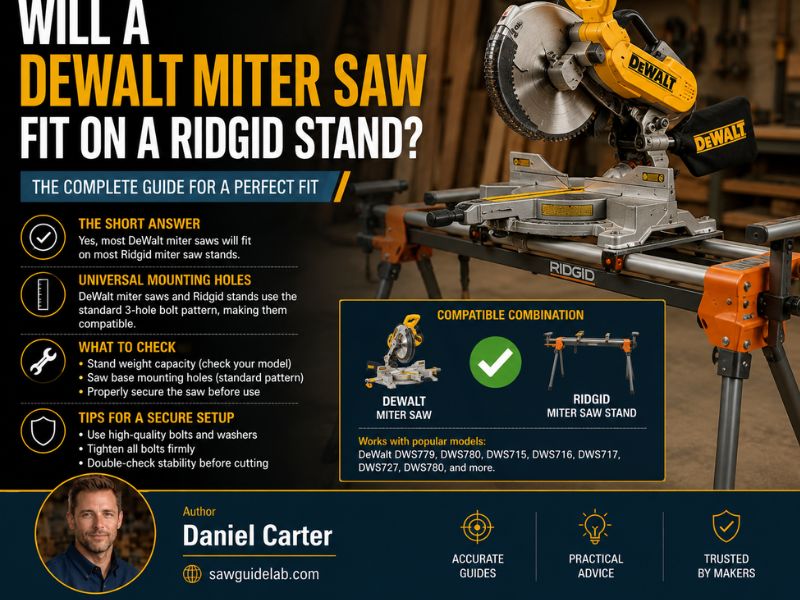
In most cases, a DeWalt miter saw can be mounted on a current RIDGID universal miter saw stand.
The RIDGID AC9946 is sold as a universal mobile stand and includes two mounting brackets. RIDGID states that the stand works with most common miter saws. Another RIDGID product page describes its universal quick-release mounting brackets as compatible with sliding and compound miter saws.
That is important because miter saw stands do not generally require the saw and stand to come from the same manufacturer.
The saw is normally attached to a pair of removable mounting brackets. Those brackets then lock onto the stand.
In other words, the important connection is:
DeWalt saw base → RIDGID mounting brackets → RIDGID stand
You are not trying to attach DeWalt stand brackets directly to a RIDGID frame.
That distinction clears up much of the confusion around cross-brand miter saw stand compatibility.
Why DeWalt and RIDGID Can Be Compatible
Miter saw manufacturers use different base castings, but most stationary miter saws include mounting holes in the feet or base.
Those mounting points allow the saw to be secured to:
- A workbench
- A permanent saw station
- A portable stand
- Removable stand brackets
A universal miter saw stand takes advantage of those mounting points.
Instead of designing its brackets for one exact saw footprint, the stand provides enough adjustment to accommodate a range of saw-base dimensions.
RIDGID specifically markets the AC9946 as compatible with most standard miter saws. That makes cross-brand combinations such as a DeWalt saw on a RIDGID stand a normal use case rather than an unusual modification.
Brand Matching Is Not the Main Issue
It is easy to assume a DeWalt saw needs a DeWalt stand.
It does not necessarily.
DeWalt itself uses the same universal concept on several of its stands. For example, DeWalt states that its DWX723 and DWX724 stands are designed to work with all brands of miter saws.
That does not prove every DeWalt saw fits every RIDGID stand, but it shows how the industry approaches portable miter saw mounting: compatibility is usually based on the bracket system and saw footprint rather than matching logos.
Which RIDGID Stand Matters Most for Compatibility?
The exact RIDGID stand model matters.
For current equipment, the model most relevant to this question is the RIDGID AC9946 Universal Mobile Miter Saw Stand.
RIDGID lists the AC9946 with:
- Two mounting brackets
- Material supports
- Material stops
- Wheels
- Mounting hardware
- A folding mobile frame
RIDGID also lists a 300-pound maximum weight specification for the stand and describes the included brackets as universal.
For a typical DeWalt miter saw, the stand’s overall load rating is generally not the difficult part of the compatibility question. The physical mounting arrangement deserves more attention.
Older RIDGID Stands May Be Different
RIDGID has produced multiple stands and utility-vehicle designs over the years.
An older stand found in a garage, workshop, jobsite, or used-equipment listing should not automatically be treated as identical to the current AC9946.
Bracket design can change between stand generations.
If someone says, “I have a RIDGID miter saw stand,” the model number is more useful than the color or general appearance of the stand.
This becomes especially important when buying replacement mounting brackets. RIDGID’s current AC994BR replacement brackets are specifically described as being designed for the RIDGID Mobile Miter Saw Stand.
Do DeWalt Mounting Holes Line Up With RIDGID Brackets?
They often can, but the exact hole spacing depends on the DeWalt miter saw model.
A miter saw’s mounting holes are part of the saw base. The RIDGID mounting brackets run underneath that base and provide the attachment points needed to connect the saw to the stand.
What matters is whether the mounting bolts can pass through suitable holes or slots while keeping both brackets properly positioned.
There is no single “DeWalt bolt pattern” shared by every DeWalt miter saw.
A compact cordless miter saw does not necessarily have the same footprint as a full-size 12-inch sliding compound model.
The Saw Footprint Matters More Than Blade Size Alone
Blade diameter gives a useful indication of saw size, but it does not determine the mounting pattern.
Two 12-inch miter saws can have different:
- Base widths
- Base depths
- Foot shapes
- Mounting-hole spacing
- Motor positions
- Slide-rail arrangements
For stand compatibility, the underside and mounting points of the saw are therefore more important than simply knowing whether it uses a 7 1/4-, 10-, or 12-inch blade.
Will a 12-Inch DeWalt Miter Saw Fit on a RIDGID Stand?
Many full-size DeWalt miter saws can potentially be used with a universal RIDGID stand, including 12-inch models, as long as the mounting brackets properly accommodate the base.
A 12-inch sliding compound miter saw creates more demanding conditions than a compact saw because it has a larger footprint and more mass.
The saw also moves through a larger range during operation.
That means compatibility should be considered in terms of more than whether four bolts can physically be installed.
Clearance Matters With Sliding Saws
A sliding compound miter saw has rails or another sliding mechanism that allows the saw head to move.
Depending on the saw design, parts of the mechanism may extend behind the fence.
The stand needs to allow normal saw movement without the saw body, rails, handles, or controls interfering with the frame.
This is particularly relevant with a large DeWalt sliding miter saw.
A secure bolt pattern is necessary, but it is only one part of a proper fit.
Does a DeWalt Saw Need DeWalt Mounting Brackets?
Not when the saw is being mounted to a RIDGID stand.
This is another point that causes unnecessary confusion.
DeWalt sells mounting brackets such as the DW7231 for its own compatible stand systems. DeWalt states that those brackets work with stands including the DWX723, DWX724, and DWX725.
Those are DeWalt stand brackets.
A RIDGID stand uses RIDGID stand brackets.
The miter saw bolts to the brackets supplied or specified for the stand.
Therefore, a DeWalt miter saw mounted on a RIDGID AC9946 normally uses the RIDGID mounting bracket system, not a pair of DeWalt DW7231 brackets.
Think of the Brackets as the Adapter
The easiest way to understand the system is to treat the removable brackets as the interface between the saw and stand.
The saw itself does not need to clip directly onto the stand frame.
Once the brackets are secured to the saw, the bracket-and-saw assembly connects to the stand.
This is also why universal brackets make a stand far more useful in a workshop where saws may be replaced over time.
What Determines Whether a DeWalt Saw Will Actually Fit?
Four factors are more important than the brand names printed on the tools.
Mounting-Hole Position
The saw needs suitable mounting points that can be secured to the stand’s brackets.
The bolts must hold the saw firmly rather than simply passing through holes that happen to overlap.
Saw Base Dimensions
The mounting brackets need to sit in a useful position beneath the saw.
An unusually deep, narrow, or irregular base can create compatibility problems even when the saw technically has mounting holes.
Saw Weight
The combined saw and workpiece load must remain within the stand manufacturer’s specifications.
RIDGID lists the AC9946 at a maximum weight capacity of 300 pounds.
Operating Clearance
A sliding or dual-bevel miter saw must retain its normal range of movement.
The stand or mounting hardware should not obstruct:
- Sliding rails
- Bevel movement
- Miter rotation
- Blade guard movement
- Dust collection
- Handles or controls
A saw that bolts down but cannot move through its normal range is not properly compatible.
Are Mounting Brackets Included With a RIDGID Miter Saw Stand?
The current RIDGID AC9946 is listed with two mounting brackets and mounting hardware included.
That means a separate pair of brackets should not normally be necessary when purchasing a complete new stand with all of its supplied components.
Used stands are different.
A secondhand RIDGID stand may be missing:
- One or both brackets
- Bolts
- Knobs
- Hardware
- Material supports
- Other removable parts
Replacement-bracket availability should therefore be considered when evaluating an incomplete used stand.
RIDGID currently lists AC994BR mounting brackets with hardware for its mobile miter saw stand system.
Is a RIDGID Stand a Good Match for a DeWalt Miter Saw?
From a compatibility standpoint, a universal RIDGID stand can be a sensible match for a DeWalt miter saw.
The main advantage is that the stand does not depend on owning a RIDGID saw.
The AC9946 is designed as a mobile stand with folding storage, wheels, adjustable material support, and universal mounting brackets. RIDGID lists an overall extension length of 9 feet 6 inches and a work-surface height of 33.5 inches with the mounting brackets installed.
For a DeWalt owner, however, those features matter only after physical saw compatibility has been confirmed.
A good stand should securely support the saw while allowing:
- Full miter adjustment
- Full bevel adjustment
- Normal sliding movement
- Stable support for long material
- Safe operation of the saw’s controls
Fit should be judged by the complete working setup, not just by whether the mounting bolts can be tightened.
RIDGID Stand vs. DeWalt Stand for a DeWalt Miter Saw
Using the same brand for the saw and stand can simplify accessory selection, but it is not mandatory.
| Factor | RIDGID Universal Stand | DeWalt Stand |
| DeWalt saw compatibility | Often possible | Designed to accommodate miter saws, including DeWalt |
| Cross-brand use | Yes on universal models | Yes on several DeWalt stand models |
| Required brackets | RIDGID-compatible brackets | DeWalt stand brackets |
| Saw brand must match stand | No | No |
| Main compatibility concern | Bolt pattern, base fit, clearance | Bolt pattern, base fit, clearance |
DeWalt describes both the DWX723 and DWX724 as working with all brands of miter saws, while RIDGID describes the AC9946 as compatible with most standard miter saws.
The practical difference is therefore more about stand design, portability, material support, bracket system, and the exact saw footprint than brand loyalty.
Common Compatibility Mistakes
Assuming All RIDGID Stands Are Identical
RIDGID has produced more than one stand design. Replacement brackets and mounting arrangements should be matched to the actual stand model.
Trying to Use DeWalt Stand Brackets on the RIDGID Stand
The saw may be DeWalt, but the brackets that interface with the stand need to match the RIDGID stand system.
Checking Only the Saw’s Weight
Weight capacity matters, but mounting-hole location and operating clearance are equally important.
Assuming a Universal Stand Means Literally Every Saw
“Universal” describes broad compatibility, not a guarantee that every miter saw ever manufactured will fit without issue.
RIDGID’s current product listing uses the more careful description “compatible with most standard miter saws.”
That wording is worth paying attention to.
Ignoring Rear Clearance on a Sliding Saw
Large sliding miter saws need room for their mechanisms to operate. A secure base attachment does not automatically guarantee unrestricted movement.
Frequently Asked Questions
Will a 12-inch DeWalt miter saw fit on a RIDGID stand?
Many 12-inch DeWalt miter saws can fit a RIDGID universal stand if their mounting holes align with the RIDGID brackets and the saw has adequate operating clearance. Because footprints vary between DeWalt models, compatibility should be checked for the exact saw and stand.
Will a DeWalt sliding miter saw fit the RIDGID AC9946?
The RIDGID AC9946 is marketed for broad miter-saw compatibility, and RIDGID describes its universal mounting system as suitable for common sliding and compound miter saws. Exact fit still depends on the individual DeWalt saw’s base and mounting arrangement.
Are RIDGID miter saw stands universal?
The current RIDGID AC9946 is marketed as a Universal Mobile Miter Saw Stand and is described by RIDGID as compatible with most standard miter saws. That does not mean every older RIDGID stand or every saw has identical compatibility.
Do I need DeWalt brackets for a DeWalt saw on a RIDGID stand?
Normally, no. The brackets need to match the stand rather than the saw brand. A DeWalt saw used on the RIDGID AC9946 would typically attach to the RIDGID mounting brackets.
Can I use RIDGID mounting brackets with a DeWalt saw?
The AC9946 stand uses universal mounting brackets intended to support common miter saw configurations. A DeWalt saw can be compatible when its base mounting points can be securely attached to those brackets.
Are replacement brackets available for the RIDGID AC9946?
Yes. RIDGID lists the AC994BR mounting brackets for its Universal Mobile Miter Saw Stand system and includes mounting hardware with the bracket set.
Does blade size determine whether a DeWalt saw fits the stand?
No. Blade diameter gives a rough indication of overall saw size, but stand compatibility depends more directly on the saw’s base dimensions, mounting-hole pattern, weight, and operating clearance.
Conclusion
Yes, a DeWalt miter saw will fit on a Ridgid stand in many cases, particularly when the stand is the RIDGID AC9946 Universal Mobile Miter Saw Stand. RIDGID specifically designs that model for broad compatibility with common miter saws rather than limiting it to RIDGID-branded machines.
The deciding factor is the mounting system. The DeWalt saw needs to bolt securely to the RIDGID mounting brackets, remain within the stand’s capacity, and retain enough clearance for normal miter, bevel, and sliding movement. For most typical DeWalt miter saw and current RIDGID universal-stand combinations, cross-brand mounting is entirely realistic—but the exact saw and stand model should determine the final fit.