
Why Use a Table Saw Sled? Accuracy, Safety, and Cleaner Cuts
A table saw sled is used to make crosscuts more accurate, repeatable, and well supported than they often are with a standard miter gauge alone. The sled rides in the table saw’s miter slots while its fence holds the workpiece square to the blade, giving the operator a stable platform for controlled cuts.
If you are asking why use a table saw sled, the biggest reasons are accuracy, workpiece support, repeatability, and better control during crosscuts. A well-made crosscut sled can also reduce small alignment errors, support short or wide workpieces, and provide a replaceable zero-clearance kerf around the blade.
A sled does not replace every table saw accessory, and it is not intended for ripping long boards along the grain. Its strongest advantage appears when the table saw is being used for precise crosscuts, repeated parts, small components, or woodworking where a fraction of an inch matters.
Why Use a Table Saw Sled?
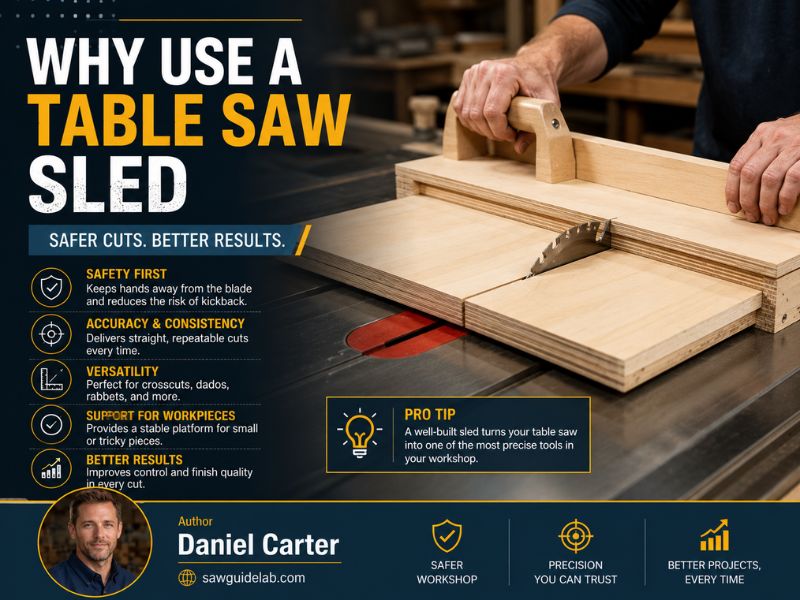
A table saw sled creates a moving platform that carries both the workpiece and the fence past the blade.
Unlike a normal miter gauge, which supports the material mainly from one narrow bar and fence, a sled supports a larger portion of the board from underneath.
That difference produces several practical benefits:
- Better crosscut accuracy
- More support for wide or short workpieces
- Consistent 90-degree cuts
- Easier repeated cuts
- Reduced tear-out at the bottom edge
- Greater control over small parts
- A stable reference fence
- Less reliance on the table saw’s factory miter gauge
For many woodworkers, the crosscut sled becomes one of the most frequently used table saw accessories because it turns the saw into a more precise crosscutting machine.
What Does a Table Saw Sled Actually Do?
A typical table saw sled consists of a flat base, one or two fences, and runners that fit into the table saw’s miter slots.
The runners guide the entire sled in a straight path parallel to the saw blade.
The workpiece rests on the sled base and registers against the fence. As the sled moves forward, the material travels through the blade while staying supported and aligned.
The blade cuts through both the workpiece and a narrow slot in the sled base.
That slot is commonly called the kerf.
The Fence Establishes the Cutting Angle
For a standard crosscut sled, the rear fence is normally positioned perpendicular to the blade.
That fence becomes the reference surface for the workpiece.
If the fence is accurately aligned at 90 degrees, boards placed against it can be cut square repeatedly without resetting a miter gauge for every piece.
This fixed reference is one reason a good sled can improve consistency in furniture making, cabinetry, trim work, box building, and other precision woodworking.
A Table Saw Sled Improves Crosscut Accuracy
Accuracy is one of the strongest reasons to use a table saw sled.
A standard miter gauge can make accurate crosscuts, but its performance depends on the fit between the miter bar and slot, the size of the gauge fence, and the operator’s ability to hold the workpiece firmly against it.
A sled reduces several of those variables.
The workpiece sits on a broad platform, while the fence provides a larger reference surface.
Instead of trying to guide the board independently across the table, the operator moves the entire sled.
Why Small Errors Matter
A crosscut can look square while still being slightly off.
On a short board, a tiny angular error may be difficult to notice.
On a wide panel or furniture component, the same error becomes much more obvious because it is spread across a greater distance.
Small inaccuracies can create:
- Gaps in cabinet assemblies
- Uneven drawer boxes
- Misaligned frames
- Poor-fitting shelves
- Problems during glue-up
- Parts that are different lengths
A properly calibrated sled helps reduce those cumulative errors.
A Sled Gives the Workpiece Better Support
A table saw’s surface supports material before and after the blade, but a miter gauge provides relatively limited support directly around the workpiece.
A sled adds its own flat base beneath the material.
This is particularly useful for:
- Short boards
- Wide boards
- Small components
- Narrow parts
- Panels
- Pieces that are awkward to hold against a miter gauge
Better support makes it easier to keep a workpiece flat and properly registered against the fence throughout the cut.
Support Matters With Small Pieces
Small pieces can be difficult to control using a standard miter gauge because there may be little surface area available for holding them securely.
A sled allows the small workpiece to rest on the sled instead of directly on the cast-iron or aluminum saw table.
The fence remains close behind the workpiece and moves with it.
That creates a more controlled cutting environment for many small crosscutting tasks.
A Table Saw Sled Makes Repeated Cuts More Consistent
Woodworking projects often require several pieces of exactly the same length.
Examples include:
- Cabinet parts
- Drawer components
- Face-frame pieces
- Box sides
- Furniture rails
- Small shelf components
- Repeated trim pieces
A sled provides a convenient platform for using a stop block.
Once a stop is positioned at the desired distance from the blade, multiple pieces can register against the same reference point.
The result is repeatable part length without measuring and marking every individual board.
Repeatability Can Matter More Than the Exact Number
In many woodworking projects, identical parts are more important than hitting a theoretical measurement perfectly.
For example, four frame components that are all exactly the same length will generally assemble better than four pieces that were independently measured and differ slightly.
A sled with a reliable stop system makes repeated dimensions easier to maintain.
A Sled Can Reduce Tear-Out
A table saw sled often develops a narrow blade kerf through its base.
Because the material immediately around the blade is supported by the sled, the setup can function similarly to a zero-clearance insert.
The base supports wood fibers close to the cut line, particularly on the underside of the workpiece.
This can reduce some types of tear-out.
Blade Choice Still Matters
A sled cannot compensate for a poor blade.
Cut quality also depends on:
- Blade sharpness
- Tooth count
- Tooth geometry
- Wood species
- Grain direction
- Feed rate
- Material condition
A sharp crosscut or combination blade usually produces a cleaner edge than a dull coarse blade.
The sled provides additional support, but blade selection remains an important part of the result.
Table Saw Sled vs. Miter Gauge
A miter gauge and crosscut sled perform overlapping jobs, but they are not identical.
| Feature | Table Saw Sled | Miter Gauge |
| Workpiece support | High | Moderate |
| 90-degree repeatability | Excellent when calibrated | Good with accurate setup |
| Repeated cuts | Excellent with stop block | Good |
| Small-part support | Very good | More limited |
| Portability | Lower | Higher |
| Storage space | Requires more | Minimal |
| Angle adjustment | Limited on basic sled | Usually easier |
| Setup weight | Heavier | Lighter |
A miter gauge is convenient when angles change frequently.
A crosscut sled is usually more attractive when square cuts and repeatability are the priority.
Why Many Woodworkers Keep Both
A sled does not make the miter gauge obsolete.
A miter gauge is compact and can quickly handle angled cuts without requiring a dedicated jig.
A sled excels at repeatable 90-degree crosscuts.
Keeping both accessories available allows the table saw to handle a wider range of work.
Why a Sled Is Useful for Wide Boards
Wide boards can be awkward to control with a narrow miter gauge fence.
The further the board extends away from the gauge, the more leverage it has to twist during the cut.
A sled supports more of the board and provides a longer reference fence.
That makes wide crosscuts easier to keep square.
This can be particularly valuable when cutting cabinet components, furniture stock, or other boards that are too wide to feel stable against a small factory miter gauge.
Does a Table Saw Sled Make the Saw Safer?
A sled can improve control for many crosscuts because the workpiece is supported by a platform and registered against a fixed fence.
However, a sled should not be described as making a table saw inherently safe.
A table saw still contains an exposed, high-speed blade and can cause serious injury if used incorrectly.
The real advantage is that the sled can reduce certain handling problems during appropriate crosscuts.
Better Hand Positioning
A rear fence provides a clear surface for controlling the workpiece and moving the sled.
Hands can remain on the fence or designated grip areas rather than being placed near the workpiece edge close to the blade.
Some sleds also incorporate a blade guard block at the rear where the blade exits the fence.
The exact protection depends on the sled design.
A Sled Does Not Prevent Every Hazard
A crosscut sled cannot eliminate:
- Contact with the blade
- Kickback caused by poor technique
- Loose workpieces
- Incorrect blade height
- Damaged blades
- Improperly supported stock
- Unsafe hand placement
It should be viewed as a precision and work-holding aid, not as a replacement for safe table saw practices.
Why a Sled Works Well for Small Parts
Very small components are often uncomfortable to cut with a standard miter gauge because there is little material to hold securely.
A sled provides a broad base and a fixed rear fence.
The piece moves with the sled rather than sliding independently across the table.
This can make small-part crosscutting more predictable.
Woodworkers frequently use sleds for parts used in:
- Boxes
- Frames
- Small furniture
- Jigs
- Decorative woodworking
- Joinery components
For extremely small or irregular pieces, additional holding fixtures may still be appropriate.
Can a Table Saw Sled Help With Joinery?
Yes. A sled can serve as a stable platform for several joinery-related operations when paired with suitable jigs or fixtures.
Examples include cuts associated with:
- Dados
- Rabbets
- Tenons
- Lap joints
- Finger-joint fixtures
- Spline cuts
The main benefit is repeatable positioning.
A sled establishes a known relationship between the fence, blade, and workpiece, allowing repeated cuts to remain more consistent.
However, specialized joinery operations may require a purpose-built sled rather than a standard crosscut sled.
Crosscut Sled vs. Miter Saw
A table saw sled and a miter saw can both make accurate crosscuts, but they have different strengths.
A miter saw brings the blade down through a stationary workpiece.
A table saw sled carries the workpiece through a stationary rotating blade.
Where the Sled Has an Advantage
A sled can be particularly useful for:
- Small parts
- Wide boards
- Repeated square cuts
- Fine woodworking
- Cabinet components
- Projects already being worked on at the table saw
Where a Miter Saw Has an Advantage
A miter saw is often more convenient for:
- Long construction lumber
- Rapid jobsite crosscuts
- Frequent miter angles
- Long trim
- Framing stock
- Crown molding
Neither machine completely replaces the other.
For woodworking that demands repeatable square parts, a table saw sled can offer a level of control that is difficult to duplicate with a portable miter saw.
Why Not Use the Table Saw Fence for Crosscuts?
The rip fence is primarily intended for ripping material parallel to the grain.
Using the fence improperly as a length stop during a crosscut can trap a cutoff between the blade and fence.
That trapped piece can rotate or be thrown.
A crosscut sled avoids relying on the rip fence as the primary guide for the workpiece.
The rear sled fence controls the workpiece while the sled moves through the blade.
Stop Blocks Are Different
A properly positioned stop block can sometimes be used with a rip fence to establish length, provided the workpiece clears the stop before reaching the blade.
The important point is that the cutoff should not remain trapped between the blade and a fixed fence during the cut.
A sled with its own stop system makes repeated crosscuts easier to manage without treating the rip fence like a crosscut guide.
What Are the Limitations of a Table Saw Sled?
A crosscut sled is useful, but it has disadvantages.
It Takes Up Space
A full-size sled can be bulky.
Large sleds require storage space and can be awkward in a small workshop.
It Adds Weight
A base, runners, fences, and hardware can make the sled considerably heavier than a miter gauge.
Cutting Width Is Limited
The physical dimensions of the sled and fence limit the largest workpiece it can support.
Basic Sleds Are Mainly for 90-Degree Cuts
A traditional crosscut sled is optimized for square cuts.
Frequent miters may require a separate miter sled, adjustable fence, or miter gauge.
The Sled Must Be Accurate
A poorly aligned fence defeats one of the main reasons for using a sled.
If the rear fence is not square to the blade, repeated cuts will reproduce the same error.
Who Benefits Most From a Table Saw Sled?
A table saw sled is particularly valuable for woodworkers who regularly need accurate, repeatable crosscuts.
It is commonly useful for:
- Furniture makers
- Cabinet builders
- Hobby woodworkers
- DIY woodworkers
- Box makers
- Trim and finish woodworkers
Someone using a table saw mostly for ripping construction lumber may use a sled less frequently.
Someone building cabinets or furniture may use one on nearly every project.
The value of the sled depends on the type of work being done.
Frequently Asked Questions
Is a table saw sled necessary?
No. A table saw can make crosscuts with a good miter gauge, and many users work without a sled. A sled becomes valuable when better workpiece support, repeatability, and consistent square cuts are important.
Is a table saw sled more accurate than a miter gauge?
A properly built and calibrated sled can provide excellent repeatable accuracy because it uses a fixed fence and broad workpiece support. A high-quality, accurately adjusted miter gauge can also produce precise cuts.
What is the main purpose of a crosscut sled?
The main purpose is to guide a workpiece squarely across the table saw blade while supporting it from underneath. This improves control and makes repeated crosscuts easier to reproduce.
Can you rip wood with a table saw sled?
A standard crosscut sled is not intended to replace the rip fence for normal ripping operations. Its fence is positioned for crosscuts, where the workpiece moves perpendicular to the blade.
Does a table saw sled reduce kickback?
A sled can improve workpiece control during appropriate crosscuts, but it does not eliminate kickback or other table saw hazards. Correct material support, blade setup, and safe operating practices are still necessary.
Does a crosscut sled need two runners?
Not necessarily. Some sleds use two runners for stability, while smaller designs may use a single runner. The important factors are smooth travel, minimal side-to-side play, and reliable alignment with the blade.
Can a table saw sled cut angles?
A basic crosscut sled is normally configured for 90-degree cuts. Angled cuts can be made with specialized miter sleds, adjustable fences, or additional fixtures designed for the required angle.
Conclusion
The main reason why use a table saw sled is to gain better support, accuracy, and repeatability during crosscuts. By carrying the workpiece on a stable platform and referencing it against a fixed fence, a sled makes it easier to produce square parts, duplicate lengths, cut small pieces, and control wide boards.
A crosscut sled is not necessary for every table saw user, and it does not replace the rip fence or miter gauge for every task. For woodworking that depends on consistently square and repeatable crosscuts, however, it is one of the most useful accessories a table saw can have.