What Is a Panel Sizing Saw? Uses, Types, and How It Works
If you are wondering what is a panel sizing saw, it is a woodworking machine designed to cut large sheet materials such as plywood, MDF, particleboard, melamine, and laminated panels accurately to finished dimensions. Unlike a basic table saw, many panel sizing saws use a sliding carriage or another panel-support system that allows large sheets to move smoothly and squarely through the blade.
Panel sizing saws are especially common in cabinet shops, furniture factories, millwork operations, and businesses that process large quantities of sheet goods. Their main purpose is exactly what the name suggests: taking oversized panels and sizing them accurately into smaller components.
A professional cabinetmaker may use one to turn a 4 × 8-foot sheet of plywood into cabinet sides, shelves, bottoms, and partitions. A furniture manufacturer may use a larger industrial sizing saw to process stacks of particleboard or laminated sheets into dozens of identical parts.
The term can describe several machines, but the sliding table panel saw, often called a sliding table saw or sliding panel saw, is one of the most common. Industrial beam saws are another type of panel-sizing equipment used for high-volume production.
Panel sizing saws are valued because large sheets are difficult to control on an ordinary table saw. Instead of forcing the operator to support and guide the whole panel manually, the machine provides a large stable carriage, fence, or clamping system that keeps the material controlled throughout the cut.
In this guide, I’ll explain what a panel sizing saw is, how it works, the different types available, what materials it can cut, how it compares with a regular table saw and vertical panel saw, and when this type of machine is worth using.
What Is a Panel Sizing Saw Used For?
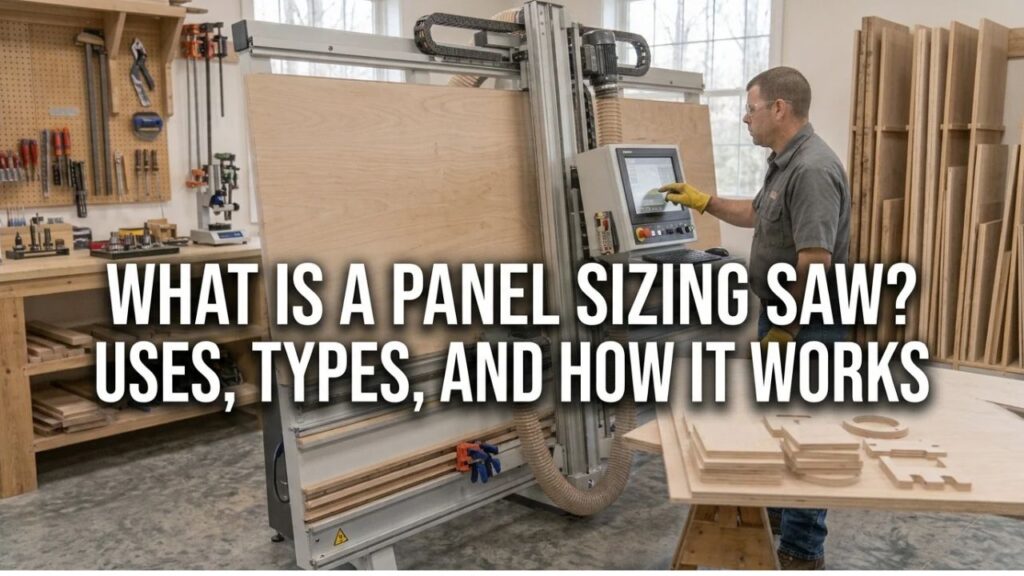
A panel sizing saw is primarily used to make straight, accurate cuts in large sheet materials.
Typical jobs include cutting sheets to rough size, trimming factory edges, crosscutting cabinet components, ripping long panels, squaring sheet goods, and producing multiple parts with identical dimensions.
The machine is particularly useful when the material is too large or heavy to handle comfortably on a conventional table saw.
Sizing Panels to Final Dimensions
One of its main purposes is producing accurately dimensioned parts.
For example, a cabinet side may need to finish at exactly 23-1/4 inches wide by 34-1/2 inches long.
A panel sizing saw can first rip the sheet to width and then crosscut the strip to the required length.
With properly adjusted stops and fences, multiple identical parts can be produced efficiently.
Squaring Large Sheets
Factory sheet edges are not always suitable as finished reference edges.
A panel sizing saw lets the operator trim one edge straight and then use that edge as the reference for subsequent cuts.
The result is a rectangular panel with square corners and accurate dimensions.
Cutting Laminated Panels
Melamine, laminate-faced particleboard, veneered panels, and similar sheet materials are common in furniture and cabinet production.
Many professional panel sizing saws include a scoring blade that helps reduce chipping on the lower surface of these materials.
Key Takeaways:
- A panel sizing saw is built primarily for accurate cutting of large sheet goods.
- Its support system makes large panels easier to control than on a standard table saw.
- Cabinetmaking and furniture production are among its most common uses.
How Does a Panel Sizing Saw Work?
The operating principle depends on the type of machine.
On a sliding table panel saw, the saw blade remains in a fixed position while the panel rests on a moving carriage.
The operator places the sheet on the carriage, aligns it against a fence or stop, starts the machine, and pushes the carriage past the blade.
The entire sheet moves with the table.
This is a major difference from a conventional table saw, where the workpiece slides directly across a stationary table.
The Sliding Carriage Supports the Panel
A large sheet can weigh a considerable amount and be awkward to balance.
The sliding carriage supports much of that weight.
Because the panel and carriage move together, there is less sliding friction between the sheet and machine surface.
This makes it easier to maintain alignment through the cut.
The Fence Controls Dimensions
Most panel sizing saws include a crosscut fence and a rip fence.
The crosscut fence is mounted to the sliding carriage and is used to make cuts across the sheet.
The rip fence is positioned parallel to the saw blade and is used for lengthwise cuts.
Adjustable stops allow repetitive parts to be cut to the same dimension.
The Main Blade Makes the Cut
The main blade performs the actual cutting.
Blade diameter and motor power depend on the machine.
Industrial machines may use large blades and powerful three-phase motors because they are expected to process thick or dense panels continuously.
What Is a Scoring Blade on a Panel Sizing Saw?
A scoring blade is a small blade positioned ahead of the main saw blade.
Its purpose is to make a shallow preliminary cut on the underside of a laminated or veneered panel.
This helps prevent the main blade from tearing out or chipping the decorative surface.
Why Laminate Chips
The main saw blade generally cuts upward through the material on a table-style panel saw.
As the teeth emerge through the surface, brittle laminates or melamine coatings can chip.
The scoring blade rotates in the opposite direction and cuts a narrow groove before the main blade reaches the material.
The main blade then cuts within that prepared groove.
Scoring Blade Alignment Matters
The scoring kerf must correspond closely with the main blade kerf.
If the scorer is too narrow, the main blade may still chip the surface.
If it is too wide, you can see an unwanted shoulder or double-cut appearance along the edge.
Professional machines therefore provide adjustment for scoring width and lateral position.
Main Parts of a Panel Sizing Saw
Although designs differ, most sliding panel saws share several important components.
Main Saw Unit
The saw unit contains the arbor, main blade, motor, blade-height mechanism, and often the tilting mechanism.
Some machines allow the blade to tilt for bevel cuts.
Sliding Table
The sliding table or carriage supports the panel and moves parallel to the blade.
A high-quality carriage should move smoothly without lateral play.
The length of the sliding table determines how large a panel can be crosscut in a single controlled stroke.
Crosscut Fence
The crosscut fence sits perpendicular to the blade.
It normally includes measuring scales and adjustable flip stops for repetitive work.
Some fences can be positioned at angles for miter cuts.
Rip Fence
The rip fence runs parallel to the blade and is used when ripping panels to width.
It should lock securely without shifting.
Outrigger Table
Large machines often have an outrigger table attached to the sliding carriage.
This gives additional support beneath wide sheets.
It can make handling a full-size panel much easier.
Scoring Unit
Machines intended for laminated materials often include a separate scoring motor and blade.
This is one of the key features distinguishing many professional panel saws from simpler table saws.
Blade Guard and Dust Extraction
A guard covers the exposed upper section of the blade.
Dust extraction ports remove sawdust from around the blade and underneath the machine.
Good extraction is particularly important when cutting MDF and particleboard because they generate large quantities of fine dust.
Types of Panel Sizing Saws
The phrase panel sizing saw can refer to more than one machine.
Understanding the different designs helps prevent confusion.
Sliding Table Panel Saw
This is one of the most common machines associated with the term.
The workpiece is placed on a large sliding carriage and pushed past a stationary blade.
This design is popular in cabinet shops because it combines excellent accuracy with flexibility.
Vertical Panel Saw
A vertical panel saw holds the sheet nearly upright against a frame.
The saw carriage travels along rails.
Depending on the design, the saw may move vertically for crosscuts and rotate for horizontal rip cuts.
Vertical saws require less floor space than large sliding table saws.
However, they are mechanically and operationally different from conventional sliding panel sizing saws.
Beam Saw
A beam saw is an industrial panel-sizing machine designed for high production.
Panels are placed on a large table, clamped by a pressure beam, and cut automatically by a saw carriage moving beneath or across the material.
Some machines can cut stacks of several sheets at once.
Beam saws are common in large cabinet, furniture, and panel-processing factories.
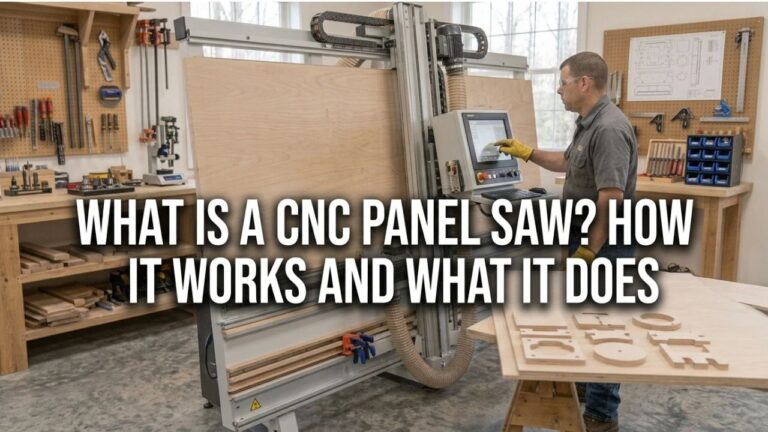
CNC Panel Saw Systems
Highly automated panel-processing systems can load, position, measure, and cut sheets with minimal operator involvement.
Software can optimize cut layouts to reduce waste.
These systems are designed for production environments where speed and repeatability are critical.
Panel Sizing Saw vs. Table Saw
A panel sizing saw and table saw may both use circular blades mounted beneath a horizontal table, but their handling systems differ significantly.
A standard table saw requires the operator to push the panel across the stationary table.
A sliding panel saw carries the material past the blade on a moving table.
Large-Sheet Handling
This is the biggest advantage of the panel saw.
Trying to crosscut a full 4 × 8-foot sheet on a compact table saw can be awkward.
The sheet extends far beyond the table and can rotate or shift as you push it.
A sliding carriage provides continuous support and preserves alignment.
Accuracy
Both machines can make accurate cuts when properly adjusted.
However, a high-quality panel sizing saw is designed specifically for maintaining squareness over large workpieces.
Its long fence, carriage, and stops make repetitive panel work much easier.
Capacity
Panel saws usually offer greater sheet-processing capacity.
Large sliding tables can accommodate complete sheets without requiring the operator to break them down first.
Cost and Space
A conventional table saw is usually less expensive and occupies less floor space.
For a small shop that cuts mostly solid wood and only occasional sheet goods, a table saw may be more practical.
A panel sizing saw becomes more attractive as the volume and size of panel work increase.
Key Takeaways:
- A table saw depends more heavily on the operator sliding and supporting the sheet.
- A panel sizing saw provides a carriage or dedicated sheet-handling system.
- Panel saws generally offer better productivity for cabinets and sheet-goods work.
Panel Sizing Saw vs. Vertical Panel Saw
These names are sometimes used interchangeably, but the machines can be quite different.
A traditional sliding panel sizing saw is horizontal.
The sheet lies flat on the machine.
A vertical panel saw holds the material nearly upright.
Floor Space
Vertical panel saws are attractive when shop space is limited.
A large sliding table saw needs substantial clearance in front of, behind, and beside the machine.
A vertical saw occupies much less horizontal floor area.
Material Handling
A vertical saw can make it easier for one person to load a large sheet because the panel remains upright.
However, heavy material still requires safe lifting techniques.
Cutting Flexibility
A sliding panel saw is usually more versatile for precision cabinetmaking.
It can often perform bevels, miters, solid-wood cuts, dado-type operations where permitted, and many general table-saw tasks.
A vertical panel saw is more specialized toward sheet breakdown.
What Materials Can a Panel Sizing Saw Cut?
Panel sizing saws are primarily woodworking machines, but they can process a wide variety of wood-based materials when fitted with the correct blade.
Plywood
Plywood is one of the most common materials.
A fine-tooth carbide blade can produce clean cabinet-grade cuts.
MDF
Medium-density fiberboard cuts cleanly but produces large amounts of fine dust.
Good dust extraction is particularly important.
Particleboard
Particleboard is widely used for cabinets and furniture, especially when faced with melamine or laminate.
Because it can be abrasive, high-quality carbide tooling is valuable.
Melamine
Melamine-faced panels can chip easily.
A correctly set scoring blade combined with a suitable main blade produces much cleaner edges.
Veneered Panels
Thin decorative veneers are also vulnerable to tear-out.
The scoring system and sharp blades are important.
OSB
A panel saw can cut oriented strand board, although extremely fine edge quality is usually less important for structural OSB.
Solid Wood
Many sliding table panel saws can also cut solid lumber.
However, their primary advantage appears when processing panels.
Can a Panel Sizing Saw Cut Plastic?
Some sheet plastics can be cut with suitable saw blades and machine settings.
Acrylic, polycarbonate, and other materials may require specialized tooth geometry.
Heat buildup is important because some plastics can melt or chip.
The machine and blade manufacturers’ recommendations should be followed.
Can a Panel Saw Cut Aluminum?
Some machines can process certain nonferrous aluminum profiles or sheets when specifically approved and fitted with an appropriate blade.
However, you should not assume every woodworking panel saw is suitable for metal.
Blade speed, clamping, lubrication, guarding, and chip management may differ substantially.
Verify the machine specifications before cutting anything other than its intended materials.
What Size Panels Can a Panel Sizing Saw Cut?
Capacity depends on carriage length, crosscut width, rip capacity, and blade size.
Professional sliding panel saws are commonly designed to handle standard full-size sheet goods.
Some machines are specifically configured for sheets approximately 4 × 8 feet.
Larger industrial machines may accommodate oversized architectural or furniture panels.
Why Carriage Length Matters
Suppose you need to square the end of an 8-foot sheet.
The sliding carriage must provide enough controlled travel to move the entire cut line past the blade.
A short carriage can still cut panels, but it may limit how easily full sheets can be processed.
How Accurate Is a Panel Sizing Saw?
A good machine can produce extremely accurate cuts when correctly aligned.
However, accuracy depends on setup.
The sliding table must travel exactly parallel to the blade where required by the manufacturer’s geometry.
The crosscut fence must be correctly squared.
The stops and measurement scales must be calibrated.
Blade Condition Matters Too
Even a perfectly adjusted machine cannot produce excellent results with a dull or inappropriate blade.
Worn teeth can create rough edges, increased cutting force, or wandering cuts.
Scoring blades also require careful alignment.
How Do You Use a Panel Sizing Saw?
The exact procedure depends on the machine, but the general process is straightforward.
First inspect the machine and verify that the blade, guards, fences, and dust extraction are ready.
Place the panel flat on the sliding table.
Position it against the crosscut fence or other reference surface.
Set the desired measurement using the fence or stop.
Secure and support the panel properly.
Start the saw and allow it to reach full speed.
Then move the carriage smoothly past the blade.
Do not force the cut.
Keep Hands Away From the Blade
Large panels can distract the operator because so much attention is focused on controlling the sheet.
Always remain aware of hand position.
Use guards, push devices, and clamps according to the machine instructions.
Never reach across a rotating blade to retrieve a cutoff.
Can One Person Operate a Panel Sizing Saw?
Yes, depending on the panel size, weight, and machine design.
One of the advantages of a large sliding table is that it helps one operator support sheet material.
However, full sheets of thick MDF, plywood, or particleboard can be very heavy.
A helper, vacuum lifter, panel cart, or other material-handling equipment may be safer.
The machine makes cutting easier but does not eliminate the physical hazards of moving large sheets.
Why Do Cabinet Shops Use Panel Sizing Saws?
Cabinet construction requires many rectangular sheet components with precise dimensions.
A single kitchen project may require dozens of cabinet sides, shelves, backs, bottoms, and door components.
The panel saw lets a shop process these parts quickly and repeatably.
Repetitive Cuts
Stops on the crosscut fence make it easy to produce multiple components of identical length.
Clean Decorative Edges
The scoring system helps prevent chipping on melamine and other finished surfaces.
Better Workflow
Full sheets can move directly from storage to the saw and then to edge banding, drilling, CNC routing, or assembly.
This makes production more efficient.
Advantages of a Panel Sizing Saw
The biggest advantage is control over large workpieces.
Supporting the work correctly improves both productivity and accuracy.
Other major advantages include cleaner cuts, strong repeatability, easier squaring, high sheet capacity, and reduced effort when working with heavy panels.
Machines equipped with scoring blades are particularly valuable for finished panels.
High Production Capability
A shop processing sheet goods every day can save a large amount of labor compared with breaking every sheet down using handheld circular saws.
The saw can become the center of a cabinet-production workflow.
Disadvantages of a Panel Sizing Saw
The machine also has drawbacks.
A large sliding table model requires substantial shop space.
It may need several feet of clearance around the carriage.
Professional machines can also be expensive.
Installation and alignment require care.
Material Loading
Although cutting is easier, lifting full heavy sheets onto a horizontal table can still be physically demanding.
Maintenance
Sliding bearings, fences, scoring systems, dust extraction, blades, and drive components require ongoing adjustment and maintenance.
Not Necessary for Every Shop
A hobbyist making occasional plywood projects may get excellent results using a track saw and table saw.
A panel sizing saw makes the most sense when sheet processing is frequent enough to justify its size and cost.
Panel Sizing Saw vs. Track Saw
A track saw provides another popular way to break down panels.
The guide rail lies on top of the sheet, and the handheld saw travels along the rail.
Track Saw Advantages
A track saw is portable, relatively affordable, and requires almost no dedicated floor space.
It is excellent for breaking down sheets before moving smaller pieces to other machines.
Panel Saw Advantages
The panel saw is much faster for repetitive production.
Once stops and fences are set, multiple parts can be cut without measuring and positioning a guide rail for every cut.
For professional cabinet production, this efficiency can be significant.
Panel Sizing Saw vs. Beam Saw
Both machines are intended for accurate panel sizing, but their production levels are different.
A sliding panel saw is typically operator-controlled.
The operator loads the panel and manually pushes the carriage.
A beam saw is much more automated.
It clamps panels and moves the blade or material through a programmed cutting sequence.
When Beam Saws Make Sense
Beam saws excel when a factory needs hundreds or thousands of repeated panel components.
They can also process stacks of sheets in a single cutting cycle.
For smaller custom shops, a sliding table saw often offers greater flexibility at much lower cost.
Key Takeaways:
- Track saws are portable and ideal for occasional sheet breakdown.
- Sliding panel saws are faster for repeatable shop production.
- Beam saws are intended for high-volume automated panel processing.
What Blade Does a Panel Sizing Saw Use?
Most machines use carbide-tipped circular saw blades.
The correct blade depends on the material.
For clean plywood or melamine, a blade with many teeth and suitable tooth geometry is generally preferred.
For ripping thicker solid wood, a lower tooth count may cut more efficiently.
The manufacturer’s recommendations should guide blade diameter, arbor size, kerf, and maximum RPM.
Main Blade and Scoring Blade Must Work Together
On scoring-equipped machines, the two blades need compatible kerfs and alignment.
Changing the main blade may require adjusting the scoring unit.
A mismatch can lead to poor edge quality.
Does a Panel Sizing Saw Need Dust Collection?
Yes, particularly in a professional environment.
Sheet products such as MDF can produce very fine airborne dust.
A panel saw can generate dust both above and below the table.
Many machines therefore include extraction at the lower blade enclosure and upper guard.
Connecting both points to an adequately sized dust-collection system greatly improves cleanliness and visibility.
It also reduces the amount of fine dust entering the carriage and machine components.
Is a Panel Sizing Saw Dangerous?
Like any stationary saw with an exposed cutting blade, it can cause severe injury if used improperly.
The larger workpieces involved add additional hazards such as lifting injuries and loss of panel control.
Always use the manufacturer’s blade guard, riving or safety devices where provided, and proper material support.
Keep the floor clear around the sliding carriage.
Never stand where the moving carriage can strike you.
Do not bypass guards or interlocks to gain a small amount of cutting capacity.
How Much Space Does a Panel Sizing Saw Need?
Usually more than first-time buyers expect.
You need room for the machine itself, full sliding-table travel, loading large sheets, removing finished pieces, and walking safely around the machine.
A long sliding table can dramatically increase the effective footprint.
Before buying one, lay out the full travel range on your shop floor rather than looking only at the manufacturer’s base dimensions.
Who Should Buy a Panel Sizing Saw?
A panel sizing saw makes the most sense for users who cut large quantities of sheet goods.
This includes cabinetmakers, commercial furniture shops, millwork companies, closet-system manufacturers, architectural woodworkers, and panel-processing businesses.
A serious home workshop may also benefit if large-sheet projects are common and adequate floor space is available.
When You May Not Need One
If you cut only a few sheets each month, a track saw combined with a good table saw can be a much more economical solution.
The goal is not to own the largest machine.
It is to choose the tool that matches your production needs.
FAQs about what is a panel sizing saw
What is a panel sizing saw?
A panel sizing saw is a machine designed to cut large sheet materials accurately into smaller finished dimensions.
Is a panel sizing saw the same as a table saw?
Not exactly.
A sliding panel sizing saw uses a moving carriage to support and move large sheets past the blade, while a conventional table saw usually requires the workpiece to slide across a fixed table.
Is a sliding table saw a panel sizing saw?
Yes, many sliding table saws are specifically designed for panel sizing and are commonly called sliding panel saws.
What is the main purpose of a panel saw?
Its main purpose is accurately breaking down and sizing large sheets such as plywood, MDF, particleboard, and melamine.
What is a scoring blade?
A scoring blade makes a shallow preliminary cut on the underside of laminated material to help prevent chipping when the main blade cuts through.
Does every panel saw have a scoring blade?
No.
Professional cabinetmaking machines commonly include one, but simpler machines may not.
Can a panel sizing saw cut plywood?
Yes.
Plywood is one of the most common materials cut on these machines.
Can it cut MDF?
Yes.
MDF cuts well on a panel saw, although good dust extraction is important.
Can it cut melamine?
Yes.
A machine with a correctly adjusted scoring blade can produce particularly clean melamine cuts.
Can a panel saw cut solid wood?
Many sliding table panel saws can, although their strongest advantage is processing large sheet materials.
Is a panel sizing saw better than a track saw?
For high-volume repetitive production, usually yes.
For portability and occasional sheet breakdown, a track saw may be more practical.
Is a panel sizing saw better than a table saw?
It is generally better for large sheet goods, while a conventional table saw may be more practical for smaller shops and general woodworking.
What is the difference between a panel saw and a beam saw?
A sliding panel saw is commonly operated manually, while a beam saw uses automated clamping and cutting for higher-volume production.
What is a vertical panel saw?
It is a panel-cutting machine that holds sheets nearly upright and moves the saw carriage along a vertical frame.
Which is better, vertical or horizontal panel saw?
It depends on the shop. Vertical saws save floor space, while horizontal sliding saws usually offer greater versatility for precision cabinetmaking.
Can one person use a panel sizing saw?
Often yes, although very large or heavy sheets may require a second person or mechanical lifting assistance.
How accurate is a panel sizing saw?
A properly aligned professional machine can make very accurate and repeatable cuts.
What industries use panel sizing saws?
Cabinetmaking, furniture manufacturing, architectural millwork, closet manufacturing, woodworking, and commercial panel processing commonly use them.
Do panel sizing saws tilt?
Many sliding table models allow the main blade to tilt for bevel cuts.
What blade should I use?
Use a blade suitable for the material and compatible with the machine’s diameter, arbor, kerf, and speed specifications.
Do you need dust collection?
Yes, strong dust extraction is highly recommended, especially when cutting MDF, particleboard, and other manufactured panels.
Is a panel sizing saw worth it for a small shop?
It can be if sheet-goods work makes up a large part of your workload and you have enough space. Otherwise, a track saw and conventional table saw may provide better value.
Conclusion
If you are asking what is a panel sizing saw, it is a woodworking machine specifically designed to turn large sheet materials into accurately sized finished components.
The most common shop version is the sliding table panel saw. Instead of forcing a full sheet to slide over a small stationary table, the panel rests on a large moving carriage that carries it smoothly past the blade.
That support makes plywood, MDF, melamine, particleboard, veneered panels, and similar materials much easier to handle accurately.
Professional machines often add a scoring blade to reduce chipping on laminated surfaces, along with long crosscut fences, repetitive stops, outriggers, powerful dust extraction, and large cutting capacities.
A vertical panel saw accomplishes a similar sheet-processing job while requiring less floor space, while an automated beam saw takes panel sizing into high-volume industrial production.
For occasional DIY sheet cutting, you may not need such a large machine. A track saw or standard table saw can be more practical.
For a cabinet or furniture shop processing full-size sheets every day, however, a panel sizing saw can dramatically improve speed, repeatability, edge quality, and material control.
The simplest way to think about it is this: a regular saw can cut panels, but a panel sizing saw is built specifically to support, square, and cut large panels accurately and repeatedly.