What Is a Vertical Panel Saw?
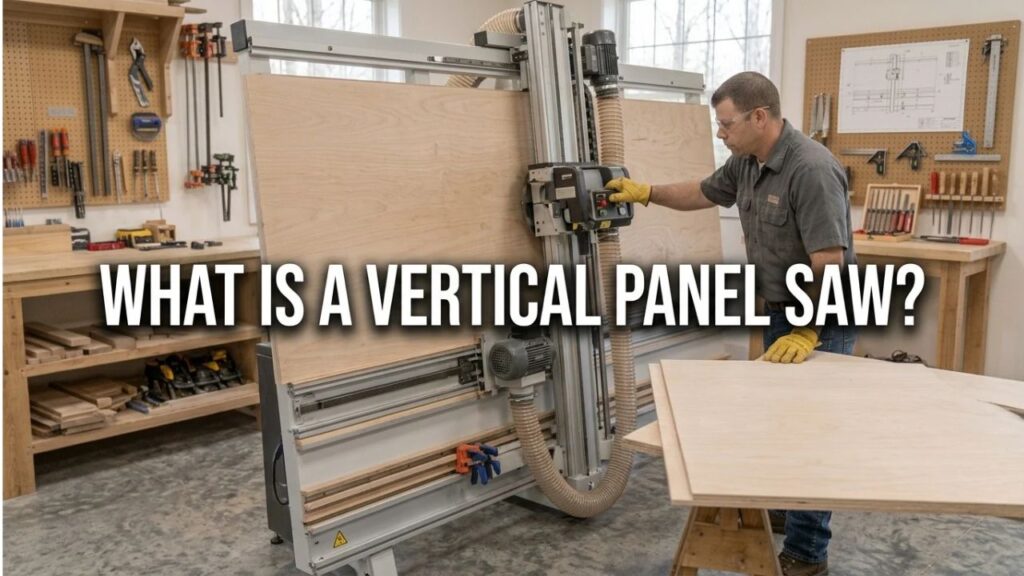
A vertical panel saw is a woodworking machine designed to cut large sheet materials while the panel stands nearly upright against a tall support frame. Instead of pushing a full sheet across a table saw, the operator places plywood, MDF, particleboard, laminate, plastic, or another panel on the machine’s lower supports and moves the saw carriage through the material.
Vertical panel saws are especially useful for cutting large 4 × 8-foot sheets because the material remains supported by the frame. This can make sheet handling easier and require considerably less floor space than cutting the same panel on a large table saw.
For a vertical crosscut, the sheet normally remains stationary while the saw carriage travels downward through it. On many models, the saw head can also rotate 90 degrees for horizontal rip cuts. In that configuration, the carriage is locked at the required height and the sheet is moved sideways through the blade.
This type of saw is common in cabinet shops, lumberyards, home-improvement stores, sign shops, furniture manufacturing, and businesses that regularly break down large sheet goods.
A vertical panel saw should not be confused with a handheld circular saw and straightedge. Both can cut large sheets, but the panel saw provides a dedicated frame, guides, material supports, and measuring system designed specifically for repeated panel processing.
In this guide, I’ll explain what a vertical panel saw is, how it works, its major components, what materials it can cut, the difference between rip and crosscut operation, its advantages and disadvantages, and how it compares with table saws and sliding panel saws.
What Does a Vertical Panel Saw Do?
The primary purpose of a vertical panel saw is to break large panels into smaller, accurately sized pieces.
Imagine trying to cut a 4 × 8 sheet of 3/4-inch plywood on a conventional jobsite table saw.
The sheet is large, heavy, and awkward.
You need significant support in front of, behind, and beside the saw. The operator may also need to control a large portion of the sheet while keeping it tight against the fence.
A vertical panel saw changes the process.
The sheet is placed on edge on a series of supports or rollers at the bottom of the machine. The tall rear frame keeps the material supported over a large surface.
The operator then positions the sheet or saw carriage according to the desired cut.
This arrangement is particularly useful for repetitive straight cuts.
Typical Vertical Panel Saw Jobs
A vertical panel saw may be used to cut:
Plywood cabinet components, MDF shelving, particleboard panels, melamine boards, furniture panels, sign material, plastic sheets, composite panels, and similar large sheet goods.
The exact material capacity depends on the machine, blade, motor, and manufacturer instructions.
Some industrial vertical panel saws are designed for much heavier production than portable or shop-oriented models.
Why Is It Called a Vertical Panel Saw?
The name describes the machine’s basic configuration.
Vertical refers to the way the sheet material is held.
Instead of lying flat on a horizontal table, the panel is positioned nearly vertically, usually with a slight backward lean.
Panel refers to the large sheet materials the machine is designed to cut.
Saw refers to the motor-driven circular blade mounted in a guided carriage.
The machine combines these three characteristics into a specialized cutting system.
Is the Saw Completely Vertical?
Usually not.
Many vertical panel saws lean backward slightly.
This allows gravity to help keep the sheet against the support frame.
The exact angle varies by manufacturer and machine design.
You should never change the machine’s angle simply because you think it should stand perfectly upright. The manufacturer’s mounting geometry is part of the machine’s safe operating design.
Key Takeaways:
- A vertical panel saw holds large sheet material almost upright instead of flat.
- It is primarily designed for straight crosscuts and rip cuts in panels.
- The supported vertical layout reduces the amount of floor space needed for large-sheet cutting.
How Does a Vertical Panel Saw Work?
A vertical panel saw uses a motor and circular saw blade mounted on a carriage.
The carriage moves along a rigid vertical guide system.
The material rests against the frame and is supported from below.
For a typical crosscut, the carriage starts above the panel and travels downward.
The blade cuts through the sheet as the carriage moves along its guide.
Because the carriage path is fixed by the machine, the cut can be much straighter and more repeatable than trying to guide a handheld circular saw freehand.
The Material Support Frame
The frame is one of the defining features of the machine.
It supports a large portion of the sheet so the operator does not have to balance the full panel manually.
Depending on the machine, the support surface may use:
Horizontal rails, vertical supports, replaceable plastic strips, rollers, or other low-friction components.
The design needs to support the sheet without interfering with the rotating blade.
The Saw Carriage
The motor and blade move together as a carriage.
Guide tubes, tracks, or rails keep the carriage traveling along a controlled path.
Many machines use a counterweight to offset some of the carriage weight.
This makes it easier for the operator to raise and lower the saw.
Counterbalance System
A counterbalance is especially useful because the saw carriage can be relatively heavy.
Without assistance, repeatedly raising the motor to the top of the machine would be tiring.
A cable and counterweight system can reduce the effective weight the operator feels.
The counterbalance should move freely and must not be obstructed by walls, brackets, dust hoses, or other equipment.
How Does a Vertical Panel Saw Make Crosscuts?
Crosscutting is one of the easiest operations on a vertical panel saw.
For this type of cut, the blade generally remains in its normal vertical cutting orientation.
The sheet is positioned horizontally along the lower supports until the desired cut line is beneath the carriage.
The operator then locks or stabilizes the material as required and moves the saw carriage downward.
The blade travels across the width of the panel.
Example
Suppose you have a 4 × 8 sheet of plywood and need to shorten it from 96 inches to 72 inches.
You position the sheet so the cut line is aligned with the vertical saw carriage.
The sheet stays in position.
The saw carriage moves down through the 48-inch width.
You now have a 4 × 6-foot section and a 2-foot offcut.
This is a vertical crosscut.
How Does a Vertical Panel Saw Make Rip Cuts?
Many vertical panel saws can also perform horizontal rip cuts.
The procedure is different.
On models designed for ripping, the saw head can normally rotate approximately 90 degrees.
The carriage is positioned at the desired height and locked.
Then the sheet is pushed horizontally across the machine through the blade.
Example
Suppose you want to cut a 48-inch-wide plywood sheet into two pieces approximately 24 inches wide.
The saw carriage is positioned at the required height.
The motor assembly is rotated into the rip-cut orientation according to the machine instructions.
The carriage is secured.
The operator then feeds the sheet sideways across the bottom rollers.
The blade cuts along the full length of the sheet.
Not Every Model Works Identically
Some machines have different rip-cut mechanisms, capacities, stops, or carriage-locking systems.
Never assume that the procedure from one panel saw applies to another.
Follow the manual for the exact machine.
Main Parts of a Vertical Panel Saw
Understanding the parts makes it easier to understand how the machine operates.
Frame
The frame is the large structural assembly that supports everything.
It provides support for the material and mounting points for the saw guides.
Because the frame determines machine geometry, bending or twisting it can affect cutting accuracy.
Guide Rails or Tubes
The carriage moves along vertical guides.
These must remain straight and correctly aligned.
Dirt, damage, or incorrect adjustment can make the carriage bind or affect cut quality.
Saw Carriage
The carriage carries the motor, blade, guards, and related hardware.
It moves up and down the guide structure during crosscutting.
Saw Motor
Most panel saws use an electric motor to turn a circular saw blade.
Motor power varies widely depending on whether the machine is a portable shop model or an industrial production saw.
Circular Saw Blade
The blade resembles other circular saw blades but must match the machine’s required:
Diameter, arbor size, kerf, speed rating, material, and intended cutting application.
A blade intended for plywood may not be ideal for plastics or other specialized materials.
Blade Guard
The guard helps reduce accidental contact with the blade and helps contain debris.
Do not remove or defeat the guard simply to make a difficult cut.
Material Supports
Panels rest on supports along the bottom of the frame.
Some machines use rollers so large panels can slide easily from side to side.
Measuring Scale
Most panel saws include rulers or measuring systems that help position sheet material for repetitive cuts.
These scales should be calibrated after the machine is mounted and squared.
Stops
Optional or built-in stops can make repetitive production easier.
For example, if you need twenty panels cut to exactly the same length, a stop can reduce repeated measuring.
Counterweight and Cable
The counterweight offsets carriage weight.
The cable and pulley system should be inspected regularly and kept free of interference.
Dust Collection System
Some panel saws include dust collection ports or optional dust kits.
Dust control is important when cutting MDF, particleboard, plywood, and similar materials that generate substantial fine dust.
Key Takeaways:
- The carriage controls the vertical movement of the saw.
- The frame supports both the machine and the sheet material.
- Measuring scales, stops, rollers, and counterweights make repetitive panel processing easier.
What Materials Can a Vertical Panel Saw Cut?
Wood-based sheet materials are the most common.
These include:
Plywood, MDF, particleboard, melamine-faced panels, oriented strand board, and many laminated sheet products.
However, machine capabilities can extend beyond wood.
Plastic Sheets
Some panel saws can cut acrylic, polycarbonate, PVC sheet, and similar plastics when equipped with the correct blade and operated at appropriate feed conditions.
Plastic can chip or melt when cut incorrectly.
Blade selection becomes especially important.
Aluminum Composite Material
Sign shops may use certain vertical panel saws to process aluminum composite panels.
Again, the saw and blade must be approved for the material.
Solid Aluminum Sheets
Do not assume a woodworking panel saw can cut solid aluminum merely because the material is thin.
The machine manufacturer must permit it, and a suitable nonferrous blade, appropriate guarding, and operating procedure are required.
Drywall or Cement-Based Panels
Some specialized panel saw systems can process additional construction materials, but this varies greatly.
A machine intended for woodworking should not automatically be used on fiber cement, masonry products, or other abrasive sheets.
These materials can generate hazardous dust and rapidly destroy unsuitable blades.
Check the machine rating first.
Can a Vertical Panel Saw Cut Solid Lumber?
It is primarily a sheet-goods machine.
Although some designs may physically cut certain boards, a panel saw is generally not the best tool for conventional dimensional lumber.
Table saws, miter saws, radial arm saws, or other woodworking machinery may be more appropriate depending on the cut.
The support geometry and guarding on a panel saw are designed around panels.
Do not use it for unconventional workpieces unless the manufacturer approves that application.
What Is a Vertical Panel Saw Used for in a Cabinet Shop?
Cabinet shops frequently need to convert large sheets into cabinet sides, shelves, backs, doors, and other rectangular parts.
A vertical panel saw is well suited to the initial breakdown stage.
For example, a cabinetmaker might start with a 4 × 8 sheet of 3/4-inch plywood.
The panel saw can quickly divide that sheet into manageable rectangular blanks.
Those blanks may then move to:
A table saw, CNC router, edge bander, drilling machine, or assembly station.
Why Cabinet Shops Like Them
They reduce the physical effort required to handle full sheets.
They also use wall space efficiently.
A sliding table saw capable of safely processing 4 × 8 sheets can occupy a large portion of a small shop.
A vertical panel saw has a relatively narrow footprint because most of the panel stands upright.
Why Do Home Improvement Stores Use Vertical Panel Saws?
You’ve probably seen a panel saw in a lumber or home-improvement store.
Customers often buy full-size sheets but need them cut down for transportation.
A vertical saw is ideal for this environment.
An employee can load the panel onto the frame, position it according to the requested dimension, and make a straight cut without needing a huge horizontal table.
Production Efficiency
Because the frame supports the material, large sheets can be processed quickly.
The machine also keeps the cutting operation in a relatively compact area.
This makes it useful in retail environments where floor space is valuable.
Vertical Panel Saw vs. Table Saw
Both machines can cut sheet goods, but they handle them very differently.
| Feature | Vertical Panel Saw | Table Saw |
| Panel orientation | Nearly vertical | Horizontal |
| Large-sheet handling | Excellent | Can be difficult |
| Floor-space requirement | Relatively low | High with infeed/outfeed support |
| Crosscuts in large sheets | Excellent | Often awkward |
| Rip cuts | Good on equipped models | Excellent |
| Small parts | Less convenient | Excellent |
| Angled/beveled cuts | Model dependent | Usually more versatile |
| Repetitive panel breakdown | Excellent | Good with proper setup |
Which Is Better for Full Sheets?
For routinely breaking down 4 × 8 panels, the vertical saw is often easier.
For cutting narrow boards, small cabinet components, dados, bevels, and a wide variety of woodworking operations, the table saw is generally more versatile.
Many professional shops use both.
The panel saw breaks large sheets into manageable blanks, and the table saw performs subsequent precision operations.
Vertical Panel Saw vs. Sliding Table Saw
A sliding table saw is another high-quality solution for sheet processing.
The panel lies flat on a large sliding carriage.
The operator moves the carriage past a stationary saw blade.
Advantages of a Sliding Saw
Sliding saws can provide excellent accuracy and are highly versatile.
Many support crosscuts, rip cuts, miters, and bevels.
They are common in professional cabinet and furniture factories.
Advantage of a Vertical Saw
Floor space is the major difference.
A large sliding saw needs substantial horizontal room for both the machine and moving carriage.
A vertical saw places the sheet upright, dramatically reducing its footprint.
For a smaller shop that mainly needs rectangular sheet breakdown, that can be a major advantage.
Vertical Panel Saw vs. Track Saw
A track saw is much smaller and more portable.
The operator lays a guide rail directly on the sheet and runs the handheld saw along it.
A track saw can make extremely accurate cuts when used correctly.
Why Choose a Track Saw?
It costs less than a commercial panel saw.
It is portable.
It can be stored when not needed.
It also allows the panel to remain supported on a workbench or foam board.
Why Choose a Vertical Panel Saw?
A panel saw excels at repeated production.
Once calibrated, it provides a permanent cutting station with built-in support and measuring systems.
If you cut dozens of sheets every week, repeatedly laying out track saw rails becomes less efficient.
Advantages of a Vertical Panel Saw
The biggest advantage is easier handling of large sheets.
A full sheet of MDF can be extremely heavy.
Moving it over a horizontal table while maintaining control requires substantial strength and space.
On a vertical machine, much of the weight remains supported by the lower rollers or supports.
Saves Floor Space
This is another major advantage.
The sheet stands nearly vertically rather than lying flat.
A vertical machine can therefore fit along a shop wall while leaving more working floor area available.
Fast Repetitive Cuts
Measuring scales and stops make repetitive work efficient.
This is valuable in production shops and retail cutting operations.
Straight Guided Crosscuts
The saw carriage follows a fixed guide path.
This eliminates much of the challenge of steering a handheld saw accurately across a large sheet.
Reduced Large-Sheet Handling
The operator does not need to balance the entire sheet over a small saw table.
That can improve both convenience and control.
Key Takeaways:
- Vertical panel saws are particularly good for repetitive large-sheet breakdown.
- Their biggest advantages are compact footprint and easier panel handling.
- They complement rather than completely replace table saws and other woodworking machines.
Disadvantages of a Vertical Panel Saw
A panel saw is specialized equipment.
That creates limitations.
Less Versatile Than a Table Saw
A table saw can perform many operations beyond basic panel cutting.
A vertical panel saw is primarily intended for straight panel cuts.
Takes Up Wall Space
Although it saves floor space, it requires a substantial uninterrupted wall or machine footprint.
A crowded garage may not have enough width for both the machine and full-sheet movement.
Can Be Expensive
Professional vertical saws can cost considerably more than a circular saw or track saw.
The investment makes the most sense when sheet processing is frequent.
Calibration Matters
A panel saw is only accurate if it is properly mounted, squared, and maintained.
Frame twist, worn rollers, loose carriage components, or an improperly calibrated measuring scale can cause inaccurate cuts.
Not Ideal for Tiny Pieces
Small workpieces may not be safely or conveniently supported.
Use machinery designed for small parts instead of trying to force a panel saw into a job outside its intended purpose.
Is a Vertical Panel Saw Accurate?
A properly installed and calibrated machine can produce very accurate straight cuts.
Accuracy depends on:
Frame alignment, carriage condition, blade quality, measuring-scale calibration, material support, and operator technique.
Squareness Is Critical
A vertical crosscut needs to be exactly perpendicular to the material-support line.
If the guide is slightly out of square, the error becomes more noticeable across a wide panel.
For example, a tiny angular error over a few inches may seem insignificant.
Across a 48-inch-wide sheet, it can produce a visibly out-of-square edge.
Blade Quality Matters
A dull or inappropriate blade can wander, chip laminate, burn material, or create rough edges.
Use a blade matched to the panel material and cut-quality requirements.
What Kind of Blade Does a Vertical Panel Saw Use?
Most use circular saw blades, but the exact diameter and arbor depend on the machine.
Blade selection should follow the manufacturer’s specifications.
For plywood and finished sheet goods, a fine-tooth carbide blade commonly provides cleaner cuts than a coarse framing blade.
Melamine and laminated panels may require blades specifically designed to reduce chipping.
Plastics may require a different tooth geometry and feed speed.
Never Install an Oversized Blade
An oversized blade can contact guards or other machine components.
It also changes blade-tip speed and cutting geometry.
Use only the blade diameter and arbor size approved for the saw.
Is a Vertical Panel Saw Safe?
It can be very safe when correctly installed and operated, but it remains a powerful circular saw.
The blade can cause severe injury.
Safety depends on using all guards and following the manufacturer’s procedures.
Wear Eye and Hearing Protection
Cutting sheet goods can produce flying chips and substantial noise.
Use appropriate safety glasses and hearing protection.
Control Dust
MDF and similar products create very fine dust.
Use dust collection when available and appropriate respiratory protection when required.
Keep Hands Away From the Blade Path
Never reach across the cutting line while the blade is operating.
Wait until the blade has fully stopped before repositioning scraps near the cutting area.
Support the Offcut
Large cut pieces can shift unexpectedly after separation.
Make sure both the main workpiece and offcut remain adequately supported.
Disconnect Power Before Adjustments
Unplug or lock out the machine before:
Changing blades, adjusting guards, servicing the carriage, working on the counterbalance, or correcting mechanical problems.
Can One Person Use a Vertical Panel Saw?
Many vertical panel saws are designed so one trained operator can process typical sheet materials.
However, panel size and weight matter.
A large sheet of thick MDF can be extremely heavy even if the machine supports it once loaded.
Loading that sheet onto the saw may require two people or mechanical assistance.
Do not exceed safe manual-handling limits simply because the saw itself can hold the material.
Who Should Buy a Vertical Panel Saw?
A vertical panel saw makes the most sense when you regularly process full-size sheet goods.
Good candidates include:
Cabinet shops, furniture builders, sign shops, lumberyards, home-improvement retailers, display manufacturers, remodeling businesses, and production shops.
Home Workshops
A serious home woodworker who builds cabinets frequently may also benefit from one.
However, someone who cuts only a few sheets per year will probably get better value from a track saw or circular saw with a guide.
The machine’s cost and permanent space requirements need to be justified by how often it will be used.
What to Look for When Choosing a Vertical Panel Saw
Start with cutting capacity.
Make sure the saw can handle the maximum sheet dimensions and thickness you use.
Then consider:
Crosscut capacity, rip capacity, motor power, blade size, frame stiffness, measuring system, dust collection, available stops, portability, and mounting method.
Production Volume
Occasional shop use and full-day commercial production are very different applications.
An industrial saw should be designed for the required duty cycle.
Material Type
If you regularly cut laminated panels, plastics, or specialty sheets, verify that the machine supports those materials and that appropriate blades are available.
Available Space
Measure the complete operating area, not just the frame.
You need enough side clearance to move the longest panels you plan to cut.
Does a Vertical Panel Saw Replace a Table Saw?
Usually not completely.
The two machines are best viewed as complementary.
The vertical saw excels at breaking large panels down into manageable rectangular pieces.
The table saw excels at processing those smaller parts and handling numerous other woodworking operations.
A cabinet shop might use the vertical saw to divide a 4 × 8 sheet into rough-sized cabinet components, then use a table saw or CNC machine for final sizing and machining.
That workflow combines the strengths of both machines.
Common Mistakes With Vertical Panel Saws
One mistake is assuming the machine is simply a circular saw mounted to a frame.
The frame alignment, carriage system, counterbalance, and material supports are all part of the machine’s cutting accuracy and safety.
Another mistake is trying to cut unsupported small pieces.
Another is using an incorrect blade for the material.
Operators may also forget to lock the carriage correctly before a rip cut on machines that require it.
Poor mounting is another major issue. A twisted or unstable frame can make even a high-quality saw perform badly.
Finally, measuring scales should not be trusted until they have been calibrated with actual test cuts.
FAQs about What Is a Vertical Panel Saw
What is a vertical panel saw?
A vertical panel saw is a stationary or semi-portable cutting machine that holds large sheet materials almost upright while a guided circular saw cuts them.
What is a vertical panel saw used for?
It is used primarily to cut large sheets of plywood, MDF, particleboard, melamine, plastics, and similar panel materials into smaller pieces.
How does a vertical panel saw work?
The material rests on a support frame while a motorized saw carriage moves along guides.
For crosscuts, the carriage normally moves vertically through the sheet.
Can a vertical panel saw make rip cuts?
Many models can.
The saw head is rotated into a horizontal cutting orientation, the carriage is locked at the desired height, and the sheet is moved sideways through the blade.
Can a vertical panel saw cut plywood?
Yes.
Plywood is one of the most common materials cut on a panel saw.
Can it cut MDF?
Yes, provided the machine and blade are suitable.
Good dust collection is particularly important because MDF produces fine dust.
Can a panel saw cut melamine?
Yes, with the correct fine-finish or laminate-oriented blade and proper machine setup.
Chipping can be a concern.
Can it cut plastic?
Some models can cut plastics when equipped with an appropriate blade.
Always check the manufacturer’s material recommendations.
Can a vertical panel saw cut metal?
Certain machines may be approved for specific nonferrous or composite materials, but a woodworking panel saw should not automatically be used for metal.
Is a vertical panel saw better than a table saw?
For handling full-size sheet goods, it can be easier and more space-efficient.
A table saw is generally more versatile for other woodworking operations.
Is a vertical panel saw better than a track saw?
It is better for repetitive production and permanent shop use.
A track saw is less expensive and much more portable.
Does a vertical panel saw take up less space?
Usually yes.
Because the material is nearly upright, the machine requires much less horizontal floor space than many large-sheet table-saw setups.
Is a vertical panel saw accurate?
Yes, when correctly mounted, aligned, calibrated, and fitted with an appropriate blade.
Why does a vertical panel saw lean backward?
The lean helps gravity keep panels against the support frame and is part of the machine’s intended geometry.
Does every panel saw have a counterweight?
No, but many vertical designs use counterweights or another balancing mechanism to make carriage movement easier.
Can one person operate a panel saw?
Often yes, although heavy sheets may require a second person or lifting equipment for safe loading.
What size sheets can a vertical panel saw cut?
Many are designed around common 4 × 8-foot sheet goods, while industrial models may handle larger panels.
Check the specific machine capacity.
Can you cut small pieces on a vertical panel saw?
The machine is primarily designed for panels.
Very small workpieces may not be adequately supported and should be cut with a more appropriate tool.
Do panel saws use circular saw blades?
Most vertical panel saws use circular blades, although the required diameter, arbor, tooth design, and speed rating depend on the machine.
Are panel saws dangerous?
Like any powered saw, they can cause serious injury if used improperly.
Guards, proper mounting, correct material support, and safe operating procedures are essential.
Where are vertical panel saws commonly used?
They are common in cabinet shops, lumberyards, home-improvement stores, sign shops, furniture factories, and other businesses that regularly cut large panels.
Is a panel saw worth it for a home shop?
It can be if you regularly process large quantities of sheet goods and have permanent space for the machine.
For occasional use, a track saw may be more economical.
Conclusion
So, what is a vertical panel saw? It is a specialized machine that holds large sheet material almost vertically while a guided circular saw cuts it into smaller pieces.
Its main advantage is the way it handles full-size panels.
Instead of balancing a 4 × 8 sheet across a relatively small table saw, you place the sheet on the panel saw’s lower supports and let the tall frame support most of the material.
For a crosscut, the sheet normally stays in place while the saw carriage travels vertically through it. On many machines, the saw head can rotate for rip cutting, allowing the carriage to remain at a fixed height while the sheet moves horizontally through the blade.
Vertical panel saws are commonly used for plywood, MDF, particleboard, melamine, plastics, and other large sheet goods. That makes them particularly valuable in cabinet shops, furniture manufacturing, sign shops, lumberyards, and retail building-supply stores.
Their major benefits are easy large-sheet handling, a relatively small floor footprint, fast repetitive cuts, and guided cutting accuracy.
Their primary limitation is specialization. A panel saw is excellent at breaking down large sheets, but it generally does not replace the versatility of a table saw, sliding saw, CNC router, or other woodworking machinery.
For someone who processes full-size panels frequently, however, a vertical panel saw can turn one of the most awkward woodworking tasks into a much faster and more controlled operation.