What Is an Abrasive Saw? Types, Uses & How It Works
If you are wondering what is an abrasive saw, it is a power saw that cuts material with a high-speed abrasive cutting wheel instead of a conventional toothed saw blade. The wheel contains hard abrasive particles bonded together, and those particles grind away material as the wheel passes through metal, masonry, concrete, or other suitable materials.
Abrasive saws are also commonly called cut-off saws or, particularly in stationary metalworking applications, abrasive chop saws. A typical shop model has a 14-inch abrasive wheel mounted on a pivoting saw head above a metal base. The workpiece is clamped in a vise, the motor brings the wheel to speed, and the operator lowers it through the material.
Unlike a toothed blade that creates chips with individually sharpened teeth, an abrasive wheel continuously wears as it cuts. Fresh abrasive particles become exposed as the bonded wheel gradually erodes. For this reason, an abrasive saw wheel becomes smaller in diameter with use.
Abrasive saws are popular for cutting steel pipe, tubing, angle iron, rebar, channels, and other metal stock because they are relatively simple and inexpensive. Different machines and wheels are also used for concrete, brick, stone, asphalt, and similar construction materials.
However, they have disadvantages. Abrasive cutting generates significant heat, sparks, dust, noise, and a rougher cut than many carbide or cold-saw systems. Choosing the correct wheel and operating the machine safely are therefore essential.
In this guide, I’ll explain what an abrasive saw is, how it works, what it can cut, the different types available, how it compares with chop saws and cold saws, and how to use one safely.
What Exactly Is an Abrasive Saw?
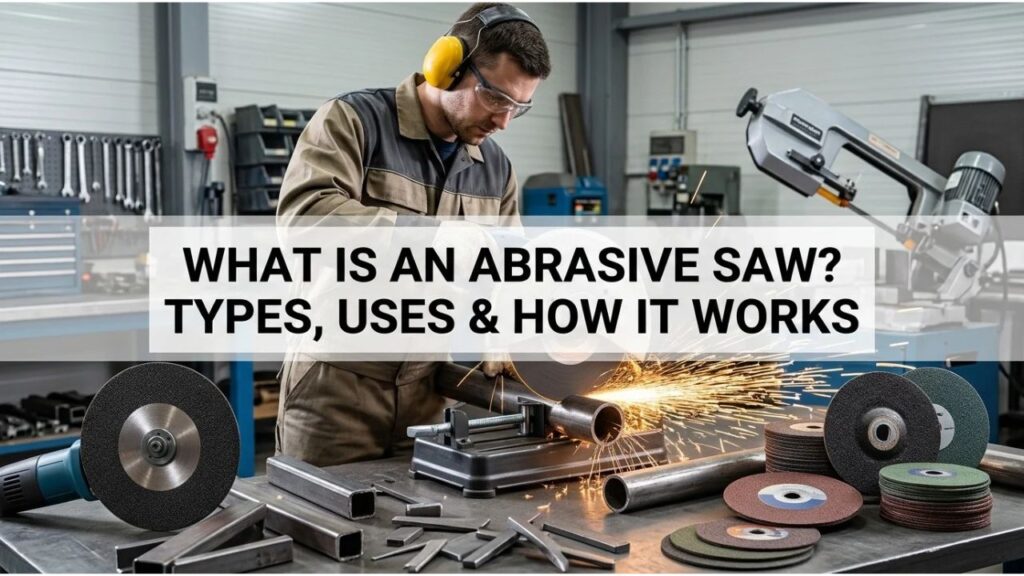
An abrasive saw is a cutting machine that uses a bonded abrasive wheel as its cutting element.
The wheel looks somewhat like a large circular saw blade from a distance, but it does not have individual teeth.
Instead, it contains abrasive grains held together by a bonding material and, in many cut-off wheels, reinforcing layers that help the thin wheel withstand operating forces.
As the wheel rotates at high speed and contacts the workpiece, the abrasive grains remove tiny particles of material.
It Cuts by Abrasion Rather Than Saw Teeth
A conventional circular saw blade cuts because its teeth repeatedly slice or shear material.
An abrasive wheel behaves more like a very thin grinding wheel.
Each abrasive grain acts as a microscopic cutting point.
As grains become dull or break away, new cutting surfaces are exposed.
This continuous wearing process allows the wheel to keep cutting, but it also means the wheel gradually decreases in diameter.
Abrasive Saw vs. Abrasive Wheel
The saw is the complete machine.
The abrasive wheel is the replaceable cutting accessory mounted on the spindle.
Using the correct wheel is critical because wheels are designed for specific:
Materials, diameters, thicknesses, arbor sizes, maximum speeds, and machine types.
A wheel that physically fits the arbor is not necessarily safe or appropriate for the saw.
What Is an Abrasive Saw Used For?
Abrasive saws are especially common in metal fabrication and construction.
A stationary abrasive chop saw is useful for rapidly cutting stock to length before:
Welding, fabrication, machining, or installation.
Typical metal workpieces include steel tubing, pipe, solid bar, rebar, angle iron, flat bar, channel, and structural sections.
Portable abrasive cut-off saws can be used on construction sites for materials that cannot easily be brought to a stationary saw.
Larger machines may cut masonry, concrete, stone, pavement, or other mineral products when equipped with the correct wheel and dust-control system.
Key Takeaways:
- An abrasive saw cuts with a high-speed abrasive wheel rather than sharpened teeth.
- The cutting wheel gradually wears smaller during use.
- Abrasive saws are widely used for metal fabrication and construction materials.
How Does an Abrasive Saw Work?
The operating principle is straightforward.
An electric motor, gasoline engine, pneumatic motor, or other power source rotates an abrasive wheel at high speed.
The wheel’s outer edge contacts the material.
Abrasive particles remove material from a narrow path called the kerf until the workpiece is separated.
Friction Creates Heat
Abrasive cutting generates considerably more friction than many toothed cutting methods.
That heat can cause the freshly cut metal to become extremely hot.
The workpiece may show:
Discoloration, burrs, slag-like deposits, or hot edges.
Never assume a freshly cut piece of steel is safe to pick up immediately with bare hands.
The Wheel Sacrifices Itself
An abrasive cutting wheel is a consumable.
Every cut removes a small amount of the wheel along with material from the workpiece.
As the wheel becomes smaller, its maximum cutting depth decreases.
Eventually, it becomes too small for practical use and needs replacement.
Sparks Are Normal When Cutting Steel
The bright spark stream produced when cutting steel consists largely of hot material removed from the workpiece and abrasive debris.
Sparks are expected, but their direction must be controlled.
They should never be directed toward:
Flammable liquids, combustible dust, gas cylinders, electrical cables, vehicles, finished surfaces, or people.
What Is an Abrasive Chop Saw?
An abrasive chop saw is the most familiar stationary type of abrasive saw.
It resembles a heavy-duty miter saw but is designed primarily for cutting metal.
Typical components include:
A base, material vise, pivoting motor head, abrasive wheel, blade guard, handle, trigger switch, and adjustable fence.
Many common shop models use a 14-inch cut-off wheel.
How It Is Used
The workpiece is placed against the fence and secured in the vise.
After the wheel reaches operating speed, the operator lowers it gradually through the material.
The head pivots downward until the cut is complete.
The operator then raises the head and allows the wheel to stop before handling the cut pieces.
Can an Abrasive Chop Saw Make Angle Cuts?
Many models have adjustable fences that allow basic miter cuts, commonly up to approximately 45 degrees.
However, an abrasive chop saw is generally less precise than a quality cold saw or metal-cutting miter saw.
It is primarily a fast stock-cutting machine.
Types of Abrasive Saws
The term abrasive saw covers several different machine configurations.
Stationary Abrasive Chop Saw
This is the common workshop machine used for steel stock.
It is compact, relatively inexpensive, and simple to operate.
A vise holds the material while the wheel pivots downward.
This type is excellent for fabrication shops, farms, garages, and construction work where extremely smooth cuts are not required.
Handheld Cut-Off Saw
A portable cut-off saw carries a large abrasive or diamond wheel in a handheld power unit.
Depending on the machine, power may come from:
Gasoline, battery, or electricity.
These saws are frequently used on construction sites to cut concrete, masonry, metal, pipe, and pavement.
They require considerably more operator control than a stationary machine.
Masonry Saw
Some masonry saws use abrasive or diamond cutting wheels specifically for:
Brick, block, stone, tile, and similar mineral materials.
Wet-cutting systems may supply water to the wheel to help control dust and cooling where the saw and wheel are designed for wet operation.
Floor and Walk-Behind Saw
Large floor saws use abrasive or diamond wheels to cut:
Concrete slabs, asphalt, roads, expansion joints, and pavement.
These are specialized construction machines rather than ordinary workshop chop saws.
What Are Abrasive Cutting Wheels Made From?
A bonded abrasive wheel contains abrasive particles held in a matrix.
The precise formulation varies according to the intended material.
Aluminum Oxide
Aluminum oxide is widely used for cutting:
Steel and other ferrous metals.
Many 14-inch chop-saw wheels intended for general steel fabrication use aluminum oxide abrasive.
It provides a useful combination of cutting speed, durability, and cost.
Silicon Carbide
Silicon carbide is another common abrasive.
It is frequently used in wheels intended for materials such as:
Masonry, stone, and certain nonferrous applications.
However, abrasive formulations are specialized, so you should not select a wheel based solely on whether it contains aluminum oxide or silicon carbide.
The manufacturer’s material rating should determine your choice.
Modern Premium Abrasives
Higher-performance cut-off wheels may use ceramic or other engineered abrasive grains.
These can provide faster cutting and longer life in demanding applications.
The wheel’s label remains the best guide to its intended material and maximum operating speed.
What Materials Can an Abrasive Saw Cut?
The answer depends primarily on the wheel.
| Material | Can an Abrasive Saw Cut It? | Typical Requirement |
| Mild steel | Yes | Metal cut-off wheel |
| Steel pipe | Yes | Metal cut-off wheel |
| Rebar | Yes | Metal cut-off wheel |
| Angle iron | Yes | Metal cut-off wheel |
| Stainless steel | Yes | Wheel rated for stainless |
| Cast iron | Often | Appropriate metal wheel |
| Aluminum | Only with suitable wheel | Wheel specifically approved |
| Brick | Yes | Masonry-rated wheel |
| Concrete | Yes | Concrete/masonry wheel |
| Stone | Yes | Appropriate masonry/stone wheel |
| Wood | Generally not recommended | Use a woodworking saw instead |
| Plastic | Usually better with another saw | Material-specific cutting method |
Never assume a metal wheel can also be used on masonry or vice versa.
Use the exact material categories printed on the wheel or specified by the manufacturer.
Can an Abrasive Saw Cut Steel?
Yes. Steel is one of the most common materials cut with stationary abrasive saws.
A properly equipped abrasive chop saw can cut:
Steel pipe, square tubing, rectangular tubing, angle iron, flat bar, channel, rebar, and solid stock within the machine’s capacity.
Why Abrasive Saws Are Popular for Steel
They are relatively inexpensive compared with many cold saws.
They also require no expensive carbide-tipped steel blade.
If you need rough fabrication cuts before welding, an abrasive saw can be very practical.
The Cut Will Be Hot
A major disadvantage is heat.
The cut edge may be hot enough to burn skin immediately after cutting.
Heat can also discolor the metal.
If a cool, burr-minimized, highly accurate cut is important, another saw may be preferable.
Can an Abrasive Saw Cut Aluminum?
It can if the specific wheel is approved for aluminum or other nonferrous material.
Do not automatically use a wheel intended only for steel.
Aluminum can load certain abrasive wheels, reducing cutting effectiveness and potentially creating unsafe operating conditions.
If aluminum is a regular part of your work, a carbide-tipped nonferrous-metal saw may produce cleaner and faster results.
Can an Abrasive Saw Cut Concrete?
Yes, but use a machine and abrasive or diamond wheel specifically designed for concrete or masonry.
Concrete cutting introduces additional hazards because it can produce large amounts of fine dust.
Depending on the concrete composition, that dust can contain respirable crystalline silica.
Professional construction work may require engineering controls such as:
Water delivery or dust extraction.
Never assume an indoor metal chop saw is an appropriate concrete-cutting machine merely because you can install a wheel that looks suitable.
The machine, guard, wheel, and dust-control method all need to be appropriate for the application.
Key Takeaways:
- Wheel selection determines what an abrasive saw can safely cut.
- Aluminum oxide wheels are commonly used for steel, while masonry applications often use different abrasive formulations.
- Concrete and masonry cutting require serious attention to dust control.
Abrasive Saw vs. Chop Saw: What’s the Difference?
The terminology overlaps.
A stationary abrasive saw is commonly called an abrasive chop saw because the cutting head chops downward through the material.
However, not every chop saw uses an abrasive wheel.
Modern metal-cutting chop saws may use carbide-tipped toothed blades instead.
So:
Abrasive saw describes the cutting technology.
Chop saw often describes the pivoting machine configuration.
A machine can therefore be both an abrasive saw and a chop saw.
Abrasive Saw vs. Cold Saw
These machines both cut metal but work very differently.
| Feature | Abrasive Saw | Cold Saw |
| Cutter | Abrasive wheel | Toothed metal blade |
| Cutting action | Grinding/abrasion | Tooth cutting |
| Heat | High | Relatively low at workpiece |
| Sparks | Many | Very few |
| Cut finish | Rougher | Cleaner |
| Burrs | More common | Usually less |
| Wheel/blade wear | Wheel shrinks continuously | Blade can often be resharpened |
| Initial machine cost | Lower | Higher |
| Precision | Moderate | Usually higher |
Why Is It Called a Cold Saw?
A cold saw uses a toothed blade at relatively low rotational speed, often with coolant.
Much of the cutting heat is carried away in the chips rather than being concentrated in the workpiece.
The result is generally a cooler and cleaner cut.
When Is an Abrasive Saw Better?
Choose an abrasive saw when you want:
Low initial cost, simple operation, portability, and fast rough cuts.
For occasional steel fabrication, those advantages can outweigh its rougher finish.
When Is a Cold Saw Better?
A cold saw becomes attractive when you need:
High accuracy, clean ends, minimal burrs, repeatable angles, and reduced heat.
Production fabrication often benefits from these characteristics.
Abrasive Saw vs. Carbide Metal-Cutting Saw
A carbide metal-cutting saw typically uses a toothed blade specifically designed to cut steel at an appropriate speed.
Compared with an abrasive saw, it generally produces:
Fewer sparks, a cooler workpiece, less abrasive dust, and a cleaner cut.
It can also maintain full blade diameter throughout much of its service life.
Abrasive Saw Advantage
Abrasive wheels are inexpensive and can tolerate rough fabrication environments.
Replacing a worn wheel costs much less than replacing a premium carbide metal-cutting blade.
Carbide Saw Advantage
For repeated clean fabrication cuts, the reduced heat and improved finish can save considerable cleanup time.
The right choice depends on whether initial tool cost or finished-cut quality matters more to you.
Abrasive Saw vs. Angle Grinder
Both can use abrasive cut-off wheels, but their roles are different.
An abrasive chop saw holds the material in a vise and controls the wheel through a fixed pivot.
This makes straight repetitive cuts much easier.
An angle grinder is handheld.
It offers much more freedom for:
Cutting installed material, trimming, grinding, and reaching confined locations.
For cutting multiple pieces of tubing accurately to length, I would generally choose the stationary saw.
For removing a rusted bolt underneath a vehicle, an angle grinder or compact cut-off tool is much more practical.
Why Does an Abrasive Saw Make So Many Sparks?
When abrasive grains contact steel, they remove extremely small metal particles at high speed.
These particles become very hot and oxidize as they travel through the air, producing the familiar bright spark stream.
The number and appearance of sparks vary with:
Material, wheel type, pressure, speed, and condition of the wheel.
Sparks themselves do not necessarily mean something is wrong.
The important issue is where they are going.
How to Use an Abrasive Saw Safely
Abrasive wheels rotate at high speed and can fail violently if they are damaged, incorrectly mounted, or used above their rated speed.
Good setup matters as much as cutting technique.
Inspect the Wheel Before Use
Look for:
Cracks, chips, moisture damage, distorted areas, excessive wear, or other obvious defects.
Do not use a damaged wheel.
Make sure its maximum rated speed is at least as high as the saw’s operating speed.
Also verify:
Diameter, arbor size, thickness, and material application.
Keep the Guard Installed
The wheel guard is a critical safety component.
Never remove it simply to fit a larger wheel or gain more cutting clearance.
Use only wheel sizes for which the machine was designed.
Clamp the Workpiece
A stationary abrasive chop saw normally includes a vise.
Use it.
The work should sit securely against the fence and remain stable throughout the cut.
Do not hold short steel pieces near the wheel with your fingers.
If the material cannot be securely clamped, change the setup.
Let the Wheel Reach Operating Speed
Start the machine and allow it to come to full speed before contacting the workpiece.
Listen for unusual vibration or noise.
If the wheel appears damaged or the saw vibrates abnormally, switch it off and investigate.
Lower the Wheel Smoothly
Use controlled pressure.
Do not slam the wheel into the work.
Excessive force can:
Overheat the wheel, increase wear, deflect the wheel, overload the motor, or contribute to wheel failure.
Let the abrasive do the cutting.
Don’t Side-Load a Cut-Off Wheel
Thin cut-off wheels are designed primarily for cutting on their outer edge.
Do not twist the saw head or force the side of the wheel against the workpiece as though it were a grinding disc unless that exact wheel is specifically designed and rated for such use.
Side loading can damage a thin wheel.
Wait for the Wheel to Stop
After the cut, raise the saw head and wait until the wheel stops before making adjustments or reaching into the cutting area.
Never try to stop an abrasive wheel with your hand or by pressing another object against it.
Key Takeaways:
- Inspect the wheel, match its speed rating to the machine, and keep the guard installed.
- Clamp material securely and apply smooth cutting pressure.
- Do not side-load a thin cut-off wheel or reach into the saw while it is coasting.
What PPE Should You Wear?
Abrasive saws can produce sparks, hot particles, noise, dust, and wheel fragments.
Proper personal protective equipment is important.
Wear appropriately rated eye protection.
A face shield may provide additional protection but should not replace required safety glasses.
Hearing protection is also sensible because abrasive saws are extremely loud during cutting.
Clothing
Avoid loose clothing, jewelry, dangling cords, and anything else that could enter the rotating wheel.
Wear sturdy closed-toe footwear.
Do not position yourself directly in the path where sparks and debris are discharged.
Respiratory Protection
Dust requirements depend on the material.
Metal abrasive cutting creates particulate matter.
Concrete, masonry, and stone can create particularly hazardous fine dust.
Use effective dust-control methods and respiratory protection appropriate for the job and applicable workplace requirements.
Why Does an Abrasive Saw Wheel Get Smaller?
The shrinking diameter is normal.
The abrasive grains and bonding material are consumed as the wheel cuts.
As the wheel becomes smaller:
Maximum cutting depth decreases and the machine may take longer to cut large stock.
Eventually, replacement is necessary.
Don’t Install an Oversized Wheel to Compensate
Use only the diameter approved for the saw.
An oversized wheel may exceed guard clearance and can produce excessive peripheral speed.
If a worn wheel no longer reaches through the stock, replace it with a new wheel of the specified size.
How Long Does an Abrasive Saw Wheel Last?
There is no universal number of cuts.
Wheel life depends on:
Material hardness, material cross section, abrasive formulation, wheel quality, feed pressure, machine power, and cutting technique.
Cutting thin-wall tubing may consume much less wheel per cut than cutting thick solid steel.
An operator who constantly forces the wheel may also wear it more quickly.
Replace It Before It Becomes Impractical
There is usually no benefit in trying to use an extremely small wheel merely because some abrasive material remains.
As cutting capacity decreases, productivity falls.
Follow the wheel and saw manufacturers’ replacement requirements.
Does an Abrasive Saw Need Coolant?
Typical portable shop abrasive chop saws are designed for dry cutting and generally do not use coolant.
Do not introduce water or coolant to a dry-cut machine or wheel unless both are specifically designed for wet operation.
Special industrial abrasive cut-off machines may use wet cutting.
Likewise, masonry saws may have engineered water-delivery systems.
The machine design determines whether liquid is appropriate.
Why Is My Abrasive Saw Cutting Crooked?
A crooked cut can have several causes.
A worn or flexible abrasive wheel can deflect under excessive pressure.
The workpiece may also be:
Poorly clamped, incorrectly positioned, or unsupported.
The fence or vise may be out of alignment.
Pressing Harder Can Make It Worse
Forcing the saw sideways does not straighten the cut.
It increases wheel deflection and may put dangerous side loads on the wheel.
Check setup and reduce feed pressure.
If high precision is essential, an abrasive saw may simply not be the ideal cutting machine.
Why Is My Abrasive Saw Cutting Slowly?
A slow cut can result from:
The wrong wheel, worn abrasive, glazing, inadequate motor power, low supply voltage, an overloaded circuit, excessive material thickness, or an unsuitable cutting technique.
A wheel designed for one material may cut another very poorly.
Before blaming the saw motor, verify that the wheel matches the workpiece.
Can You Put a Toothed Blade on an Abrasive Chop Saw?
Do not assume you can.
Abrasive saws and carbide metal-cutting saws may operate at very different spindle speeds.
A toothed blade must be specifically approved for the machine’s RPM, arbor, guarding, and intended cutting system.
Installing a random circular saw blade on a high-speed abrasive chop saw can be extremely dangerous.
If the manufacturer does not approve the conversion, use a purpose-built carbide metal-cutting saw instead.
Can You Cut Wood With an Abrasive Saw?
An abrasive chop saw is generally a poor choice for wood.
The wheel can:
Burn the material, generate smoke, cut inefficiently, and produce an unnecessarily rough result.
Use a:
Miter saw, circular saw, table saw, or another proper woodworking saw instead.
Likewise, do not install an ordinary woodworking blade on an abrasive saw unless the machine manufacturer explicitly approves that configuration.
Advantages of an Abrasive Saw
The biggest benefit is affordability.
A basic abrasive chop saw can provide substantial metal-cutting capacity for considerably less money than many professional cold saws.
It is also mechanically simple.
Wheels are widely available and inexpensive.
For rough fabrication work, the speed and simplicity are attractive.
The machine can handle many shapes of ferrous stock without requiring elaborate setup.
Disadvantages of an Abrasive Saw
The biggest drawbacks are:
Heat, sparks, noise, abrasive dust, wheel consumption, and comparatively rough cut quality.
Because the wheel shrinks with use, cutting capacity also changes over time.
Abrasive cutting tends to produce more burrs than a quality cold or carbide saw.
For precision fabrication, these disadvantages can increase cleanup and finishing time.
Common Abrasive Saw Mistakes
One major mistake is using a wheel rated below the saw’s spindle speed.
Another is installing the wrong wheel for the material.
Do not remove the guard to fit a larger wheel.
Do not use cracked or damaged wheels.
Do not hold short stock by hand when it can be clamped.
Avoid pushing the wheel excessively hard into the workpiece.
Never twist a thin cutting wheel sideways inside the kerf.
And always consider where sparks will land before starting the machine.
FAQs About What Is an Abrasive Saw
What is an abrasive saw?
An abrasive saw is a power saw that uses a high-speed bonded abrasive cutting wheel rather than a toothed blade to remove material and separate a workpiece.
Is an abrasive saw the same as a chop saw?
A stationary abrasive saw is commonly called an abrasive chop saw. However, some chop saws use carbide-tipped toothed blades instead of abrasive wheels.
What can an abrasive saw cut?
Depending on the wheel, it can cut steel, stainless steel, rebar, pipe, tubing, masonry, concrete, stone, and other compatible materials.
Does an abrasive saw have teeth?
No. Its cutting wheel contains abrasive grains bonded together rather than individual saw teeth.
Why does the wheel get smaller?
The abrasive wheel wears away as it cuts, continually exposing fresh abrasive grains.
Can an abrasive saw cut steel?
Yes. Cutting steel stock is one of the most common uses for stationary abrasive chop saws.
Can you cut aluminum with an abrasive saw?
Yes, but only with a wheel specifically rated for aluminum or the relevant nonferrous material.
Can an abrasive saw cut concrete?
Yes, when using a machine and wheel specifically designed for concrete or masonry.
Is an abrasive saw better than a cold saw?
It depends on the application. Abrasive saws are inexpensive and effective for rough cutting, while cold saws generally provide cleaner, cooler, and more precise metal cuts.
Why does an abrasive saw create sparks?
Abrasive grains remove tiny hot particles of metal, which glow and oxidize as they travel through the air.
Do abrasive saws need coolant?
Most common portable abrasive chop saws are dry-cut machines. Some specialized industrial and masonry systems are specifically designed for wet cutting.
Can you put a carbide blade on an abrasive saw?
Only if the saw manufacturer specifically approves the blade type, dimensions, and operating speed. Do not assume an abrasive chop saw can safely be converted.
Conclusion
So, what is an abrasive saw? It is a power cutting machine that uses a high-speed abrasive wheel to grind through material rather than cutting with conventional saw teeth.
The most familiar version is the stationary abrasive chop saw, commonly equipped with a large cut-off wheel and a vise for securing metal stock. Portable cut-off saws, masonry saws, and larger construction machines use the same general abrasive-cutting principle in different configurations.
For metal fabrication, abrasive saws are especially useful for cutting steel pipe, tubing, rebar, angle iron, channel, and similar stock. With different purpose-built wheels, abrasive cutting can also be used on concrete, brick, stone, and other materials.
The main advantages are simplicity, relatively low purchase cost, readily available cutting wheels, and good rough-cutting capacity.
The disadvantages are equally important. Abrasive saws create substantial heat, sparks, noise, dust, and burrs. Their wheels also wear continuously and become smaller with use, gradually reducing maximum cutting capacity.
Compared with a cold saw or carbide metal-cutting saw, an abrasive saw generally produces a hotter and rougher cut. However, for general fabrication where the pieces will later be welded, ground, or otherwise finished, it remains a practical and economical tool.
Whatever material you cut, use a wheel specifically rated for that application, make sure its maximum operating speed matches or exceeds the machine’s speed, keep the safety guard installed, and clamp the work securely.
The simplest way to remember the difference is this: a conventional saw cuts with teeth, while an abrasive saw cuts by grinding material away with thousands of tiny abrasive cutting points.