Why Won’t My Chainsaw Stay Running: Complete Guide and Facts
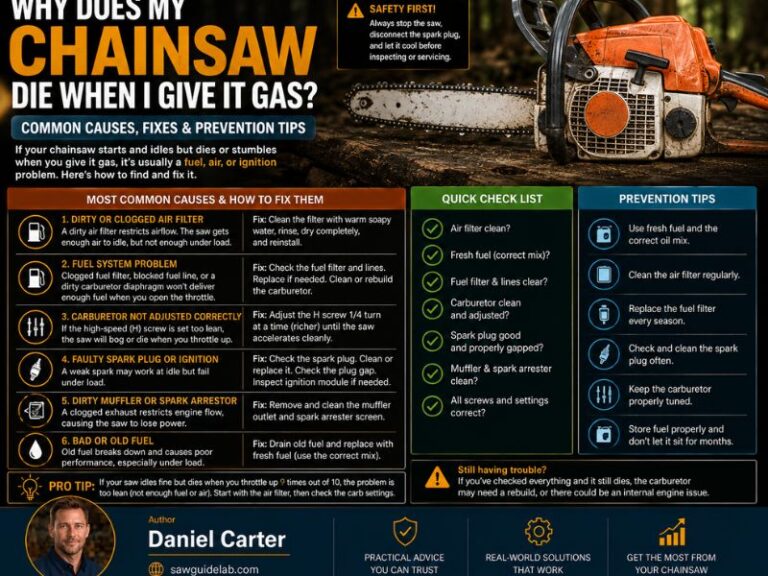
A chainsaw that starts but will not keep running usually has a fuel, air, ignition, or carburetor problem. The most common causes are stale fuel, a clogged fuel filter, a restricted air filter, an incorrect choke setting, or a carburetor that is dirty or improperly adjusted.
The timing of the shutdown provides an important clue. If the engine dies immediately after the choke opens, it may be running too lean; if it stalls when the throttle is released, the idle circuit or idle-speed adjustment may be involved. A saw that quits only when hot can point toward a failing ignition coil, blocked fuel vent, or heat-related carburetor issue, even though the engine may appear normal during a cold start.
This guide explains how to separate an easy operating mistake from a genuine mechanical fault without replacing parts unnecessarily. You will learn what to check first, how fuel flow and airflow affect engine speed, which symptoms suggest a carburetor problem, when adjustment is unsafe or ineffective, and when a technician should handle the repair. Before testing, the article also covers chain-brake position, spark-plug inspection, fuel-system checks, and the safety limits that matter when a running chain could move unexpectedly.
What the Shutdown Pattern Tells You
A two-stroke chainsaw engine needs the correct balance of fuel, air, compression, and spark. It also needs that mixture to remain stable as the choke opens, the throttle changes, and the engine warms. A saw can therefore start successfully while still having a problem that prevents it from sustaining combustion.
Pay attention to exactly when it stops. The following patterns narrow the diagnosis:
- Dies as soon as the choke is opened: The engine may not be receiving enough fuel, or the air supply may be excessive because of a leak or incorrect carburetor adjustment.
- Runs only with the choke partly on: This often indicates a lean fuel mixture caused by a clogged carburetor passage, restricted fuel filter, air leak, or inadequate fuel delivery.
- Starts, then dies after several seconds: A blocked tank vent, stale fuel, or an obstructed fuel filter may allow initial operation but prevent continued fuel flow.
- Stalls when the throttle is released: The idle-speed setting may be too low, or the idle circuit may be dirty.
- Dies when the throttle is squeezed: The engine may be flooding, starving for fuel, or unable to transition from the idle circuit to the high-speed circuit.
- Runs cold but quits when hot: Suspect an ignition component, vapor-related fuel problem, or internal wear that appears only after expansion and heat buildup.
Do not keep restarting a saw that repeatedly stalls while the chain brake is released or the chain is close to people and objects. Diagnosis should begin with the engine stopped, the chain brake engaged, and the guide bar pointed away from anything that could be damaged.
Check the Simple Operating Causes First
Confirm the choke and starting controls
A cold engine generally needs a richer mixture, so the choke is used during starting. Once the engine fires, the choke should normally be moved to the run or half-choke position according to the saw’s control design. Leaving full choke engaged after the engine starts can flood the engine and make it stall.
Some models use a fast-idle or half-throttle setting that is easy to misread. Follow the control labels and the manufacturer’s starting sequence rather than repeatedly pulling the starter while changing random positions. If the engine smells strongly of fuel and will not restart, it may be flooded; allowing time for evaporation and following the model’s specified flooded-engine procedure is safer than continuing to pump fuel into the cylinder.
Inspect the chain brake and throttle trigger
The chain brake stops the chain, but it does not usually prevent the engine from running. However, a saw should not be tested casually with the brake released. Make sure the throttle trigger moves freely and that the throttle lockout is not stuck or partially engaged.
If the engine races as soon as it starts, shut it down immediately. A high idle can make the chain move, and an air leak or incorrect idle adjustment may create an unsafe condition even when the saw seems to start normally.
Fuel Problems That Make a Chainsaw Stall
Old or incorrect fuel is one of the most common reasons a chainsaw will not stay running. Gasoline changes as it sits, and a two-stroke engine depends on the correct gasoline-to-oil mixture specified for that model. Fuel that is stale, contaminated, separated, or mixed at the wrong ratio can cause hard starting, poor acceleration, smoke, or repeated stalling.
Drain questionable fuel into an approved container and dispose of it according to local requirements. Do not guess at the oil ratio; use the ratio and fuel type printed in the operator’s manual. Fresh fuel may solve the problem, but it will not clean deposits that have already restricted the carburetor.
Check fuel flow and the tank vent
A chainsaw may run briefly on the fuel already in the carburetor and then stop when the supply from the tank cannot keep up. A clogged fuel filter, cracked fuel line, loose line connection, or blocked tank vent can produce this pattern.
With the engine off and the fuel cap area clean, inspect the visible fuel line for cracks, hardening, kinks, or collapse. If the saw runs longer with the fuel cap loosened, the tank vent may be restricted; do not treat that as a permanent operating solution, because fuel can spill and vapors can escape.
Fuel-system components vary by model, so avoid pulling on a filter or line unless the manual shows the correct access method. A filter that looks clean from the outside may still restrict flow, and an old fuel line can break inside the tank during removal.
Airflow and Exhaust Restrictions
The engine needs a measured amount of clean air. A heavily blocked air filter can make the mixture too rich, causing rough running, smoke, sluggish acceleration, and stalling. Remove the filter only after brushing debris away from the cover so dirt does not fall into the intake.
Clean the filter using the method approved for its material. Some filters can be washed and dried completely, while others should be replaced or cleaned only by tapping or brushing. Never reinstall a damp filter, and never operate the saw without its air filter in dusty conditions.
A restricted muffler screen or exhaust outlet can also reduce engine speed and cause shutdown. Carbon may accumulate on the spark-arrestor screen, particularly when the saw has been run with an excessively rich mixture. Inspection and cleaning require a completely cool saw, and the screen should be replaced if it is damaged or cannot be cleared safely.
Inspect the Spark Plug and Ignition
A spark plug that is fouled, worn, loose, or incorrectly gapped can produce a weak or intermittent spark. Remove the plug only after cleaning the surrounding area so debris does not enter the cylinder. Look for heavy carbon, wet fuel, a cracked insulator, or an electrode that is badly worn.
A wet plug often indicates flooding, while a dry plug after repeated starting can suggest that fuel is not reaching the cylinder. Plug appearance is useful, but it is not conclusive by itself. Use the correct replacement plug and gap listed for the saw rather than relying on a generic setting.
Ignition faults may become more apparent as the engine heats. If the saw starts cold, runs for a few minutes, and then loses spark until it cools, the ignition coil or another electrical connection may be failing. Testing ignition components involves high voltage and model-specific procedures, so a repair shop is usually the better choice unless the required test equipment and instructions are available.
When the Carburetor Is the Likely Cause
The carburetor meters fuel through separate circuits for starting, idle, acceleration, and high-speed operation. Small deposits can restrict these passages even when the rest of the saw appears clean. A saw that runs only with partial choke, dies when the throttle opens, or will not hold an idle commonly has a carburetor or fuel-delivery problem.
Before removing the carburetor, confirm the fuel quality, air filter condition, fuel-line condition, and spark. Replacing a carburetor without checking those items can hide the actual fault and create new adjustment problems.
Some saws have limiter caps or electronically controlled carburetors, while others have adjustable low- and high-speed mixture screws. Turning adjustment screws without the correct procedure can make the engine run too lean. A lean mixture can cause overheating, piston damage, or loss of lubrication in a two-stroke engine.
Why “runs with choke” matters
Partial choke reduces incoming air and enriches the mixture. If the engine stays alive only in that condition, it is often compensating for insufficient fuel. Possible causes include a blocked carburetor jet, restricted fuel filter, air leak at the intake boot, damaged carburetor diaphragm, or an incorrectly adjusted low-speed circuit.
Do not use prolonged partial choke as a repair. It may keep the engine running temporarily while masking a condition that can worsen, foul the plug, increase deposits, or create unstable chain movement.
Safe Step-by-Step Troubleshooting
Work from the least invasive checks to the more involved ones. Stop if the saw shows signs of mechanical damage, uncontrolled engine speed, fuel leakage, or a chain that moves at idle.
- Prepare the work area: Move outdoors or to a well-ventilated location away from flames, sparks, and smoking materials. Let the engine cool before opening the fuel system or removing the muffler screen.
- Secure the saw: Engage the chain brake, place the saw on a stable surface, and keep the guide bar and chain clear of people and objects.
- Verify the fuel: Replace stale or questionable fuel with the correct fresh mixture specified for the model.
- Check controls: Use the correct choke and run positions, and confirm that the throttle trigger and lockout move freely.
- Inspect the air filter: Clean or replace it as directed, then reinstall it correctly.
- Examine the spark plug: Check for fouling, damage, correct fit, and the specified gap.
- Observe the shutdown pattern: Note whether the engine dies at choke release, throttle application, idle, or after warming.
- Check fuel-system symptoms: Look for damaged lines, a restricted filter, or a tank vent issue without spilling fuel or forcing parts.
- Escalate carefully: If the problem points to carburetor adjustment, an air leak, ignition failure, compression loss, or internal damage, arrange professional service.
Signs the Saw Needs Professional Repair
Stop troubleshooting and seek qualified service if fuel leaks from the tank, fuel line, carburetor, or fittings. Fuel leakage creates a fire hazard, and a saw with a damaged fuel system should not be operated simply to observe its symptoms.
Professional diagnosis is also appropriate when the engine has very low compression, the starter rope behaves unusually, the piston may be scored, or the saw continues to run at an uncontrolled high speed. A high-speed lean condition can damage the engine quickly, even if the saw still cuts.
Carburetor work may require pressure testing, diaphragm replacement, special adjustment procedures, or an engine-speed tachometer. If the model has limiter caps or electronic controls, forcing adjustments can violate the intended calibration and make the saw less safe.
FAQ: Why Won’t My Chainsaw Stay Running?
Why does my chainsaw start and then die when I
It usually is not receiving enough fuel once the choke opens. Check fresh fuel, the fuel filter, fuel line, air filter, tank vent, and carburetor passages. An intake air leak or lean adjustment can create the same symptom.
Why does my chainsaw stay running only with the choke
Running only with partial choke commonly indicates a lean fuel mixture. The carburetor may be restricted, the fuel supply may be weak, or an air leak may be adding unmetered air. Avoid using the choke as a long-term workaround.
Why does the saw die when I press the throttle?
The engine may be unable to transition from idle to the higher-speed fuel circuit. A dirty carburetor, poor fuel flow, incorrect mixture adjustment, flooding, or a restricted air or exhaust path can cause hesitation followed by stalling.
Can old gas make a chainsaw start but not stay
Yes, stale or contaminated fuel can allow a brief start and then cause repeated shutdowns. Replace questionable fuel with the correct fresh mixture, but remember that old fuel may already have left deposits inside the carburetor.
Why does my chainsaw run for a few minutes
A blocked tank vent, restricted fuel filter, or heat-related ignition fault is possible. The engine may stop when fuel flow is interrupted or when a failing ignition component reaches operating temperature. A technician can confirm the fault with fuel-flow and spark testing.
Should I adjust the carburetor if my chainsaw will not
Do not adjust mixture screws unless the model’s procedure and safe engine-speed limits are known. A low idle may involve a dirty idle circuit, air leak, throttle problem, or mechanical issue rather than a simple adjustment. Incorrect tuning can create a dangerous lean condition.
Why does the chain move when the engine is idling?
A moving chain at idle is unsafe and should not be ignored. The idle speed may be too high, the clutch may be damaged or contaminated, or the throttle may not be returning fully. Shut the saw down and have the cause corrected before using it.
Conclusion: Restore Reliable Running Safely
When a chainsaw starts but will not stay running, begin with fuel quality, choke position, the air filter, spark plug, fuel flow, and the shutdown pattern. A saw that runs only with choke or dies during throttle changes often needs fuel-system or carburetor diagnosis, while hot-only stalling may indicate an ignition problem.
The main limitation is that adjustment cannot safely replace testing, especially when a lean mixture, air leak, uncontrolled speed, fuel leak, or compression problem is possible. Use the basic checks with the chain secured and the engine cool, then stop and arrange professional service if the saw still stalls or the chain moves at idle.