What Is a CNC Panel Saw? How It Works and What It Does
A CNC panel saw is a computer-controlled machine designed to cut large sheet materials into accurately sized rectangular parts quickly and repeatedly. Instead of an operator manually measuring every cut and positioning each sheet against a fence, the saw uses programmed dimensions, powered positioning systems, clamps or grippers, and automated blade movement to carry out a cutting plan.
CNC stands for Computer Numerical Control. In a CNC panel saw, the computer determines where the panel needs to be positioned and where each cut must occur. Depending on the machine, the operator may load a single sheet or an entire stack, select or import a cutting program, and let the saw automatically position and divide the material.
CNC panel saws are widely used in cabinet manufacturing, furniture production, closet and millwork shops, store-fixture production, and other businesses that process large quantities of MDF, particleboard, plywood, melamine, laminate-faced panels, and similar sheet materials.
Many industrial machines are also called beam saws, panel dividing saws, or horizontal panel saws. These terms often describe closely related machines, although exact terminology varies among manufacturers.
In this guide, I’ll explain what is a CNC panel saw, how it works, its major components, the different types available, what materials it can cut, and how it compares with manual panel saws, table saws, and CNC routers.
What Does a CNC Panel Saw Do?
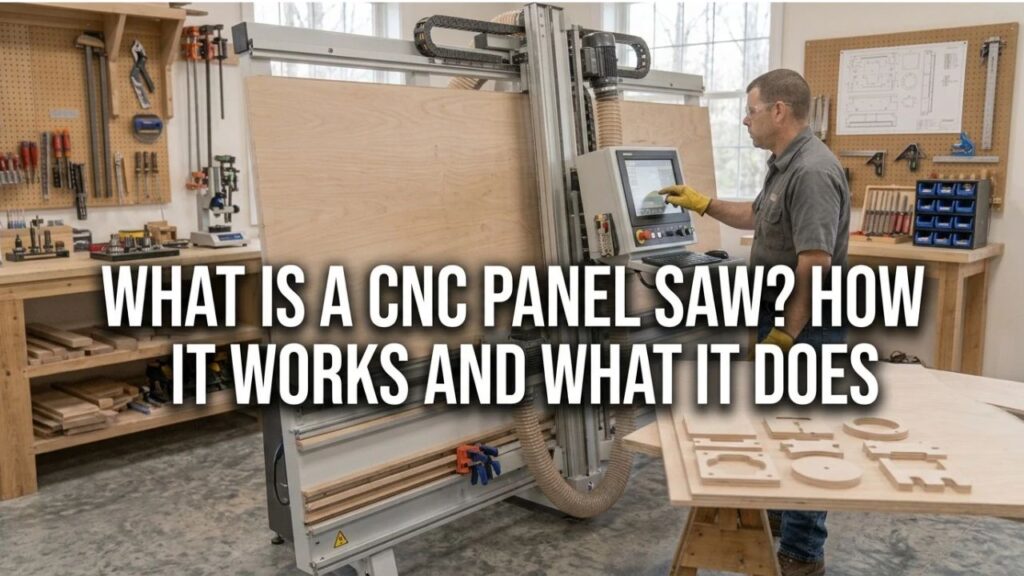
The main job of a CNC panel saw is panel sizing.
It takes a large sheet or stack of sheets and divides it into smaller pieces according to a programmed cutting list.
Suppose a cabinet shop needs hundreds of cabinet sides, shelves, bottoms, and doors from 4 × 8-foot sheets of melamine-faced particleboard.
With a conventional table saw, workers may need to measure, position, rip, rotate, crosscut, and repeatedly handle each sheet.
A CNC panel saw automates much of that process.
The cutting program tells the machine what finished part sizes are needed. The software can organize those parts into an efficient cutting pattern. The machine then positions the panel accurately and makes the required straight cuts.
CNC Panel Saws Specialize in Straight Cuts
A panel saw is primarily designed for straight-line panel division.
It excels at making:
Rip cuts.
Crosscuts.
Repeated strips.
Rectangular cabinet components.
Multiple identical parts.
Optimized nested rectangular cutting patterns.
It is not normally the machine you would choose for cutting curved shapes, routing pockets, drilling shelf-pin holes, or machining complex contours.
Those tasks are more suited to a CNC router or CNC machining center.
Key Takeaways:
- A CNC panel saw automatically divides large sheets into accurately sized rectangular parts.
- The computer controls panel positioning and cutting dimensions.
- It is especially efficient for high-volume straight rip and crosscuts.
What Does CNC Mean on a Panel Saw?
CNC means Computer Numerical Control.
Instead of relying entirely on an operator to manually position material, the machine follows numerical instructions stored in its control system.
The operator may enter dimensions directly or import cutting data generated by production software.
The machine then uses servo-controlled or other powered positioning systems to place the sheet at the correct cutting location.
A Simple Example
Imagine you need the following pieces from one panel:
Two pieces measuring 24 × 36 inches.
Four pieces measuring 12 × 24 inches.
Three pieces measuring 8 × 30 inches.
With manual cutting, you need to calculate an efficient sequence, measure each position, account for blade kerf, and repeatedly set the fence.
With an appropriately configured CNC panel saw, software can generate the cutting sequence.
The machine positions the material according to that program and tells the operator what to load, rotate, or remove—or performs more of those operations automatically on advanced systems.
CNC Reduces Repeated Manual Measurement
The operator still has an important role.
Material must be identified correctly.
Programs need to contain the proper dimensions.
Panels need to be loaded and handled safely.
Blades need to be maintained.
But much of the repetitive measuring and fence adjustment is moved from the operator to the machine’s control system.
How Does a CNC Panel Saw Work?
Although individual machines differ, a typical horizontal CNC panel saw follows a predictable workflow.
Step 1: The Cutting Program Is Created
The operator enters the required part dimensions or loads a cutting program from production software.
In a cabinet or furniture factory, the cutting data may come directly from design, estimating, or manufacturing software.
A cutting optimizer can arrange the required parts across standard sheet sizes to reduce material waste.
Step 2: The Panel Is Loaded
A worker places a panel on the machine’s loading or air-float tables.
Larger production systems may receive material automatically from a panel storage and retrieval system.
Some beam saws can process a stack of panels simultaneously rather than cutting only one sheet.
This is commonly called cutting panels in a book or stack.
Step 3: Grippers Position the Material
A programmable pusher or positioning fence grips the panel.
The machine moves it to the exact position required for the first cut.
Because the positioning system is computer controlled, it can repeat dimensions very consistently.
Step 4: A Pressure Beam Secures the Panel
Before the blade crosses the material, a pressure beam or clamping system holds the sheet securely.
This prevents the panel from shifting during cutting.
It also helps control thin sheets or stacks of material.
Step 5: The Saw Carriage Makes the Cut
On many horizontal beam saws, the circular blade travels underneath the panel table.
When the cut begins, the blade rises into the material and the saw carriage travels across the cutting line.
The blade then retracts below the table before returning.
The exact motion varies among machine designs.
Step 6: The Panel Is Repositioned
After the first cut, the resulting panel or strip can be repositioned for additional cuts.
The computer tells the operator what to do next or automatically manages the positioning on more advanced systems.
The sequence continues until all required components have been produced.
What Is a Beam Saw?
A beam saw is one of the most common types of industrial CNC panel saw.
The term usually refers to a horizontal panel-dividing machine with a long pressure beam spanning the width of the material.
The panel is positioned beneath the beam, clamped, and cut by a traveling saw carriage.
Modern beam saws often include CNC positioning, optimization software, scoring blades, programmable clamps, and automated material handling.
Is a Beam Saw the Same as a CNC Panel Saw?
Often, but the terms are not perfectly interchangeable.
Panel saw is a broad category describing machines designed to cut large panels.
Beam saw describes a particular horizontal machine architecture.
CNC panel saw emphasizes computer-controlled positioning and cutting.
Therefore, many modern beam saws are CNC panel saws, but not every panel saw is a beam saw.
A simple manually operated vertical panel saw, for example, is a panel saw but not normally what people mean by an industrial CNC beam saw.
Main Parts of a CNC Panel Saw
Understanding the major components makes the machine much easier to visualize.
Main Saw Blade
The main blade performs the actual panel cut.
Industrial panel saw blades are typically carbide-tipped and selected according to material type, cutting quality, blade diameter, machine speed, and other requirements.
The correct blade for MDF may not be ideal for every plastic or aluminum panel.
Scoring Blade
Many machines designed for laminated or coated panels use a smaller scoring blade positioned ahead of the main blade.
The scoring blade makes a shallow preliminary cut through the bottom decorative surface.
The main blade then completes the cut.
This helps reduce chipping on materials such as melamine-faced particleboard and laminated panels.
Saw Carriage
The saw carriage contains or carries the cutting assemblies and travels across the machine during each cut.
Industrial machines may control carriage speed electronically according to material and cutting conditions.
Pressure Beam
The pressure beam spans the cutting area and holds the material down while the saw carriage passes through it.
This provides stability and helps maintain accurate cuts.
CNC Pusher
The programmable pusher moves material to precise positions.
It commonly uses several grippers or clamps to hold the rear edge of the panel or stack.
Instead of manually setting a fence at 18 inches, for example, the control system commands the pusher to place the material at the appropriate coordinate.
Grippers
Grippers hold the panels while the pusher positions them.
Industrial machines may have multiple grippers distributed across the pusher beam to control large sheets and stacks securely.
Air-Float Tables
Many horizontal panel saws use tables equipped with small air jets.
The air creates a thin cushion beneath heavy panels, reducing friction and allowing operators to slide large sheets more easily.
This can make handling full-size particleboard, MDF, or laminated panels considerably easier.
CNC Control
The control interface allows operators to select jobs, enter dimensions, monitor the cutting sequence, and adjust machine settings.
Modern systems often use graphical touchscreens.
Optimization Software
Cutting optimization software determines how required rectangular parts should be arranged on full sheets.
Its objective is typically to balance material yield, cutting time, machine constraints, leftover management, and production sequence.
Label Printer
Automated shops may print a label for every finished component.
Labels can include a part number, cabinet identification, dimensions, edge-banding information, drilling data, and barcode.
That label helps the component move through later operations without being confused with similar-looking parts.
Key Takeaways:
- The pusher positions material while the pressure beam holds it during cutting.
- A scoring blade helps produce cleaner cuts in laminated sheet goods.
- Optimization and labeling software can connect panel cutting with the rest of the production workflow.
What Materials Can a CNC Panel Saw Cut?
CNC panel saws are strongly associated with woodworking, but their capabilities can extend beyond ordinary plywood.
Typical woodworking applications include:
MDF.
Particleboard.
Melamine-faced particleboard.
Plywood.
Veneered panels.
Laminated sheets.
Fiberboard.
Furniture panels.
Some machines are also designed or equipped for plastic, acrylic, composite, or other nonferrous panel materials.
The machine, blade, lubrication system, feed settings, and dust extraction must all be appropriate for the material.
Can a CNC Panel Saw Cut Solid Wood?
Some machines can process certain solid-wood panels or laminated solid-wood products.
However, industrial beam saws are primarily optimized around panel processing rather than ripping unpredictable rough lumber in the same way a traditional rip saw operates.
Use the manufacturer’s material specifications.
Can It Cut Plastic?
Some CNC panel saws have versions or optional equipment specifically intended for plastics.
Plastic cutting can require different blade geometry, cutting speed, cooling, lubrication, clamping, and chip extraction.
Do not assume a woodworking blade and setup are appropriate just because the plastic sheet physically fits on the machine.
Can It Cut Aluminum?
Certain industrial panel saw systems can process aluminum or other nonferrous sheet products when specifically equipped for them.
This is highly machine-dependent.
Blade selection, lubrication, spark and chip control, extraction, and manufacturer approval become critical.
A woodworking panel saw should never automatically be treated as a metal saw.
CNC Panel Saw vs. Manual Panel Saw
The biggest difference is automation.
A manual vertical panel saw still makes sheet-goods handling easier, but the operator controls most positioning and cutting decisions.
A CNC panel saw can calculate and execute dimensions automatically.
| Feature | CNC Panel Saw | Manual Panel Saw |
| Positioning | Computer controlled | Operator controlled |
| Repeatability | Very high | Depends more on operator |
| Production volume | Medium to very high | Low to medium |
| Cutting optimization | Often integrated | Usually manual |
| Stack cutting | Common on beam saws | Generally limited |
| Investment | High | Lower |
| Training | Software and machine operation | Mostly mechanical operation |
| Best use | Production manufacturing | Smaller shops and occasional panel cutting |
A manual panel saw can be an excellent choice for a small cabinet shop that handles a modest number of sheets.
A CNC system begins making more sense when production volume, repeatability, labor efficiency, material optimization, and workflow integration become more important.
CNC Panel Saw vs. Table Saw
Both machines can make accurate straight cuts, but they are built for very different production environments.
A cabinet saw or sliding table saw is flexible and relatively compact.
The operator physically controls the sheet through much of the cut.
A CNC beam saw automates panel positioning and can handle repetitive production much faster.
Sheet Handling
A 4 × 8-foot MDF sheet can be heavy and awkward on a conventional table saw.
A beam saw supports the sheet on a large table and uses powered positioning.
That reduces the amount of manual control required around the blade.
Repeatability
A skilled table-saw operator can produce very accurate work.
However, producing hundreds of identical pieces requires repeated setups and measurements.
A CNC panel saw repeats programmed dimensions automatically.
Production Volume
For custom one-off woodworking, a table saw can be more practical.
For repetitive cabinet production, a CNC panel saw can offer much greater throughput.
CNC Panel Saw vs. CNC Router
These two machines are often used together rather than being direct competitors.
A CNC router moves a rotating cutting tool across the sheet.
A panel saw uses a circular saw blade to divide the panel along straight lines.
CNC Panel Saw Is Excellent for Rectangular Parts
If you need 100 rectangular cabinet sides, a beam saw can divide panels extremely quickly.
It can also stack multiple sheets on machines designed for book cutting.
CNC Router Handles Complex Machining
A CNC router can perform operations a basic panel saw cannot, including:
Curved profiles.
Circles and irregular shapes.
Pockets.
Dados.
Grooves.
Drilling.
Cutouts.
Some edge machining.
The router is much more versatile geometrically.
Which Is Faster?
For straightforward straight panel sizing, a production beam saw can be extremely fast.
For a part that requires cutting its perimeter plus holes, slots, and pockets, a CNC router may complete several operations without moving the workpiece to another machine.
Large factories frequently use both.
The panel saw sizes parts efficiently, and those parts then move to CNC machining centers, drilling machines, or edge banders.
CNC Panel Saw vs. CNC Nesting Router
Nesting routers deserve a separate comparison because they have become common in cabinet manufacturing.
With nested-based manufacturing, full sheets are placed on a CNC router table, and individual cabinet components are arranged or “nested” across the sheet.
The router cuts the perimeter of each component and may drill or route features at the same time.
Advantages of Nesting
Complex components can be machined in one setup.
Part shapes do not have to be strictly rectangular.
Drilling and routing can occur during the same cycle.
Advantages of a Beam Saw
Straight cuts can be very fast.
Several sheets may be cut together on machines designed for stack cutting.
Saw kerf can be narrower than some router-tool paths.
The system can work extremely well with high volumes of rectangular furniture parts.
The correct production method depends on product mix.
Horizontal vs. Vertical CNC Panel Saws
Not every CNC panel saw is horizontal.
Horizontal CNC Panel Saw
This is the classic industrial beam-saw configuration.
Panels lie horizontally on tables.
A powered pusher controls their position, and a saw carriage moves across the cutting line.
These machines dominate many medium- and high-volume cabinet and furniture operations.
Vertical CNC Panel Saw
A vertical CNC panel saw keeps the panel upright or slightly tilted.
This reduces floor-space requirements and can simplify sheet handling in certain facilities.
Some advanced vertical machines use programmable stops or automated axes to control cuts.
However, fully automated high-volume production is more commonly associated with horizontal beam-saw systems.
What Is an Angular Panel Saw?
An angular panel saw uses multiple cutting stations or saw units arranged to perform longitudinal and transverse cuts efficiently.
A panel stack can move through the first cutting direction and then into a second saw for crosscutting.
The system reduces the need for manual panel rotation.
These machines are aimed at very high production volumes.
Why Use Two Cutting Directions?
A basic single-line beam saw may rip a panel into strips, after which those strips need to be turned and crosscut.
An angular system can automate more of that process.
In large furniture factories producing thousands of parts, reducing handling between rip and crosscut operations can significantly improve throughput.
How Accurate Is a CNC Panel Saw?
A properly installed, maintained, and calibrated CNC panel saw can produce highly repeatable dimensions.
Actual accuracy depends on machine quality, positioning-system calibration, blade condition, material behavior, maintenance, and setup.
It would be misleading to assign one universal tolerance to every CNC panel saw.
Industrial manufacturers design machines for very precise panel sizing, but the final result still depends on proper operation.
Blade Condition Matters
A computer can position the sheet perfectly while a dull or inappropriate blade produces a poor edge.
CNC does not eliminate basic cutting-tool maintenance.
Material Can Move
Sheets are not always perfectly flat.
Thin panels can bow.
Stacked material can shift if not clamped properly.
Pressure-beam and gripper systems help manage these issues.
What Is Cut Optimization?
Optimization is one of the biggest advantages of computer-controlled panel processing.
Imagine a production order contains 300 parts of different sizes.
There may be thousands of possible ways to arrange them across full sheets.
Optimization software calculates cutting layouts that can reduce waste and organize production efficiently.
It Can Balance More Than Waste
The absolute lowest-waste layout is not necessarily the fastest layout to manufacture.
Advanced optimization systems can consider factors such as:
Material utilization.
Number of cuts.
Machine cycle time.
Gripper positions.
Reusable offcuts.
Part sequencing.
Stacking requirements.
Different material types.
The chosen strategy may therefore balance yield and productivity rather than focusing exclusively on scrap percentage.
What Is Batch Size 1?
You may encounter the phrase batch size 1 when researching CNC panel saws.
It means producing individualized or unique parts efficiently rather than running hundreds of identical components.
For example, a cabinet factory may receive ten kitchen orders in which every cabinet configuration is different.
Modern software can combine those orders, optimize sheets, label individual parts, and send each unique component through the factory.
High automation therefore is not useful only for mass-producing identical furniture.
It can also support highly customized manufacturing.
Key Takeaways:
- CNC panel saws can support both mass production and highly customized batch-size-1 manufacturing.
- Optimization software can balance waste, cutting time, offcuts, and production sequence.
- Horizontal beam saws dominate automated production, while vertical systems can save floor space.
What Are the Advantages of a CNC Panel Saw?
The biggest advantage is productivity.
A CNC saw can repeatedly position material without the operator manually setting every measurement.
That reduces setup time across large production runs.
High Repeatability
Once a program is correct and the machine is calibrated, it can repeatedly produce components at programmed dimensions.
This is valuable for cabinets and furniture where multiple parts must fit together precisely.
Reduced Manual Measuring
Operators spend less time measuring and resetting fences.
That reduces opportunities for simple transcription or measurement errors.
Better Material Yield
Optimization software can arrange parts efficiently across sheets.
In a shop processing thousands of panels per year, even a modest improvement in yield can represent substantial material savings.
Stack Cutting
Many industrial beam saws can cut multiple panels at once.
This dramatically increases output when several identical parts are required.
Easier Sheet Handling
Air tables, powered pushers, lifts, storage systems, and other material-handling equipment reduce the physical effort involved in controlling heavy sheets.
Production Integration
A CNC saw can connect with design software, inventory systems, panel storage, labeling equipment, edge banders, machining centers, and factory management systems.
This turns the saw into one stage of a larger digital manufacturing workflow.
What Are the Disadvantages?
CNC panel saws are not ideal for every shop.
High Purchase Cost
A commercial CNC beam saw represents a much larger investment than a table saw or basic vertical panel saw.
Automation, storage integration, loading equipment, and software increase that investment further.
Floor Space
Horizontal panel saws require substantial space for the saw, loading tables, panel movement, and operator access.
A small garage workshop may simply not have room.
Training
The operator needs to understand both machinery and software.
Incorrect cutting data can produce a large quantity of incorrectly sized parts very quickly.
Maintenance
CNC positioning components, clamps, sensors, saw carriages, computers, air systems, dust extraction, and other subsystems require maintenance.
Straight-Cut Specialization
A panel saw is exceptionally good at dividing panels into straight rectangular components.
It cannot replace a full CNC machining center when complex shapes and drilling operations are required.
Who Needs a CNC Panel Saw?
A CNC panel saw makes the most sense for businesses that process a significant volume of sheet goods.
Typical users include cabinet manufacturers, furniture factories, commercial millwork shops, closet-system manufacturers, store-fixture companies, office-furniture plants, door manufacturers, and panel-processing businesses.
Small Cabinet Shop
A small shop may benefit when sheet processing has become a major bottleneck.
If employees spend hours every day measuring and breaking down panels, CNC cutting can free labor for assembly, machining, finishing, or installation.
Medium Production Shop
This is where automated beam saws can become particularly attractive.
The business may have enough panel volume to justify optimization, labeling, stack cutting, and production-management software.
Large Factory
Large plants may use automated panel storage, robotic handling, angular saws, conveyor systems, and integrated software.
At that level, panels can move from storage to cutting with minimal manual handling.
Can One Person Operate a CNC Panel Saw?
Many machines are designed so one trained operator can perform normal cutting tasks.
Air tables and automated positioning reduce the difficulty of handling heavy panels.
However, sheet dimensions and weights still matter.
Large, heavy, or flexible material can require additional handling assistance or mechanical loading equipment.
High-volume systems may incorporate automatic lifts, storage retrieval, or robotic material handling specifically to reduce manual loading.
Always follow the machine manufacturer’s handling limits and workplace safety procedures.
Is a CNC Panel Saw Safe?
Modern commercial panel saws incorporate guarding, pressure beams, interlocks, emergency stops, controlled blade movement, and other safety systems.
The blade on many horizontal beam saws operates largely inside the machine rather than remaining continuously exposed like a conventional table-saw blade.
However, the machine still contains a powerful high-speed circular saw.
CNC automation does not eliminate risk.
Operators must stay clear of moving pushers, pressure beams, clamps, saw carriages, pinch points, and cutting zones.
Never Defeat Safety Systems
Interlocks and guards are part of the machine’s design.
Bypassing them to save a few seconds can expose an operator to high-energy moving machinery.
Lockout procedures should be followed before blade changes, maintenance, jam clearing, or other work requiring access to hazardous areas.
How Much Does a CNC Panel Saw Cost?
Prices vary too widely to provide one useful universal number.
Machine size, cutting length, blade projection, motor power, software, automation level, loading system, labeling, storage integration, and installation all influence total cost.
A relatively simple CNC panel saw for a smaller shop occupies a very different market from a fully automated industrial cutting cell.
Look at Total Cost, Not Just Purchase Price
A realistic investment calculation can include:
Machine price.
Freight.
Installation.
Electrical work.
Compressed air.
Dust collection.
Software.
Training.
Floor preparation.
Material-handling equipment.
Maintenance.
At the same time, calculate potential savings from labor, increased throughput, fewer cutting mistakes, and improved material utilization.
How to Choose a CNC Panel Saw
Start with your actual production needs rather than buying the largest machine you can afford.
Consider your maximum sheet size and common material types.
Estimate how many sheets you process per shift.
Determine whether you frequently need stacks of identical components or mostly unique parts.
Think about what production software you currently use and whether it can communicate with the saw.
Pay Attention to Cutting Capacity
Cutting length and blade projection determine what panels and stack heights the machine can process.
A higher blade projection can allow thicker books of material, but capacity you never use does not automatically make production more profitable.
Consider Automation Carefully
A small shop may need only programmable cutting.
A larger factory may benefit from automatic labeling, lifting tables, rear loading, storage integration, robots, or angular cutting cells.
Automation should solve a real production bottleneck.
FAQs about What Is a CNC Panel Saw
What is a CNC panel saw?
A CNC panel saw is a computer-controlled machine that automatically positions and cuts large sheet materials into accurately sized parts according to a programmed cutting plan.
What does CNC stand for?
CNC stands for Computer Numerical Control.
It means machine movements are controlled by programmed numerical instructions rather than being positioned entirely by hand.
Is a CNC panel saw the same as a beam saw?
Many industrial CNC panel saws are beam saws. A beam saw is a specific type of horizontal panel-dividing saw with a pressure beam and traveling saw carriage.
What is a panel dividing saw?
A panel dividing saw is a machine designed to divide large panels into smaller components. Modern industrial versions commonly use CNC controls.
What can a CNC panel saw cut?
Common materials include plywood, MDF, particleboard, melamine-faced panels, laminated panels, fiberboard, and other sheet goods.
Certain machines can also process plastics, composites, or nonferrous materials when properly equipped.
Can a CNC panel saw cut multiple sheets at once?
Many industrial beam saws can cut stacked sheets, often called a book of panels.
Maximum stack thickness depends on blade projection and machine specifications.
Does a CNC panel saw use a scoring blade?
Many machines intended for laminated panel processing use a scoring blade to reduce chipping on the lower surface before the main blade completes the cut.
Is a CNC panel saw better than a table saw?
For high-volume panel sizing, it can be far more productive.
A table saw remains more practical and versatile for many small woodworking shops and one-off jobs.
Is a CNC panel saw the same as a CNC router?
No.
A panel saw primarily makes straight saw cuts. A CNC router can create contours, pockets, grooves, holes, and complex shapes.
Which is better, CNC router or panel saw?
It depends on the work.
A panel saw excels at rapidly producing rectangular parts, while a router offers greater machining flexibility.
Many production shops use both.
What is cut optimization?
Cut optimization software arranges required components on available sheets to reduce waste and organize an efficient cutting sequence.
Can a CNC panel saw cut melamine?
Yes. Melamine-faced particleboard is a common panel-saw material.
A suitable main blade and scoring system help produce clean decorative edges.
Can a CNC panel saw cut plywood?
Yes.
Plywood is one of the common sheet materials processed on panel saws.
Can a CNC panel saw cut MDF?
Yes.
MDF is widely processed on beam saws and other panel-sizing equipment.
Suitable dust extraction is especially important because cutting MDF generates substantial fine dust.
Can a CNC panel saw cut curves?
A standard panel saw is designed primarily for straight cuts.
A CNC router, jigsaw, bandsaw, or other appropriate machine is usually needed for curved shapes.
Can a CNC panel saw drill holes?
A conventional panel saw does not normally perform drilling operations.
Some highly integrated production systems combine several processes, but drilling is typically handled by a CNC machining or drilling center.
How accurate is a CNC panel saw?
Industrial machines are capable of highly repeatable panel sizing when properly calibrated and maintained.
Exact tolerances depend on the specific machine, material, blade, setup, and operating conditions.
What is an automatic panel saw?
An automatic panel saw uses powered systems to automate operations such as positioning, clamping, cutting, and sometimes loading, labeling, or unloading.
A CNC panel saw is a common type of automatic panel saw.
What is an angular panel saw?
An angular system uses multiple cutting directions or saw units to automate both rip and crosscut processing, making it particularly useful for high-volume production.
Is a CNC panel saw good for a small shop?
It can be if panel processing is a major production bottleneck and the labor, accuracy, and material savings justify the investment.
For occasional sheet cutting, simpler equipment is usually more economical.
Does a CNC panel saw need an operator?
Usually yes, although the amount of operator involvement varies greatly.
Some systems require manual loading and panel rotation, while advanced robotic cutting cells can automate much more of the process.
Conclusion
What is a CNC panel saw? It is a computer-controlled panel-cutting machine designed to turn large sheets into precisely sized components quickly, repeatedly, and with far less manual positioning than a conventional saw.
The most common industrial version is the horizontal beam saw. A programmable pusher grips and positions the panel, a pressure beam secures it, and a traveling circular saw blade makes the cut. Many machines also include a scoring blade for clean laminated edges, air tables for easier material handling, optimization software for reducing waste, and labeling systems for tracking finished parts.
CNC panel saws are particularly effective when producing rectangular cabinet, furniture, closet, and millwork components from MDF, particleboard, plywood, melamine, and similar sheet materials.
Their greatest strengths are speed, repeatability, stack-cutting capability, reduced manual measuring, and integration with digital production systems.
They are not the same as CNC routers. A router is better for holes, pockets, grooves, curves, and complex shapes, while a panel saw specializes in fast straight-line sizing. In many professional factories, the two machines complement each other.
For a small shop processing only occasional sheets, a table saw, sliding saw, or manual vertical panel saw may be more practical. As sheet volume increases and panel cutting becomes a production bottleneck, CNC control, optimization, automated positioning, and material handling can offer substantial advantages.
The simplest way to think about a CNC panel saw is this: it takes the basic job of cutting large sheet goods and turns it into a programmable, repeatable, production-oriented process.