What Is a Sliding Table Panel Saw? How It Works & Uses
A sliding table panel saw is a stationary woodworking machine designed to make highly accurate straight, crosscut, rip, and angled cuts in large panels, sheet goods, and solid wood. Its defining feature is a large sliding carriage that moves the workpiece smoothly past a fixed circular saw blade, rather than requiring the operator to push a large sheet directly across a stationary table.
Sliding table panel saws are especially common in cabinet shops, furniture factories, millwork businesses, and professional woodworking shops. They are excellent for cutting plywood, MDF, particleboard, melamine, laminated panels, solid lumber, and similar materials.
Many professional machines also include a separate scoring blade positioned ahead of the main blade. The scoring blade makes a shallow cut in the underside of a laminated panel immediately before the main blade cuts through it, helping prevent chip-out on materials such as melamine and veneered board.
The sliding carriage is what separates this machine from an ordinary cabinet or table saw. Instead of balancing a 4 × 8-foot sheet on a relatively small stationary table and pushing it through the blade, the operator supports the panel on a carriage or outrigger table and moves the entire support system through the cut.
This provides excellent control, repeatability, and accuracy when working with large material.
In this guide, I’ll explain what a sliding table panel saw is, how it works, what its major components do, how it differs from a regular table saw and vertical panel saw, and whether it makes sense for your woodworking shop.
What Is a Sliding Table Panel Saw?
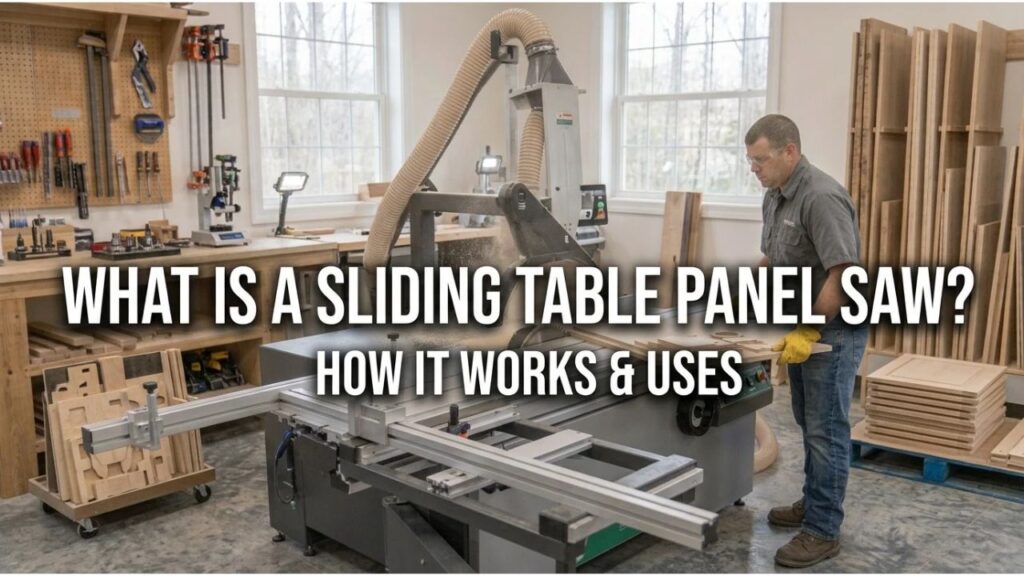
A sliding table panel saw is essentially a precision circular saw combined with a large linear sliding carriage.
The circular saw blade remains in a fixed position in the machine.
The workpiece rests against the sliding table, crosscut fence, or outrigger support.
Instead of pushing the workpiece freely across a fixed tabletop, you move the carriage forward.
The carriage carries the wood past the rotating blade along a predetermined straight path.
This arrangement makes it much easier to control large plywood or MDF panels.
Why Is It Called a Panel Saw?
It is called a panel saw because one of its primary purposes is accurately sizing large sheet materials or panels.
Typical materials include:
plywood, MDF, particleboard, melamine-faced board, veneered panels, laminated board, and cabinet sheet goods.
However, the machine is not limited to panels.
With the appropriate blade and setup, it can also cut solid lumber, hardwood, softwood, furniture components, and other woodworking materials.
Why Is It Called a Sliding Table Saw?
The table or carriage beside the blade physically slides.
On professional machines, that carriage can be several meters long.
For example, full-size machines may use approximately a 3,200 mm sliding table, giving enough travel to size full sheets accurately.
That long smooth carriage is one of the main reasons sliding panel saws dominate many professional European-style cabinet shops.
How Does a Sliding Table Panel Saw Work?
The principle is straightforward.
The main circular saw blade projects through the machine table much like the blade on an ordinary table saw.
The difference is how the workpiece reaches it.
You place your panel or board on the sliding carriage and position it against the fence or stops.
Once the workpiece is aligned, you hold or clamp it securely.
You then push the sliding carriage forward.
Because the carriage travels on precision guides or bearings, it carries the workpiece through the blade in a very straight path.
The operator does not have to manually guide a large sheet while simultaneously trying to keep it square to a small miter gauge.
The Workpiece Moves, Not the Saw
This is an important distinction from some other panel saw designs.
On a sliding table panel saw:
the blade stays in place while the panel moves.
On many vertical panel saws:
the panel remains supported vertically while the saw carriage itself travels across or down the sheet.
Both machines can process large panels, but their operating systems and shop layouts are very different.
Main Parts of a Sliding Table Panel Saw
A modern sliding panel saw may look complicated, but its major components are relatively easy to understand.
Main Saw Blade
The main circular blade performs the actual through-cut.
Depending on the machine, blades around 250–400 mm in diameter are common, although exact sizes vary considerably.
The blade can normally be raised or lowered to control cutting depth.
Professional machines often allow the blade to tilt, commonly up to approximately 45 degrees, for bevel cuts.
Higher-end models may use electronic controls for blade height and angle.
Sliding Carriage
The sliding carriage is the defining feature of the machine.
It runs beside the saw blade on precision bearings or guide systems.
A good carriage should move smoothly without noticeable side-to-side play.
Longer carriages make it easier to cut full-size panels in one continuous movement.
For sheet-goods production, carriage length is one of the most important specifications to consider.
Outrigger Table
Large professional panel saws often have an outrigger attached to the sliding carriage.
This creates a broad supporting surface for large panels.
Without an outrigger, a heavy sheet can extend far beyond the carriage and become difficult to control.
The outrigger may also support a long crosscut fence.
Crosscut Fence
The crosscut fence sits perpendicular or at an adjustable angle to the direction of carriage travel.
You position a panel against this fence when making square or angled cuts.
Adjustable stops on the fence make repetitive cutting much faster.
For example, if you need twenty cabinet parts exactly 600 mm long, you can set a stop once and cut each component to the same dimension.
Rip Fence
The rip fence is positioned on the opposite side of the main saw blade.
It functions similarly to the rip fence on a normal table saw.
You set the distance between the fence and blade according to the desired width of the finished piece.
This makes the panel saw useful not only for crosscutting sheets but also for ripping boards and panels to consistent widths.
Scoring Blade
A scoring blade is one of the most valuable features of a professional sliding table panel saw.
It is a small blade positioned just ahead of the main blade.
The scorer cuts only a shallow groove into the underside of the panel.
The main saw blade then follows through the same cutting line.
Because the surface fibers or laminate have already been cleanly severed, the main blade is much less likely to chip the underside.
Key Takeaways:
- The sliding carriage moves the workpiece past a stationary circular saw blade.
- Crosscut and rip fences allow accurate sizing in both directions.
- A scoring blade is particularly valuable when cutting melamine, laminate, or veneered panels.
What Does a Scoring Blade Do?
When a normal circular saw blade cuts a laminated panel, the teeth enter one surface and exit the other.
The exit side is particularly vulnerable to chipping because the blade can lift and tear the brittle decorative surface.
A scoring blade solves this problem by making a shallow preliminary cut.
The scorer normally rotates so its tooth action creates a clean cut on the lower surface before the main blade reaches the material.
The main blade then cuts through the complete thickness.
Why Scoring Is Important for Cabinet Work
A small chip on ordinary construction plywood may not matter.
A chip along the exposed edge of a white melamine cabinet panel can ruin the part.
Professional cabinet shops therefore value scoring systems because they can produce clean edges on both sides of a laminated sheet without taping every cut.
The scoring blade must be accurately aligned with the main blade.
If its kerf is too narrow or shifted sideways, the main blade can still damage the finished surface.
Many professional machines provide vertical and lateral scoring adjustment for this reason.
What Materials Can a Sliding Table Panel Saw Cut?
These machines are primarily woodworking saws.
With the correct blade, they are commonly used for plywood, MDF, OSB, particleboard, veneered panels, melamine, laminate-faced board, hardwood, and softwood.
Some manufacturers also provide blade and speed options for certain plastics, composites, and nonferrous materials.
However, material compatibility depends on the exact saw, blade, speed, and manufacturer instructions.
Do not assume that because a panel saw can physically cut a material, the operation is appropriate or safe.
Sliding Table Panel Saw vs Regular Table Saw
The machines look related because both use a circular blade projecting through a horizontal table.
Their handling of large workpieces is very different.
Workpiece Support
A regular table saw has a stationary table.
To crosscut a large panel, the operator has to move the sheet across the table while keeping it against a miter gauge, sled, or other guide.
That becomes difficult as the panel gets larger.
A sliding panel saw carries the panel on a moving platform.
The panel, fence, and support move together through the cut.
This dramatically improves control over large sheet goods.
Crosscut Capacity
A normal table saw excels at ripping long boards.
Large crosscuts typically require a crosscut sled, miter gauge, or other accessory.
A sliding table saw is designed around crosscutting capability from the beginning.
Long sliding carriages can crosscut full-size panels with high precision.
Accuracy With Large Panels
A cabinet saw can be extremely accurate.
The difference is not that ordinary table saws are inherently inaccurate.
The advantage of the sliding table is that large workpieces are easier to keep aligned accurately.
When handling a heavy 4 × 8-foot sheet, support and guidance are major factors.
Footprint
A sliding panel saw needs substantially more floor space.
The machine itself is large, and you also need open space for the full carriage movement and large sheets.
A compact cabinet table saw is therefore much easier to fit into a garage workshop.
Typical Comparison
| Feature | Sliding Table Panel Saw | Regular Table Saw |
| Large panel handling | Excellent | More difficult |
| Full-sheet crosscuts | Excellent | Accessories/support often needed |
| Repetitive cabinet work | Excellent | Good |
| Scoring blade | Common on professional machines | Uncommon |
| Sliding carriage | Standard | Usually absent or accessory |
| Rip cutting | Excellent | Excellent |
| Floor-space requirement | Large | Smaller |
| Portability | Very low | Low to moderate |
| Professional panel production | Excellent | More limited |
Neither machine is automatically better for every woodworker.
The sliding panel saw is simply much more specialized for precision panel processing.
Sliding Table Panel Saw vs Vertical Panel Saw
These two machines are often confused because both are called panel saws.
A sliding table panel saw holds the workpiece approximately horizontal.
A vertical panel saw holds the sheet upright against a vertical frame.
Sliding Panel Saw
The panel lies flat on a sliding table and outrigger.
The workpiece moves past the blade.
This setup is highly versatile because the machine can perform panel sizing, solid-wood ripping, beveling, miter cutting, and many other woodworking operations.
Vertical Panel Saw
A large sheet rests vertically against a support frame.
The saw carriage usually travels vertically for one type of cut and can be repositioned for horizontal cuts depending on the design.
Vertical saws save floor space because the sheet stands upright rather than lying across a wide horizontal machine.
Which Is Better?
For a cabinet or furniture shop that needs maximum versatility and precision, the sliding table saw is often the stronger choice.
For a lumberyard, building-material store, or shop mainly breaking down large sheets while conserving floor space, a vertical panel saw can be extremely useful.
Key Takeaways:
- Sliding table panel saws hold the material horizontally.
- Vertical panel saws support sheets upright and move the saw carriage across them.
- Sliding table saws generally offer greater woodworking versatility, while vertical saws can save substantial floor space.
What Cuts Can a Sliding Table Panel Saw Make?
Its capabilities go far beyond simply shortening plywood.
Crosscuts
Crosscutting is one of the machine’s greatest strengths.
You place the workpiece against the crosscut fence and move the carriage through the blade.
Because the fence and workpiece move together, achieving a square cut is straightforward once the machine is calibrated correctly.
Rip Cuts
A rip fence allows the machine to function much like a conventional table saw.
You can cut solid boards or long panel strips to width.
Miter Cuts
Crosscut fences and miter systems can often be adjusted to different angles.
Professional machines may provide positive stops at common angles.
This allows precise mitered cabinet, furniture, and architectural components.
Bevel Cuts
The main blade can usually tilt for bevel cutting.
Many machines tilt between 90 and 45 degrees.
Some premium industrial models offer wider or electronically controlled tilt ranges.
Compound Cuts
With the fence and blade both angled, some machines can make compound cuts.
This is useful for specialized millwork, architectural woodworking, and complex joinery.
Grooves and Dados
Some machines can accept approved dado or grooving tooling.
This depends heavily on the saw model and regional safety regulations.
Never install a dado set unless the machine manufacturer specifically supports it.
Why Are Sliding Table Panel Saws So Accurate?
Their accuracy comes largely from supporting and guiding the workpiece mechanically.
When crosscutting on an ordinary table saw, any sideways movement of the board can change the cut angle.
On a properly adjusted sliding panel saw, the workpiece rests against a rigid fence attached to a carriage traveling in a precise straight line.
The operator is therefore not responsible for manually maintaining the cutting path.
Precision Carriage Guides
High-quality machines use hardened guideways, roller-bearing systems, or similar precision mechanisms.
The carriage should move easily while remaining rigid.
Even a tiny amount of sideways looseness could affect long cuts, so carriage construction is a major factor separating professional machines from inexpensive alternatives.
Precision Stops
Crosscut fence stops also improve repeatability.
Once a stop is positioned accurately, multiple pieces can be cut to the same dimension without measuring and marking every part.
This saves considerable time in cabinet production.
Advantages of a Sliding Table Panel Saw
The biggest advantage is safe, controlled handling of large panels.
A full sheet of MDF can be heavy and awkward.
Trying to balance one against a small table-saw miter gauge while pushing it through a blade requires significant effort and introduces more opportunities for error.
A sliding table supports the sheet throughout the cut.
Precision is another major benefit.
Once the carriage and fences are calibrated, square repetitive cuts are fast and consistent.
Professional scoring capability is also valuable for finished panels.
Finally, the machine is extremely versatile. One properly equipped saw can handle panel sizing, solid-wood ripping, crosscuts, bevels, miters, and many repetitive furniture-manufacturing tasks.
Disadvantages of a Sliding Table Panel Saw
The biggest disadvantage for most small shops is size.
A full-format machine can require a very large working area.
You need space not only for the machine but also for loading panels and moving the carriage through its complete stroke.
Cost is another consideration.
Professional sliding table saws cost substantially more than typical contractor or cabinet table saws.
They are also heavy. Machines designed for commercial production can weigh hundreds of kilograms or more.
Moving and installing one may require specialized equipment.
Setup and Calibration
A sliding table saw also contains more precision systems that must remain properly adjusted.
The carriage must travel parallel to the blade.
The crosscut fence must be square when set to 90 degrees.
The rip fence needs correct alignment.
If the machine has a scoring blade, the scorer must align with the main blade.
A poorly calibrated expensive panel saw can produce inaccurate cuts just like any other poorly adjusted machine.
Is a Sliding Table Panel Saw Safer Than a Table Saw?
The sliding carriage can improve workpiece control, particularly with large sheet goods.
Better support reduces the need to wrestle a heavy sheet around the blade.
However, a sliding panel saw still contains a large, powerful rotating circular blade.
It requires serious attention to safety.
Professional machines use equipment such as overhead blade guards, riving knives or splitters, emergency stops, and dust extraction.
Some modern machines also offer advanced contact-detection or preventive safety technology.
The Riving Knife Still Matters
When ripping solid wood, the kerf can close behind the blade because of internal stress.
A properly installed riving knife helps prevent the workpiece from contacting the rear teeth of the blade.
This reduces kickback risk.
Do not remove safety equipment simply because the saw uses a sliding carriage.
Hand Placement
Keep hands away from the cutting path and use the machine’s clamps, fences, handles, and workpiece supports.
Large workpieces can create a false sense of safety because your hands may begin far from the blade but approach it as the carriage advances.
Plan the complete movement before starting the cut.
How Large Is a Sliding Table Panel Saw?
Sizes vary from relatively compact workshop models to enormous industrial machines.
A smaller sliding saw may use a carriage around 1,200–2,000 mm long.
Professional full-format cabinet-shop machines commonly offer around 2,500–3,200 mm of sliding travel.
A 3,200 mm carriage is particularly useful because it allows full-length cuts on common sheet goods.
Rip capacity also varies.
Machines may provide approximately 800 mm, 1,250 mm, or more between the blade and rip fence.
The best size depends on the largest workpieces you routinely process.
What Size Sliding Table Panel Saw Do You Need?
For occasional furniture building, a compact slider may provide enough capacity without dominating the workshop.
For professional cabinet production involving full sheets, a full-length carriage is much more useful.
Consider four measurements before buying:
maximum crosscut length, rip capacity, maximum cutting height, and total floor-space requirement.
Also consider whether you need a scoring blade.
If most of your work involves solid wood, a scorer may be less important.
If you constantly cut melamine and prefinished cabinet board, I would consider it a major advantage.
Who Should Buy a Sliding Table Panel Saw?
A sliding table saw makes the most sense for someone processing large material frequently.
Cabinet shops are ideal users.
They repeatedly cut full sheets into accurately sized cabinet sides, shelves, doors, partitions, and backs.
Furniture makers can also benefit when large panels are a regular part of production.
Architectural millwork and commercial woodworking shops frequently use them as central production machines.
Is It Worth It for a DIY Woodworker?
Possibly, but usually only if you have the space and regularly process large sheets.
For occasional plywood projects, a track saw combined with a good table saw is much easier to justify.
A track saw can break down full sheets accurately while the material remains supported on a workbench or foam panel.
You can then perform smaller machining operations on the table saw.
A large sliding panel saw begins making financial sense when panel processing becomes routine rather than occasional.
Key Takeaways:
- Sliding panel saws are ideal for cabinet shops and high-volume sheet-goods woodworking.
- A compact shop can often achieve similar occasional results with a track saw and conventional table saw.
- Carriage length, rip capacity, scoring capability, and available floor space are major buying considerations.
Sliding Table Panel Saw vs Track Saw
A track saw is much smaller and cheaper.
You lay a guide rail directly on the panel and move a handheld saw along the rail.
This makes it excellent for breaking down full sheets in a small workshop or even on a jobsite.
A sliding panel saw reverses the process.
The machine remains permanently set up, and the panel moves through it.
The panel saw is faster and more repeatable for production.
The track saw offers greater portability and much lower space requirements.
For making ten identical cabinet panels every day, I would choose the sliding panel saw.
For building one set of kitchen cabinets in a garage, the track saw may be far more practical.
Sliding Table Panel Saw vs CNC Router
These machines also overlap in cabinet manufacturing but perform different jobs.
A sliding panel saw specializes in straight-line cutting.
It can divide a large sheet into rectangular components extremely quickly.
A CNC router can cut complex shapes, drill holes, create dados, machine cabinet joinery, and follow computer-generated tool paths.
For simple rectangular panel sizing, a good sliding saw can be exceptionally fast.
For nested cabinet production with complex machining, CNC technology offers much greater automation.
Many larger cabinet shops use both.
How Accurate Should a Sliding Panel Saw Be?
A quality machine should be capable of very precise repeatable work when correctly installed and calibrated.
Rather than focusing on one universal tolerance, evaluate whether the machine can repeatedly reproduce dimensions appropriate for your woodworking.
Cabinet parts generally need consistency more than theoretical laboratory precision.
A properly adjusted carriage should remain parallel to the cutting line.
The crosscut fence should produce repeatable square cuts.
Stops should return to the same dimensions.
If repeated parts vary noticeably, the machine should be checked for fence movement, carriage wear, incorrect blade alignment, or operator setup problems.
Does a Sliding Table Saw Need a Scoring Blade?
Not always.
For solid wood, ordinary plywood, and many construction materials, a suitable main blade can produce an excellent cut without scoring.
A scoring blade becomes especially useful for melamine, plastic laminate, prefinished panels, and delicate veneers.
If both faces need to remain cosmetically clean, I strongly prefer a scorer.
For a cabinet shop processing hundreds of laminated panels, it can dramatically reduce edge chipping and rejected parts.
What Blade Should You Use?
Blade choice depends on the material.
Solid-wood ripping generally benefits from a lower tooth count and larger gullets.
Crosscutting and veneered panels generally require more teeth and a finer cutting geometry.
Melamine and laminated board commonly use specialized carbide blades designed for clean panel cutting, ideally in combination with a properly aligned scoring blade.
Blade diameter and arbor specification must match the machine.
Never exceed the manufacturer’s approved blade diameter or rotational speed.
How Is a Sliding Table Panel Saw Set Up?
Proper installation begins with a level, stable machine.
The sliding carriage should travel freely without play.
The main blade must be correctly aligned to the carriage travel.
The crosscut fence is then calibrated to 90 degrees.
The rip fence must also run correctly relative to the blade.
If fitted, the scoring blade needs to be adjusted so its cut aligns precisely with the main blade.
Dust extraction should be connected before regular production.
A full calibration procedure varies by manufacturer, so use the machine’s manual rather than relying only on generic measurements.
FAQs about What Is a Sliding Table Panel Saw
What is a sliding table panel saw used for?
It is mainly used for accurately sizing large sheet goods such as plywood, MDF, melamine, particleboard, and veneered panels.
It can also rip and crosscut solid wood.
Is a sliding table saw the same as a panel saw?
A sliding table saw is one type of panel saw.
Vertical panel saws are another major type.
How does a sliding table panel saw work?
The workpiece rests on a moving carriage.
The operator pushes the carriage past a fixed rotating circular saw blade, producing a controlled straight cut.
What is the sliding table for?
It supports and guides the workpiece through the blade.
This makes large panels much easier to control than pushing them across a stationary table.
What is the small blade on a panel saw?
It is usually the scoring blade.
It makes a shallow preliminary cut to reduce chip-out on laminated and veneered panels.
Does a sliding table saw need a scoring blade?
No, but scoring is extremely useful when cutting melamine, laminate, or other chip-prone finished panels.
Can a sliding table saw rip wood?
Yes.
Most professional machines include a rip fence and can rip solid wood or sheet material much like a conventional table saw.
Can a sliding panel saw cut angles?
Yes.
The crosscut fence can usually be adjusted for miter cuts, while the main blade can often tilt for bevels.
Can a sliding table saw cut plywood?
Yes.
Plywood is one of its primary materials.
Can it cut MDF?
Yes.
Sliding panel saws are widely used for MDF and cabinet sheet goods.
Can it cut melamine?
Yes.
A scoring blade is particularly helpful for minimizing chips on melamine surfaces.
Is a sliding table saw safer than a regular table saw?
The sliding carriage can improve control of large workpieces, but the machine still has a powerful exposed cutting system.
Proper guards, riving knife, training, and safe hand positioning remain essential.
How long should the sliding table be?
For regularly processing full-size sheet goods, a carriage around 3,200 mm is common on professional full-format machines.
Smaller shops can use shorter sliding tables.
Does a sliding panel saw take up a lot of room?
Yes.
Full-size models require substantial floor space for both the machine and the complete movement of large panels.
Is a sliding table panel saw worth it?
It is highly worthwhile for cabinet and furniture shops that regularly process panels.
For occasional DIY work, a track saw plus conventional table saw is often more practical.
Conclusion
So, what is a sliding table panel saw? It is a precision stationary woodworking saw designed around a large sliding carriage that carries the workpiece past a fixed circular saw blade.
Its biggest advantage is the ability to support and guide large sheets accurately.
Instead of wrestling a full plywood or MDF panel across a small stationary table, you place the material on the carriage and outrigger, align it against the fence, and move the complete support system through the blade.
That makes full-sheet crosscuts faster, more repeatable, and easier to control.
A typical professional machine combines a main saw blade, long sliding carriage, outrigger table, adjustable crosscut fence, rip fence, and often a scoring blade.
The scoring blade is particularly important in cabinet production because it allows clean cuts on melamine, laminate, veneers, and other surfaces that chip easily.
Compared with a regular table saw, a sliding panel saw offers much better support for large workpieces and substantially greater crosscut capacity.
Compared with a vertical panel saw, it consumes more floor space but generally offers greater versatility for furniture and cabinetmaking.
For a professional cabinet shop processing full sheets every day, a full-size sliding table panel saw can become one of the most important machines in the workshop.
For a small garage shop that cuts sheet goods only occasionally, a track saw and conventional table saw can provide much of the required capability at lower cost and with far less space.
The best way to think about a sliding table panel saw is as a high-precision production table saw built specifically around safe, controlled, repeatable movement of large workpieces. That sliding carriage is what transforms it from an ordinary circular-saw table into one of the most capable panel-processing machines used in professional woodworking.