Can a Panel Saw Rip Cut?
If you are wondering can a panel saw rip cut, the answer is yes—many panel saws are specifically designed to make both rip cuts and crosscuts in plywood, MDF, particleboard, melamine, OSB, and other sheet materials. However, the exact rip-cut procedure depends on whether you are using a vertical panel saw, sliding panel saw, or another type of panel-cutting machine.
On a vertical panel saw, rip cutting commonly involves rotating or repositioning the saw head into a horizontal cutting position, locking it at the desired height, and then moving the sheet horizontally through the blade. On a horizontal sliding panel saw, the material is generally supported flat and guided past the blade using a rip fence, sliding table, or machine-specific positioning system.
Not every vertical panel saw has the same rip-cut mechanism, though. Some compact or specialized models may have limited rip capacity or may be primarily designed for crosscutting. Always check the manual for your exact machine before assuming the saw head can be rotated or the sheet can be fed in either direction.
A panel saw is particularly useful for rip cutting full sheets because the machine supports much of the material’s weight. Trying to rip a 4 × 8-foot sheet on a small conventional table saw can be awkward, while a panel saw is built specifically around large sheet goods.
In this guide, I’ll explain how panel saw rip cuts work, the difference between vertical and horizontal machines, how to set the rip width correctly, how to prevent chipping, what blades work best, and the most important safety rules to follow.
What Is a Rip Cut on a Panel Saw?
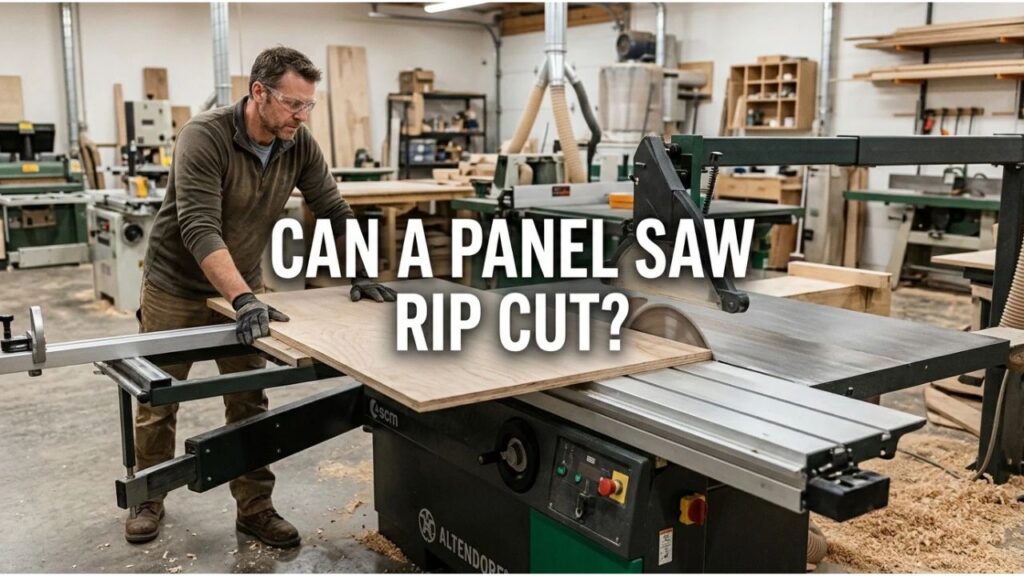
A rip cut is a straight cut that divides a panel along its length or generally runs parallel to one of its long factory edges.
For example, suppose you have a standard 4 × 8-foot plywood sheet that is 48 inches wide.
If you cut the sheet lengthwise into two pieces that are each approximately 24 inches wide, you are making a rip cut.
The finished pieces remain 8 feet long but become narrower.
This differs from a typical crosscut, which shortens the panel.
If you cut the same 4 × 8 sheet across its width to create two approximately 4 × 4-foot pieces, that is a crosscut.
Panel saws are useful because they can often perform both operations without requiring you to balance the entire sheet on a small work surface.
Can a Vertical Panel Saw Rip Cut?
Yes, many full-featured vertical panel saws can make rip cuts.
The process is different from making a vertical crosscut.
During a normal crosscut, the sheet generally remains stationary against the frame while the saw carriage moves vertically.
During a rip cut, many machines allow the saw head to rotate approximately 90 degrees into a horizontal cutting orientation.
The saw carriage is then positioned at the desired height and locked in place.
Instead of moving the saw through the material, you move the sheet horizontally across the bottom supports or rollers and through the blade.
That allows you to rip long strips from full sheets while most of the panel remains supported by the machine.
Not Every Vertical Panel Saw Works the Same Way
This is important.
Do not simply rotate the saw head because you saw someone do it on another machine.
Different vertical panel saws may use:
Different head-locking systems.
Different rip scales.
Different blade-rotation arrangements.
Different feed directions.
Different material supports.
Some machines may have restrictions on minimum rip width or panel thickness.
Others may require optional accessories for certain types of rip cuts.
The owner’s manual for your saw should always override a generic procedure.
Key Takeaways:
- Many vertical panel saws can make both crosscuts and rip cuts.
- Crosscutting usually moves the saw carriage; rip cutting commonly moves the panel.
- Exact setup and feed direction are machine-specific.
Can a Horizontal Panel Saw Rip Cut?
Yes.
Horizontal panel saws, particularly sliding table saws, are excellent for rip cutting.
A horizontal sliding panel saw supports the workpiece flat rather than vertically.
Depending on the operation, the panel can be positioned against a rip fence or supported on the sliding carriage.
The sheet is then guided past the blade while remaining well supported.
Professional cabinet shops commonly use this type of saw for repetitive panel sizing because it can provide excellent accuracy.
Some machines also have digital readouts, programmable fences, and scoring blades.
Sliding Table vs. Vertical Frame
The key difference is orientation.
A vertical panel saw stores and supports the panel upright.
A sliding panel saw supports it horizontally.
Both can make a long straight cut.
The right choice depends on shop space, required precision, production volume, and material type.
How to Rip Cut on a Vertical Panel Saw
The exact procedure varies by machine, but the following explains the general process.
Always use your saw’s manual for the exact controls and feed direction.
Step 1: Inspect the Machine
Before loading a panel, inspect the saw.
Make sure the blade guard works correctly.
Check that the saw carriage moves smoothly.
Verify that the saw-head rotation and locking mechanism are secure.
Look at the blade for damaged or missing teeth.
Make sure the lower panel supports or rollers are clean.
A small piece of debris under the panel can throw off your cut or cause the sheet to move unpredictably.
If the saw has dust collection, connect it before cutting.
Step 2: Choose the Correct Blade
Use a blade appropriate for both the machine and material.
Plywood generally benefits from a good carbide-tipped sheet-goods blade.
Melamine and laminated particleboard usually need a finer-tooth blade for a cleaner edge.
MDF requires a sharp blade suitable for abrasive composite material.
Do not select the blade based only on tooth count.
The correct blade diameter, arbor size, maximum RPM, tooth geometry, and material rating all matter.
A dull blade can create excessive cutting force, burning, chipping, and poor accuracy.
Step 3: Load the Panel
Place the sheet against the vertical frame with its lower edge resting securely on the material supports or rollers.
Keep the panel flat against the frame.
A full sheet should not be leaning outward while you are trying to set the saw.
If the panel is extremely heavy, such as thick MDF or particleboard, use another person or appropriate lifting equipment.
A panel saw makes sheet handling easier, but it does not make a heavy panel weightless.
Step 4: Determine the Desired Rip Width
Suppose you want to rip a 48-inch-wide plywood sheet into a strip 18 inches wide.
You need to position the blade so the final cut leaves the required width on the intended side.
Use the machine’s rip scale or measure manually.
Before relying on the built-in ruler, make sure it is calibrated.
If precision matters, verify the setup with a tape measure before cutting the expensive sheet.
Remember the Blade Kerf
The saw blade removes a narrow strip of material during the cut.
That removed material is the kerf.
If your finished part must be exactly 18 inches wide, make sure the blade is positioned so the kerf falls on the waste side.
Do not simply center the blade on your desired dimension unless that is what your layout specifically requires.
Step 5: Rotate the Saw Head Into Rip Position
Turn the saw off and wait until the blade is completely stopped.
Reposition the saw head according to the manufacturer’s procedure.
On many machines, the saw motor and blade assembly rotate into a horizontal orientation.
Make sure the head reaches its intended detent or position.
Then lock it firmly.
Never attempt to rotate or reposition the saw head while the blade is spinning.
Step 6: Set the Rip Height
Move the carriage until the blade is positioned at the correct height on the panel.
Use the machine’s measuring scale or your layout marks.
Once positioned, engage the carriage lock.
Double-check it.
During a rip cut, you generally do not want the saw carriage sliding vertically while the panel moves horizontally.
A poorly locked carriage can ruin the cut and create a safety hazard.
Step 7: Confirm the Correct Feed Direction
This is one of the most important steps.
The panel must be fed through the blade in the direction specified by the manufacturer.
Do not assume you can push the sheet from either side.
Blade rotation can cause the saw to pull aggressively on material fed in the wrong direction.
That can lead to poor control, lifting, binding, or kickback-like movement.
Look for feed-direction labels on the machine or check the manual.
Step 8: Position Your Hands Before Starting
Plan the entire feed before switching the saw on.
Your hands should never approach the blade path.
Keep them far enough from the cutting line that the panel can complete the entire movement without requiring you to reposition a hand close to the blade.
Do not plan to reach across the blade to catch an offcut.
If necessary, use a helper positioned safely away from the cutting line to support a large finished piece.
Step 9: Start the Saw
With the sheet still clear of the blade, switch on the saw.
Allow the blade to reach full operating speed.
Do not begin by pushing the material into a blade that is still accelerating.
Listen for unusual vibration.
If the machine sounds different than normal, shut it off before beginning the cut.
Step 10: Feed the Panel Smoothly
Move the sheet horizontally through the blade at a steady rate.
Keep it flat against the support frame.
Do not twist the sheet.
Do not force it.
A sharp, correctly selected blade should move through plywood or MDF without requiring extreme pushing force.
If the motor slows significantly, stop and investigate.
The blade may be dull, the panel may be binding, or the material may exceed the machine’s capacity.
Step 11: Complete the Rip Cut
Continue moving the sheet until the entire panel and offcut have cleared the blade.
Do not stop with the blade trapped inside the sheet unless an emergency requires it.
Once the cut is complete, turn the saw off.
Wait for the blade to stop fully before adjusting the machine or reaching near the cut area.
Then remove the finished pieces.
Step 12: Return the Saw to Its Safe Position
After the rip operation, return the saw head to its normal position if required.
Lock the carriage appropriately.
If another cut is needed, reset the saw only after the blade has completely stopped.
How to Rip Narrow Strips on a Panel Saw
Narrow rip cuts require extra attention because the finished strip or offcut may pass close to the blade.
Some machines have a minimum safe rip width.
Follow that limit.
Do not place your fingers next to the blade simply because the material is narrow.
If the panel saw cannot safely produce the strip you need, make the initial breakdown cut on the panel saw and finish the narrow rip using a more appropriate machine such as a properly configured table saw.
The correct tool is more important than forcing every cut to happen on one machine.
Can You Rip a Full 4 × 8 Sheet?
Yes, this is one of the major reasons panel saws exist.
A standard 4 × 8-foot plywood sheet can often be ripped lengthwise without requiring an enormous horizontal support table.
On a vertical saw, the panel is supported upright while the sheet moves horizontally.
That dramatically reduces the floor-space requirement.
However, make sure there is enough room to move the full 8-foot sheet across the machine.
The saw itself may have a narrow footprint, but the material still requires clearance on both sides.
Is a Panel Saw Good for Ripping Plywood?
Yes.
Plywood is one of the primary materials panel saws are designed to process.
A properly set up machine can produce long, straight, repeatable rip cuts with much less sheet-handling difficulty than a small table saw.
The quality of the finished edge depends on:
Blade quality.
Blade sharpness.
Machine alignment.
Feed rate.
Panel support.
Plywood quality.
For cabinet-grade plywood, use a blade intended for clean sheet-material cutting.
Can You Rip MDF on a Panel Saw?
Yes, assuming the machine is rated for the material.
MDF cuts predictably but is abrasive and produces extremely fine dust.
A sharp carbide blade is important.
Dust collection is even more important.
MDF dust can spread throughout a shop and should not be treated like ordinary coarse sawdust.
Wear suitable respiratory protection when needed and make sure the dust-extraction system is functioning before cutting.
Can You Rip Melamine on a Panel Saw?
Yes.
Panel saws are widely used for melamine and laminated particleboard.
The challenge is preventing chipping.
A sharp fine-tooth blade designed for melamine or laminate will generally produce better results.
High-end horizontal panel saws may use a scoring blade that lightly cuts the bottom face before the main blade passes through.
A vertical saw usually lacks that same scoring arrangement, so blade quality and machine alignment become particularly important.
If edge appearance matters, make a test cut on scrap first.
Can You Rip OSB With a Panel Saw?
Yes, if the saw is rated for wood-based sheet materials.
OSB generally does not demand the same finish quality as melamine, so a general-purpose sheet-material blade may be sufficient.
However, OSB can contain adhesives that are relatively abrasive.
Inspect the blade regularly if you process a large volume.
Can a Panel Saw Rip Solid Wood?
Some panel saws can cut certain solid-wood boards, but that is not necessarily the best use for the machine.
Panel saws are designed primarily around flat sheets.
Solid lumber can have:
Bow.
Twist.
Cup.
Uneven edges.
Internal tension.
Those characteristics can make it less stable against a vertical frame.
For routine solid-wood ripping, a table saw or suitable band saw is generally more appropriate.
Follow the panel-saw manufacturer’s approved material limits.
Panel Saw Rip Cut vs. Table Saw Rip Cut
Both machines can rip plywood, but the material-handling experience is very different.
With a conventional table saw, the full sheet is laid horizontally and pushed past the blade.
That requires substantial infeed, side, and outfeed support.
Without enough support, the panel can rotate or tip.
A panel saw carries much more of the sheet’s weight.
This makes large-panel handling easier.
When the Table Saw Is Better
A table saw is often better for:
Narrow strips.
Solid lumber.
Smaller workpieces.
Repeated ripping of boards.
Joinery-related cuts.
When the Panel Saw Is Better
A panel saw is especially good for:
Full-size plywood.
MDF sheets.
Melamine panels.
Large particleboard.
Breaking down sheet stock.
A professional shop may use the panel saw for rough or finished sheet sizing and the table saw for later operations.
Panel Saw Rip Cut vs. Track Saw
A track saw is another excellent option for ripping sheet goods.
You place a guide rail on the sheet and move the saw along the rail.
The biggest advantage is portability.
A track saw can be used in a garage, job site, or small shop without a permanent machine.
It can also produce very clean edges.
A panel saw becomes more attractive when you need to cut many sheets repeatedly.
Once calibrated, you can set a measurement and process panels much faster than aligning a track for every cut.
Is a Vertical Panel Saw Accurate for Rip Cuts?
It can be very accurate when properly adjusted.
Accuracy depends heavily on the machine’s frame, carriage, scales, locks, and material supports.
If the saw head is not perfectly aligned after being rotated into rip mode, the cut can wander or become slightly out of square.
The rip scale also needs calibration.
For high-precision work, make periodic test cuts.
Measure both ends of the ripped piece.
For example, if the finished strip should be 18 inches wide, measure near both ends.
If one end is 18 inches and the other is 18-1/8 inches, something is out of alignment.
Do not simply compensate by pushing the sheet crooked.
Correct the machine.
Key Takeaways:
- A well-aligned panel saw can produce accurate rip cuts.
- Check both ends of test pieces when verifying alignment.
- If cuts taper, correct the machine rather than steering the panel manually.
How to Make Cleaner Rip Cuts
The blade is the first thing to inspect.
A sharp blade creates a cleaner edge and requires less feed force.
Next, keep the panel flat against the supports.
A sheet that moves away from the frame changes its relationship with the blade.
Maintain a smooth feed rate.
Stopping repeatedly during the cut can leave burn marks or uneven tooth marks.
For delicate face veneers or melamine, choose the panel orientation that produces the cleanest visible surface based on your blade rotation.
Because vertical panel saws vary in blade direction, test this rather than assuming one face should always point outward.
Why Does a Panel Saw Rip Cut Wander?
Several problems can cause a tapered or wandering cut.
The saw head may not be correctly locked in the rip position.
The carriage can be out of alignment.
The sheet may not be flat against the frame.
Support rollers may contain debris.
The blade can be warped.
The blade may also be dull enough that the operator begins pushing the sheet unevenly.
A straight cut should come from machine geometry, not from the operator constantly correcting the sheet.
Why Does the Blade Bind During a Rip Cut?
Binding can happen when the panel twists or moves away from the frame.
A warped sheet can also close around the blade.
The offcut may shift unexpectedly as the cut progresses.
If the blade binds, stop pushing.
Turn the saw off while maintaining control of the material.
Wait for the blade to stop.
Then determine why the sheet moved before continuing.
Do not pull a bound sheet aggressively backward against a running blade.
Should You Push Hard During a Panel Saw Rip Cut?
No.
Use steady, moderate feed pressure.
Excessive force can reduce accuracy and increase the likelihood of binding.
If the blade will not cut without heavy force, check:
Blade sharpness.
Blade type.
Material thickness.
Feed direction.
Saw alignment.
Motor condition.
A panel saw should not feel like you are forcing material through a dull construction blade.
What Blade Is Best for Panel Saw Rip Cuts?
There is no single tooth count that works for every machine.
For general plywood, choose a quality carbide blade designed for sheet materials.
For laminated or veneered panels, choose a finer finish blade.
For MDF and particleboard, use a durable carbide blade suitable for abrasive composites.
The blade must also match the manufacturer’s required diameter, arbor, kerf, and speed rating.
A high tooth count is not automatically better.
Too many teeth in thick material can increase heat and reduce chip clearance.
The blade design should match the material and machine.
Can You Rip Cut Without Measuring the Kerf?
You can make a rough cut without worrying much about kerf, but accurate parts require you to consider where the blade removes material.
Suppose you need a finished strip exactly 12 inches wide.
If your layout line represents the finished edge, place the blade on the waste side of that line.
The entire blade kerf should be removed from the unwanted portion.
For repetitive cuts, calibrating the machine’s measuring scale to the actual blade kerf makes the process much faster.
Is Rip Cutting on a Panel Saw Safe?
It can be safe when performed according to the machine’s design.
In fact, the large built-in material supports can make full sheets easier to control than they would be on a small table saw.
But a panel saw still has a high-speed circular blade.
The main safety rules are straightforward.
Keep hands well away from the cutting path.
Use all guards.
Use the correct feed direction.
Lock the saw head and carriage correctly.
Support large offcuts.
Wait for full blade stop before making adjustments.
Wear eye and hearing protection.
Use dust control.
Do not operate the saw if guards, locks, or electrical components are damaged.
Common Mistakes When Rip Cutting With a Panel Saw
A very common mistake is feeding the sheet in the wrong direction.
Another is failing to lock the saw head after rotating it into rip position.
Operators also sometimes rely completely on an unverified measuring scale and end up cutting every panel slightly undersized.
Another mistake is trying to rip strips narrower than the machine can safely handle.
Large-panel machines are optimized for large pieces.
There is no benefit in forcing them to perform an unsafe narrow rip when a table saw would handle it better.
Using the wrong blade is another major issue.
A rough framing blade may technically cut melamine, but the edge quality can be terrible.
Finally, never attempt to adjust the head or material while the blade is still spinning.
FAQs About Can a Panel Saw Rip Cut
Can a panel saw rip cut?
Yes. Many panel saws are specifically designed to make both rip cuts and crosscuts in large sheet materials.
Can a vertical panel saw make rip cuts?
Yes, many vertical models can.
The saw head is commonly rotated and locked horizontally while the sheet is moved through the blade.
Can every vertical panel saw rip?
Not necessarily.
Some models may have limited functions or rip capacities. Check the specifications and manual for your exact saw.
Can a sliding panel saw rip cut?
Yes.
Horizontal sliding panel saws are widely used for accurate rip and sizing cuts in cabinet shops.
What direction is a rip cut?
On a sheet, a rip cut generally runs lengthwise or parallel to the long edge.
Can you rip a 4 × 8 sheet on a panel saw?
Yes.
Handling full-size sheet goods is one of the machine’s primary purposes.
Can you rip plywood?
Yes.
Plywood is one of the most common panel-saw materials.
Can you rip MDF?
Yes, with a suitable blade and good dust extraction.
Can you rip melamine?
Yes.
Use a sharp blade designed for clean laminated-panel cuts.
Can you rip OSB?
Yes, provided the machine is rated for wood-based sheet goods.
Can you rip particleboard?
Yes.
Use a sharp carbide blade because composite panels can be abrasive.
Can you rip solid wood on a panel saw?
Some machines may allow it, but panel saws are mainly designed for flat sheet material.
A table saw is usually better for routine solid-lumber ripping.
How do you rip on a vertical panel saw?
Typically, you rotate and lock the saw head into rip position, set its height, and feed the panel horizontally in the manufacturer-specified direction.
Does the saw move during a vertical panel saw rip cut?
Usually the saw head stays locked while the panel moves, although machine designs vary.
How do you crosscut on a vertical panel saw?
The sheet generally stays stationary while the saw carriage travels vertically through it.
Which is easier, ripping on a panel saw or table saw?
For full sheets, a panel saw is often easier because the machine supports most of the material.
For small boards and narrow strips, a table saw may be better.
Is a track saw better for ripping plywood?
A track saw is excellent for occasional or portable work.
A panel saw is generally faster for repeated production cuts.
Do you need a special blade for rip cutting?
Use a blade appropriate for both the sheet material and your machine. Plywood, MDF, and melamine may benefit from different blade designs.
How do you prevent chipping?
Use a sharp fine-finish blade, maintain proper alignment and feed speed, and test the best face orientation for your machine.
Why is my rip cut tapered?
The saw head, carriage, blade, or panel supports may be misaligned, or the sheet may be moving away from the frame.
Can you make narrow rip cuts on a panel saw?
Only within the machine’s rated safe capacity.
For very narrow strips, another saw may be safer and easier.
Do you need to account for blade kerf?
Yes, if you need an accurate finished dimension.
Place the blade so its kerf falls on the waste side.
Can one person rip a full sheet?
Often, yes, especially with a vertical panel saw.
Very heavy or oversized panels may still require a helper or lifting equipment.
Is a panel saw safe for rip cuts?
Yes when used correctly with the proper feed direction, guards, locks, blade, and material support.
Conclusion
So, can a panel saw rip cut? Yes. Many panel saws are designed specifically to make both rip cuts and crosscuts in large sheet materials such as plywood, MDF, particleboard, OSB, and melamine.
On a vertical panel saw, a typical rip cut involves rotating the saw head into a horizontal cutting orientation, setting it at the required height, locking the carriage, and moving the panel horizontally through the blade.
On a horizontal sliding panel saw, the sheet remains flat and is guided past the blade using the machine’s fence, carriage, or positioning system.
The biggest advantage of using a panel saw for rip cuts is support.
A full 4 × 8-foot sheet that may be difficult to balance on a standard table saw can remain largely supported by the panel saw’s frame or sliding table.
That makes large-sheet processing faster and easier.
However, not every panel saw uses the same rip-cut procedure. Feed direction, saw-head positioning, minimum rip width, material thickness, and locking mechanisms differ between machines.
Always follow the instructions for your exact model.
For the best results, use a sharp material-appropriate blade, calibrate the measurement scale, account for blade kerf, keep the panel flat against the support system, and feed it at a smooth controlled rate.
Most importantly, keep your hands out of the blade path and never reposition the saw head while the blade is running.
For full-sheet work, rip cutting is one of the primary jobs a properly equipped panel saw is built to do.