How Accurate Are Panel Saws?
Panel saws can be very accurate when they are properly installed, squared, calibrated, and fitted with a good blade. A quality vertical panel saw can produce straight, repeatable cuts suitable for cabinetmaking, furniture parts, shelving, and sheet-goods processing, but its actual accuracy depends heavily on frame alignment, carriage condition, measuring-system calibration, blade quality, material support, and operator technique.
A well-adjusted professional panel saw can repeatedly cut full sheets to consistent dimensions with very little deviation. However, you should not assume that every panel saw automatically produces furniture-grade accuracy straight out of the box.
Vertical panel saws have large frames, long guide systems, moving carriages, rollers, stops, and measuring scales. Even a small alignment error can become noticeable across a 4-foot-wide panel.
For example, a saw carriage that is slightly out of square may look perfectly acceptable near one edge of a sheet but produce a measurable difference by the time the cut reaches the opposite side.
The good news is that panel saw accuracy is usually adjustable. Proper mounting, squaring, calibration, blade selection, and maintenance can make a major difference.
In this guide, I’ll explain how accurate panel saws are, what kind of tolerance you can realistically expect, what causes inaccurate cuts, how to test a panel saw for squareness, and how to improve repeatability for cabinet and production work.
Are Panel Saws Accurate?
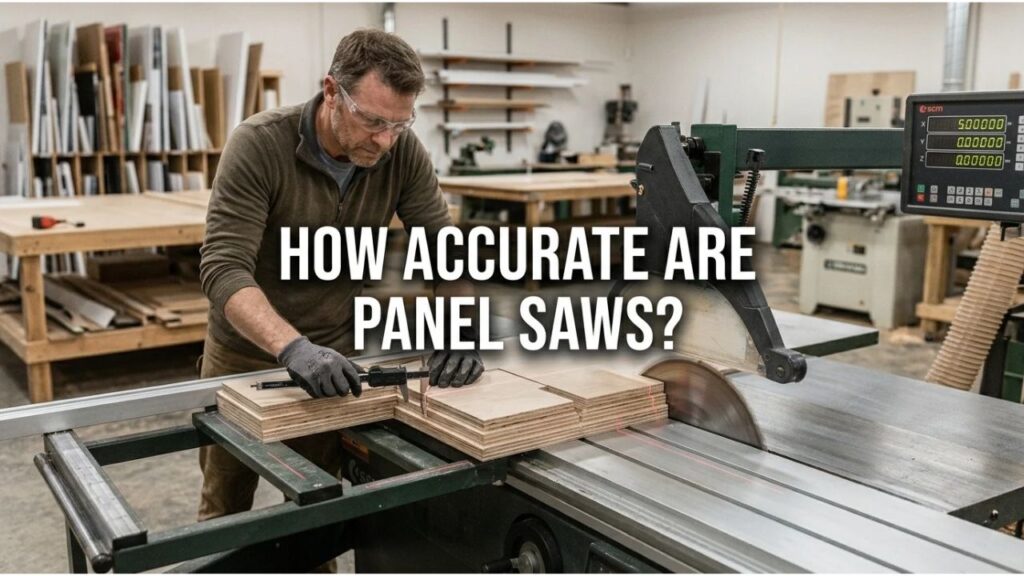
Yes. A good panel saw can be highly accurate.
Professional vertical panel saws are designed specifically for straight, repeatable cuts in large sheet materials.
That makes them much more controlled than trying to cut a full 4 × 8 sheet freehand with a handheld circular saw.
The saw carriage follows a rigid guide system instead of relying entirely on the operator to steer the blade.
The panel itself also rests against a fixed support frame.
Together, these features help maintain a consistent cutting path.
Accuracy Depends on Setup
The machine’s design gives it the potential to be accurate, but setup determines whether it actually achieves that potential.
A poorly mounted expensive panel saw can cut worse than a carefully set-up inexpensive machine.
Likewise, a panel saw that was accurate when new can become inaccurate after being moved, bumped, or allowed to go out of adjustment.
The most important variables include:
Frame geometry, carriage alignment, blade condition, material support, measuring-scale calibration, and how firmly the panel rests against the machine.
How Accurate Can a Panel Saw Be?
There is no universal accuracy specification that applies to every panel saw.
Light-duty portable machines, commercial shop saws, and industrial panel-processing systems are built to different standards.
For normal woodworking, however, a properly adjusted vertical panel saw can generally produce cuts accurate enough for cabinet components, shelving, furniture panels, and similar work.
Dimensional Accuracy
Dimensional accuracy means how close the finished piece is to the intended size.
If you set the saw for 24 inches and the part measures 24 inches consistently, the machine has good dimensional accuracy.
If one cut measures 23-31/32 inches and the next measures 24-1/16 inches, repeatability is poor even if the average is close.
Squareness
A cut can be the correct length but still be out of square.
For panel work, squareness is often more important than a tiny dimensional difference.
Cabinet sides, shelves, doors, and backs need edges that meet correctly.
A cut that is only slightly angled across a 48-inch sheet can create assembly problems later.
Repeatability
Repeatability is the ability to make the same cut multiple times and get nearly identical results.
This is one of the strongest advantages of a well-calibrated panel saw.
Once a stop or measuring system is correctly set, repetitive parts can be produced quickly without laying out every piece individually.
Key Takeaways:
- Panel saws can be highly accurate when properly calibrated.
- Squareness, dimensional accuracy, and repeatability are separate measurements.
- Setup quality often matters as much as the price of the machine.
Are Vertical Panel Saws Accurate Enough for Cabinetmaking?
Yes, many are.
Vertical panel saws are widely used in cabinet shops because they are well suited to breaking large sheets into accurately sized rectangular parts.
Typical cabinet materials include:
Plywood, MDF, particleboard, melamine, and laminated panels.
A good panel saw can cut cabinet sides, shelves, backs, partitions, and similar parts efficiently.
Rough Breakdown vs. Final Sizing
Some cabinet shops use the panel saw primarily for rough breakdown.
The pieces are then taken to a table saw, sliding saw, or CNC router for final sizing.
Other shops use a well-calibrated panel saw for finished dimensions directly.
Both workflows can be valid.
It depends on the accuracy required, machine quality, blade, and production process.
When Final Sizing Matters
If a cabinet side must be exactly square and fit into a precision assembly, the machine needs to be carefully calibrated.
A small squareness error can become obvious when multiple panels are joined.
For rough construction panels or material that will be trimmed later, the tolerance is less critical.
Panel Saw Accuracy vs. Table Saw Accuracy
Both machines can be extremely accurate, but they achieve accuracy differently.
A table saw uses a stationary blade and a fence or miter guide.
The workpiece moves through the blade.
A vertical panel saw supports the sheet almost upright while the saw carriage moves through it for crosscuts.
Table Saw Advantages
A well-tuned cabinet table saw can provide extremely precise rip cuts.
Its rigid cast-iron table, fence, and trunnion system create a strong reference surface.
For smaller workpieces, a table saw is often easier to fine-tune to very tight dimensions.
Panel Saw Advantages
A panel saw becomes especially advantageous with full sheets.
Trying to hold a 4 × 8 sheet perfectly against a table saw fence can introduce operator error.
The sheet may twist, drift away from the fence, or sag without enough support.
A vertical panel saw supports most of the sheet and guides the cutting head mechanically.
For large-panel crosscuts, this can produce better practical accuracy than a table saw in a small shop.
Which Is More Accurate?
Neither is automatically more accurate.
A properly calibrated machine used for the type of cut it was designed for will generally outperform a poorly set-up machine of another type.
For full-sheet breakdown, a panel saw can be exceptionally consistent.
For small-part precision ripping, a high-quality table saw may be more convenient.
Panel Saw Accuracy vs. Track Saw
A high-quality track saw can also produce very straight cuts.
The guide rail provides a controlled path for the saw.
With a carefully positioned track, excellent cabinet-grade cuts are possible.
Where a Track Saw Can Be More Precise
For one-off custom cuts, a track saw can be positioned directly on layout marks.
This makes it flexible for odd dimensions and special situations.
Where a Panel Saw Wins
A panel saw is much faster for repeated cuts.
Once calibrated, you can load a sheet, position it using the built-in scale or stop, and make the cut.
There is no need to realign a guide rail for every panel.
Repeatability is therefore one of the biggest advantages of a production panel saw.
Panel Saw Accuracy vs. Sliding Table Saw
A high-quality sliding table saw is one of the most accurate machines for sheet processing.
It supports the workpiece horizontally on a moving carriage and often includes precision crosscut fences, stops, scoring blades, and digital measuring systems.
For high-end production work, sliding saws can provide exceptional accuracy.
Why Use a Vertical Panel Saw Then?
Space and material handling.
Sliding saws require a large amount of floor area.
Vertical saws keep panels upright and use much less horizontal space.
A shop may therefore accept a small difference in versatility or theoretical precision in exchange for easier sheet handling and a smaller footprint.
For many cabinet and sign shops, a properly calibrated vertical saw is accurate enough that this tradeoff is worthwhile.
What Affects Panel Saw Accuracy?
Several components work together to determine the final cut.
Frame Alignment
The frame is the foundation of the machine.
If it is twisted, bent, or improperly mounted, nearly every other adjustment becomes difficult.
The material-support system and carriage guides must remain in the correct relationship to each other.
Floor Conditions Matter
An uneven floor can distort a freestanding machine.
Likewise, wall brackets installed unevenly can twist a wall-supported frame.
If a saw suddenly becomes inaccurate after being moved or mounted, check the frame before adjusting smaller components.
Carriage Squareness
For a vertical crosscut, the carriage path must be exactly perpendicular to the line supporting the bottom of the panel.
If it is not, the cut will be angled.
The farther the blade travels across the sheet, the more noticeable the error becomes.
Small Angular Errors Become Large
This is one of the most important concepts in panel saw calibration.
A tiny error at the carriage guide can create a visible dimensional difference across a 48-inch panel.
That is why panel saw squaring procedures usually use large reference measurements rather than checking only a few inches near the blade.
Blade Condition
A panel saw can be perfectly aligned and still cut inaccurately if the blade is poor.
A dull blade may wander through the material.
A blade with damaged teeth may pull slightly to one side.
A blade with excessive runout can widen the kerf or create an uneven edge.
Blade Type Matters
A coarse framing blade may cut quickly but leave a rough edge.
A fine-tooth carbide blade generally produces a cleaner, more controlled cut in plywood and finished panels.
Melamine may benefit from a blade designed specifically to reduce chipping.
Plastic requires suitable tooth geometry and feed rate.
Correct blade selection affects both edge quality and practical accuracy.
Blade Runout
Runout means the blade does not rotate in a perfectly flat plane.
Instead, it wobbles slightly from side to side.
This can come from:
A damaged blade, dirty arbor flange, bent arbor, or improperly seated blade.
Even small runout can create a wider-than-expected kerf and inconsistent edge quality.
If a machine seems calibrated but cuts still vary, inspect the blade and arbor.
Material Support
The panel must rest consistently against the support frame.
If one corner lifts away, the cutting geometry changes.
Warped panels are particularly difficult.
A bowed sheet may not sit flat against the frame, so the cut edge may not behave like a perfectly flat reference surface.
Keep Rollers and Supports Clean
Dust, chips, adhesive residue, or damaged rollers can lift the panel slightly.
Clean material supports improve consistency.
Measuring Scale Calibration
The printed or digital scale does not determine whether the cut is straight.
It determines whether the cut occurs at the intended dimension.
A panel saw may cut perfectly square while its ruler is still off by 1/8 inch.
That is a calibration problem, not a squareness problem.
Calibrate After Squaring
Always square the machine first.
Then calibrate the ruler or stop system.
Otherwise, you may calibrate the measurement to a machine that is still geometrically incorrect.
Operator Technique
Even automated-looking machinery depends on technique.
During ripping, the operator may need to move the sheet smoothly across the rollers.
Jerking, twisting, or lifting the panel can alter the cut.
During crosscutting, the sheet must be seated correctly before the carriage moves.
Good technique produces more consistent results.
Key Takeaways:
- Frame alignment and carriage squareness are fundamental.
- A bad blade can make a correctly calibrated machine cut poorly.
- Measuring scales should be calibrated only after mechanical alignment is correct.
How to Check Panel Saw Accuracy
The best method is to make controlled test cuts and measure them.
Do not rely only on the machine’s ruler or a small carpenter’s square.
Start With a Large Test Panel
Use a reasonably flat scrap sheet.
A wide panel makes small angular errors easier to detect.
Place the panel on the saw exactly as you would during normal work.
Make a crosscut.
Then measure the result carefully.
Check the Cut With a Large Square
Place a reliable framing square or machinist-style reference against the new cut edge.
Look for a gap along the square.
A large square provides a quick visual indication.
However, the square itself must be accurate.
Cheap or damaged squares can create false readings.
Use the Diagonal Measurement Method
For a rectangular panel, measure both diagonals.
If the rectangle is truly square, the diagonals should be equal.
For example, after trimming a test panel into a rectangle, measure:
Top-left corner to bottom-right corner.
Then measure:
Top-right corner to bottom-left corner.
If the measurements differ, the panel is not perfectly square.
This method is useful because it amplifies angular errors across a large area.
Use a Flip Test
Another method is to make a cut, flip the workpiece, and compare the edges.
When done correctly, this can double the visible error and make small misalignment easier to detect.
The exact method depends on what part of the panel saw you are checking.
It is particularly useful when calibrating crosscut squareness.
Measure Repeated Cuts
Accuracy is not only about one perfect cut.
Make several identical parts using the same stop or scale setting.
Measure each one.
If the first is correct but the next four vary, you have a repeatability problem.
Potential causes include:
Loose stops, moving scales, panel movement, roller issues, or inconsistent operator technique.
How to Square a Panel Saw
The exact procedure varies by manufacturer, but the general principle is the same.
You are adjusting the relationship between the saw carriage and material-support line.
Start With the Frame
Make sure the machine is installed correctly and is not twisted.
Do not try to compensate for a bent frame by adjusting the carriage excessively.
Check Carriage Travel
With the machine unplugged, move the carriage through its full travel.
It should move smoothly without side play or binding.
Worn or loose carriage bearings can affect cutting accuracy.
Make a Test Cut
Use a wide scrap panel and make a full crosscut.
Measure squareness.
Adjust According to the Manual
Depending on the machine, squaring may involve changing:
Guide rail position, roller alignment, material-support reference, carriage bearings, or an adjustment bracket.
Make small changes.
Retest after every adjustment.
Avoid changing multiple adjustments at once because you will not know which one affected the result.
How Accurate Is the Measuring Scale on a Panel Saw?
It can be highly accurate after calibration.
However, factory ruler position should not automatically be trusted after shipping, installation, or blade changes.
The scale must account for the blade kerf and reference side of the cut.
Kerf Matters
A circular saw blade removes material.
That removed width is called the kerf.
If you measure from the wrong side of the blade, the final piece can be off by the kerf width.
A panel saw’s measuring system should be calibrated to whichever side of the cut is considered the finished dimension.
Blade Changes Can Affect Calibration
Different blades can have different kerf widths.
Switching from a thin-kerf blade to a full-kerf blade may slightly change how your measuring scale relates to the actual cut.
Check calibration after installing a blade with significantly different geometry.
How Accurate Are Panel Saw Stops?
Good mechanical stops can be extremely repeatable.
They are often more reliable than measuring every sheet individually.
A stop gives the material a fixed physical reference point.
Keep the Stop Clean
Dust or debris trapped between the material and stop can add measurable error.
Likewise, a loose stop can shift during repetitive work.
Check locking hardware regularly.
Digital Stops
Some industrial machines use digital readouts or powered positioning systems.
These can offer excellent repeatability, but digital measurement still depends on the physical machine being square and mechanically sound.
Electronics cannot compensate for a twisted frame or dull blade.
Does Blade Kerf Affect Panel Saw Accuracy?
Yes.
Kerf is the width of material removed by the blade.
If a blade has a 1/8-inch kerf, material approximately 1/8 inch wide becomes sawdust during the cut.
You must know which side of the blade your measurement references.
Waste Side Matters
For manual layout, position the blade so the kerf falls on the waste side of the line.
On a calibrated panel saw, the ruler or stop usually handles this relationship for you.
Still, changing blades may require recalibration.
Does Sheet Thickness Affect Accuracy?
It can.
Thicker panels increase the amount of material the blade must cut.
A dull or underpowered saw may deflect more when cutting thick stock.
A good sharp blade and appropriate feed rate help minimize this problem.
Very Thin Sheets
Thin sheets can flex.
If a sheet bows away from the frame, the cut may become less predictable.
Use the machine’s recommended support method for flexible material.
Can Warped Plywood Reduce Accuracy?
Yes.
Panel saw calibration assumes the sheet is positioned consistently against the support frame.
A heavily warped panel does not provide a reliable reference.
You may make a perfectly straight cut relative to the blade path while the material itself is twisted.
Once the panel is removed and allowed to relax, dimensions may appear inconsistent.
For precision work, use flat stock whenever possible.
Does Feed Speed Affect Accuracy?
Yes, especially during horizontal ripping.
Feed too quickly and the blade may deflect or leave a rough edge.
Feed too slowly and some materials may burn or melt.
The ideal speed allows the blade to cut freely without forcing it.
Listen to the Motor
If the motor noticeably slows down during the cut, the feed may be too aggressive or the blade may be dull.
Forcing the panel through rarely improves accuracy.
How to Improve Panel Saw Accuracy
Start with the machine rather than the measuring tape.
Make sure the frame is mounted correctly.
Then square the carriage.
Check material rollers and supports.
Install a high-quality sharp blade.
Calibrate the measuring scale.
Finally, make test cuts and verify the result.
Use a Consistent Reference Edge
When cutting multiple cabinet parts, establish one known straight edge and use it consistently.
Randomly changing which edge references the measuring system can compound errors.
Make Rough Cuts Before Precision Cuts
If a factory sheet edge is damaged or not square, trim it first.
Then use the newly established edge as your reference.
A panel saw cannot produce a square rectangle if you start by referencing an edge that is already significantly crooked.
Check Calibration Regularly
Production vibration, blade changes, machine movement, and accidental impacts can alter alignment.
A quick periodic test cut can identify a problem before dozens of panels are processed incorrectly.
Are Portable Panel Saws Less Accurate?
Not necessarily, but lighter machines may be more sensitive to setup and movement.
A large industrial saw has greater frame mass and rigidity.
This can improve long-term consistency.
Portable or lightweight panel saws are designed to balance accuracy with mobility.
If moved frequently, they should be checked for alignment after relocation.
Stability Matters
If a portable frame flexes or rocks while cutting, accuracy will suffer.
Make sure the machine is fully supported in its intended operating configuration.
Are Expensive Panel Saws More Accurate?
Often they offer better rigidity, bearings, measuring systems, stops, and adjustability.
However, price alone does not guarantee accurate cuts.
A premium saw still needs:
Proper mounting, calibration, maintenance, and a suitable blade.
Meanwhile, a simpler saw that has been carefully aligned can produce excellent results.
Higher-end machines generally make it easier to maintain repeatability under frequent production use.
Can a Panel Saw Cut Within 1/16 Inch?
A good, properly calibrated panel saw should normally be capable of work where 1/16-inch dimensional control is realistic, and many professional machines can perform substantially better under suitable conditions.
However, whether you achieve that consistently depends on:
Machine quality, scale resolution, blade kerf, panel flatness, stop quality, and operator technique.
For cabinetry, aiming merely for “within 1/16” may not always be enough for certain finished components.
Production shops often demand tighter consistency.
Do Not Promise a Universal Tolerance
Avoid assuming every panel saw is accurate to ±1/32 inch or another specific number.
Manufacturers may publish model-specific accuracy specifications, and those should be used when you need a guaranteed tolerance.
Can a Panel Saw Make Perfectly Square Cuts?
It can make extremely square cuts when properly adjusted.
“Perfect,” however, is not a useful practical woodworking standard.
Every measuring system has some tolerance.
The real question is whether the remaining error is small enough for the project.
For cabinet construction, if parts assemble cleanly, dimensions repeat consistently, and diagonals remain equal within the required tolerance, the machine is doing its job.
How Often Should You Check Panel Saw Accuracy?
Check it after:
Moving the machine, installing it in a new location, changing major carriage components, replacing or changing blade type, noticing rough or angled cuts, or experiencing an impact to the frame.
For production use, periodic verification is good practice even when no obvious problem exists.
A quick calibration check can prevent expensive sheet waste.
Key Takeaways:
- Test cuts are more reliable than assuming the machine’s ruler is correct.
- A panel saw should be checked after relocation or major adjustments.
- Repeatability over several cuts matters more than one lucky accurate cut.
Common Causes of Inaccurate Panel Saw Cuts
If your cuts are not accurate, check the problem systematically.
A cut that is out of square suggests carriage or frame alignment.
A cut that is square but the wrong size points more toward scale calibration.
Rough or wandering cuts may indicate blade problems.
Random variations can indicate loose stops, dirty rollers, warped material, or inconsistent feeding.
Cut Is Consistently Too Long or Too Short
Likely causes include:
Misadjusted measuring scale, incorrect blade-kerf reference, or stop calibration.
Cut Is Out of Square
Likely causes include:
Carriage alignment, material-support alignment, or frame twist.
Cut Varies Every Time
Look for:
Loose stops, panel movement, carriage play, inconsistent reference edges, or operator technique.
Cut Edge Is Rough but Dimension Is Correct
Blade condition or tooth design is the likely starting point.
Panel Saw Accuracy for Melamine
Melamine demands both dimensional accuracy and clean edges.
A cut can be perfectly square but still unusable if the surface chips badly.
Use a blade intended for laminated sheet goods.
Some production systems also use scoring technology to reduce chipping.
A standard vertical panel saw without scoring can still produce excellent results with the right blade and setup, but edge quality depends heavily on blade selection.
Panel Saw Accuracy for Plywood
Plywood is generally forgiving.
A sharp fine-tooth carbide blade can produce very good edges.
Because plywood is usually reasonably rigid, it sits against the frame well.
Warped construction-grade plywood, however, can reduce dimensional consistency.
For cabinet-grade plywood, a well-calibrated panel saw is an excellent cutting tool.
Panel Saw Accuracy for MDF
MDF is flat and dimensionally consistent, which makes it well suited to panel saws.
The main concerns are blade wear and dust.
MDF is abrasive compared with many solid woods and can dull blades.
As the blade becomes dull, cut quality and accuracy may decline.
Keep the blade sharp and use effective dust extraction.
FAQs about How Accurate Are Panel Saws
How accurate are panel saws?
A properly calibrated quality panel saw can produce very straight, square, and repeatable cuts suitable for cabinetmaking and professional sheet-goods work.
Are panel saws accurate enough for cabinets?
Yes.
Many cabinet shops use panel saws for cabinet sides, shelves, backs, and other rectangular components.
Is a panel saw more accurate than a table saw?
Not inherently.
A panel saw may be easier to control with full sheets, while a table saw can be excellent for precise smaller-part ripping.
Is a panel saw more accurate than a track saw?
Both can be highly accurate.
A panel saw generally offers better repeatability for high-volume cutting, while a track saw is highly flexible for one-off work.
Can a panel saw cut within 1/16 inch?
A properly set-up quality machine should normally be capable of that level of dimensional control, and many professional machines can do better.
Can a panel saw cut within 1/32 inch?
Some high-quality machines and setups can achieve very tight repeatability, but do not assume this tolerance without checking the specific machine and test results.
Why is my panel saw cutting out of square?
The carriage may not be perpendicular to the panel support, or the machine frame may be twisted or incorrectly mounted.
Why are my panel saw cuts different lengths?
Check the measuring scale, stops, blade kerf reference, panel positioning, and whether the material is moving during the cut.
Does blade quality affect accuracy?
Yes.
A dull, damaged, or inappropriate blade can wander, deflect, or produce inconsistent kerf.
Does blade kerf affect measurements?
Yes.
The scale must reference the correct side of the blade and account for the material removed by the kerf.
Should I recalibrate after changing blades?
It is a good idea, especially when switching to a blade with a different kerf or geometry.
Can warped plywood cause inaccurate cuts?
Yes.
Warped material may not sit consistently against the support frame.
How do I check if a panel saw is square?
Make a wide test cut and check it with a reliable large square or by measuring diagonals on a rectangular test piece.
How do I improve panel saw accuracy?
Square the machine, check the frame for twist, use a sharp blade, clean the supports, calibrate the measuring scale, and make controlled test cuts.
Do panel saws lose accuracy over time?
They can.
Carriage wear, loose fasteners, blade wear, machine movement, and frame distortion can gradually affect calibration.
Are portable panel saws accurate?
Yes, they can be, but frequent movement makes periodic calibration especially important.
Are industrial panel saws more accurate?
They are often more rigid and have better measuring and stop systems, which can improve repeatability under heavy production use.
How often should I square a panel saw?
Check it whenever the machine is moved, after major adjustments, after impacts, or when cuts begin showing measurable errors.
Can a panel saw cut melamine accurately?
Yes.
Use a properly calibrated machine and a blade designed for clean cuts in laminated sheet goods.
Can a panel saw cut MDF accurately?
Yes.
MDF’s flatness makes it well suited to panel saws, although its abrasiveness can dull blades.
Can a panel saw make finished-size cuts?
Yes, if the machine is sufficiently calibrated for the tolerance required by your project.
Some shops still use panel saws only for rough breakdown and final-size parts on another machine.
Conclusion
So, how accurate are panel saws? A properly installed, squared, calibrated, and maintained panel saw can be highly accurate and provide repeatable cabinet-grade cuts in large sheet materials.
The machine’s greatest strength is control over full-size panels. Instead of trying to balance a 4 × 8 sheet across a small table or guide a handheld circular saw manually, the panel rests against a rigid frame while the cutting carriage follows a controlled path.
That design can produce excellent straightness and repeatability.
However, accuracy is not automatic.
The frame must be installed without twist. The carriage must travel square to the material-support line. Rollers and supports must hold the sheet consistently. The blade must be sharp, properly seated, and suitable for the material. Finally, the measuring scale and stops must be calibrated to the actual blade position and kerf.
If the cut is straight but consistently the wrong dimension, recalibrate the measuring system. If the dimensions vary from cut to cut, inspect stops, material positioning, and carriage play.
For cabinetmaking, shelving, furniture panels, and general sheet-goods processing, a good panel saw is usually more than accurate enough when maintained correctly.
The practical answer is simple: panel saw accuracy depends less on the fact that it is a panel saw and more on how rigid, square, calibrated, and well maintained the complete cutting system is.