Can a Radial Arm Saw Kickback? Causes, Risks & Prevention
Yes, a radial arm saw can kick back. Kickback can happen when the blade grabs, pinches, climbs into the workpiece, or when material is fed in the wrong direction during ripping. On a radial arm saw, the risk is especially important because the blade carriage moves toward the operator during a normal crosscut, and many older models can also be configured for ripping.
A radial arm saw behaves differently from a table saw. During a crosscut, the workpiece normally stays against the fence while the motor and blade move through it. Because of the direction of blade rotation, the saw can sometimes try to pull itself rapidly toward the operator. This is commonly described as self-feeding or climb-cutting behavior.
During ripping, kickback can be even more severe if the stock is fed from the wrong direction, the blade pinches, or anti-kickback devices are missing or incorrectly adjusted.
That does not mean every radial arm saw is inherently uncontrollable. A properly aligned machine, correct blade, secure fence, correct feed direction, good guarding, and controlled technique greatly reduce risk.
In this guide, I’ll explain can a radial arm saw kickback, why it happens, how crosscut and rip kickback differ, what self-feeding means, and what you can do to operate the saw more safely.
Can a Radial Arm Saw Kickback?
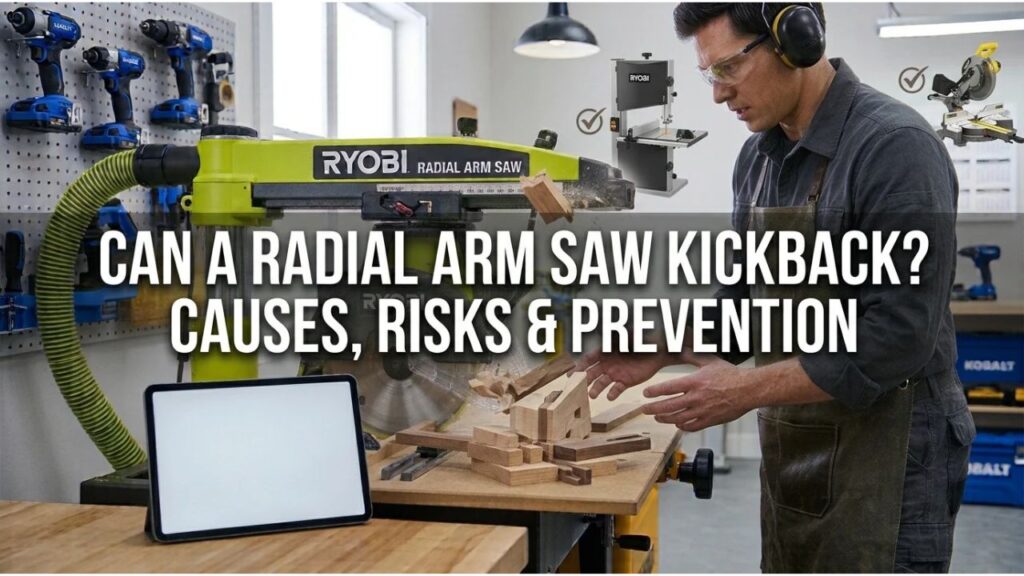
Yes.
A radial arm saw can kick back in several different ways.
The blade may pull the carriage toward you too quickly during a crosscut.
The workpiece may be thrown during a rip cut.
A board may pinch the blade and suddenly move.
An offcut may contact the rear of the blade and get launched.
The specific type of kickback depends on the operation.
Crosscut Kickback Is Different From Table Saw Kickback
On a table saw, kickback usually involves the workpiece being caught by the back of the blade and thrown toward the operator.
On a radial arm saw during a crosscut, the more common danger is the blade carriage pulling itself aggressively through the wood.
The saw head itself can accelerate toward you.
That is why controlling carriage feed is so important.
Rip Kickback Can Resemble Table Saw Kickback
When the radial arm saw is configured for ripping, the workpiece moves past the blade.
If it pinches or is fed incorrectly, the board can be thrown or pulled violently.
This can happen very quickly.
Key Takeaways:
- Radial arm saws can kick back during both crosscuts and rip cuts.
- Crosscut kickback often involves the saw head self-feeding.
- Rip kickback can throw the workpiece violently.
- Proper setup and feed direction are critical.
Why Do Radial Arm Saws Kick Back?
Kickback occurs when the blade applies force to the workpiece or carriage in an uncontrolled direction.
Several things can cause that.
Blade Rotation Can Pull the Saw Forward
During a normal radial arm saw crosscut, the blade rotates in a direction that can make it want to climb through the workpiece.
If you pull too quickly or use an aggressive blade, the saw may accelerate unexpectedly.
This is one of the defining differences between a radial arm saw and a modern miter saw.
A miter saw normally pivots or slides in a way that tends to keep the cutting action more contained.
A radial arm saw carriage moves directly along the arm.
The Blade Can Become Pinched
Wood can close around the blade as internal stress is released.
Warped lumber can also move during the cut.
If the kerf pinches the blade, the machine may jerk, stall, or move suddenly.
The Workpiece Can Shift
If the workpiece is not firmly against the fence, the blade can rotate it.
Once the board turns, it may bind between the blade and fence or be thrown.
Large boards are particularly difficult if they are poorly supported.
Wrong Feed Direction During Ripping
This is one of the most serious hazards.
A radial arm saw can usually be configured for in-rip or out-rip positions on models designed for ripping.
The stock must be fed from the correct direction relative to blade rotation.
Feeding from the wrong side can cause the blade to grab the board and propel it unexpectedly.
Never guess which direction is correct.
Use the feed-direction markings and instructions for your exact saw.
What Is Self-Feeding on a Radial Arm Saw?
Self-feeding means the blade pulls the carriage through the workpiece faster than the operator intends.
Instead of you controlling the speed of the cut, the rotating blade starts pulling itself forward.
This can feel like the saw suddenly lunges toward you.
Why It Happens
The blade teeth are entering the wood at an angle that creates forward force on the carriage.
The more aggressive the blade tooth geometry, the stronger this force may become.
A blade with a high positive hook angle can make the effect much worse.
Why It Is Dangerous
If the saw moves faster than expected, your hand position may no longer be safe.
The blade can also take too heavy a cut.
This may cause rough cutting, binding, or complete loss of control.
Can a Radial Arm Saw Kick Back During a Crosscut?
Yes.
Crosscut kickback commonly appears as aggressive self-feeding.
You begin pulling the carriage normally, then the blade suddenly digs in and the saw head surges forward.
This is especially likely if:
The blade is too aggressive.
The carriage is pulled too quickly.
The wood is warped or twisted.
The blade is dull.
The workpiece shifts.
The fence is unstable.
The saw is misaligned.
Correct Crosscut Technique Matters
For a standard radial arm saw crosscut, start with the carriage behind the fence.
Place the workpiece flat on the table and firmly against the fence.
Bring the blade to full speed.
Pull the carriage toward you smoothly.
Do not yank it.
Keep enough resistance on the carriage handle to prevent it from accelerating.
After the blade clears the workpiece, return the carriage to the rear position.
Can a Radial Arm Saw Kick Back While Ripping?
Yes, and rip kickback can be particularly violent.
During ripping, the blade is rotated so it runs parallel with the fence.
The board is fed along the fence past the blade.
If the board catches the wrong part of the blade, it can be driven backward or forward forcefully.
Feed Direction Is Critical
A radial arm saw may have different approved feed directions depending on whether the saw is set to in-rip or out-rip.
The stock must be fed against the cutting action in the intended direction.
If you feed from the wrong side, you may create a climb-cut situation.
The blade can then grab the board and accelerate it.
Anti-Kickback Pawls Matter
Many radial arm saw rip guards include anti-kickback pawls.
These are designed to resist backward movement of the workpiece.
If they are missing, damaged, or adjusted too high, the risk increases.
Key Takeaways:
- Crosscut kickback usually involves carriage self-feeding.
- Rip kickback can launch the workpiece.
- Feed direction is especially important during ripping.
- Anti-kickback hardware should not be removed.
What Blade Is Best for Reducing Radial Arm Saw Kickback?
Blade choice is extremely important.
For crosscutting, a blade designed for radial arm saws or sliding miter saws is generally preferable.
These blades often use a low or negative hook angle.
What Is Hook Angle?
Hook angle describes how far the tooth leans forward or backward relative to the center of the blade.
A highly positive hook angle makes the tooth more aggressive.
It pulls itself into the wood.
This can be desirable on a table saw rip blade, but it can be problematic on a radial arm saw.
Low or Negative Hook Angle
A low or negative hook angle makes the cutting action less aggressive.
This gives you better control of the carriage.
The blade is less likely to grab the workpiece and pull the saw head forward suddenly.
Do Not Use Just Any Table Saw Blade
A blade may physically fit the arbor and still be a poor choice.
A high-positive-hook ripping blade can make radial arm saw crosscuts much more difficult to control.
Use a blade approved for the machine and operation.
Can a Dull Blade Cause Kickback?
Yes.
A dull blade requires more feed pressure.
That extra force can make the saw more likely to bind or grab.
A dull blade may also burn the wood, deflect, or create an uneven cut.
If you find yourself forcing the carriage through the workpiece, stop and inspect the blade.
A properly sharp blade should cut without excessive effort.
Can a Warped Blade Cause Kickback?
Yes.
A warped or damaged blade may not track straight.
As it rotates, part of the blade may rub against the sides of the kerf.
That friction can cause binding.
Replace cracked, warped, or badly damaged blades.
Do not attempt to straighten a compromised saw blade and continue using it.
Can Misalignment Cause Kickback?
Yes.
Radial arm saw alignment has a major effect on how the machine cuts.
The blade must be aligned with carriage travel.
The arm should be square to the fence for normal crosscuts.
The yoke must be locked securely.
The fence must be straight.
Blade Heel
If the blade is not parallel to carriage travel, the rear of the blade may rub against the cut.
This is sometimes called heel.
It can cause burning, rough edges, and increased cutting resistance.
In severe cases, it can contribute to kickback.
Can a Loose Yoke Cause Kickback?
Potentially, yes.
The yoke holds the motor beneath the arm.
If it is not locked securely, the motor assembly can rotate slightly during a cut.
That changes blade alignment instantly.
Never operate the saw if the yoke can move under hand pressure after locking.
Can a Loose Arm Cause Kickback?
Yes.
The arm must be locked securely at the desired angle.
If it shifts while cutting, the blade path changes.
This can force the blade sideways through the kerf.
If the arm lock does not hold reliably, repair it before using the machine.
Can a Bad Fence Cause Kickback?
Yes.
The fence must provide a straight and stable reference.
If the workpiece moves away from the fence or the fence itself shifts, the blade can catch the board at an angle.
Replace severely damaged or bowed fences.
Make sure the fence is firmly attached to the table.
Can Warped Wood Cause Kickback?
Yes.
Warped wood is harder to keep flat against the table and fence.
As the blade removes material, internal stresses may also cause the board to move.
A bowed board may pinch the blade.
A twisted board may rotate into it.
Use Extra Caution With Tensioned Lumber
Some boards contain significant internal stress.
As you cut them, the kerf may close.
If the blade starts binding, do not force the cut.
Stop safely and reassess the workpiece.
Can Small Pieces Kick Back?
Yes.
Small pieces can be especially dangerous because they are difficult to hold securely while maintaining safe hand clearance.
A small offcut may also be caught by the blade.
Use appropriate jigs, clamps, or hold-downs when necessary.
If the piece is too small to control safely, use another tool or cutting method.
Can Offcuts Cause Kickback?
Yes.
An offcut can rotate or move after separating from the main board.
If it contacts the rear of the blade, it may be thrown.
Support long and heavy offcuts so they do not fall or twist.
Do not grab an offcut while the blade is still moving.
How to Reduce Radial Arm Saw Kickback
No setup can remove every risk, but several practices make a significant difference.
Use the Correct Blade
Choose a blade suited for radial arm saw crosscutting.
A low or negative hook angle usually gives better carriage control.
Keep the blade sharp and clean.
Keep the Saw Aligned
Check arm squareness.
Check yoke alignment.
Check blade bevel.
Check carriage bearings.
Check the fence.
If something is loose or inaccurate, correct it before use.
Control the Carriage
Do not let the blade pull itself forward.
Keep a firm grip on the handle.
Use a smooth, moderate feed rate.
Do not yank the saw through the wood.
Keep the Workpiece Against the Fence
The workpiece should remain flat on the table and tight against the fence.
Use clamps or hold-downs if necessary and if they do not interfere with the blade path.
Support Long Material
Long boards need support on both sides of the saw.
If one end drops, the board may twist into the blade.
Use extension tables or stable stands.
Stand Out of the Direct Blade Path
Do not put your torso directly in line with the blade.
Stand in a stable position slightly to one side.
This gives you better control and reduces exposure if material is thrown.
Key Takeaways:
- Correct blade choice is one of the best ways to reduce self-feeding.
- Alignment and secure locks are essential.
- Support long workpieces and offcuts.
- Keep your body out of the likely kickback path.
How Should You Hold the Workpiece?
Keep one hand on the workpiece well away from the blade path.
Your other hand controls the carriage handle.
The workpiece should be flat on the table and tight against the fence.
Never cross your arms in front of the blade.
Never place your hand behind the blade path.
Mark a No-Hands Zone
Some woodworkers mark the table or fence with a visible safe-distance line.
This provides a reminder that hands should not enter the blade’s travel zone.
Should You Push or Pull a Radial Arm Saw?
For a normal crosscut, traditional radial arm saw operation usually involves pulling the carriage from the rear through the workpiece.
The problem is that the blade can try to assist this motion.
That is why carriage control is essential.
Do not reverse the normal cutting sequence casually to avoid self-feeding.
Use the method specified by the manufacturer.
Can You Stop a Kickback Once It Starts?
Do not try to grab the blade, workpiece, or offcut.
Maintain your grip on the operating handle if possible and move away from the immediate blade path.
Turn off power when safe to do so.
Then wait for the blade to stop completely.
Afterward, identify the cause before making another cut.
A kickback event is a warning that something about the setup or technique needs correction.
What Should You Do After a Kickback?
Disconnect power.
Inspect the blade.
Check the blade guard.
Check the carriage.
Inspect the yoke and arm locks.
Check the fence and table.
Examine the workpiece for hidden damage or stress.
If the blade struck metal, replace it unless you can verify it remains completely undamaged.
Can a Radial Arm Saw Kick Back if the Blade Is Too High?
Blade depth can influence how aggressively the saw cuts.
For normal crosscuts, set the blade only deep enough to pass completely through the workpiece and slightly into the sacrificial table surface.
Excessive blade depth provides no useful advantage.
Follow the machine’s setup instructions.
Can Kickback Break a Radial Arm Saw?
A severe event can damage components.
The blade may bend.
The guard can be struck.
The carriage bearings or locks may be stressed.
The fence or table can break.
If the machine experiences a violent kickback, inspect it carefully before returning it to service.
Are Older Radial Arm Saws More Likely to Kick Back?
Not simply because they are old.
However, older machines may have worn locks, loose carriage bearings, damaged guards, or inappropriate replacement blades.
They may also have been modified by previous owners.
A well-restored vintage saw can operate accurately.
A neglected machine can be hazardous.
Inspect Used Machines Carefully
Before using an old radial arm saw, check:
Power cord condition.
Blade guard.
Arm lock.
Yoke lock.
Carriage bearings.
Fence.
Blade type.
Table condition.
Motor and arbor bearings.
Is a Radial Arm Saw More Dangerous Than a Miter Saw?
A radial arm saw has operating characteristics that demand more attention.
The moving carriage and self-feeding tendency make it less forgiving than many modern miter saws.
A miter saw typically has a more enclosed blade and more standardized cutting motion.
That does not mean a radial arm saw cannot be used safely.
It means you need to understand how it behaves.
Is a Radial Arm Saw More Dangerous Than a Table Saw?
Both tools have serious kickback risks.
The type of risk differs.
A table saw can launch workpieces toward the operator during ripping.
A radial arm saw can self-feed during crosscuts and can also kick back workpieces during ripping.
Both tools require correct guarding, alignment, blade selection, and technique.
Should You Rip on a Radial Arm Saw?
If you are unfamiliar with the machine, I would generally recommend using a table saw or track saw for ripping instead.
Many radial arm saws were designed to rip, but setup is more complicated.
Correct feed direction is critical.
Anti-kickback devices must work.
The blade must be aligned properly.
For most modern shops, using the radial arm saw primarily for crosscutting simplifies operation.
Can a Radial Arm Saw Climb Cut?
Yes.
This self-feeding action is essentially a form of climb-cutting tendency.
The blade’s rotation can pull the saw head through the wood rather than resisting feed.
The effect becomes worse with aggressive blade geometry.
A proper radial arm saw blade and controlled feed help reduce it.
What Is the Most Dangerous Radial Arm Saw Mistake?
There is no single mistake, but several are especially serious.
Using the wrong rip feed direction is one.
Using a highly aggressive blade is another.
Operating without proper guards or anti-kickback devices during ripping also increases risk.
Running the machine with loose arm or yoke locks is equally dangerous.
Another common mistake is placing a hand in the blade path because the blade appears far away before the carriage is pulled forward.
Common Causes of Radial Arm Saw Kickback
The most common causes include an aggressive blade, incorrect feed direction, poor alignment, warped wood, dull teeth, loose workpieces, unsupported stock, and missing safety equipment.
Often, more than one factor is involved.
For example, a warped board combined with a dull blade and excessive feed pressure creates much more risk than any one issue alone.
FAQs About Can a Radial Arm Saw Kickback
Can a radial arm saw kickback?
Yes. It can self-feed during crosscuts or throw the workpiece during ripping.
Why does my radial arm saw pull toward me?
Blade rotation can make the carriage self-feed. An aggressive positive-hook blade can make this much worse.
Can a radial arm saw throw wood?
Yes, especially during ripping or if an offcut contacts the blade.
What blade reduces kickback?
A blade designed for radial arm or sliding saw service, often with a low or negative hook angle, generally provides better control.
Can a dull blade cause kickback?
Yes. Dull blades increase feed pressure and can contribute to binding.
Can a warped board kick back?
Yes. Warped stock can twist, pinch the blade, or move away from the fence.
Can a loose fence cause kickback?
Yes. The workpiece may rotate or bind if its reference surface moves.
Does a radial arm saw need anti-kickback pawls?
For rip operations where the machine specifies them, yes. They should be correctly installed and adjusted.
Which direction do you feed wood when ripping?
Use the exact feed direction specified for the saw’s in-rip or out-rip configuration. Never guess.
Why does the saw grab the wood?
Possible causes include aggressive blade geometry, excessive feed speed, poor alignment, or workpiece movement.
Should you stand directly behind a radial arm saw?
No. Stand in a stable position slightly out of the direct blade and kickback path.
Can a radial arm saw kick back during a miter cut?
Yes. Self-feeding and binding can still occur during angled cuts.
Can bad carriage bearings cause kickback?
Loose or poorly adjusted bearings can contribute to blade misalignment and unstable cutting.
Is ripping safer on a table saw?
For many users, yes. A table saw provides a more familiar and purpose-oriented ripping setup.
What should I do after a kickback?
Turn off and disconnect the saw, inspect the blade and machine, correct the cause, and do not resume cutting until the setup is safe.
Conclusion
So, can a radial arm saw kickback? Yes.
Kickback is one of the most important hazards to understand before using this type of machine.
During a normal crosscut, the blade can create a self-feeding force that pulls the carriage toward the operator faster than expected.
During a rip cut, the workpiece can be grabbed and thrown if it binds, twists, or is fed from the wrong direction.
Blade selection is especially important.
A highly positive-hook table-saw blade can make a radial arm saw feel overly aggressive. A blade intended for radial arm or sliding saw use, often with a low or negative hook angle, generally gives much better control.
Alignment matters just as much.
The arm, yoke, carriage, blade, table, and fence all need to be secure and correctly adjusted.
Warped stock, unsupported boards, dull blades, and loose fences can all increase the chance of binding or sudden movement.
For crosscutting, start with the carriage behind the fence, hold the workpiece firmly, allow the motor to reach full speed, and pull the saw through the material at a controlled rate.
Do not let the carriage accelerate on its own.
For ripping, use only the correct manufacturer-specified feed direction and make sure all required anti-kickback hardware and guards are installed.
If you are uncomfortable with the rip setup, use a table saw or track saw instead.
The practical rule is simple: a radial arm saw can kick back, but proper blade choice, correct alignment, stable work support, controlled feed, and working safety hardware greatly reduce the risk.