
Will a 400 Watt Inverter Run a Circular Saw? What to Know
A power inverter can be useful when you need to operate tools away from a regular electrical outlet. However, not every inverter is powerful enough for high-demand tools such as circular saws.
If you are wondering, will a 400 watt inverter run a circular saw, the short answer is usually no. Most corded circular saws require considerably more power than a 400-watt inverter can continuously provide, and their motors can draw an even higher amount of power when starting.
Before connecting a circular saw to an inverter, you need to consider the saw’s running wattage, startup surge, inverter capacity, and battery’s ability to supply the required current.
Will a 400 Watt Inverter Run a Circular Saw?
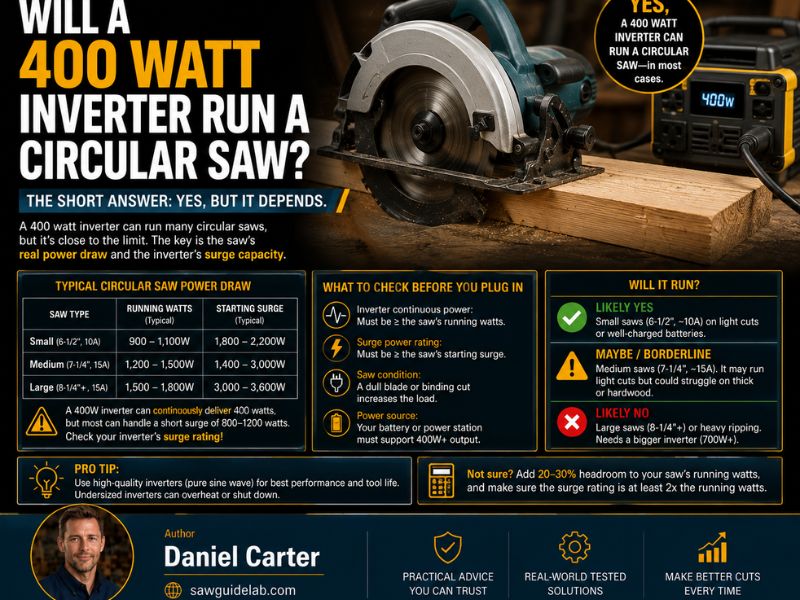
In most cases, a 400-watt inverter will not run a standard corded circular saw reliably.
A typical corded circular saw can require well over 1,000 watts while operating. When the motor starts, it can briefly demand significantly more power than its normal running consumption.
A 400-watt inverter is designed for relatively low-power devices such as:
- Phone chargers
- Small electronics
- LED lights
- Small fans
- Some laptops
- Other low-wattage equipment
A circular saw is a very different type of load because its electric motor requires substantial power, particularly during startup.
If you connect a typical circular saw to a 400-watt inverter, the inverter may:
- Shut down immediately
- Trigger its overload protection
- Produce an alarm
- Cause the saw not to start
- Overheat if repeatedly overloaded
Therefore, a 400W inverter is generally not an appropriate choice for a standard corded circular saw.
How Many Watts Does a Circular Saw Need?
The exact power requirement depends on the particular saw.
Many corded circular saws use motors rated somewhere around 1,200 to 1,800 watts, although smaller models may require less and larger models may require more.
The best way to determine the requirement is to check the saw’s nameplate or manufacturer’s specifications.
If the saw is rated in amps rather than watts, you can estimate its running power using:
Watts = Volts × Amps
For example, a 120-volt saw rated at 15 amps has a theoretical electrical input of:
120 × 15 = 1,800 watts
This does not mean the saw will continuously consume exactly 1,800 watts under every cutting condition, but it shows why a 400-watt inverter is far too small for such a tool.
Why Does a Circular Saw Need Extra Power at Startup?
The biggest issue is not just the saw’s normal operating power.
An electric motor can require a substantial startup surge when it first begins spinning.
When the motor is stationary, it can temporarily draw much more current than it does after reaching operating speed.
For example, a saw that normally operates around 1,500 watts may briefly require considerably more power when the trigger is first pulled.
This is why an inverter needs both:
- Adequate continuous wattage
- Adequate surge or peak wattage
A 400-watt inverter might technically supply enough power for some small devices, but it does not have enough capacity for the startup and operating demands of most circular saws.
What Happens If You Connect a Circular Saw to a 400W Inverter?
If the saw requires substantially more power than the inverter can provide, several things can happen.
The Inverter May Shut Down
Many modern inverters have built-in overload protection.
When the connected load exceeds the inverter’s capacity, it may automatically shut off to protect itself.
The Saw May Not Start
The motor may attempt to start but fail because the inverter cannot provide enough power.
You may hear the motor hum briefly before the inverter shuts down.
The Inverter May Overheat
If the inverter does not immediately shut down and remains overloaded, excessive current can cause heat buildup.
Repeatedly operating an inverter beyond its rated capacity can damage the inverter.
The Battery Can Drain Quickly
A higher-powered load requires substantially more current from the battery.
Trying to operate a large tool through an undersized inverter can place significant demand on the battery and wiring.
What Size Inverter Do You Need for a Circular Saw?
There is no single inverter size that works for every circular saw.
You should choose an inverter based on the saw’s actual power requirements and startup surge.
As a general guide:
| Circular Saw Requirement | Suggested Inverter Capacity |
| Small low-power saw | Around 1,000–1,500W |
| Typical corded saw | Around 1,500–2,000W+ |
| High-powered saw | 2,000W+ |
| Saw with high startup surge | Higher continuous and surge capacity |
These are general guidelines rather than exact specifications.
The manufacturer’s rated amperage should be the starting point when selecting an inverter.
For example, if you have a 120V 15A circular saw, its rated electrical input can be around 1,800 watts. An inverter with only 1,500 watts of continuous output would therefore not be an ideal match.
Is a Pure Sine Wave Inverter Better for a Circular Saw?
A pure sine wave inverter is generally the preferred option for running motor-driven tools.
A pure sine wave inverter produces AC power that more closely resembles the electricity supplied by a standard utility outlet.
This can be beneficial for devices containing motors because it can provide smoother operation and reduce compatibility concerns.
Some modified sine wave inverters can operate certain tools, but performance can vary depending on the motor and inverter.
For an expensive power tool, a properly sized pure sine wave inverter is generally the safer choice.
Can a 400W Inverter Run a Small Circular Saw?
Possibly in unusual cases, but you should not assume it will.
A very small, low-power saw could theoretically have a much lower electrical requirement than a standard full-size circular saw.
However, the inverter still needs to handle the motor’s startup surge.
Before attempting it, check:
- Saw voltage
- Saw amperage
- Rated wattage
- Inverter continuous output
- Inverter surge output
- Battery voltage and capacity
If the saw’s normal power requirement already exceeds 400 watts, the answer is straightforward: the 400W inverter is too small.
How to Calculate Your Circular Saw’s Power Requirement
If the saw’s label provides voltage and amperage, you can estimate its power requirement.
Use:
Power (watts) = Voltage (volts) × Current (amps)
For example:
120V × 10A = 1,200W
A 10-amp saw at 120 volts has a rated electrical input of approximately 1,200 watts.
Now compare that number with the inverter’s continuous rating.
A 400W inverter would be far below the estimated requirement.
Remember that this calculation does not fully account for motor startup surge, so the inverter also needs sufficient peak capacity.
What About the Battery?
The inverter is only one part of the system.
The battery must also be capable of supplying enough energy to the inverter.
For example, a high-power tool running from a 12V battery can require very high current.
A simplified calculation is:
Current ≈ Power ÷ Battery Voltage
At 1,500 watts from a 12V system:
1,500 ÷ 12 = 125 amps
Real-world current can be even higher because of inverter losses.
This is why high-powered tools require appropriate:
- Battery capacity
- Battery type
- Cables
- Fuses
- Connections
- Inverter rating
A small battery and thin cables may not be suitable for a high-powered circular saw.
Can a Car Battery Run a Circular Saw Through an Inverter?
A car battery can potentially supply substantial short-term current, but that does not mean it is an ideal power source for a circular saw.
A properly sized inverter can draw a very large amount of current from a 12V battery.
For occasional use, the system needs to be correctly sized and protected.
You should not simply connect a large inverter to a battery with undersized cables or unsuitable connections.
Also remember that a standard car battery is primarily designed for starting an engine, not for repeated deep discharge.
A deep-cycle battery or properly designed portable power system may be more appropriate for sustained tool use.
What Is the Best Alternative to a 400W Inverter?
If you already have a 400W inverter, it is better suited to smaller electrical devices rather than a standard circular saw.
For running a circular saw, consider:
- A larger pure sine wave inverter
- A properly sized battery system
- A portable power station with sufficient output
- A generator with adequate continuous and surge capacity
- A cordless circular saw with compatible batteries
A cordless saw can be particularly convenient when portability is important because it eliminates the need for an inverter and external AC power source.
Frequently Asked Questions
Can a 400 watt inverter run a 15 amp circular saw?
No. A 15-amp circular saw operating at 120 volts can have a rated input of approximately 1,800 watts, which is far beyond a 400-watt inverter’s continuous output.
Can a 400 watt inverter run a small circular saw?
Only if the saw’s actual power requirement, including startup demand, is within the inverter’s continuous and surge ratings. Most conventional circular saws will exceed a 400W inverter’s capacity.
How many watts does a circular saw need?
Many corded circular saws require roughly 1,200 to 1,800 watts, although the exact requirement varies by model.
What size inverter do I need for a 15 amp circular saw?
A 15-amp, 120V saw can have a rated input around 1,800 watts. You would generally want an inverter with enough continuous capacity above that requirement and sufficient surge capacity for motor startup.
Will a modified sine wave inverter run a circular saw?
Some circular saws may operate on a modified sine wave inverter, but compatibility and motor performance can vary. A properly sized pure sine wave inverter is generally preferable.
Why does my inverter shut off when I start my circular saw?
The saw’s motor may be drawing more power during startup than the inverter can provide. This activates the inverter’s overload protection or causes its output voltage to drop.
Final Thoughts
So, will a 400 watt inverter run a circular saw? For most standard corded circular saws, the answer is no.
The main problem is that circular saw motors typically require far more than 400 watts, and their startup surge can be substantially higher than their normal running demand.
Before choosing an inverter, check the saw’s voltage and amperage, calculate its approximate wattage, and make sure the inverter has enough continuous and surge capacity. You should also make sure the battery, cables, and connections are capable of handling the required current.
For most standard circular saws, a properly sized 1,500W–2,000W or larger pure sine wave inverter is a much more realistic starting point than a 400W model.