Why Does My Circular Saw Stop Mid Cut: Important Facts Explained
Yes, a circular saw that stops mid cut is almost always caused by one of a handful of identifiable issues, ranging from a tripped thermal overload to a worn-out carbon brush. The exact reason depends on your saw model, the material you are cutting, and how long the tool has been in service.
Why Does My Circular Saw Stop Mid Cut
This article explains the relevant reasons, conditions, and practical fixes for this frustrating problem, so you can diagnose it without wasting time or money. I will walk through the most common mechanical, electrical, and user-related causes, and I will help you distinguish between a minor annoyance and a serious safety hazard.
The stakes here are practical: every minute a saw sits dead on a job site costs you productivity, and every unnecessary replacement part eats into your budget. More importantly, some causes of mid-cut stoppage point to electrical faults that can damage the tool or create a shock risk. A one-size-fits-all answer—like “just replace the blade” or “it’s overheated”—will not solve every situation.
By the end of this guide, you will know how to check the power supply, inspect the motor brushes, reset the thermal protection, and decide when a professional repair is the only safe option.
Immediate Checks Before You Tear Anything Apart
Before you assume the motor is burned out, run through a few simple checks that take less than two minutes. Many mid-cut stoppages are not internal failures at all.
First, confirm the extension cord or outlet is actually delivering power. A tripped breaker, a blown fuse, or a damaged cord can cut power exactly when the saw is under the heaviest load. If the saw stops and will not restart, plug a lamp or another tool into the same outlet to verify power is present.
Second, inspect the blade itself. A blade that is pinched in the kerf—the cut channel—can stall the motor. This happens frequently when cutting with a dull blade, when the material closes up behind the cut, or when you try to force the saw forward too quickly.
Third, check the lower blade guard. If debris or sawdust jams the guard, it can create enough friction to stop the blade. Always unplug the saw before you touch the guard or attempt any inspection.
Thermal Overload Protection: The Most Common Culprit
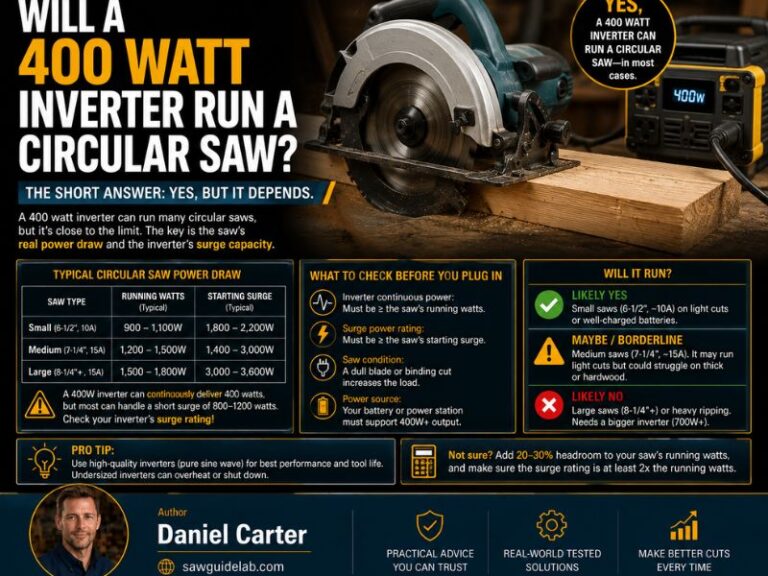
Most modern circular saws include a thermal overload switch that kills power to the motor when internal temperatures climb too high. This is a deliberate safety feature, not a defect. When the motor windings overheat, the switch trips and interrupts the circuit until the saw cools down.
You will notice this most often during long, continuous cuts in dense material like hardwood, pressure-treated lumber, or thick plywood. If you have been pushing the saw hard for several minutes without a break, the thermal protection may engage. The saw simply stops, and pressing the trigger does nothing.
The fix is straightforward: release the trigger, unplug the saw, and wait 10 to 20 minutes for the motor to cool. In many cases, the saw will restart once the internal temperature drops below the trip threshold. Do not try to bypass the thermal switch or hold the trigger down while resetting it—that can cause permanent motor damage.
To prevent repeated thermal trips, let the saw do the work. Apply steady, moderate forward pressure rather than forcing the blade through the material. Take brief pauses between long cuts to let the motor shed heat, and make sure the ventilation slots on the saw body are not clogged with sawdust.
Worn Carbon Brushes: A Gradual Loss of Power
Carbon brushes are small conductive blocks that transfer electricity to the spinning armature inside the motor. Over time, they wear down from friction. When they become too short, they lose contact with the commutator, and the motor will sputter, lose power, or stop entirely under load.
A saw with worn brushes often runs fine when idle but dies when you start cutting. The extra current draw during a cut exposes the weak brush contact. You may also notice visible sparking through the motor vents or a burning smell.
Replacing carbon brushes is one of the few repairs most homeowners can do safely. Many saws have external brush caps on the motor housing that allow access without disassembling the whole tool. Remove the caps, pull out the old brushes, and compare them to new ones.
If the old brush is shorter than about a quarter inch, or if it is chipped or unevenly worn, replacement is overdue.
Always buy brushes made for your specific saw model. Aftermarket universal brushes sometimes fit, but they may not match the exact resistance or dimensions required for reliable operation.
Extension Cord Issues: Voltage Drop Under Load
A long or undersized extension cord is a hidden cause of mid-cut stoppage that many people overlook. When electricity travels through a thin or lengthy cord, resistance increases and voltage drops. Under no load, the saw may still spin up.
But when the blade bites into wood, the motor demands more current, and the voltage sag becomes too severe for the motor to maintain torque.
The result is a saw that stops or slows dramatically the moment you start a cut. If you are using a 100-foot cord rated for light-duty tools, this is very likely your problem.
Use the shortest extension cord that reaches your work area, and choose one with a wire gauge thick enough for the saw’s amperage rating. A 14-gauge cord is generally acceptable for up to 50 feet; beyond that, step up to 12-gauge. For cordless saws, the equivalent issue is a depleted or aging battery that cannot deliver sustained current.
Blade Issues: Pinching, Dulling, and Binding
The blade is the only part of the saw that physically contacts the material, so blade problems often manifest as sudden stops. A dull blade generates excessive friction and heat, forcing the motor to work harder. Eventually, the motor either trips its thermal protection or stalls completely.
Blade pinching is another frequent cause. When cutting a piece of wood that is not properly supported, the material can sag or close up around the blade. This creates a bind that stops the blade instantly.
The same thing happens when you cut a sheet of plywood that is resting on the ground—the waste side drops down and pinches the blade.
To avoid pinching, support both sides of the cut so the kerf remains open. Use a straightedge guide for long rips, and consider a blade with a thinner kerf or anti-kickback shoulders if you frequently cut sheet goods.
Also check that the blade is installed correctly. A blade mounted backward will still spin, but the teeth will cut poorly and generate excessive heat. The blade rotation arrow on the saw body should match the arrow printed on the blade.
Lock-On Button and Trigger Malfunctions
Sometimes the saw stops not because of the motor, but because of the switch mechanism. Many circular saws have a lock-on button that lets you run the saw without holding the trigger. If this button is worn or sticking, it can disengage mid-cut, killing power to the motor.
Similarly, the trigger itself can develop internal contact issues. If the saw cuts out intermittently and then starts again when you jiggle the trigger, the switch contacts are likely worn. A failing switch is an electrical hazard and should be replaced rather than repaired.
Test the switch by unplugging the saw and pressing the trigger. It should move smoothly and return to the off position when released. If it feels gritty, sticks, or requires excessive force, plan to replace the switch assembly.
Armature or Field Winding Failure
If the saw stops mid cut and will not restart even after cooling, and the brushes look fine, the problem may be internal. The armature—the rotating part of the motor—or the field windings (the stationary electromagnets) can fail. This often happens after a saw has been overloaded repeatedly or after moisture has entered the motor housing.
A telltale sign of armature damage is a distinct burning odor or visible scorch marks on the commutator when you remove the brushes. If you see dark, pitted, or uneven segments on the commutator, the armature is likely beyond repair.
Replacing an armature or field winding is not a DIY job for most people. The cost of parts and labor often approaches half the price of a new saw. Unless the saw is a high-end model, replacement is usually the more economical choice.
Safety Considerations and When to Stop Using the Saw
A circular saw that stops unpredictably is not just an inconvenience—it is a safety risk. If the saw stops and then restarts unexpectedly, the blade can catch the material and cause kickback. Always assume the saw could restart on its own if you leave it plugged in.
Unplug the saw before any inspection, blade change, or cleaning. Never try to force a stalled blade by rocking the saw back and forth while the motor is engaged. This can strip the gears, damage the blade, or cause the saw to jump out of the cut.
If you notice any of the following, stop using the saw immediately and seek professional service:
- Burning smell that persists after the saw cools
- Excessive sparking visible through the motor vents
- Smoke coming from the housing
- The saw stops and will not restart after a full cool-down period
- Visible damage to the power cord or plug
Frequently Asked Questions
Why does my circular saw stop mid cut but starts
This is the classic signature of a tripped thermal overload switch. When the motor gets too hot, the switch cuts power until the saw cools down. If the saw restarts after 10 to 20 minutes, the thermal protection is doing its job.
Reduce the load by using a sharper blade and cutting more slowly.
Can a dull blade cause my circular saw to stop
Yes, a dull blade increases friction and motor load significantly. The motor draws more current to maintain blade speed, which generates heat and can trip the thermal overload or stall the motor entirely. Replace or sharpen the blade if you notice slow cutting, burning marks on the wood, or excessive resistance.
Why does my circular saw stop when I press harder
Forcing the saw forward increases the load on the motor beyond its rated capacity. The motor either stalls because it cannot maintain torque, or the thermal protection trips from the sudden current spike. Let the blade cut at its own pace and apply only light forward pressure.
Is it safe to use a circular saw that stops
No, a saw that stops unpredictably is a safety hazard. It can restart unexpectedly, cause kickback, or fail completely while the blade is embedded in the material. Stop using the saw until you have identified and fixed the root cause.
Conclusion
The most practical takeaway is that a circular saw stopping mid cut is rarely a mystery once you know what to check. Start with the simple causes—power supply, blade condition, and thermal overload—before assuming the motor is dead. These account for the majority of stoppages and are often fixable in minutes with no special tools.
The major limitation to keep in mind is that internal motor failures, such as a damaged armature or worn switch contacts, are not safe or economical for most users to repair at home. If the saw has cooled, the blade is sharp, the cord is adequate, and it still stops under load, take it to a qualified service center or replace the tool. Never bypass safety switches or continue using a saw that shows signs of electrical distress.
Your next step is simple: unplug the saw, check the blade and cord first, and then let the motor cool completely before your next test cut. If the problem persists, a professional diagnosis will save you time and prevent a dangerous failure.