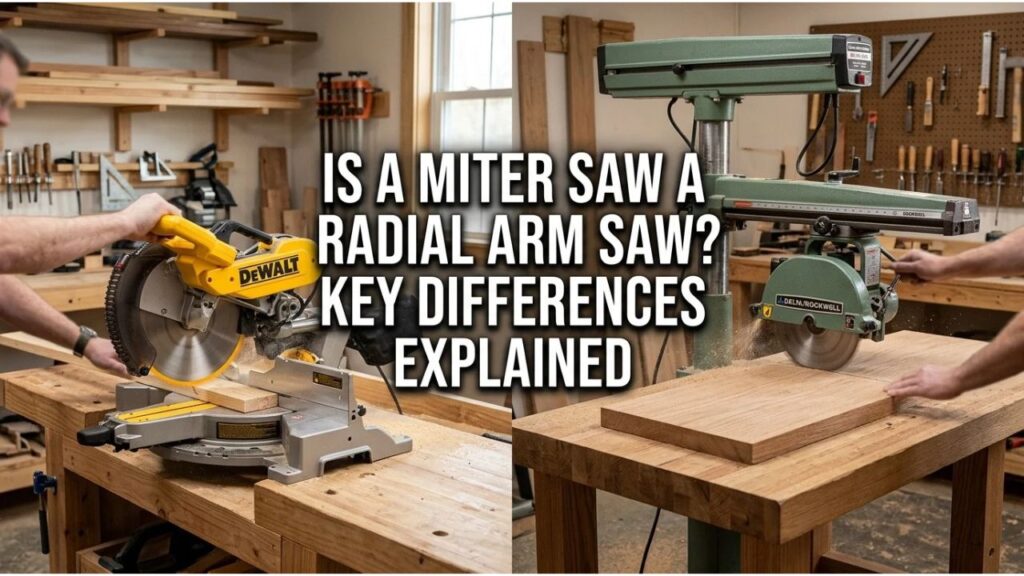
Is a Miter Saw a Radial Arm Saw? Key Differences Explained
No, a miter saw is not a radial arm saw. Both machines use circular saw blades and are commonly used for crosscuts, miters, bevels, and compound cuts, but their mechanical designs and operating methods are different.
A traditional radial arm saw has a motor and blade mounted on a carriage that travels along a long overhead radial arm. During a normal crosscut, the workpiece stays against the fence while the operator pulls the carriage forward through the board. The entire radial arm can also swing horizontally for miter cuts, and many traditional models can rotate the motor into a rip-cutting position.
A miter saw uses a shorter pivoting saw head. On a basic miter saw, the blade swings downward into the workpiece. A sliding compound miter saw adds rails or another sliding mechanism that allows the saw head to move forward and backward for wider crosscuts, but that still does not make it a radial arm saw.
The two tools overlap considerably in what they can do, which is why they are often confused. Modern sliding miter saws perform many of the crosscutting jobs that radial arm saws once handled, but radial arm saws traditionally offer greater versatility and a very different machine layout.
In this guide, I’ll explain is a miter saw a radial arm saw, how each machine works, their major differences, which one is more versatile, and which is generally the better choice for different woodworking jobs.
What Is a Miter Saw?
A miter saw is a stationary or portable circular saw designed primarily for cutting boards to length and making accurate angled cuts.
The blade is mounted to a motorized saw head located above a small table.
The workpiece rests against a rear fence.
For a normal crosscut, you position the board against that fence, switch on the saw, and bring the spinning blade down through the workpiece.
Basic Miter Saw
A basic or non-sliding miter saw pivots downward from a fixed hinge.
Its crosscut capacity is limited by blade diameter and the geometry of the saw head.
It is simple, relatively compact, and well suited to:
Trim.
Framing lumber.
Baseboards.
Picture frames.
Furniture parts.
General crosscutting.
Compound Miter Saw
A compound miter saw can make both:
Miter cuts, where the table or saw orientation changes horizontally.
Bevel cuts, where the saw head tilts sideways.
Combining the two produces a compound miter.
Sliding Compound Miter Saw
A sliding miter saw adds horizontal movement.
Depending on the design, the head travels along rails or another sliding mechanism.
This allows it to cut much wider boards than a basic chop-style miter saw.
A modern 10- or 12-inch sliding miter saw can handle many of the wide crosscuts that once encouraged woodworkers to buy radial arm saws.
Key Takeaways:
- A miter saw uses a pivoting saw head rather than a long radial arm.
- Sliding models add horizontal blade movement for wider crosscuts.
- Miter saws are primarily designed for crosscuts and angled cuts.
What Is a Radial Arm Saw?
A radial arm saw is also a stationary circular saw, but the blade and motor are suspended beneath a long overhead arm.
The motor is attached to a carriage that travels along tracks on that arm.
The workpiece rests on a relatively large stationary table against a replaceable fence.
How a Crosscut Works
For a conventional radial arm saw crosscut, the carriage begins behind the fence.
The board remains stationary.
The operator pulls the motor-and-blade carriage forward along the radial arm and through the workpiece.
After completing the cut, the carriage returns to the rear.
This is fundamentally different from the hinged action of a conventional miter saw.
The Arm Can Rotate
The entire radial arm can normally pivot horizontally around its supporting column.
This produces miter cuts.
The motor can also tilt for bevels.
Many models allow the motor yoke to rotate 90 degrees so the saw can perform rip cuts with the blade fixed in place while the material moves through it.
This ability to change the complete orientation of the cutting assembly made radial arm saws exceptionally versatile.
Why Are Miter Saws and Radial Arm Saws Confused?
The confusion makes sense because both tools perform many of the same everyday woodworking operations.
Both can commonly make:
Square crosscuts.
Miter cuts.
Bevel cuts.
Compound cuts.
Repeated-length cuts.
Both hold the workpiece against a rear fence.
Both use circular saw blades.
Both can occupy a dedicated crosscut station in a woodworking shop.
And from a distance, a large sliding compound miter saw can look somewhat like a simplified radial arm saw.
The major differences become clear when you look at how the blade is supported and how the machine moves.
Miter Saw vs. Radial Arm Saw: Main Differences
Here is a quick comparison.
| Feature | Miter Saw | Radial Arm Saw |
| Main blade support | Pivoting saw head | Carriage on overhead radial arm |
| Crosscut motion | Downward, often with sliding action | Carriage travels along radial arm |
| Miter adjustment | Table/head rotates | Radial arm rotates |
| Bevel cuts | Yes on compound models | Yes on most models |
| Compound cuts | Yes | Yes |
| Rip cuts | No | Many traditional models can rip |
| Wide crosscuts | Good on sliders | Often excellent |
| Portability | Generally good | Usually poor |
| Setup complexity | Relatively simple | More complex |
| Alignment points | Fewer | Many |
| Floor/table space | Usually less | Usually more |
| Modern availability | Very common | Much less common |
The overlap is considerable, but mechanically they remain distinct types of saw.
Blade Movement Is the Biggest Difference
The clearest way to understand the difference is to watch the blade.
On a Basic Miter Saw
The blade pivots downward.
Think of the saw head as a hinged arm.
The board stays on the table while the blade swings into it.
On a Sliding Miter Saw
The saw head can also move horizontally.
However, that sliding system is integrated into the compact pivoting head.
It does not use the long radial arm and column system found on a traditional radial arm saw.
On a Radial Arm Saw
The motor and blade travel on a carriage along a large overhead arm.
The entire arm itself can rotate horizontally.
This provides a longer guided cutting path and allows additional machine configurations.
Key Takeaways:
- The miter saw’s blade is attached to a pivoting head.
- A radial arm saw uses a carriage traveling on an overhead arm.
- Sliding action alone does not make a miter saw a radial arm saw.
Is a Sliding Miter Saw Basically a Radial Arm Saw?
It is understandable to describe it that way casually, but technically, no.
A sliding miter saw and radial arm saw both move the blade horizontally through a stationary board, but the supporting mechanisms differ.
A radial arm saw typically has:
A vertical column.
A long horizontal radial arm.
A carriage riding along the arm.
A rotatable yoke.
A large fixed table.
A separate fence integrated into that table.
A sliding miter saw typically has:
A compact base.
A rotating miter table.
A pivoting saw head.
Sliding rails or an articulated mechanism.
An integrated fence.
The designs produce some similar cuts but are not the same machine.
Which Saw Has More Crosscut Capacity?
Historically, radial arm saws often had a major advantage.
Large radial arm saws could crosscut very wide boards, panels, and structural material.
That was one reason they were widely used in lumberyards and woodworking shops.
Modern Sliding Miter Saws Have Closed the Gap
Today’s sliding compound miter saws can crosscut surprisingly wide material.
A typical 10-inch slider may handle boards around a foot wide, while some 12-inch models provide even more capacity.
For ordinary trim, framing lumber, cabinet parts, and furniture stock, that is enough for many users.
Industrial Radial Arm Saws Still Go Much Larger
Heavy-duty radial arm saws can have considerably longer arms and larger blades.
Industrial machines may be designed for very wide lumber or production crosscutting where a portable miter saw is not intended to compete.
Can a Miter Saw Rip Wood Like a Radial Arm Saw?
No.
A conventional miter saw is not designed for ripping boards lengthwise.
The workpiece normally stays stationary against the fence while the blade crosses it.
There is no normal configuration in which you rotate the blade parallel to the board and feed lumber through the miter saw.
Many Radial Arm Saws Can Rip
Traditional radial arm saws can often rotate the motor/yoke so the blade runs parallel to the fence.
The carriage is locked at the desired distance from the fence.
The wood is then fed through the stationary blade.
That makes the radial arm saw capable of functioning somewhat like a rip saw or table saw.
Ripping Requires Special Caution
Just because a radial arm saw can rip does not mean it is the easiest modern tool for the job.
Feed direction is critical.
Anti-kickback pawls, guards, hold-downs, and splitters or spreaders specified for the machine must be correctly positioned.
Many modern woodworkers prefer using:
A table saw.
Track saw.
Circular saw with guide.
for ripping, while keeping the radial arm saw dedicated to crosscuts.
Which Saw Is Easier to Use?
For most beginners, the miter saw is easier.
It has fewer adjustments and fewer operating configurations.
You generally set the miter angle, set the bevel if necessary, hold the work against the fence, and lower the blade.
A radial arm saw requires understanding several separate controls.
These can include:
Arm rotation.
Arm lock.
Carriage movement.
Carriage lock.
Yoke rotation.
Yoke lock.
Bevel adjustment.
Blade elevation.
Fence position.
Rip direction.
Anti-kickback adjustment.
That versatility gives the radial arm saw more capabilities, but also increases the opportunity for incorrect setup.
Which Saw Is More Accurate?
Either can be highly accurate when properly adjusted.
A quality miter saw generally has the advantage of simplicity.
There are fewer major machine relationships that can move out of alignment.
Radial Arm Saw Accuracy
A well-tuned radial arm saw can be extremely accurate, particularly when permanently configured for square crosscuts.
The workpiece stays against a long fence while the carriage follows the same mechanical path repeatedly.
This can make it excellent for production cutting.
However, its accuracy depends on several alignments:
Arm square to fence.
Blade square to table.
Blade parallel with carriage travel.
Carriage bearing adjustment.
Fence straightness.
Table flatness.
Column rigidity.
If any of these changes, cut accuracy can suffer.
Miter Saw Accuracy
A modern miter saw generally requires fewer alignment steps.
That can make it easier for the average user to maintain consistent accuracy.
For precision trim work and frequent angle changes, this is a significant advantage.
Which Is Better for Repeated Crosscuts?
Both can be excellent when connected to a long support bench and stop system.
A radial arm saw has traditionally been particularly good at production crosscutting.
The machine can sit permanently in the middle of a long fence, with boards sliding easily from either side.
Set a stop, position each board, and pull the carriage through it.
Miter Saw Stations Work Similarly
A modern miter saw can also be built into a long workstation with:
Support wings.
Measuring tape.
T-track.
Flip stops.
Dust collection.
For most small woodworking shops, this setup offers nearly all the repeated crosscut functionality they need.
Which Is Better for Miter Cuts?
For frequent miter and compound-miter work, I would generally favor a modern miter saw.
That is its primary purpose.
Modern miter saws commonly have positive detents at common angles and highly visible scales.
Some have dual-bevel mechanisms so the blade can tilt in both directions.
Radial Arm Saws Can Make Excellent Miters
On a radial arm saw, the complete overhead arm rotates.
A machine with a precise arm-indexing mechanism can produce accurate miters.
However, frequently rotating the arm and returning it to 90 degrees can introduce another opportunity for alignment variation, especially on an older machine with worn indexing hardware.
Many radial arm saw owners who value maximum crosscut accuracy leave the arm locked at 90 degrees and use a miter saw for angled work.
Which Is Better for Bevel Cuts?
Again, the modern compound miter saw usually wins for convenience.
The saw head is specifically designed for quickly setting common bevel angles.
Many models have clear bevel scales and positive stops.
A radial arm saw can also tilt its motor and blade, but the adjustment system may be less convenient on an older machine.
Which Is More Versatile?
Traditionally, the radial arm saw.
A classic radial arm saw can potentially perform:
Crosscuts.
Miter cuts.
Bevel cuts.
Compound cuts.
Rip cuts.
Dados on approved models.
Certain molding operations with approved accessories.
Some older machines were even marketed with attachments for sanding, routing, drilling, or other operations.
That type of “one machine does everything” philosophy was a major selling point decades ago.
More Capabilities Are Not Always Better
Modern shops usually prefer specialized machines.
A table saw handles ripping.
A miter saw handles angled crosscuts.
A router handles grooves and profiles.
A drill press handles drilling.
Specialized machines tend to be easier to configure and often safer and more efficient for their primary jobs.
Which Is Safer?
Both tools can cause severe injuries, but the operating risks differ.
A miter saw is relatively straightforward because the blade is usually enclosed by a retractable guard and follows a limited path.
The workpiece stays against the fence.
Radial Arm Saw Safety Is More Complex
The blade carriage moves directly along an overhead track.
During traditional crosscutting, blade rotation can make the saw try to self-feed toward the operator.
Blade selection is therefore important.
A strongly positive-hook ripping blade can make a radial arm saw much more aggressive than a blade intended for radial-arm or sliding-saw use.
Ripping creates additional kickback risks if:
The feed direction is wrong.
Anti-kickback devices are missing.
The blade is misaligned.
The workpiece binds.
For this reason, a radial arm saw demands more knowledge from the operator.
Why Did Miter Saws Replace Radial Arm Saws?
Radial arm saws were once extremely common.
For decades, they offered a combination of capacity and versatility that was difficult to duplicate.
Then sliding compound miter saws improved.
They became:
More portable.
More compact.
Easier to adjust.
Easier to guard.
Capable of wider crosscuts.
More convenient for jobsite work.
At the same time, table saws continued to handle ripping more naturally.
The combination of a table saw and sliding miter saw covered most of the jobs for which a homeowner might previously have bought one radial arm saw.
Portability Was a Major Factor
A radial arm saw often becomes a permanent shop machine.
Even relatively small models can be awkward and heavy.
A miter saw can be carried to a jobsite, mounted on a folding stand, used for the day, and stored afterward.
That makes it far more attractive for carpenters and remodelers.
Key Takeaways:
- Radial arm saws traditionally offer more functions, particularly ripping.
- Modern sliding miter saws cover most common crosscut and miter jobs with simpler setup.
- Portability and ease of use helped miter saws replace radial arm saws for many users.
Is a Chop Saw a Radial Arm Saw?
No.
A chop saw normally uses a fixed pivoting head that moves downward into the material.
It is mechanically much closer to a non-sliding miter saw.
The term “chop saw” is also frequently used for abrasive or metal-cutting saws.
A radial arm saw has a traveling carriage on a horizontal arm.
Is a Sliding Compound Miter Saw Safer Than a Radial Arm Saw?
It is generally simpler for the average operator because there are fewer machine configurations to understand.
However, it still requires correct technique.
Sliding miter saws have their own specified cutting procedure, and the correct movement can depend on design.
Always follow the manufacturer’s manual.
Do Not Transfer Radial Arm Saw Technique Automatically
A traditional radial arm saw crosscut usually involves pulling the carriage toward the operator.
A sliding miter saw may use a different sequence involving extending the head first and then making the cut in the direction specified by its manufacturer.
Do not assume that because both tools slide, they should be operated identically.
Can a Miter Saw Replace a Radial Arm Saw?
For many users, yes.
If your normal work consists of:
Crosscutting 2x lumber.
Cutting trim.
Building furniture.
Cutting molding.
Making picture frames.
Cutting cabinet components.
Making miter and bevel cuts.
a good sliding compound miter saw can replace most of the radial arm saw functions you would actually use.
When a Radial Arm Saw Still Has Advantages
A radial arm saw may make more sense if you need:
Very large crosscut capacity.
Heavy production crosscutting.
A permanent long-board crosscut station.
An industrial machine for large timber.
Traditional radial-arm-specific operations.
A high-quality older machine you already own.
Can a Radial Arm Saw Replace a Miter Saw?
For many cuts, yes.
A radial arm saw can make square crosscuts, miters, bevels, and compound cuts.
However, that does not necessarily mean it is as convenient.
If you frequently change angles while doing trim work, a modern compound miter saw is usually quicker to adjust.
If you need to carry the machine between jobs, the difference becomes even greater.
Which Saw Is Better for a Small Workshop?
A miter saw is generally easier to fit.
It occupies less permanent space and can sometimes be stored when not in use.
A radial arm saw works best as a dedicated station with a large table and enough clearance for the carriage and long stock.
A Radial Arm Saw Can Still Save Space in One Way
Because the blade moves across a stationary board, you do not need the same infeed and outfeed path required for crosscutting long lumber on a table saw.
Placed against a wall with long support benches, it can be very space-efficient for crosscuts.
Still, the overall machine is usually larger than a miter saw.
Which Saw Is Better for a Beginner?
For most beginners, I would choose a miter saw for crosscutting.
Its controls are easier to learn.
The blade path is easy to understand.
Modern guarding is straightforward.
It also does not invite the user to switch into a completely different rip-cutting configuration.
When a Beginner Can Use a Radial Arm Saw
A radial arm saw is not automatically inappropriate for a beginner.
A complete, mechanically sound machine can be used effectively if the owner:
Has the correct manual.
Understands the crosscut direction.
Uses an appropriate blade.
Keeps the fence secure.
Checks the carriage and locks.
Avoids unsupported operations.
Does not experiment with missing guards or rip accessories.
The biggest problem is that many radial arm saws available today are older used machines with unknown maintenance histories.
Should You Buy an Old Radial Arm Saw Instead of a New Miter Saw?
That depends on what you want from the machine.
An old heavy-duty radial arm saw can be an excellent value for a permanent woodworking shop.
You may get substantial crosscut capacity and a very rigid machine for relatively little money.
However, carefully inspect:
Guards.
Electrical wiring.
Motor condition.
Carriage bearings.
Radial arm tracks.
Column play.
Yoke and bevel locks.
Table and fence.
Recall status where applicable.
Replacement-parts availability.
A New Miter Saw Is Simpler
With a new miter saw, you typically receive:
Modern guarding.
A current manual.
Warranty support.
Readily available blades.
Portable design.
Modern dust-collection provisions.
For many users, those conveniences outweigh the radial arm saw’s extra versatility.
Radial Arm Saw vs. Sliding Miter Saw for Furniture Making
For general furniture work, either can produce excellent results.
A sliding miter saw is convenient for cutting parts quickly at a variety of angles.
A radial arm saw can be excellent if left permanently aligned as a square crosscut station.
Repeated Components
If you need 20 rails of identical length, either saw can work beautifully with a stop system.
The quality of the fence and stop setup may matter more than which saw type you choose.
Fine Miters
A modern miter saw is often easier for frequent angle work.
The radial arm saw can still produce accurate miters if its indexing system is in good condition.
Radial Arm Saw vs. Miter Saw for Trim Work
The miter saw is the clear practical choice for most trim carpentry.
Trim jobs require frequent:
45-degree cuts.
Compound crown-molding cuts.
Small angle adjustments.
Jobsite transportation.
The miter saw was designed around exactly this type of work.
A radial arm saw can make those cuts but is usually too large and inconvenient to move around a jobsite.
Radial Arm Saw vs. Miter Saw for Framing
Again, the miter saw is generally more convenient.
A basic compound miter saw can quickly crosscut framing lumber and handle angled cuts.
Mounted on a portable stand, it can be moved around a construction site.
A radial arm saw makes more sense in a permanent lumber-processing station or production shop.
FAQs about Is a Miter Saw a Radial Arm Saw
Is a miter saw a radial arm saw?
No. A miter saw uses a pivoting saw head, while a radial arm saw uses a motor-and-blade carriage that travels along a horizontal overhead arm.
Is a sliding miter saw a radial arm saw?
No.
Although both can slide through wide workpieces, their mechanical designs are different.
What is the biggest difference between a miter saw and radial arm saw?
The blade-support system is the major difference. A radial arm saw has a traveling carriage on a long overhead arm, while a miter saw uses a pivoting saw head.
Can both saws make crosscuts?
Yes.
Crosscutting is one of the primary uses of both machines.
Can both make miter cuts?
Yes.
A miter saw generally rotates its table or head arrangement, while a radial arm saw rotates the entire radial arm.
Can both make bevel cuts?
Compound miter saws and most radial arm saws can make bevel cuts.
Can both make compound cuts?
Yes, if the individual model supports both miter and bevel adjustment.
Can a miter saw rip wood?
No.
A standard miter saw is not designed for longitudinal rip cuts.
Can a radial arm saw rip wood?
Many traditional radial arm saws can, provided the machine is correctly configured with the required guarding and anti-kickback equipment.
Is a radial arm saw more versatile?
Traditionally, yes.
It can perform more types of operations, particularly ripping and certain dado operations on approved machines.
Is a miter saw easier to use?
Generally, yes.
It has fewer adjustments and a more limited range of operations.
Which is more accurate?
Either can be highly accurate.
A properly tuned radial arm saw can be exceptional for repeated crosscuts, while a modern miter saw is typically easier to keep aligned.
Which is safer?
Both require careful operation. A modern miter saw generally has simpler operating geometry, while a radial arm saw requires additional knowledge about carriage control, blade selection, and ripping setup.
Which saw is better for crosscutting?
Both are excellent.
A radial arm saw can have greater capacity and excel in a permanent production station, while a miter saw provides easier setup and portability.
Which is better for wide boards?
A large radial arm saw can offer excellent width capacity, but modern sliding miter saws can also crosscut very wide boards.
Check actual machine specifications.
Why are radial arm saws less common now?
Modern sliding compound miter saws handle most crosscutting tasks in a smaller, lighter, and simpler package, while table saws remain better suited to ripping.
Did the miter saw replace the radial arm saw?
For many homeowners and contractors, effectively yes.
The combination of a sliding miter saw and table saw covers most common radial arm saw operations.
Is a radial arm saw obsolete?
Not completely.
Heavy industrial radial arm saws are still useful for large-capacity and production crosscutting, and many older woodworking machines remain excellent shop tools.
Which is better for trim carpentry?
A modern compound or sliding compound miter saw is generally the better choice because it is portable and quick to adjust for angled cuts.
Which is better for a permanent woodworking shop?
Either can work.
A radial arm saw is attractive as a large dedicated crosscut station, while a miter saw occupies less space and is easier to reposition.
Is a radial arm saw just an old-fashioned miter saw?
No.
They overlap in crosscutting functions, but the radial arm saw was designed as a much more versatile stationary woodworking machine.
Conclusion
Is a miter saw a radial arm saw? No. They are two distinct saw designs, even though they perform many of the same cuts.
A miter saw uses a pivoting motor-and-blade assembly. Basic models swing downward through the work, while sliding miter saws add horizontal movement to increase crosscut capacity.
A radial arm saw suspends its motor and blade from a carriage that travels along a long overhead radial arm. For conventional crosscutting, the carriage moves through the stationary board. The arm itself can rotate for miters, the motor can tilt for bevels, and many traditional models can rotate into a completely different configuration for rip cutting.
That last capability highlights the radial arm saw’s traditional advantage: versatility.
A miter saw is primarily a crosscutting and angle-cutting machine. A radial arm saw was designed to perform a much broader range of woodworking operations.
However, versatility is not always the same as convenience.
Modern sliding compound miter saws are smaller, lighter, easier to adjust, easier to transport, and capable of wide crosscuts. Combined with a table saw or track saw for ripping, they cover most of the work that once justified owning a radial arm saw.
For trim carpentry, framing, jobsite work, and general-purpose crosscutting, the miter saw is usually the more practical modern choice.
For a permanent shop, especially where wide or repetitive production crosscuts are important, a properly aligned radial arm saw can still be an excellent machine.
The easiest way to remember the difference is this: a miter saw pivots its saw head, while a radial arm saw carries the blade along a long overhead arm. Similar jobs, different machines.