Which Is Better: Radial Arm Saw or Table Saw?
If you are wondering which is better radial arm saw or table saw, a table saw is the better all-around choice for most woodworkers, while a radial arm saw is better for repetitive crosscutting of long boards. A table saw is generally easier to use for ripping, more widely supported with modern accessories, and more practical as the primary stationary saw in a home or professional woodworking shop.
A radial arm saw, however, still has a real advantage in certain situations. Because the blade carriage moves across a stationary workpiece, it can be excellent for cutting long boards repeatedly to the same length. With a long fence and stop system, it can become an efficient dedicated crosscut station.
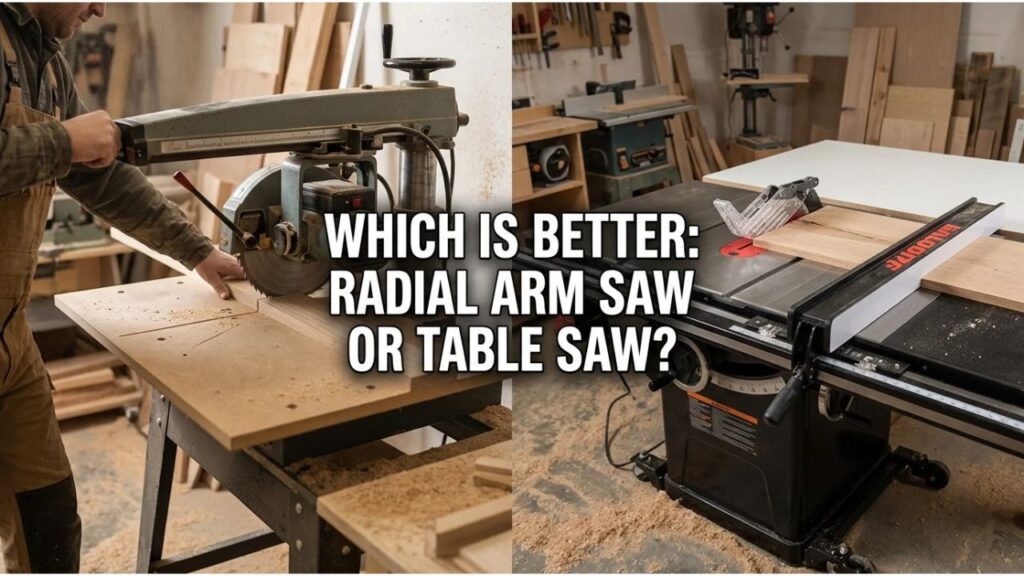
The two machines overlap in capability, but they are designed around different cutting motions. On a table saw, the blade stays in one place while you push the workpiece through it. On a radial arm saw, the workpiece usually remains against the fence while the blade and motor move across it.
That difference affects everything from ripping and crosscutting to safety, accuracy, footprint, and ease of setup.
For someone buying only one major stationary saw, I usually recommend a table saw. For someone who already owns a table saw and regularly cuts long stock to length, a properly aligned radial arm saw can be an excellent second machine.
In this guide, I’ll compare radial arm saw vs table saw performance, cutting capacity, accuracy, ripping, crosscutting, dado work, safety, shop space, maintenance, and which machine makes more sense for different users.
Radial Arm Saw vs Table Saw at a Glance
The quickest way to compare the two is by looking at what each machine does best.
| Category | Radial Arm Saw | Table Saw |
| Best use | Crosscutting long stock | Ripping and general woodworking |
| Ripping | Possible on some models, less preferred | Excellent |
| Crosscutting | Excellent | Good with sled or miter gauge |
| Repetitive length cuts | Excellent | Good |
| Sheet goods | Limited without support | Good with enough support |
| Dadoes | Possible on approved models | Excellent on compatible models |
| Miters | Good | Good with miter gauge/sled |
| Bevels | Good | Good |
| Setup complexity | Higher | Lower |
| Alignment maintenance | More frequent | Usually simpler |
| Modern accessories | Limited | Extensive |
| Shop popularity | Less common | Very common |
| Best one-saw choice | Usually no | Usually yes |
The table saw wins as the more versatile primary machine.
The radial arm saw wins when the job is repeated crosscutting of long lumber.
Key Takeaways:
- A table saw is usually the better primary woodworking saw.
- A radial arm saw is especially strong as a dedicated crosscut station.
- If you can own both, they complement each other better than they replace each other.
What Is the Main Difference Between a Radial Arm Saw and a Table Saw?
The main difference is which part moves during the cut.
On a table saw, the blade remains fixed in the table while you move the wood.
On a radial arm saw, the wood usually remains stationary while you move the blade carriage.
This changes the way each machine handles material.
Table Saw
A table saw has a circular blade projecting upward through the table.
For a rip cut, the board is guided by a rip fence and pushed past the blade.
For a crosscut, you typically use a miter gauge or crosscut sled.
Radial Arm Saw
A radial arm saw has the motor and blade mounted on a carriage suspended beneath an overhead arm.
For a normal crosscut, the board is placed against the rear fence and the blade is pulled across it.
The radial arm can also rotate for miter cuts.
Which Is Better for Ripping?
The table saw is clearly better for ripping.
Ripping means cutting along the length of a board or panel, usually parallel to the grain.
This is the job a table saw is fundamentally designed to do.
Why the Table Saw Is Better
The rip fence provides a long, straight reference.
You set the desired width, lock the fence, and feed the board through the blade.
For repeated strips of equal width, this is fast and accurate.
Modern table saws also have mature safety systems, riving knives, blade guards, push blocks, featherboards, outfeed tables, and countless ripping accessories.
Can a Radial Arm Saw Rip?
Many older radial arm saws can.
The motor yoke rotates 90 degrees so the blade is aligned with the fence, and the board is fed through the stationary blade position.
However, radial arm saw ripping requires careful attention to blade orientation, feed direction, anti-kickback devices, and guarding.
Feeding the work from the wrong direction can make the blade grab the board aggressively.
For routine ripping, I recommend a table saw.
Which Is Better for Crosscutting?
This is where the radial arm saw has its biggest advantage.
Crosscutting means cutting a board across its width to shorten it.
On a radial arm saw, the board stays against the fence and the blade travels directly across it.
That makes repeated crosscuts convenient.
Cutting Long Boards
Suppose you need to cut twenty 8-foot boards down to 48 inches.
On a radial arm saw, you can place a stop at 48 inches and repeatedly slide each board into position.
The board remains fully supported while the blade moves.
Crosscutting on a Table Saw
A table saw can crosscut very accurately with a good sled.
For smaller and medium-size parts, a crosscut sled may actually give better support and precision than a radial arm saw.
However, a long 8- or 10-foot board can be awkward to balance on a table saw sled or miter gauge.
Winner for Long Stock
For long dimensional lumber, molding, framing material, or production crosscutting, the radial arm saw is excellent.
For smaller furniture parts, the table saw with a crosscut sled is often more practical.
Which Is More Accurate?
Both can be highly accurate.
The difference is how much work is required to keep them accurate.
Table Saw Accuracy
A properly aligned table saw is relatively straightforward.
The blade needs to be parallel to the miter slots and the fence needs to be parallel to the blade.
Once set correctly, a good cabinet saw can hold alignment for a long time.
Radial Arm Saw Accuracy
A radial arm saw has more relationships to maintain.
The arm must be square to the fence.
The blade must track parallel to carriage movement.
The blade must be perpendicular to the table.
The carriage bearings must have minimal play.
The arm indexing mechanism must return accurately to 90 degrees.
If any one of these shifts, the cut can suffer.
Which Is Easier to Keep Accurate?
The table saw.
A well-adjusted radial arm saw can be extremely precise, but it generally demands more setup knowledge.
Which Is Better for Dadoes?
Both can cut dadoes if the specific model and arbor are approved for dado stacks.
However, the table saw is usually more convenient.
Table Saw Dadoes
Install the compatible dado stack, set the width and depth, then move the board over the cutter using the fence or miter gauge as appropriate.
This is a common cabinetmaking operation.
Radial Arm Saw Dadoes
A radial arm saw can make excellent cross-grain dadoes because the board remains stationary while the cutter travels across it.
For repetitive shelf dadoes in long cabinet sides, this can be very efficient.
However, not every radial arm saw accepts a dado stack, and guarding is more complicated.
Which Is Better?
For general dado work, table saw.
For repetitive cross-grain dadoes in long pieces, a properly equipped radial arm saw can be very effective.
Which Is Better for Miters?
Both can produce accurate miter cuts.
A radial arm saw changes miter angle by rotating the entire radial arm.
A table saw typically uses a miter gauge or sled.
Radial Arm Saw Advantage
The workpiece can remain against a long fence while the arm rotates.
This is useful for long molding or trim.
Table Saw Advantage
A precision miter sled or gauge can produce highly accurate angles, especially on smaller pieces.
For furniture parts, the table saw is often easier to control.
What About a Miter Saw?
If your main job is cutting trim or construction lumber at angles, a modern sliding compound miter saw may be more convenient than either machine.
Which Is Better for Bevel Cuts?
Both are capable.
On a table saw, the blade tilts through the table.
On a radial arm saw, the motor assembly tilts relative to the workpiece.
The table saw is generally simpler for long bevel rips.
The radial arm saw can be convenient for bevel crosscuts.
For compound angle work, a modern sliding miter saw is usually easier than either.
Which Is Better for Sheet Goods?
The table saw is generally better, but neither is always ideal.
A full 4×8 sheet of plywood is large and difficult to handle on any stationary saw without support.
Table Saw
With a large outfeed table and enough side support, a table saw can rip full sheets accurately.
However, one person may struggle with heavy sheets of MDF or plywood.
Radial Arm Saw
A radial arm saw can crosscut relatively wide sheet sections, but its carriage travel limits the maximum width.
It is usually not the first tool I would choose for breaking down full sheets.
Better Alternative
For full plywood sheets, a track saw is often easier and safer.
A vertical panel saw is another excellent solution in commercial shops.
Which Machine Is More Versatile?
Historically, the radial arm saw was marketed as one of the most versatile machines in the workshop.
Manufacturers offered attachments for:
Crosscutting, ripping, dadoing, molding, routing, sanding, drilling, and even shaping.
In theory, that made one machine capable of replacing several tools.
In practice, modern specialized machines perform most of those individual jobs more conveniently.
Modern Table Saw Versatility
A table saw can rip, crosscut, dado, bevel, cut joinery, and work with a huge variety of jigs.
You can add:
Crosscut sleds, tapering jigs, tenoning jigs, box-joint jigs, featherboards, outfeed tables, sacrificial fences, and specialty fixtures.
The modern accessory ecosystem strongly favors the table saw.
Overall Winner
For modern woodworking, table saw.
Key Takeaways:
- The radial arm saw is historically more multifunctional, but many of those functions are now better handled by dedicated tools.
- The table saw has a much stronger modern jig and accessory ecosystem.
- For everyday woodworking versatility, the table saw has the advantage.
Which Is Safer?
Neither machine is harmless.
Both use large exposed circular blades capable of severe injury.
However, the risks are different.
Table Saw Risks
The biggest table saw concerns include kickback and hand contact with the blade.
Kickback can occur if wood pinches the blade or twists between the blade and fence.
Modern riving knives, guards, push devices, and advanced blade-stop technologies can reduce risk.
Radial Arm Saw Risks
The unique concern with a radial arm saw is self-feeding.
During a normal crosscut, the blade moves toward the operator.
Blade rotation can make the carriage want to pull itself through the material.
An aggressive positive-hook blade makes this effect stronger.
Older radial arm saws may also have outdated guarding.
Which Is Easier to Operate Safely?
For most users, a modern table saw is easier to understand because its safe operating procedures are widely standardized.
A radial arm saw demands more knowledge of carriage movement, blade geometry, yoke orientation, and feed direction.
Which One Takes More Shop Space?
This depends on layout.
Table Saw Space
A table saw usually works best near the center of the workshop.
You need infeed and outfeed clearance because the material passes all the way through the machine.
If you rip an 8-foot board, you need significant space both in front of and behind the saw.
Radial Arm Saw Space
A radial arm saw works very well against a wall.
The board extends left and right along the fence while the blade moves front to back.
This can actually save central floor space.
Long-Wall Advantage
If you have a long wall but limited center-floor space, a radial arm saw can make an excellent crosscut station.
For a small garage shop, this can be surprisingly useful.
Which Is Easier to Set Up?
Table saw.
A table saw has fewer moving alignment relationships.
After installation, you generally check:
Blade-to-miter-slot alignment and fence alignment.
A radial arm saw requires attention to:
Arm squareness, blade heel, carriage bearings, bevel angle, fence position, table flatness, yoke locks, and miter indexing.
This does not make a radial arm saw bad.
It simply requires more mechanical understanding.
Which Requires More Maintenance?
The radial arm saw generally requires more alignment maintenance.
Its carriage moves on bearings or rollers.
The arm rotates.
The yoke rotates.
The motor can bevel.
The table often needs periodic replacement because the blade cuts into it.
Table saws also require maintenance, but fewer major components move relative to one another.
Which Is Better for Beginners?
A table saw is usually the better choice.
There are more modern manuals, videos, jigs, accessories, and safety devices available.
Most woodworking education is also centered around table saw use.
A radial arm saw can be excellent in experienced hands, but it is less intuitive.
Older used models may also arrive without complete guards or documentation.
Which Is Better for a Home Workshop?
For most home workshops, I recommend a table saw first.
It handles the most common woodworking needs:
Ripping boards, sizing panels, cutting joinery, making crosscuts with a sled, and working with a wide range of jigs.
If your projects involve cabinetry, furniture, shelves, drawers, or general woodworking, the table saw is difficult to beat.
When a Radial Arm Saw Makes Sense
A radial arm saw makes sense if:
You regularly crosscut long boards, have room for a permanent wall-mounted station, already own a table saw, or can get a high-quality older radial arm saw in excellent condition.
Which Is Better for a Professional Shop?
It depends on the workflow.
A cabinet shop almost certainly benefits more from a table saw or sliding panel saw.
A trim shop or lumber-processing station may still benefit from a radial arm saw.
Production Crosscutting
If hundreds of boards need to be cut to specific lengths, a long radial arm saw bench with stops can be extremely efficient.
Furniture and Cabinetmaking
Table saws are much more central.
They handle ripping, joinery, panel sizing, and jig work better.
Which Is Better for Cutting 2×4s?
For repeated crosscuts, radial arm saw.
If you need to cut dozens of framing boards to length, a radial arm saw can be quick and convenient.
For ripping a 2×4 lengthwise, table saw.
Single Cuts
For occasional 2×4 crosscuts, a miter saw is usually easier than either stationary machine.
Which Is Better for Plywood?
Table saw overall.
A table saw can rip and crosscut plywood with appropriate support.
A radial arm saw is less flexible with full sheets because carriage travel limits crosscut width.
For breaking down full-size sheets, a track saw is often even better.
Which Is Better for Hardwood?
Both can cut hardwood well with the proper blade.
For ripping hardwood boards, table saw.
For repeated crosscuts in hardwood, radial arm saw.
The table saw still wins overall because hardwood furniture work often requires both ripping and joinery.
Which Is Better for Furniture Making?
Table saw.
Furniture projects frequently require precise ripping, crosscutting, dadoes, tenons, tapers, rabbets, and jig-based operations.
A table saw can handle all of these efficiently.
A radial arm saw can still be useful as a secondary crosscut station, but I would not choose it as the only major saw for furniture building.
Which Is Better for Cabinet Making?
Table saw.
Cabinet work involves significant ripping and panel sizing.
A table saw with a large outfeed table can handle cabinet parts efficiently.
A sliding table saw or panel saw may be even better in professional cabinet production.
A radial arm saw can assist with repetitive crosscuts, but it is not the primary machine I would choose.
Which Is Better for Trim Work?
A radial arm saw is very capable, especially in a permanent shop.
Long trim stock is easy to support against a fence.
However, a sliding compound miter saw is generally more practical for modern trim work because it is compact, fast to adjust, and portable.
Which Machine Has Better Accessories?
The table saw wins easily.
Modern manufacturers produce a vast range of table saw blades, fences, sleds, jigs, dust systems, safety accessories, mobile bases, and replacement parts.
Radial arm saw accessories are much less common today.
For older saws, finding exact guards or mechanical parts can sometimes be difficult.
Is a Radial Arm Saw Obsolete?
No.
It is less common, but not useless.
A high-quality radial arm saw can still perform crosscutting extremely well.
What has changed is that specialized tools now perform most of its secondary operations more conveniently.
The radial arm saw does not need to compete with the table saw at everything.
Its strongest role is as a dedicated crosscut machine.
Is a Table Saw More Useful Than a Radial Arm Saw?
For most people, yes.
If you asked me to choose only one, I would choose the table saw.
It handles a wider variety of everyday woodworking tasks more naturally.
You can always crosscut on a table saw using a sled or miter gauge.
Trying to replace a table saw’s ripping ability with a radial arm saw is much less appealing.
Should You Own Both?
If you have the space, this can be an excellent setup.
Use the table saw for ripping, panel work, and joinery.
Keep the radial arm saw permanently aligned for 90-degree crosscuts.
Why This Works So Well
You no longer need to change setups constantly.
Long boards go to the radial arm saw.
Ripping and precision jig work stay on the table saw.
Each machine does the job it naturally handles best.
Key Takeaways:
- If you can own only one saw, choose the table saw in most cases.
- If you already have a table saw, a radial arm saw can be a valuable dedicated crosscut station.
- Using each machine for its strongest operation can make a shop faster and more efficient.
Can a Radial Arm Saw Replace a Table Saw?
Not completely for most woodworkers.
It may technically be able to perform many table saw operations, but that does not make them equally convenient.
Ripping is the biggest reason.
The table saw’s fence system is specifically designed for accurate, repetitive rip cuts.
Modern jigs and safety systems also make the table saw a stronger general-purpose platform.
Can a Table Saw Replace a Radial Arm Saw?
More easily.
A table saw with a good crosscut sled can perform most radial-arm-saw crosscuts.
Long boards may be less convenient, but they can still be handled with adequate support.
A miter saw can further fill the crosscutting role.
This is one reason many modern shops no longer use radial arm saws.
What About a Sliding Miter Saw Instead?
A sliding compound miter saw now fills much of the traditional radial arm saw role.
It can crosscut wide boards, make miters, make bevels, and handle compound cuts.
It also requires less alignment maintenance and takes up less permanent shop space.
Radial Arm Saw Advantage
The radial arm saw can offer greater carriage travel and can integrate beautifully into a long production bench.
Sliding Miter Saw Advantage
It is simpler, lighter, and easier to replace.
For most home users focused on crosscuts, I would choose a sliding miter saw over buying an old radial arm saw.
Cost Comparison
Used radial arm saws can be inexpensive because demand is relatively low.
A heavy older machine may cost much less than an equivalent-quality new table saw.
However, purchase price is not the whole story.
A used radial arm saw may require:
New blade, replacement table, guard repair, bearings, switches, wiring work, and alignment.
A table saw has a stronger modern parts market.
Long-Term Value
If you need one central woodworking machine, the table saw usually provides better long-term value.
A bargain radial arm saw is valuable only if it actually fits your workflow.
Which One Should You Buy First?
Buy a table saw first in most cases.
It gives you a strong foundation for general woodworking.
You can add a miter saw, track saw, or radial arm saw later depending on what work you do most.
Choose a Radial Arm Saw First Only If
Your work is dominated by repeated crosscutting of long lumber and you have little need for ripping.
That is a fairly specialized use case.
FAQs about which is better radial arm saw or table saw
Which is better radial arm saw or table saw?
A table saw is better for most general woodworking, while a radial arm saw is better for repetitive crosscutting of long stock.
Which is better for ripping?
A table saw.
Its fence and blade arrangement are specifically designed for ripping.
Which is better for crosscutting?
A radial arm saw is excellent for long boards, while a table saw with a crosscut sled can be excellent for smaller workpieces.
Which is more accurate?
Both can be accurate, but a table saw is usually easier to keep aligned.
Which is safer?
Both require careful operation, but modern table saws generally offer more standardized safety features and accessories.
Which is better for beginners?
A table saw is usually easier to learn and better supported by modern woodworking resources.
Which is better for furniture making?
Table saw.
Which is better for cabinet making?
Table saw, especially for ripping and panel sizing.
Which is better for long boards?
A radial arm saw is often more convenient for repeated crosscuts.
Which is better for plywood?
A table saw is more versatile, although a track saw may be easiest for full sheets.
Can a radial arm saw rip wood?
Many models can, but setup and feed direction are critical. A table saw is generally preferable.
Can a table saw crosscut wood?
Yes.
Use a miter gauge or crosscut sled.
Can both cut dadoes?
Yes, if the specific machine is approved for dado blades.
Which takes up more space?
A table saw needs more center-floor infeed and outfeed space, while a radial arm saw can often fit along a wall.
Which requires more maintenance?
A radial arm saw usually requires more alignment maintenance.
Which has more accessories?
The table saw.
Is a radial arm saw obsolete?
No. It remains useful as a dedicated crosscut machine.
Can a radial arm saw replace a table saw?
Not conveniently for most woodworkers.
Can a table saw replace a radial arm saw?
More easily, especially if combined with a crosscut sled or miter saw.
Should I own both?
If you have enough space, yes. They complement each other very well.
What is the best first saw for a woodworking shop?
For most general woodworking shops, a table saw is the better first stationary saw.
Is a radial arm saw better than a miter saw?
It can offer greater versatility and capacity, but a modern sliding miter saw is generally simpler and more convenient.
Conclusion
If you are deciding which is better radial arm saw or table saw, the table saw is the better choice for most woodworkers.
Its biggest advantage is versatility in the operations people perform every day.
A table saw excels at ripping, handles plywood and hardwood well, works with a huge range of jigs, and can make extremely accurate crosscuts with a good sled.
It is also easier to keep aligned and benefits from a much larger modern market for blades, fences, guards, safety equipment, and accessories.
The radial arm saw still has one area where it shines: repetitive crosscutting of long stock.
Because the board remains stationary against a fence while the blade carriage moves across it, long lumber is easy to support and cut repeatedly to exact length.
That makes a radial arm saw an excellent dedicated crosscut station.
My recommendation is straightforward: if you can buy only one, choose a table saw. If you already have a table saw and regularly crosscut long boards, adding a radial arm saw can be extremely useful.
Use the table saw for ripping, panel work, and general joinery.
Use the radial arm saw for controlled, repetitive crosscuts.
That combination allows each machine to do the job it was best designed to perform.