What Saw Blade to Use for Hardwood Flooring: Complete Guide
If you are wondering what saw blade to use for hardwood flooring, a sharp carbide-tipped blade with a relatively high tooth count is the best general choice. For most flooring work, use a fine-finish blade for crosscuts and a slightly lower-tooth-count carbide blade for long rip cuts. The exact blade depends on whether you are using a miter saw, circular saw, table saw, or jigsaw and whether the flooring is solid hardwood or engineered hardwood.
For clean plank-end cuts, a 60- to 80-tooth carbide blade on a typical 10-inch miter saw works very well. On a 7-1/4-inch circular saw, roughly 40 to 60 teeth is a practical range for clean flooring cuts. A table saw used primarily for ripping usually works better with a 24- to 40-tooth carbide rip or combination blade rather than an extremely fine crosscut blade.
Hardwood flooring can be demanding on blades, particularly when cutting dense species such as oak, maple, hickory, or exotic hardwoods. Engineered flooring may also contain plywood layers, adhesives, finishes, and abrasive coatings that increase blade wear.
The goal is not simply to choose the blade with the highest tooth count. You need the correct balance of tooth number, tooth geometry, kerf width, carbide quality, and blade design for the type of cut.
In this guide, I’ll explain which blade works best for each saw, how many teeth you need, what tooth geometry to look for, whether engineered hardwood needs a different blade, and how to avoid burning, chipping, and rough flooring cuts.
Best Saw Blade for Hardwood Flooring at a Glance
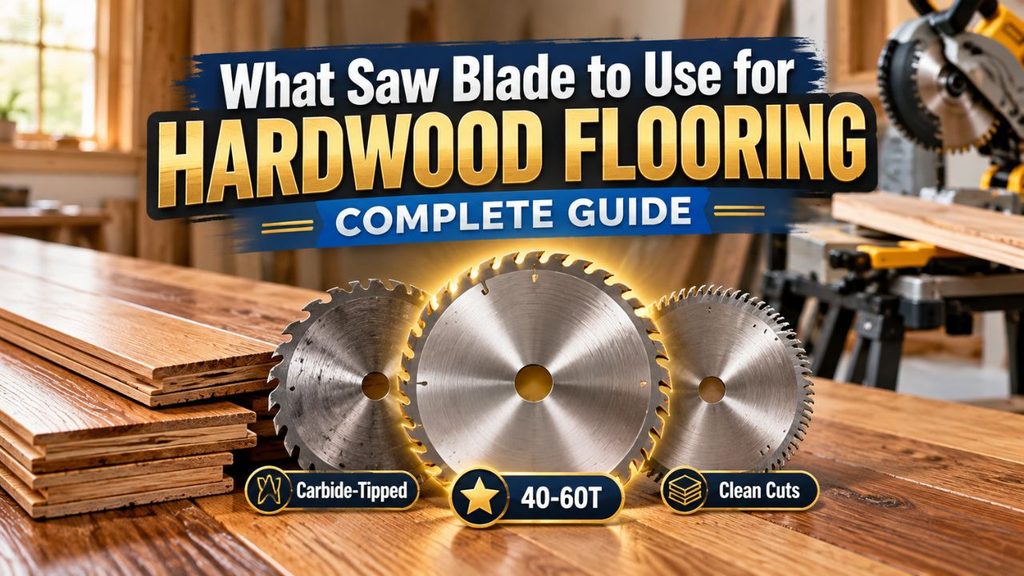
For most DIY flooring installations, a carbide-tipped finish blade is the safest general recommendation.
If you are primarily shortening plank ends with a miter saw, choose a fine crosscut blade.
If you are ripping the first or last row lengthwise, use a table-saw or circular-saw blade designed to clear material efficiently without burning.
Here is a practical comparison:
| Saw Type | Recommended Blade | Best Use |
| 10-inch miter saw | 60–80 tooth carbide | Clean plank crosscuts |
| 12-inch miter saw | 80–100 tooth carbide | Fine crosscuts |
| 7-1/4-inch circular saw | 40–60 tooth carbide | Crosscuts and general flooring work |
| Table saw | 24–40 tooth carbide rip/combination blade | Long rip cuts |
| Table saw for finish crosscuts | 50–80 tooth carbide | Smooth visible cuts |
| Jigsaw | Fine-tooth hardwood blade | Curves and notches |
| Oscillating tool | Fine wood-cutting blade | Door jambs and detail work |
These numbers are guidelines rather than absolute requirements.
A high-quality 40-tooth blade with proper tooth geometry may cut cleaner than a cheap 60-tooth blade.
Key Takeaways:
- Use carbide-tipped blades for hardwood flooring.
- Fine-tooth blades are best for clean crosscuts.
- Long rip cuts usually need fewer teeth and better chip clearance than finish crosscuts.
Why Carbide-Tipped Blades Are Best for Hardwood Flooring
Hardwood flooring is much harder on cutting edges than ordinary softwood.
Oak, maple, hickory, walnut, and other flooring species can quickly expose the weakness of an inexpensive steel blade.
Carbide teeth retain their sharp edge significantly longer.
They also tolerate the repeated cutting required during a flooring installation much better than ordinary high-speed steel or plain steel teeth.
A typical flooring project can involve dozens or hundreds of cuts.
Even a medium-sized room may require a cut at the end of almost every row, plus additional ripping around walls, cabinets, vents, and irregular openings.
Using an inferior blade can result in rough cuts, increased burning, slower progress, and more frequent blade changes.
Carbide Quality Matters
Not all carbide blades are equal.
Premium blades generally use higher-quality carbide, more precise grinding, and stronger tooth brazing.
They often stay sharp longer and produce cleaner cuts.
For one small bedroom, an inexpensive carbide finish blade may be completely adequate.
For a whole house, investing in a better blade usually saves time and produces more consistent results.
What Tooth Count Is Best for Hardwood Flooring?
Tooth count affects both cut quality and cutting speed.
A blade with more teeth removes smaller amounts of material with each tooth. This generally creates a smoother edge.
A blade with fewer teeth removes material faster and leaves more space between teeth for clearing chips.
Hardwood flooring installation requires both types of cuts.
High Tooth Count for Crosscuts
Crosscuts go across the grain and usually occur at the ends of planks.
Because the cut edge may be visible near transitions or doorways, a clean finish is important.
For crosscutting hardwood flooring, higher tooth counts are generally preferable.
A 10-inch miter saw blade with 60 to 80 teeth is an excellent range.
A 12-inch saw may use 80 to 100 teeth for similar finish quality because the blade circumference is larger.
Lower Tooth Count for Rip Cuts
Rip cuts run along the grain and are commonly needed on the first and last rows.
During a long rip, the saw must remove much more material than during a short crosscut.
An extremely fine blade can trap heat and sawdust, increasing the chance of burning.
A 24- to 40-tooth carbide blade is often a better choice for table-saw ripping.
A quality 40-tooth combination blade can handle both ripping and occasional crosscutting reasonably well.
What Saw Blade to Use for Hardwood Flooring on a Miter Saw
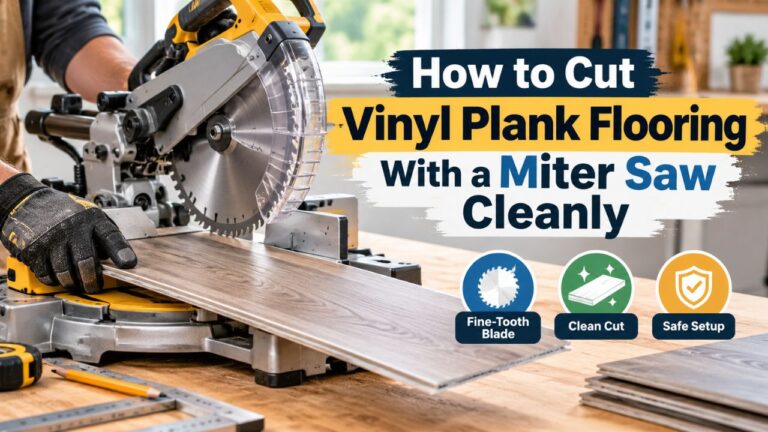
A miter saw is one of the most useful tools for flooring installation because most plank-end cuts are crosscuts.
For a 10-inch miter saw, I recommend a 60- to 80-tooth carbide finish blade.
For a 12-inch saw, approximately 80 to 100 teeth is a good general range.
The finer tooth count helps reduce splintering along the finished surface.
Why Not Use a 24-Tooth Miter Saw Blade?
A 24-tooth blade will certainly cut hardwood.
However, it is designed for fast construction cuts rather than finish work.
On flooring, the exit side may splinter noticeably.
That may not matter if the cut is completely hidden under baseboard, but a fine blade gives you more flexibility and generally produces a cleaner installation.
Sliding Miter Saw Considerations
If you are using a sliding miter saw, choose a blade designed for sliding saws.
Many sliding saw blades use a slightly negative or low hook angle to reduce the tendency of the blade to pull aggressively into the workpiece.
That can improve control when cutting hard flooring planks.
What Saw Blade to Use for Hardwood Flooring on a Circular Saw
A circular saw is useful for crosscuts, rip cuts, and especially long tapered cuts on the final row.
For a common 7-1/4-inch circular saw, I recommend approximately 40 to 60 carbide-tipped teeth for clean flooring work.
A 40-tooth blade is a versatile choice if you need one blade for several types of cuts.
A 60-tooth finish blade can produce a slightly cleaner crosscut but may cut more slowly on long rips.
When a 24-Tooth Blade Is Acceptable
A 24-tooth framing blade can cut hardwood flooring, but it is not my preferred option.
It leaves a rougher edge and increases the chance of splintering.
If the cut will be completely hidden and you only need one or two rough cuts, it may be acceptable.
For a full installation, a finer blade is worth using.
Keep the Blade Depth Shallow
Set the circular-saw blade only slightly deeper than the flooring plank.
You do not need several inches of exposed blade.
A shallow setup improves control and reduces unnecessary blade exposure.
What Saw Blade to Use on a Table Saw
A table saw is the best tool for long, straight rip cuts.
This is especially useful when narrowing the first or final row along an entire wall.
For ripping solid hardwood flooring, a 24- to 40-tooth carbide blade works well.
A dedicated 24-tooth rip blade clears chips aggressively and reduces heat.
A 40-tooth combination blade gives you a good compromise between rip speed and surface quality.
Why an 80-Tooth Blade May Be Poor for Ripping
A high-tooth-count blade creates beautiful crosscuts, but during a long rip it may not have enough space between teeth to clear sawdust efficiently.
That can increase friction.
The result may be burning along the cut edge or excessive feed resistance.
If your table saw will primarily rip flooring, a dedicated rip blade is more efficient.
Combination Blade for One-Blade Convenience
If you do not want to change blades repeatedly during the project, a quality 40- or 50-tooth combination blade can be an excellent compromise.
It may not rip as quickly as a dedicated rip blade or crosscut as perfectly as an 80-tooth finish blade, but it can handle most flooring tasks effectively.
Key Takeaways:
- Miter saws benefit from high-tooth-count finish blades.
- Circular saws work well with roughly 40–60 teeth.
- Table-saw rip cuts are usually better with 24–40 teeth than with an ultra-fine finish blade.
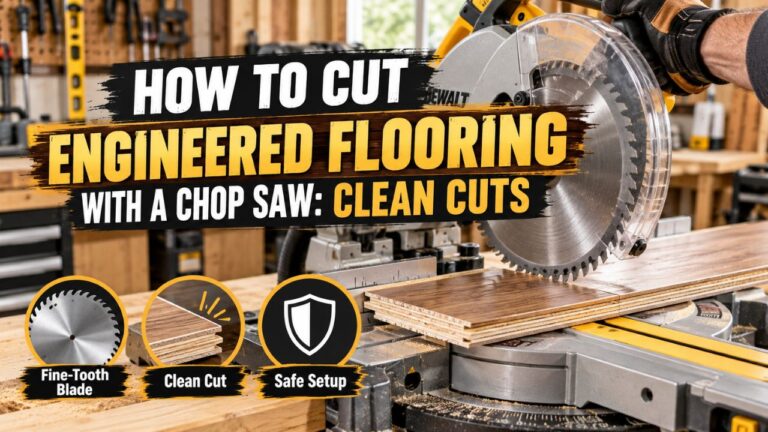
What Saw Blade to Use for Engineered Hardwood Flooring
Engineered hardwood needs many of the same blade characteristics as solid hardwood.
A sharp carbide blade is still the best general choice.
However, engineered flooring contains multiple layers.
The top surface may be real hardwood veneer, while the core consists of plywood, fiberboard, or another engineered material.
Adhesives bind those layers together.
This construction can sometimes be more abrasive than clean solid wood.
A fine carbide blade produces the best visible edge.
For crosscuts, use a 60- to 80-tooth finish blade on a 10-inch miter saw.
For circular saw work, approximately 40 to 60 teeth is still a practical range.
Watch for Veneer Chipping
The thin hardwood veneer on engineered flooring can chip if the blade is dull or coarse.
Use a sharp blade and fully support the plank.
If chipping remains a problem, painter’s tape along the cut line may help.
A zero-clearance insert on a table or miter saw can also improve support around the blade.
Best Tooth Geometry for Hardwood Flooring
Tooth count is only part of blade design.
The shape of each tooth also affects how the blade cuts.
ATB – Alternate Top Bevel
ATB blades alternate the bevel direction from one tooth to the next.
This geometry is excellent for clean crosscuts in hardwood and plywood.
For most hardwood-flooring crosscuts, ATB is an excellent choice.
TCG – Triple Chip Grind
TCG blades alternate a chamfered tooth with a flat-raker tooth.
This design is commonly used for hard, abrasive materials such as laminate, melamine, and some engineered panels.
For conventional solid hardwood, TCG is not usually necessary.
For flooring with highly abrasive coatings or engineered layers, however, a TCG blade can offer durability.
Flat Top Grind
Flat-top-grind teeth are excellent for ripping.
They remove material efficiently and leave plenty of space for chip clearance.
A dedicated table-saw rip blade often uses this geometry.
Combination Grind
Combination blades mix tooth styles or groups of teeth to provide acceptable crosscut and ripping performance from one blade.
This is convenient for homeowners who do not want to change blades repeatedly.
Thin-Kerf vs. Full-Kerf Blades for Hardwood Flooring
Kerf is the width of material removed by the blade.
A thin-kerf blade removes less wood and requires less power.
This makes thin-kerf blades particularly useful on portable jobsite table saws and cordless circular saws.
Advantages of Thin Kerf
The saw works less aggressively.
Battery life may improve on cordless tools.
Less material becomes sawdust.
A lower-powered saw can move through dense hardwood more easily.
Full-Kerf Advantages
A full-kerf blade is thicker and usually more resistant to deflection.
On a powerful cabinet table saw, this added stiffness can improve straight-line accuracy during long rips.
For typical DIY flooring installation, either can work well.
Match the blade to your saw manufacturer’s requirements, including riving-knife compatibility.
Best Blade for Oak Hardwood Flooring
Oak is one of the most common hardwood-flooring materials.
It cuts well with standard carbide blades but can splinter across the grain if you use a coarse or dull blade.
For oak flooring, my typical setup would be:
a 60- to 80-tooth carbide blade on the miter saw for crosscuts and a 24- to 40-tooth carbide blade on the table saw for ripping.
A 40- to 60-tooth circular-saw blade works well for on-site cuts.
Best Blade for Maple Hardwood Flooring
Maple is dense and can burn easily if the blade is dull or the feed rate is too slow.
Use a very sharp carbide blade.
For crosscuts, fine ATB teeth work well.
For long rips, avoid excessively high tooth counts that trap heat.
Keep the blade clean because even minor buildup can increase friction noticeably when cutting maple.
Best Blade for Hickory Hardwood Flooring
Hickory is hard and dense.
A premium carbide blade is worth the investment.
Use a sharp finish blade for crosscuts and a lower-tooth-count rip blade for long table-saw work.
If your saw begins requiring significantly more pressure, stop and inspect the blade rather than continuing to force the cut.
What About Bamboo Flooring?
Although bamboo is botanically a grass rather than wood, many flooring products are extremely dense.
Strand-woven bamboo in particular can be very hard and abrasive.
A high-quality carbide blade is essential.
For frequent bamboo cutting, a blade intended for engineered or abrasive flooring materials may last longer than a standard general-purpose blade.
How to Prevent Chipping on Hardwood Flooring
Blade choice is the first factor.
Use a sharp fine-tooth blade for visible crosscuts.
Support the plank fully so it does not vibrate.
On a miter saw, keep the plank firmly against the fence.
On a circular saw, clamp the plank to a stable surface.
Cut Orientation Matters
With a conventional circular saw, the cleaner edge is often on the bottom side of the workpiece because of blade rotation.
That means placing the finished flooring surface face down may reduce visible splintering.
With a table saw or miter saw, the cleaner side is generally opposite because the blade enters the work differently.
Make a test cut on scrap if surface quality is critical.
Use Painter’s Tape
Painter’s tape over the cut line can help support surface fibers and reduce minor splintering.
It is not a substitute for a sharp blade, but it can improve difficult cuts.
Why Hardwood Flooring Burns During Cutting
Burn marks are usually caused by friction.
Common causes include a dull blade, dirty blade, excessively high tooth count during a long rip, slow feed rate, misaligned fence, or blade deflection.
Hardwoods such as maple and cherry can show burn marks quickly.
If the flooring starts burning, do not simply push harder.
Inspect the blade and saw setup.
Clean the Blade
Pitch and resin can accumulate on carbide teeth.
This changes the effective cutting geometry and increases friction.
Blade cleaning can sometimes restore performance even when the teeth are not actually dull.
Can Hardwood Flooring Dull Saw Blades?
Yes.
Dense hardwood gradually wears carbide edges.
Prefinished hardwood can be particularly demanding because factory finishes may contain durable wear-resistant coatings.
Engineered flooring can also increase blade wear because the blade cuts through wood, adhesive, and composite layers.
If you are installing multiple rooms, consider keeping a spare blade ready.
Do You Need a Special Flooring Blade?
Not necessarily.
A high-quality general-purpose carbide blade may be enough for a small project.
However, a dedicated flooring or fine-finish blade can improve cut quality and preserve your other woodworking blades.
If you already own an expensive cabinetmaking blade, I would not necessarily use it for hundreds of flooring cuts.
A separate flooring blade becomes a normal project expense.
Key Takeaways:
- Dense hardwood and factory finishes can dull blades over time.
- A dedicated flooring blade protects your premium woodworking blades.
- Burning, increased cutting pressure, and rough edges often indicate a dull or dirty blade.
What Saw Blade to Use for Hardwood Flooring Removal
Removing hardwood is different from installing it.
If you are cutting old flooring into sections for demolition, a fine-finish blade is unnecessary.
Old flooring may contain hidden nails, staples, screws, or other fasteners.
For demolition, use a carbide demolition blade specifically rated for nail-embedded wood if metal contact is likely.
Do not intentionally cut nails unless the blade manufacturer specifically permits it.
Even with a demolition blade, hidden metal can damage teeth or create kickback.
Set the blade depth carefully so you cut the hardwood without unnecessarily damaging the subfloor.
Should You Use a Jigsaw Blade for Hardwood Flooring?
A jigsaw is excellent for irregular cuts.
Use it around pipes, door jambs, vents, corners, and other obstacles.
Choose a fine-tooth blade intended for hardwood or clean wood cutting.
A higher TPI blade generally produces a smoother edge.
However, very fine blades can cut slowly through thick hardwood.
For most flooring detail work, a medium-fine carbide or bi-metal jigsaw blade provides a good balance.
Down-Cut Jigsaw Blades
Some jigsaw blades have teeth pointing downward.
These can reduce chipping on the top decorative surface.
The tradeoff is that they tend to push the saw upward, so you need firm control.
Test the blade on scrap before using it on expensive flooring.
Should the Finished Side Face Up or Down?
The correct orientation depends on the saw.
For a conventional handheld circular saw, the finished side often goes down for the cleanest visible edge.
For a table saw, the finished side generally goes up.
For a miter saw, the finished surface generally goes up.
For a jigsaw, orientation depends on whether the blade cuts on the upstroke or downstroke.
The safest approach is to make a test cut on scrap with your actual blade.
Different blade geometries can change the result.
How to Choose One Blade if You Only Want to Buy One
If you want one general-purpose blade for a flooring installation, choose a high-quality carbide combination blade.
For a 7-1/4-inch circular saw, roughly 40 teeth is a versatile compromise.
For a 10-inch table or miter saw, around 50 to 60 teeth can handle both crosscuts and moderate ripping.
You will sacrifice some speed on rips and some finish quality compared with dedicated blades, but the overall performance can still be very good.
For the cleanest professional result, use separate crosscut and rip blades.
Common Mistakes When Choosing Hardwood Flooring Blades
One of the biggest mistakes is assuming more teeth are always better.
An 80-tooth blade may make beautiful crosscuts but perform poorly during a long rip because it cannot clear chips efficiently.
Another mistake is using a coarse framing blade for visible flooring ends.
It cuts quickly but can leave splintering that requires extra cleanup.
Using a dull blade is also common.
If you need significantly more pressure halfway through a flooring project, do not automatically blame the hardwood. The cutting edge may simply be worn.
Finally, make sure the blade matches your saw’s arbor size, diameter, maximum RPM, and riving-knife requirements.
A good blade is useless if it is incompatible with the machine.
FAQs about What Saw Blade to Use for Hardwood Flooring
What is the best saw blade for hardwood flooring?
A sharp carbide-tipped blade is the best general choice. Use a fine finish blade for crosscuts and a lower-tooth-count carbide blade for long rip cuts.
How many teeth should a blade have for hardwood flooring?
For a 10-inch miter saw, 60 to 80 teeth works well for crosscuts. For a 7-1/4-inch circular saw, around 40 to 60 teeth is a good range. Table-saw rip blades generally work well with 24 to 40 teeth.
Is a 60-tooth blade good for hardwood flooring?
Yes. A 60-tooth carbide blade is an excellent general finish blade for crosscutting hardwood flooring and can also handle light general-purpose work.
Is an 80-tooth blade better than a 60-tooth blade?
For very smooth crosscuts, often yes. For long rip cuts, no. An 80-tooth blade may generate more heat and clear chips less efficiently.
What blade should I use for oak flooring?
Use a carbide finish blade with 60 to 80 teeth for miter-saw crosscuts and a 24- to 40-tooth carbide blade for table-saw ripping.
What blade should I use for engineered hardwood flooring?
A sharp carbide finish blade is ideal. Fine teeth reduce veneer chipping, while durable carbide handles the engineered core and adhesive layers.
Can I use a framing blade on hardwood flooring?
Yes, but it is not ideal for clean finish cuts. A 24-tooth framing blade is more likely to splinter the surface.
Can I cut hardwood flooring with a circular saw?
Yes. A 7-1/4-inch circular saw with a 40- to 60-tooth carbide blade can make excellent crosscuts and rip cuts.
Can I use a table saw for hardwood flooring?
Yes. A table saw is one of the best tools for ripping first and last rows to width.
Can I use a miter saw for hardwood flooring?
Yes. A miter saw is excellent for repeated plank-end crosscuts.
What tooth geometry is best for hardwood flooring?
ATB is excellent for clean crosscuts. Flat-top or lower-tooth-count rip designs work well for ripping. Combination blades are useful if you want one blade for multiple tasks.
Does hardwood flooring dull saw blades?
Yes. Dense wood and factory finishes gradually wear carbide teeth. Engineered flooring can also be abrasive because of adhesives and composite layers.
Why is my saw blade burning hardwood flooring?
The blade may be dull, dirty, too fine for the rip cut, or moving too slowly. Table-saw fence alignment can also contribute to burning.
Should the hardwood flooring face up or down when cutting?
It depends on the saw. Circular saw cuts often look cleaner with the finished side down, while miter and table saws usually give the cleaner surface with the finished side up.
Do I need a special blade for prefinished hardwood?
Not necessarily, but a sharp fine-tooth carbide blade is strongly recommended. Prefinished surfaces can chip if the blade is coarse or dull.
Is thin kerf good for hardwood flooring?
Yes, particularly on cordless circular saws and lower-powered portable saws. Thin-kerf blades require less power, although full-kerf blades can provide greater stiffness on powerful table saws.
Conclusion
Choosing what saw blade to use for hardwood flooring depends mainly on your saw and the type of cut you need to make.
For clean crosscuts, use a fine-tooth carbide blade. On a typical 10-inch miter saw, approximately 60 to 80 teeth is a strong general choice. On a 7-1/4-inch circular saw, roughly 40 to 60 teeth works well for most flooring cuts.
For long rip cuts on a table saw, fewer teeth are usually better. A 24- to 40-tooth carbide rip or combination blade clears sawdust efficiently, cuts faster, and reduces the chance of burning.
Engineered hardwood also benefits from sharp carbide teeth because its thin veneer can chip and its layered core can be abrasive. For visible cuts, ATB tooth geometry gives excellent crosscut quality, while dedicated rip blades work better for long cuts along the grain.
My recommendation is to avoid choosing a blade based only on tooth count. Consider the cut direction, saw type, carbide quality, tooth geometry, and flooring material together.
If you are completing an entire hardwood-floor installation, having one fine crosscut blade and one dedicated rip blade gives you the best combination of speed, clean edges, and blade life.