What Is a Tenon Saw Used For? Uses, Cuts, and How to Use It
If you are wondering what is a tenon saw used for, a tenon saw is mainly used to make accurate straight cuts in wood, especially when cutting tenons, shoulders, and other woodworking joints. Its stiff reinforced back keeps the thin blade from flexing, allowing you to produce cleaner and more controlled cuts than you would normally get from a general-purpose handsaw.
Despite its name, a tenon saw is not limited to cutting tenons. Woodworkers also use it for crosscutting small pieces, cutting shoulders for several types of joinery, trimming components to length, making precise cuts with a bench hook or miter box, and performing other cabinetmaking and furniture-making tasks where accuracy matters more than cutting speed.
A tenon saw belongs to the broader family of backsaws. The metal or rigid reinforced spine along the top of the blade is what distinguishes it from an ordinary panel saw. That reinforcement prevents excessive blade movement and helps the saw track a straight line. The tradeoff is that the rigid back limits how deeply the blade can cut into a large board.
In this guide, I’ll explain exactly what a tenon saw is used for, how it works, which cuts and joints it handles best, how it differs from dovetail and other backsaws, how to use it correctly, and when a different saw is a better choice.
What Is a Tenon Saw?
A tenon saw is a medium-sized backsaw designed for controlled woodworking cuts.
Its blade is relatively thin and rectangular, with a rigid spine running along the top edge. Traditionally, that spine was made from brass or steel, although modern saws may use other rigid materials.
The reinforced back serves an important purpose.
A thin blade cuts with less effort and can leave a relatively narrow kerf, but a thin unsupported blade can also bend or buckle. The rigid spine gives the blade stiffness, allowing you to guide the saw accurately through a workpiece.
Tenon saws are commonly associated with traditional furniture making, cabinetmaking, joinery, and general bench woodworking.
Depending on the model, the teeth may be filed primarily for crosscutting, ripping, or a hybrid geometry intended to perform reasonably well in both directions.
That distinction can affect how efficiently the saw cuts certain joints.
What Is a Tenon Saw Used For Most Often?
The traditional purpose of a tenon saw is making the cuts required for mortise-and-tenon joints.
A mortise-and-tenon joint consists of two basic parts.
The tenon is a projecting tongue formed on the end of one piece of wood.
The mortise is a matching recess or hole in another piece.
The tenon fits inside the mortise to create a strong mechanical connection.
Mortise-and-tenon joinery has been used extensively in furniture, doors, frames, tables, chairs, and many other woodworking projects.
A tenon saw helps create the cheeks and shoulders that determine how accurately the tenon fits.
However, this is only one of its uses.
The combination of a fine blade, stiff back, and comfortable handle makes the saw useful for almost any small or medium-sized woodworking cut where you want greater precision than a general-purpose handsaw provides.
Cutting Tenon Cheeks
The cheeks are the broad faces of the tenon.
These cuts normally run in the same general direction as the wood grain, so a rip-filed tenon saw can be particularly effective.
The goal is to follow the layout line accurately without removing too much wood.
A tenon that is slightly oversized can usually be adjusted with a chisel, shoulder plane, or router plane.
A tenon cut too small cannot be restored as easily.
For this reason, careful sawing matters.
Cutting Tenon Shoulders
The shoulders are the cuts across the workpiece that define where the tenon begins.
A clean shoulder is important because it often forms the visible joint line when the two components are assembled.
Shoulder cuts run across the grain, making a crosscut tooth pattern particularly suitable.
Some woodworkers use one saw for both cheek and shoulder cuts, while others prefer different backsaws optimized for each direction.
Trimming Small Wood Components
A tenon saw is also excellent for cutting relatively small pieces of wood to length.
For example, you might use it to trim:
Furniture rails
Small boards
Dowels
Molding components
Wooden strips
Joinery parts
The saw is particularly useful when the workpiece can be supported in a bench hook or similar holding device.
Because the blade is stiff, you can make a more controlled square cut than with many flexible general-purpose saws.
Key Takeaways:
- A tenon saw is primarily a precision woodworking backsaw.
- Its traditional job is cutting the cheeks and shoulders of tenons.
- It is also excellent for accurate crosscuts and trimming smaller woodworking components.
Why Does a Tenon Saw Have a Reinforced Back?
The reinforced spine is arguably the defining feature of the tool.
A conventional handsaw has a blade that can extend deeply into a large workpiece because nothing blocks the top of the blade.
A tenon saw sacrifices some of that cutting depth in exchange for stiffness.
This produces several advantages.
The blade is less likely to flex from side to side. That makes following a marked line easier.
The additional rigidity also allows manufacturers to use a relatively thin saw plate, which can produce a finer cut.
Finally, the weight of a traditional brass or steel back can help the saw move through the wood smoothly without requiring excessive downward pressure.
The disadvantage is obvious: once the rigid spine reaches the top of the workpiece, the blade cannot cut any deeper.
For ordinary joinery, that is rarely a problem because tenons and other bench-work cuts are usually relatively shallow.
For cutting through a very deep board, however, a conventional handsaw or another tool is more appropriate.
What Types of Cuts Can a Tenon Saw Make?
A tenon saw can make both crosscuts and rip-oriented cuts, although tooth geometry influences which type feels easiest.
Crosscuts
A crosscut goes across the direction of the wood fibers.
This is what you do when shortening a board or cutting the shoulder of a tenon.
Fine crosscut teeth are shaped to sever wood fibers cleanly, helping reduce roughness at the cut.
A crosscut tenon saw is useful for furniture parts, cabinet components, bench work, and general precision cutting.
Rip Cuts
A rip cut runs generally with the grain.
The cheek cuts of a traditional tenon are essentially short rip cuts.
A rip-filed saw removes wood fibers somewhat like a row of tiny chisels.
For a woodworker who cuts many traditional joints by hand, a rip-filed tenon saw can be extremely useful.
Angled Cuts
A tenon saw can also make accurate angled cuts.
When paired with a miter box or carefully marked layout lines, it can cut miters for small trim, frames, moldings, and other components.
However, a dedicated miter saw or powered miter saw is generally more convenient for repeated angle cutting.
Shoulder Cuts for Other Joints
Tenons are not the only joints that require accurate shoulder lines.
A tenon saw can also help with joints such as:
Half-lap joints
Bridle joints
Housing-related shoulder cuts
Certain scarf or frame joints
Other traditional joinery layouts
The important factor is that the cut is relatively shallow and benefits from a rigid, accurately controlled saw.
Tenon Saw Uses in Furniture Making
Furniture making is one of the environments where a tenon saw makes the most sense.
Many furniture components are relatively small compared with construction lumber, and the quality of a joint can depend on fractions of an inch.
For example, imagine building a traditional table.
The legs may contain mortises, while the rails or aprons need matching tenons.
If the tenon shoulders are crooked, gaps may appear around the joint.
If the cheeks wander too far away from the intended line, the joint may fit loosely.
A good tenon saw lets you approach those layout lines carefully.
Chairs, stools, doors, cabinets, frames, and workbenches can all involve similar joinery.
Even when a woodworker uses machinery for part of the construction process, a tenon saw can remain useful for trimming or adjusting joints by hand.
Tenon Saw Uses in Cabinetmaking
Cabinetmaking involves many small, accurate components.
A tenon saw can be used to cut rails, frame members, small moldings, and joinery components.
It is particularly valuable when making traditional face frames or doors by hand.
The saw also works well for small cuts where setting up a large power tool would be slower than simply placing the component on a bench hook and making the cut manually.
That is one reason backsaws remain relevant even in workshops equipped with table saws and miter saws.
A hand tool can be faster when the job involves only one or two precise cuts.
Can a Tenon Saw Make Straight Cuts?
Yes. Making straight, controlled cuts is one of its strengths.
The reinforced back prevents much of the blade flex that can make other handsaws wander.
However, the saw does not automatically cut straight.
Accuracy still depends on proper technique.
Your layout line needs to be clear. The workpiece should be secure. Your body and wrist should allow the saw to move naturally in the desired plane.
If you force the blade sideways to correct a wandering cut, you can make the problem worse.
It is usually better to begin accurately and allow the saw to establish a shallow kerf before increasing stroke length.
Tenon Saw vs. Dovetail Saw
A tenon saw and dovetail saw are both backsaws, but they are optimized for different scales of work.
A dovetail saw is generally smaller, lighter, and finer toothed. It is designed for very delicate joinery such as dovetail pins and tails.
A tenon saw is normally larger and better suited to deeper or longer joint cuts.
| Feature | Tenon Saw | Dovetail Saw |
| Typical size | Medium to large backsaw | Smaller backsaw |
| Blade depth | Greater | Shallower |
| Tooth size | Usually somewhat larger | Usually finer |
| Main use | Tenons and general joinery | Dovetails and delicate joinery |
| Cutting speed | Faster in larger work | Slower but highly precise |
| Best workpiece size | Small to medium joinery | Small, detailed components |
If you were making a large tenon on a table rail, I would choose the tenon saw.
If you were cutting small dovetails in a drawer side, I would usually prefer the dovetail saw.
There is overlap, though. A skilled woodworker can perform many cuts with either saw.
Tenon Saw vs. Backsaw
“Backsaw” is a category rather than one specific saw.
A tenon saw is a type of backsaw.
Other backsaws include dovetail saws, carcass saws, sash saws, and traditional miter-box saws.
What they share is the stiffened spine along the top of the blade.
The term “tenon saw” generally describes a backsaw sized and toothed for relatively substantial joinery work.
So asking whether a tenon saw or backsaw is better is somewhat like asking whether a pickup truck or vehicle is better—the tenon saw belongs within the broader backsaw category.
Tenon Saw vs. Coping Saw
The two tools have very different purposes.
A tenon saw is designed to cut straight lines accurately.
A coping saw is designed primarily for curves and internal shapes.
The coping saw has a narrow flexible blade held in a bow-shaped frame. Its blade can turn through curves that a tenon saw cannot follow.
For cutting the straight shoulders of a tenon, the tenon saw is clearly better.
For coping a molding profile or cutting a curved opening, use the coping saw.
Tenon Saw vs. Fret Saw
A fret saw is even more specialized for fine curves than a coping saw.
Its extremely narrow blade and deep frame allow intricate decorative and internal cuts.
A tenon saw, by comparison, has a broad rectangular blade intended to stay straight.
Use the tenon saw when accuracy along a straight layout line is the goal.
Use the fret saw when the pattern requires tight curves and pierced openings.
Key Takeaways:
- A tenon saw belongs to the backsaw family.
- Compared with a dovetail saw, it is generally larger and suited to more substantial joints.
- Choose a coping or fret saw instead when the cut requires tight curves rather than a straight line.
Tenon Saw vs. Hand Saw
A general-purpose hand saw is designed for cutting larger pieces of timber, sheet goods, or boards.
It normally has no reinforced spine, so the blade can travel completely through deep stock.
That makes it much more versatile for large cuts.
A tenon saw trades cutting depth for precision.
Its teeth are normally finer, the blade is more rigid, and the saw is better suited to controlled bench work.
For cutting a long 2×4 to length on a jobsite, I would use a general-purpose handsaw or power saw.
For cutting a furniture rail exactly to a shoulder line, I would use the tenon saw.
Tenon Saw vs. Miter Saw
A powered miter saw is much faster for repeated crosscuts.
It is especially useful when cutting construction lumber, trim, molding, or numerous pieces to consistent angles and lengths.
However, a tenon saw has advantages of its own.
It is quiet, requires no electricity, produces relatively little airborne dust, and gives excellent control over individual joinery cuts.
For traditional hand-tool woodworking, those advantages matter.
A tenon saw and powered miter saw therefore complement each other rather than directly replacing one another.
How to Use a Tenon Saw Correctly
Using a tenon saw successfully is less about strength and more about control.
Mark the Cut Accurately
Use a sharp pencil, marking knife, combination square, or marking gauge depending on the project.
For joinery, a knife line can provide a particularly precise reference.
When cutting a tenon, mark the shoulder and cheek lines around the workpiece so you can monitor the cut from more than one side.
Secure the Workpiece
A moving workpiece makes accurate sawing almost impossible.
For crosscutting small components, a bench hook is extremely useful.
For vertical joinery cuts, hold the workpiece securely in a woodworking vise.
Position it so the cutting area is comfortable to see and reach.
Start With Short, Light Strokes
Place the saw at the waste side of the layout line.
Begin with a few short strokes to establish a shallow kerf.
Do not immediately use the entire blade length or press down heavily.
Once the kerf is established, gradually lengthen your stroke.
Let the Saw Do the Work
A sharp tenon saw requires surprisingly little downward force.
The teeth should cut as the saw moves.
Pushing too hard makes the blade more difficult to control and can cause it to wander away from the line.
Use a relaxed grip.
A tight grip tends to introduce unnecessary sideways movement.
Watch More Than One Layout Line
When cutting a tenon cheek vertically, watch the line on the top surface and the line running down the face.
This helps prevent the saw from leaning toward one side.
Some woodworkers begin the kerf on multiple faces before connecting them. This creates a physical guide that helps the blade follow the intended path.
How to Use a Tenon Saw With a Bench Hook
A bench hook is one of the best accessories for a tenon saw.
It is a simple bench appliance with stops that hold the workpiece while allowing the saw to cut safely past its edge.
Place the bench hook against the front edge of your workbench.
Set the workpiece against the upper stop.
Hold the wood firmly with your non-sawing hand, keeping that hand safely away from the cutting path.
Align the saw with the marked line and begin with light strokes.
The bench hook supports the workpiece and helps you keep the cut square.
This combination is excellent for trimming rails, small boards, dowels, and other bench-sized components.
How to Cut a Tenon With a Tenon Saw
There are several valid sequences for hand-cut tenons, but the general goal is the same: create straight cheeks and clean shoulders while leaving the joint slightly adjustable.
Begin by laying out the tenon accurately with a marking gauge and square.
Clearly identify the waste areas so you do not accidentally cut on the wrong side of the line.
For the cheek cuts, clamp the workpiece securely.
Start on the waste side of the layout line and establish a shallow kerf.
Continue carefully until you approach the shoulder line.
Do not intentionally saw past it.
Then cut the shoulders across the grain.
The exact sequence—cheeks first or shoulders first—can vary according to technique and personal preference.
After sawing, test the tenon against its mortise.
If minor adjustment is necessary, remove small amounts of material carefully using an appropriate chisel, shoulder plane, or other joinery tool.
A good habit is to leave a tiny amount of material for final fitting rather than trying to create a perfect finished joint entirely with the saw.
How Many Teeth Should a Tenon Saw Have?
Tenon saw tooth count varies with the saw’s size and intended use.
Rather than assuming one tooth count is universally best, think about the balance between speed and smoothness.
Finer teeth generally produce a smoother, more controllable cut but remove material more slowly.
Coarser teeth cut faster and clear sawdust more easily but can leave a rougher surface.
A larger tenon saw used for substantial joinery may therefore have somewhat coarser teeth than a fine dovetail saw.
Tooth geometry also matters.
A rip-filed tooth pattern is excellent for cutting tenon cheeks with the grain.
A crosscut-filed saw is better optimized for cutting shoulders across the grain.
Some modern saws use hybrid tooth geometry intended to perform well enough in both directions.
For a beginner who wants one saw for general joinery, a versatile hybrid or moderately fine crosscut-style tenon saw can be practical.
Why Is My Tenon Saw Wandering?
Even a high-quality tenon saw can wander when technique or setup is wrong.
The most common cause is excessive pressure.
When you push aggressively, small alignment errors become larger.
A dull or damaged saw can also wander because one side of the tooth line may cut more aggressively than the other.
Your body position matters as well.
Try to align your forearm with the intended cutting line rather than forcing your wrist sideways.
Make sure the workpiece is vertical or square in the vise.
Finally, start the cut carefully. Once a saw establishes a crooked kerf, correcting it becomes much harder.
Advantages of a Tenon Saw
The primary advantage is accuracy.
The stiff back, fine tooth pattern, and controlled hand-powered cutting make it ideal for joinery.
It is also quiet and easy to use in a small workshop.
Unlike a power saw, it requires almost no setup for a single cut.
There is no extension cord, blade-height adjustment, dust extraction system, or machine fence to configure.
For many small woodworking jobs, marking the line and reaching for the tenon saw is faster.
A quality saw can also last for decades when properly maintained.
Limitations of a Tenon Saw
The rigid back limits cutting depth.
That makes the saw unsuitable for deep cuts through large boards.
It is also slower than powered equipment when many identical cuts are required.
Another limitation is that it is designed primarily for straight cutting. Trying to make a curved cut with a tenon saw is frustrating and can damage the blade or workpiece.
Finally, good results require practice.
A power saw with a properly adjusted fence can mechanically guide a cut. A tenon saw relies more heavily on the user’s coordination.
That learning curve is part of traditional hand-tool woodworking, but beginners should expect their accuracy to improve gradually.
Key Takeaways:
- The reinforced back makes a tenon saw accurate but limits cutting depth.
- Sharp teeth and light pressure are more effective than forcing the blade.
- A tenon saw excels at individual precision cuts but is slower than power tools for high-volume work.
How to Choose a Tenon Saw
If you are buying your first tenon saw, think about the kind of woodworking you expect to do.
For general furniture and joinery work, a medium-sized saw is usually the most versatile.
Blade length affects how efficiently the saw handles larger joints.
Blade depth determines the maximum practical cutting depth before the reinforced back contacts the workpiece.
Tooth configuration determines whether the saw favors ripping, crosscutting, or general-purpose use.
Handle comfort is also important.
Traditional tenon saws frequently use a closed wooden handle shaped somewhat like a pistol grip. A good handle should allow a relaxed grip without forcing your wrist into an awkward position.
For beginners, I would prioritize a straight blade, good factory sharpening, comfortable handle, and versatile tooth pattern over decorative materials.
How to Maintain a Tenon Saw
Keep the blade clean and dry.
Wood resins, moisture, and workshop humidity can contribute to corrosion.
After use, wipe the blade clean before storing it.
Avoid placing heavy tools on top of the saw because even a reinforced backsaw can be damaged by careless storage.
Traditional sharpenable saws may eventually need tooth jointing, shaping, setting, and sharpening.
These tasks require specialized files and some skill.
Modern hardened-tooth saws may stay sharp for a long time but are typically replaced rather than resharpened once the teeth wear out.
Know which type you own before attempting to file the teeth.
Tenon Saw Safety
A tenon saw is safer than many powered woodworking machines, but its teeth are still extremely sharp.
Secure the workpiece before cutting.
Keep your free hand away from the projected blade path.
When using a bench hook, position your supporting hand so an accidental slip cannot bring the blade into your fingers.
Do not test sharpness by running your finger along the teeth.
Inspect the saw before use. A loose handle, badly kinked blade, or damaged tooth line should be addressed before cutting.
Eye protection is a sensible precaution, particularly when cutting brittle material or working in a shared shop where other operations are taking place.
When Should You Use a Different Saw?
A tenon saw is specialized rather than universal.
Choose a conventional handsaw or circular saw for large, deep cuts.
Use a dovetail saw for very delicate small joinery.
Choose a coping saw for curved cuts and molding profiles.
Use a fret saw for intricate pierced patterns and extremely tight curves.
A jigsaw is better for larger curved cuts in sheet material.
A powered miter saw is more efficient for large quantities of repeated crosscuts.
Understanding where the tenon saw fits among these tools makes it much more useful.
FAQs about What Is a Tenon Saw Used For
What is the main purpose of a tenon saw?
A tenon saw is mainly used for accurate straight woodworking cuts, particularly the cheek and shoulder cuts required when making mortise-and-tenon joints.
Is a tenon saw only used for making tenons?
No.
It is also useful for trimming small wood components, cutting other joints, making accurate crosscuts, and working with a bench hook or miter box.
Can a tenon saw cut straight lines?
Yes. Straight cutting is one of its main strengths.
The reinforced spine makes the blade significantly more rigid than a conventional flexible handsaw blade.
Can a tenon saw cut curves?
Not effectively.
Its broad, rigid blade is designed to track straight.
Use a coping saw, fret saw, or jigsaw for curved cuts.
Can a tenon saw cut hardwood?
Yes.
A sharp tenon saw can cut both hardwood and softwood.
Dense hardwood may require slower strokes and particularly good saw sharpness.
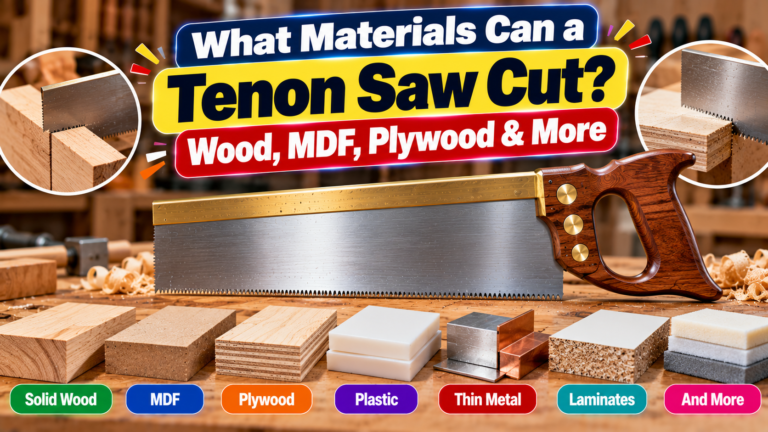
Can a tenon saw cut plywood?
Yes, especially for small accurate crosscuts.
However, plywood can splinter, so use an appropriately fine tooth pattern and support the workpiece well.
Can a tenon saw cut MDF?
Yes.
It can cut MDF, although MDF is abrasive and can dull cutting edges relatively quickly.
A dust mask or suitable respiratory protection is also important when cutting MDF because its fine dust should not be inhaled.
What is the difference between a tenon saw and a hand saw?
A tenon saw has a reinforced back and a relatively fine, stiff blade intended for precision joinery.
A standard handsaw has no rigid back and can make much deeper cuts in larger boards.
What is the difference between a tenon saw and a dovetail saw?
A tenon saw is generally larger and better suited to more substantial joinery.
A dovetail saw is smaller, lighter, and typically finer toothed for delicate dovetail work.
Is a tenon saw a backsaw?
Yes.
A tenon saw is one specific type of backsaw.
The reinforced spine running along the blade is the defining backsaw feature.
Why does a tenon saw have a brass or steel back?
The rigid spine prevents the thin blade from flexing excessively.
This improves control and helps the saw produce straight, accurate cuts.
Can a beginner use a tenon saw?
Yes.
It is an excellent tool for learning accurate hand sawing and traditional joinery.
Beginners should practice on scrap wood before cutting important project components.
Do you push or pull a tenon saw?
This depends on the saw design and tooth orientation.
Traditional Western tenon saws normally cut on the push stroke, while other saw designs may cut on the pull stroke.
Use the saw according to its intended tooth direction.
Should a tenon saw be used with a bench hook?
It does not have to be, but a bench hook is extremely useful for small crosscuts.
It supports the workpiece, improves control, and keeps the cutting area safely positioned at the edge of the workbench.
Can you sharpen a tenon saw?
Traditional non-hardened saw teeth can usually be resharpened with the correct saw file and technique.
Many modern hardened-tooth saws are not intended to be hand-sharpened.
Why is my tenon saw difficult to start?
Possible causes include dull teeth, excessive downward pressure, an awkward starting angle, or an unsuitable tooth configuration.
Begin with light, short strokes and let the teeth establish a shallow kerf.
Why does my tenon saw keep cutting off the line?
You may be applying sideways pressure, gripping too tightly, or starting the kerf inaccurately.
Check your body alignment and use lighter, smoother strokes.
Is a tenon saw worth buying?
If you do furniture making, joinery, cabinetmaking, or other precision woodworking, yes.
For someone who only performs general construction cuts, a tenon saw may be less essential.
Conclusion
So, what is a tenon saw used for? A tenon saw is primarily used to make accurate straight cuts for woodworking joints, especially the cheeks and shoulders of mortise-and-tenon joints. Its thin blade and rigid reinforced back give it significantly better control than a flexible general-purpose handsaw when precision matters.
It is also useful for trimming small boards and components, cutting half-laps and other joints, making controlled crosscuts, and performing everyday bench work with a bench hook.
The saw’s strength is precision rather than versatility. Its reinforced spine helps it cut straight but prevents deep cuts, and the broad blade is not designed to follow curves.
For traditional furniture making, cabinetmaking, and hand-cut joinery, I consider a tenon saw one of the most useful backsaws to own. A medium-sized model with a comfortable handle and an appropriate tooth pattern can handle a surprisingly wide range of precision woodworking tasks.
The key to getting good results is simple: mark carefully, secure the workpiece, begin with light strokes, stay on the waste side of the line, and let the saw’s sharp teeth do the cutting rather than forcing it. With a little practice, a tenon saw can produce clean, accurate joints that require very little final adjustment.