What Table Saw Blade Is Best for Cutting Tenons? Full Guide
If you are wondering what table saw blade is best for cutting tenons, a sharp 24- to 30-tooth flat-top-grind (FTG) rip blade is usually the best dedicated blade for cutting tenon cheeks vertically with a tenoning jig. A full-kerf blade is especially useful when your table saw has enough power because its stiffer plate can reduce deflection and help produce straighter, more consistent cheeks. If you want one blade for both tenon work and general woodworking, a quality 40-tooth general-purpose or 40- to 50-tooth combination blade is a more versatile choice.
There is another important option: a stacked dado set. If you lay the workpiece flat and remove the cheek waste with repeated passes, a dado stack can cut tenons quickly without a dedicated tenoning jig. This approach is popular for repeated furniture joinery, although the final cheek surface depends on the quality and tooth geometry of the dado set.
The best blade therefore depends on how you intend to form the tenon. A vertical tenoning jig, horizontal dado method, and shoulder-cutting setup all place different demands on a table saw blade.
In this guide, I’ll explain the best table saw blades for cutting tenons, why tooth count and tooth grind matter, when to choose a flat-top rip blade instead of a combination blade, whether a dado stack is better, how full-kerf and thin-kerf blades compare, and how to get accurate tenons safely.
What Table Saw Blade Is Best for Cutting Tenons?
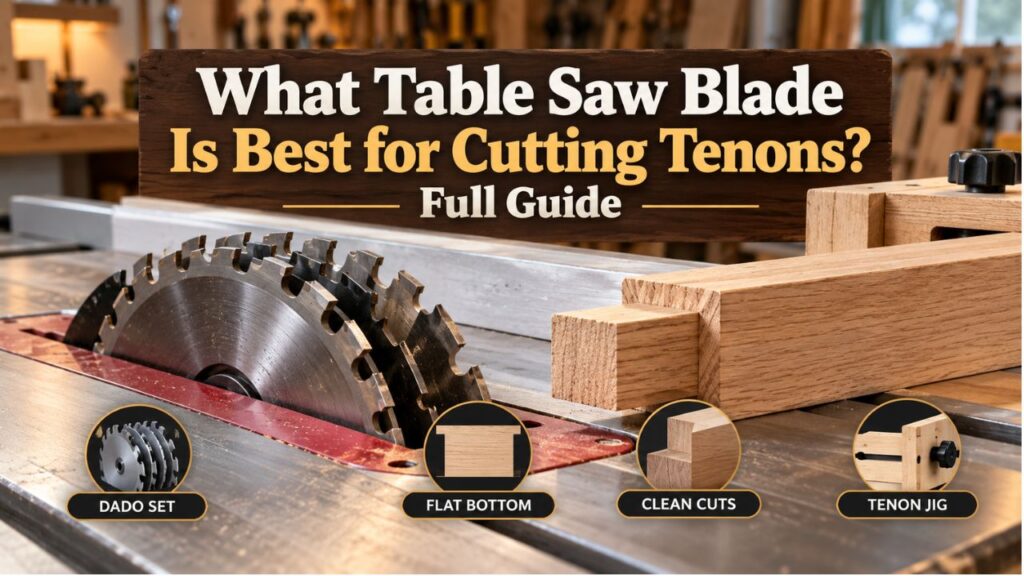
For a dedicated tenoning setup, my first choice is a 10-inch, 24- to 30-tooth FTG rip blade, preferably full kerf if your table saw is powerful enough to run one comfortably.
That recommendation applies primarily when the workpiece is held vertically in a tenoning jig and the blade cuts the cheeks of the tenon.
Why this configuration?
Tenon cheeks are essentially short rip cuts because the blade is cutting generally with the direction of the wood fibers. Rip blades are specifically designed for that task.
The relatively low tooth count provides large gullets that clear chips efficiently. The flat-top teeth cut fibers with a chisel-like action, and the simple tooth profile can be useful for joinery where a flat kerf matters.
A full-kerf blade adds stiffness, which can be beneficial when a tall workpiece is passed vertically through the blade. Blade deflection can produce a tapered tenon, where the cheek is not perfectly parallel from shoulder to tip.
However, this does not mean every woodworker needs to buy a specialized rip blade solely for tenons.
A good 40-tooth general-purpose ATB blade or 40- to 50-tooth combination blade can cut excellent tenons and may be the more sensible choice if you make joinery only occasionally.
Here is the practical comparison:
| Blade Type | Best Tenon Use | Main Advantage | Main Limitation |
| 24–30T FTG rip blade | Vertical cheek cuts | Fast, efficient, stiff cutting | Crosscut shoulders may be rougher |
| 40T general-purpose blade | Cheeks and shoulders | Excellent all-around versatility | Less specialized for ripping |
| 40–50T combination blade | General tenon cutting | Handles rip and crosscut work | Compromise compared with dedicated blades |
| 60–80T crosscut blade | Shoulder cuts | Very clean cross-grain surface | Poor choice for deep cheek ripping |
| Stacked dado set | Horizontal cheek removal | Fast, repeatable waste removal | May leave ridges depending on set and technique |
For someone building furniture regularly, I would own both a good rip blade and a general-purpose or crosscut blade.
For a beginner who wants only one blade, a high-quality 40-tooth general-purpose blade is the easier recommendation.
Key Takeaways:
• A 24- to 30-tooth FTG rip blade is my preferred dedicated blade for vertical tenon cheek cuts.
• A 40-tooth general-purpose blade is better if you want one blade for multiple woodworking operations.
• A stacked dado set is excellent when cutting tenons with the workpiece lying flat.
Why a Flat-Top Grind Blade Works Well for Tenons
To understand blade choice, it helps to understand tooth geometry.
FTG stands for Flat Top Grind.
Every carbide tooth has a square top rather than alternating bevels.
This tooth shape behaves somewhat like a tiny chisel as it passes through the wood.
FTG blades are commonly used for ripping solid lumber because they clear long wood fibers efficiently and typically have relatively large spaces between teeth.
A typical 10-inch FTG rip blade may have around 24 teeth.
Why FTG Matters for Joinery
Joinery cuts sometimes benefit from a tooth profile that leaves the bottom of the kerf relatively flat.
An FTG blade does exactly that.
By comparison, an ATB blade has teeth that alternate between left and right bevels. This geometry is excellent for slicing cleanly across wood fibers, but the bottom of a non-through kerf can contain tiny peaks rather than being completely flat.
For vertical tenon-cheek cuts, the bottom-of-kerf issue is less significant because you are usually cutting completely through the waste beside the cheek.
However, the FTG geometry still makes sense because the cut follows the grain.
Is a 24-Tooth Blade Too Rough for Tenons?
Not necessarily.
Low tooth count is sometimes associated with rough construction cuts, but tooth count alone does not determine cut quality.
Blade quality, sharpness, plate stability, carbide geometry, saw alignment, feed rate, wood species, and jig accuracy all matter.
A good 24- or 30-tooth woodworking rip blade can produce very clean cheek surfaces.
A cheap or dull 24-tooth blade may leave noticeably more saw marks.
For glued mortise-and-tenon joints, the objective is a flat, accurately sized cheek that fits the mortise properly. An extremely polished surface is not necessary, but obvious ridges, taper, burning, or deep tooth marks should be corrected.
Is a 40-Tooth Combination Blade Good for Cutting Tenons?
Yes. In fact, a quality 40-tooth general-purpose blade is probably the best choice for many home woodworkers.
A typical 40-tooth ATB blade provides a good balance between ripping and crosscutting.
It can make the vertical cheek cuts with a tenoning jig and then handle shoulder cuts across the grain without forcing you to change blades.
That convenience matters when you make tenons only occasionally.
A combination blade may use a somewhat different tooth pattern. Traditional combination designs often group alternating-top-bevel teeth with a flat raker tooth and a larger gullet.
The result is a blade intended to perform both ripping and crosscutting reasonably well.
When I Would Choose the 40-Tooth Blade
I would choose it when:
You are making only a few tenons.
You do not want to change blades repeatedly.
You use the table saw for a wide range of furniture work.
Your tenons are in moderate-thickness stock.
You value a cleaner shoulder cut as much as maximum ripping efficiency.
For a hobby woodworking shop, this is often the most practical answer.
When I Would Choose the 24-Tooth FTG Instead
I would switch to a dedicated rip blade when cutting a large number of tenons, particularly in thicker hardwood.
The larger gullets clear waste more effectively, and the blade places less unnecessary tooth contact in the cut.
A dedicated rip blade can also reduce burning during cheek cuts when everything is properly aligned.
What Blade Is Best for Cutting Tenon Shoulders?
Tenon shoulders are a different cutting operation from cheeks.
The shoulder normally runs across the grain.
That means a 40- to 60-tooth ATB or general-purpose blade is often a better choice for a clean shoulder than a coarse 24-tooth rip blade.
ATB stands for Alternate Top Bevel.
One tooth is beveled in one direction, and the next is beveled in the opposite direction. This creates a slicing action across wood fibers and generally leaves a cleaner crosscut.
A clean shoulder matters because it often determines how neatly the joint closes.
Even if the tenon cheeks fit perfectly, a damaged or uneven shoulder can create a visible gap between the two pieces.
Do You Need Separate Blades for Cheeks and Shoulders?
No.
You can successfully cut the entire tenon with one quality general-purpose blade.
Changing from a rip blade for the cheeks to an ATB blade for the shoulders simply optimizes each operation.
If I were producing a large furniture project with many identical tenons and wanted maximum control, I might use dedicated blades.
For a normal home shop, changing blades for every tenon is rarely necessary.
Is a Dado Blade Better for Cutting Tenons?
A stacked dado set can be one of the fastest and easiest ways to make tenons on a table saw.
Instead of holding the workpiece vertically in a tenoning jig, you typically lay it flat and remove the waste around the tenon using repeated passes over the dado stack.
This approach has several advantages.
The workpiece remains supported by the table.
You do not need to balance a long component vertically.
A relatively wide dado stack removes cheek waste quickly.
Once the setup is correct, multiple identical tenons can be produced efficiently.
How a Stacked Dado Set Works
A stacked dado set normally consists of two outer blades with chipper cutters placed between them.
By changing the number and arrangement of chippers and shims, you can alter the overall cutting width.
For tenon work, you do not necessarily need the dado set adjusted to the full width of the cheek.
You can use a narrower configuration and remove the waste with overlapping passes.
This can make fine adjustment easier.
Does a Dado Stack Leave Flat Tenon Cheeks?
A quality dado stack can produce a good surface, but not every set leaves a perfectly smooth cheek.
Some dado sets can leave slight ridges or grooves as you make overlapping passes.
These marks may need light cleanup with a shoulder plane, router plane, chisel, or another appropriate hand tool.
A tenoning jig using an ordinary saw blade can produce exceptionally smooth vertical cheek cuts because the side of the blade forms the cheek in a single pass.
Which Method Do I Recommend?
For short and medium-length furniture parts, either method can work extremely well.
If you already own a good dado set, the horizontal method is fast and convenient.
If you want particularly smooth cheeks or do not own a dado set, a properly designed tenoning jig and ordinary table saw blade are excellent.
For long rails, such as bed rails, holding the work vertically on a table saw can become awkward and potentially unsafe. A bandsaw, router, or another method may be better.
Key Takeaways:
• A dado set makes tenon production fast and keeps the workpiece supported horizontally.
• A tenoning jig with a standard blade can leave exceptionally smooth cheeks.
• Long or awkward workpieces may be better handled with a bandsaw, router, or another tenoning method.
Full-Kerf vs. Thin-Kerf Blade for Cutting Tenons
Kerf is the width of material removed by the blade.
A thin-kerf blade removes less wood and generally requires less motor power.
A full-kerf blade is thicker and normally has a more substantial blade plate.
Both can cut tenons.
However, I generally prefer a quality full-kerf blade for vertical tenoning when the saw has enough power.
Why Full Kerf Can Be Better
Blade stiffness matters when producing precise tenon cheeks.
If the blade deflects sideways under load, the cheek can become tapered.
Instead of maintaining the same thickness from shoulder to tip, the tenon might gradually become thinner or thicker.
A heavier full-kerf blade generally has greater resistance to this kind of lateral deflection.
This becomes particularly useful when making relatively tall vertical cheek cuts.
When Thin Kerf Makes Sense
A thin-kerf blade is useful on lower-powered portable or contractor-style saws.
Because it removes less material, the motor has less work to do.
A good modern thin-kerf blade can still produce excellent joinery.
I would not automatically replace a high-quality thin-kerf blade if it already cuts accurately.
If you experience tapered cheeks, investigate the whole setup before blaming the blade.
Check:
Blade-to-table alignment
Blade squareness
Tenoning jig alignment
Workpiece clamping
Fence or jig deflection
Blade sharpness
Feed pressure
Only after those items are correct would I seriously consider whether blade flex is causing the taper.
Check Your Riving Knife Compatibility
For ordinary through cuts, the blade kerf and plate thickness must be compatible with the table saw’s riving knife.
Do not casually switch between substantially different blade kerfs without confirming compatibility.
For non-through joinery operations where the guard or riving knife must be removed according to the saw’s instructions, reinstall the required safety equipment immediately after the operation.
Follow the table saw manufacturer’s instructions rather than improvising around the safety system.
How Many Teeth Should a Table Saw Blade Have for Tenons?
There is no single perfect tooth count because the cheeks and shoulders involve different cutting directions.
For dedicated cheek cutting, 24–30 teeth is a very useful range.
For a versatile tenoning and general woodworking blade, around 40 teeth is excellent.
Traditional combination blades may have approximately 40–50 teeth.
For extremely clean crosscut shoulders, 50–60 or more teeth can be appropriate, although very high tooth counts are unnecessary for ripping the cheeks.
Think of tooth count this way:
Fewer teeth generally mean larger gullets and more efficient chip removal.
More teeth generally mean smaller bites and smoother crosscuts.
That is why simply buying the blade with the highest tooth count is not the solution.
A 24-tooth rip blade can outperform an 80-tooth finishing blade dramatically when cutting a deep tenon cheek with the grain.
Why an 80-Tooth Blade Is Usually Not the Best Tenon Blade
An 80-tooth blade sounds precise because it is associated with fine cutting.
For crosscutting veneered plywood, molding, and other finish material, a high-tooth-count blade can be excellent.
Tenon cheeks are different.
When ripping thicker solid wood, too many teeth remain in contact with the material at once.
Chip space is reduced, heat can build more quickly, and the blade may cut less efficiently.
That can contribute to burning and excessive feed resistance.
An 80-tooth blade may make a beautiful tenon shoulder, but I would not choose it as my primary blade for vertical cheek cuts.
Why a Tenoning Jig Changes the Blade Choice
A table saw tenoning jig holds the workpiece vertically as it passes beside the blade.
Instead of removing the entire cheek surface horizontally, you make one vertical cut defining each cheek.
This produces a very efficient cut.
A well-designed jig should keep the workpiece rigid, square to the table, and safely controlled throughout the cut.
Because the blade forms the entire cheek surface in one pass, blade stability and alignment become especially important.
A full-kerf 24- to 30-tooth rip blade is an excellent match.
A 40-tooth combination blade is also highly capable when you want smoother cross-grain performance and less blade changing.
Make Test Cuts First
Do not attempt to achieve the final tenon thickness solely by measuring the jig position.
Use scrap milled to exactly the same thickness as your actual workpiece.
Make a test cheek cut, flip or reposition the work according to your jig method, and test the tenon in the mortise.
Adjust gradually.
The ideal mortise-and-tenon fit should normally slide together with firm hand pressure rather than requiring hammering.
A tenon that has to be aggressively forced into the mortise can split the surrounding wood when glue causes additional swelling.
Blade Quality Matters More Than a Small Tooth-Count Difference
Woodworkers sometimes spend too much time debating whether 24, 30, or 40 teeth are perfect while ignoring blade quality.
A sharp, accurately manufactured 30-tooth blade can easily outperform a dull or poorly made 24-tooth blade.
Important blade characteristics include carbide quality, plate flatness, tensioning, tooth consistency, brazing quality, and sharpening.
A dirty blade can also perform surprisingly poorly.
Pitch and resin buildup increase friction, encourage burning, and can make a sharp blade behave as though it is dull.
If tenon cheeks suddenly become rougher than they used to be, inspect and clean the blade before replacing it.
How to Get Cleaner Tenons With a Table Saw
Blade selection matters, but setup matters just as much.
First, make sure the blade is square to the table when the tenon requires square cheeks.
Do not rely blindly on the saw’s 0-degree stop. Verify the setting with an accurate square or another suitable measuring tool.
Next, check the tenoning jig.
Its work-supporting surface must be square to the saw table. The workpiece should sit flat against the jig and be clamped securely.
If the stock tilts while entering the blade, even the best table saw blade will produce a tapered tenon.
Sharp layout lines also help.
A marking gauge can establish cheek lines consistently, while a marking knife or sharp pencil can define shoulders.
For repeated joints, mill all mating parts to consistent dimensions before setting up the saw.
This makes one setup usable across the entire project.
Pro Tip: Cut the test tenon slightly oversized and sneak up on the final fit. Removing another few thousandths of an inch is easy; adding wood back to an undersized tenon is not.
Should Tenon Cheeks Be Perfectly Smooth?
They should be flat and reasonably smooth, but a mirror-polished surface is not necessary.
The more important goal is accurate contact between the tenon and mortise.
Deep ridges are undesirable because they reduce consistent mating contact.
Heavy burning is also a warning sign that something about blade sharpness, alignment, or feed speed needs attention.
Tiny normal saw marks are generally less concerning.
Avoid aggressively sanding the cheeks simply to make them visually smooth.
Sanding can round edges and unintentionally create a loose joint.
If a cheek requires minor correction, a shoulder plane or other controlled joinery tool often provides better dimensional accuracy.
Common Blade Mistakes When Cutting Tenons
One common mistake is choosing a high-tooth-count finishing blade simply because it produces clean crosscuts.
That does not mean it is optimized for ripping tenon cheeks.
Another is using a dull blade and compensating by pushing the stock harder. Excessive feed pressure reduces control and can increase blade deflection.
A third mistake is blaming the blade for tapered tenons before checking jig alignment.
Even a perfectly rigid blade cannot compensate for a workpiece tilted relative to the table.
Do not assume a dado stack automatically produces flawless glue-ready cheeks either. Inspect the surface and make minor cleanup cuts if necessary.
Finally, never install a blade or dado stack that your particular saw is not designed to accept.
Table Saw Safety When Cutting Tenons
Tenoning is a precision operation, but it still involves an exposed, rapidly rotating table saw blade.
Disconnect the saw from power before changing blades, dado stacks, throat plates, or making adjustments that place your hands near the blade.
Use a properly designed tenoning jig when cutting work vertically.
Do not try to balance a narrow board upright with your hands and feed it past the blade without suitable support.
The workpiece must be securely controlled.
For shoulder cuts made with a miter gauge or crosscut sled, avoid trapping a loose cutoff between the blade and rip fence.
If you use the rip fence to establish repeated lengths, use a properly positioned stop block that ends before the workpiece reaches the blade so the cutoff is not pinched.
Use zero-clearance or dado throat plates when appropriate and approved for the operation.
Keep hands out of the blade path and use the guard, riving knife, push devices, and other table saw safety equipment whenever the operation permits and according to the saw manufacturer’s instructions.
Wear eye and hearing protection.
Most importantly, if a workpiece is too long, tall, heavy, or awkward to control safely in a tenoning jig, choose a different method.
A router or bandsaw is often a better choice for large furniture rails than attempting to balance several feet of stock vertically over a table saw.
Key Takeaways:
• Accurate tenons require a square blade, square jig, securely clamped workpiece, and sharp blade.
• Never hold a workpiece vertically freehand beside the table saw blade.
• Long or awkward stock should be cut using a safer method rather than forcing it through a tenoning jig.
Should You Use a Table Saw, Bandsaw, or Router for Tenons?
The table saw is excellent for repeatable tenons on manageable workpieces.
A bandsaw is useful when the workpiece is long because you can keep the rail horizontal rather than standing it on end.
The resulting cheek may show slight blade marks and sometimes needs cleanup.
A router can also produce very accurate tenons.
Using an appropriate jig or guide, you can remove cheek waste while the workpiece remains securely supported on a bench.
For extremely large structural tenons, handheld routing or specialized machinery may be much safer than a conventional table saw tenoning jig.
There is no rule that every mortise-and-tenon joint must be produced using one specific machine.
Choose the method that provides both accuracy and safe control of the particular workpiece.
My Recommended Blade Setup for Cutting Tenons
If I were setting up a woodworking table saw specifically for traditional tenons, I would choose a high-quality 24- to 30-tooth full-kerf FTG rip blade for the vertical cheek cuts.
For the shoulders, I would either leave a good general-purpose blade installed for the entire process or change to a 40- to 60-tooth ATB blade when exceptionally clean crosscuts matter.
If I wanted only one blade for everything, I would choose a quality 40-tooth general-purpose blade.
If I planned to cut numerous tenons horizontally, I would add a quality stacked dado set compatible with the saw.
That gives three useful configurations:
| Goal | My Choice |
| Best dedicated vertical cheek blade | 24–30T full-kerf FTG rip blade |
| Best single blade for complete tenon work | 40T general-purpose blade |
| Fast repeated horizontal tenons | Quality stacked dado set |
| Extra-clean shoulders | 40–60T ATB crosscut/general-purpose blade |
| Lower-powered saw | Quality thin-kerf blade if compatible |
The important word throughout this table is quality. Tooth count alone does not determine how accurately a blade cuts.
FAQs about What Table Saw Blade Is Best for Cutting Tenons
What tooth blade is best for cutting tenons?
For vertical cheek cutting with a tenoning jig, a 24- to 30-tooth rip blade is an excellent choice. A 40-tooth general-purpose blade is more versatile if you want to cut both cheeks and shoulders without changing blades.
Is a 24-tooth blade good for tenons?
Yes.
A 24-tooth FTG rip blade is particularly effective for cutting tenon cheeks because those cuts run largely with the wood grain.
Use a sharp woodworking-quality blade rather than assuming every inexpensive 24-tooth construction blade will produce furniture-quality results.
Is a 40-tooth blade good for tenons?
Yes. For many woodworkers, a 40-tooth general-purpose blade is the most practical choice.
It can cut smooth cheeks while also producing cleaner cross-grain shoulder cuts than a coarse dedicated rip blade.
Can I cut tenons with a combination blade?
Yes.
A quality 40- to 50-tooth combination blade can produce excellent mortise-and-tenon joinery.
A specialized rip blade may cut cheeks more efficiently, but it is not mandatory.
Is a rip blade better for cutting tenons?
For vertical cheek cuts, generally yes.
The cheek is essentially a rip-oriented cut, and a low-tooth-count rip blade is designed to clear those wood fibers efficiently.
For the shoulder, a crosscut or general-purpose blade may produce a cleaner result.
What does FTG mean on a table saw blade?
FTG means Flat Top Grind.
The cutting edge across each tooth is flat rather than alternately beveled.
This tooth geometry is common on ripping blades and is useful for certain joinery cuts.
Does a flat-top blade make better tenons?
It can be an excellent choice for tenon cheeks because the FTG tooth geometry is optimized for ripping and leaves a flat-bottomed kerf.
However, blade sharpness, stability, and jig alignment are just as important.
Is a dado blade good for cutting tenons?
Yes.
A stacked dado set is one of the fastest ways to form tenons with the workpiece lying flat.
It removes a wide area of cheek waste quickly and makes repeated tenon production convenient.
Is a dado stack better than a tenoning jig?
Neither is universally better.
A dado stack keeps the workpiece horizontal and makes waste removal fast.
A tenoning jig cuts the cheeks vertically with a standard blade and can leave an extremely smooth surface.
Choose according to your equipment, stock size, and preferred workflow.
Should I use a thin-kerf blade for tenons?
You can.
Thin-kerf blades reduce motor load and are particularly useful on lower-powered table saws.
For vertical tenoning, I prefer a full-kerf blade when the saw has enough power because the thicker blade plate can provide additional stiffness.
Why are my table-saw tenons tapered?
Possible causes include blade deflection, a blade that is not square to the table, a tenoning jig that is not square, a workpiece that moves during cutting, or uneven feed pressure.
Check the entire setup before replacing the blade.
Can I use an 80-tooth blade for tenons?
You can use one for clean shoulder cuts, but I would not select an 80-tooth finish blade for most tenon cheeks.
The high tooth count is inefficient for deeper ripping cuts in solid wood.
What blade makes the cleanest tenon shoulders?
A sharp 40- to 60-tooth ATB or quality general-purpose blade normally gives cleaner cross-grain shoulder cuts than a coarse FTG ripping blade.
Can I cut a tenon without a dado blade?
Absolutely.
A tenoning jig allows you to cut the cheeks vertically using an ordinary table saw blade.
You can also make tenons with a bandsaw, router, or hand tools.
Can I cut a tenon without a tenoning jig?
Yes.
A stacked dado set lets you lay the workpiece flat and remove the cheek waste using repeated passes.
A bandsaw and router are additional alternatives.
How tight should a tenon fit?
A properly sized tenon should generally enter the mortise with firm hand pressure.
It should not fall loosely into the mortise, but it should not require severe hammering either.
Always make test joints using scrap milled to the same dimensions before cutting your actual project components.
Should I sand table-saw tenon cheeks?
Only when necessary.
Heavy sanding can round or taper the cheek and make the joint loose.
If the tenon requires precise adjustment, a shoulder plane or another controlled joinery tool is often a better choice.
Can I cut long tenons on a table saw?
Blade height limits the maximum tenon length when using a vertical tenoning jig.
Long workpieces can also become difficult to control safely when stood upright.
For long rails or oversized parts, a bandsaw or router may be a better option.
Conclusion
So, what table saw blade is best for cutting tenons? For dedicated vertical cheek cutting with a tenoning jig, my preferred choice is a sharp 24- to 30-tooth flat-top-grind rip blade, ideally full kerf when your table saw has sufficient power.
That combination suits the ripping direction of tenon cheeks, clears waste efficiently, and provides the blade stiffness needed for accurate joinery.
If you want one blade that can remain on the saw for cheeks, shoulders, ripping, and general furniture work, a quality 40-tooth general-purpose blade is the better all-around choice. It sacrifices a little specialization but gains considerable versatility.
For horizontal tenon cutting, a stacked dado set is another excellent option. It keeps the workpiece supported by the saw table and quickly removes the cheek waste, making it particularly convenient when you have multiple identical joints to produce.
I would not choose an 80-tooth finishing blade merely because it has more teeth. High tooth counts are excellent for clean crosscuts, but tenon cheeks are fundamentally rip-oriented cuts and benefit from a blade designed to clear wood fibers efficiently.
Whichever blade you choose, remember that blade selection is only part of accurate tenoning. A square blade, accurately aligned jig, securely held workpiece, sharp carbide, and careful test cuts matter just as much.
For most dedicated furniture joinery, 24–30T FTG for the cheeks, a clean general-purpose or crosscut blade for the shoulders, and a stacked dado set when speed and horizontal support are priorities is the combination I would choose.