How to Correct the Set on a Back Saw: Step-by-Step Guide
If you want to know how to correct the set on a back saw, first make test cuts to determine whether the saw has too much set, too little set, or unequal set from side to side. Then use a properly adjusted saw set to add missing set, or lightly stone the side of the teeth to reduce excessive or uneven set. Make very small corrections and test the saw after each adjustment because fine backsaws often require only a few thousandths of an inch of tooth set.
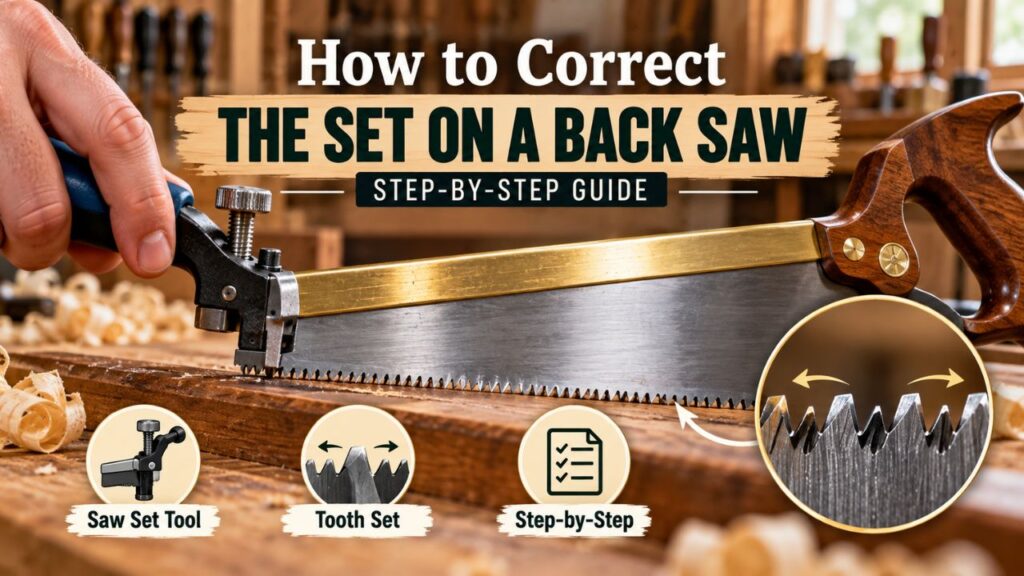
The “set” of a saw refers to the slight alternating bend of the teeth to the left and right of the saw plate. This creates a kerf slightly wider than the blade itself, providing clearance so the plate can move through the cut without binding.
Back saws—including tenon saws, carcass saws, dovetail saws, and sash saws—typically need much less set than coarse construction saws. Too much set makes the saw cut a wide kerf, requires additional effort, and can reduce precision. Too little set can cause the blade to bind. Unequal set often makes the saw consistently steer to one side.
Correcting the set is therefore not about bending every tooth as far as possible. The goal is to achieve the minimum even set that allows the particular saw to cut freely and track straight in the wood you normally use.
In this guide, I’ll explain how to diagnose incorrect set, how to add or reduce set, how to correct a back saw that pulls left or right, how to use a saw set and sharpening stone correctly, and how to test your adjustments without damaging fine saw teeth.
How to Correct the Set on a Back Saw
Start by identifying what is actually wrong with the saw.
Do not reach for a saw set simply because the saw is cutting poorly. Problems with sharpening, tooth geometry, blade straightness, technique, or the workpiece can sometimes resemble problems caused by incorrect set.
Make several controlled test cuts in straight, reasonably dry scrap wood. Ideally, use the same species or type of wood you normally cut with the saw.
Let the saw track naturally. Do not deliberately steer it back toward your layout line.
Observe what happens.
If the saw moves smoothly and the blade has slight clearance in the kerf, the set may already be correct.
If the blade repeatedly binds or becomes increasingly difficult to move as the cut deepens, there may be too little set.
If the kerf feels unnecessarily loose around the blade and the saw removes more material than expected, there may be too much set.
If the saw consistently drifts left or right despite good technique, the set may be unequal.
Quick Diagnosis
| Saw Behavior | Likely Set Problem | Typical Correction |
| Blade binds in kerf | Too little set | Add a very small amount of set |
| Kerf is excessively wide | Too much set | Lightly stone both sides |
| Saw consistently pulls right | Excessive set on right side | Lightly stone right side |
| Saw consistently pulls left | Excessive set on left side | Lightly stone left side |
| Saw alternates or behaves unpredictably | Uneven teeth, sharpening, blade, or technique may be involved | Inspect before changing set |
| Saw cuts freely and straight | Set is probably adequate | Leave it alone |
These are diagnostic clues rather than absolute rules. Before correcting a pull, make multiple test cuts to make sure your sawing technique is not causing the problem.
Key Takeaways:
- Diagnose the saw before changing the teeth.
- Binding generally suggests insufficient set, while an excessively wide kerf suggests too much.
- A saw that repeatedly drifts to one side may have excessive set on that same side.
- Correct set with very small adjustments and test frequently.
What Does “Set” Mean on a Back Saw?
Look directly down the toothline of a traditionally sharpened Western backsaw and you should see the tooth tips alternate slightly from one side of the plate to the other.
One tooth bends left, the next bends right, then left again.
That alternating pattern is the tooth set.
The resulting cut is slightly wider than the thickness of the saw plate. Without that extra clearance, friction between the wood and the sides of the blade could make the saw difficult to move.
Set is therefore necessary on most traditional backsaws, but more is not necessarily better.
Why Fine Back Saws Need Very Little Set
A tenon or dovetail saw is intended to make accurate joinery cuts.
Extra set increases kerf width. A wider kerf means the saw removes more wood on each stroke, which requires more energy and can make it more difficult to work precisely against a layout line.
Fine sawmakers therefore generally use a small amount of set.
Some premium tenon saw manufacturers, for example, specify only around 0.004 inch of set per side on properly tuned models. Smaller dovetail and carcass saws can use even less.
That number should not be treated as a universal setting for every saw. Plate thickness, tooth size, wood species, moisture content, and the intended use all affect the ideal amount.
The important principle is:
Use only enough set to keep the saw plate moving freely in the kerf.
How to Tell if a Back Saw Has Too Much Set
Too much set is one of the easier problems to create when using a saw-setting tool for the first time.
A mechanical saw set can move a tiny tooth farther than expected, especially when its anvil is adjusted for a larger or coarser saw.
When a backsaw has too much set, its kerf becomes considerably wider than its plate.
The saw may feel loose or sloppy inside the cut rather than guided by it. You also have to remove more wood, which can make the saw feel less efficient.
A heavily set saw can sometimes be easier to steer manually, but this is normally not desirable for precise back-saw work.
Check the Kerf
Make a straight cut in scrap wood and stop after the blade has entered deeply enough to judge its movement.
Gently move the saw side to side.
A little clearance is necessary, but the blade should not rattle around in a noticeably oversized kerf.
You can also compare the finished kerf visually with the saw plate.
Do not judge by appearance alone, however. The real test is whether the saw cuts smoothly, without binding, while remaining precise.
How to Reduce Excessive Set on a Back Saw
The usual way to reduce excessive set is light side stoning.
You need a flat, fine abrasive stone. A fine India stone or suitable fine sharpening stone is commonly used.
The objective is to touch only the outermost portions of the set teeth.
You are not sharpening the teeth from the side or trying to grind the blade thinner.
Stone Both Sides for Overall Excessive Set
If the saw tracks straight but simply has too much total set, both sides need a small and approximately equal reduction.
Secure the saw or place it so you can keep the stone flat against the side of the toothline.
Make one very light pass along one side.
Then make one comparable pass along the opposite side.
Clean the blade and make another test cut.
Do not automatically make five or ten passes.
Fine backsaws respond to extremely small adjustments. One pass may produce a noticeable change.
If the kerf remains wider than necessary, repeat with another light pass on each side.
Why You Should Work Slowly
Once you remove metal from the outside tips of set teeth, you cannot put that metal back.
If you remove too much set, you will have to bend the teeth outward again with a saw set.
That creates unnecessary work and increases the possibility of damaging small teeth.
The correct approach is:
Stone lightly, test, then stone again only if necessary.
How to Correct a Back Saw That Pulls to One Side
A saw that consistently tracks left or right often has more effective set on one side than the other.
Suppose you start directly on a line and deliberately allow the saw to run naturally.
If the saw repeatedly moves to the right, the right-side teeth may have too much set.
If it repeatedly moves to the left, the left-side teeth may have too much set.
The usual correction is to lightly stone the side toward which the saw is drifting.
If the Saw Pulls Right
Lightly stone the right side of the teeth.
Make a single controlled pass and make another test cut.
If it still pulls right, repeat cautiously.
If the Saw Pulls Left
Lightly stone the left side of the teeth.
Again, begin with one light pass.
This tiny reduction in the more aggressive side can bring the cutting action back into balance.
Confirm the Problem Before Stoning
A crooked test cut does not automatically mean the set is wrong.
Your grip can easily steer a backsaw.
Before modifying the saw, make several cuts. Try to hold the handle gently and allow the tool to choose its own path.
If every test cut bends in the same direction, the saw deserves closer inspection.
Also check that the saw plate itself is straight and properly aligned in the back.
A twisted blade cannot be corrected merely by stoning the teeth.
Pro Tip: When testing tracking, avoid consciously steering toward a pencil line. Make a free test cut and let the saw reveal its natural tendency. That makes unequal set easier to diagnose.
How to Correct Too Little Set
If the blade binds despite being straight and properly sharpened, the saw may not have enough set for the wood you are cutting.
This is corrected with a saw set.
A saw set is a small mechanical tool that bends individual teeth against an adjustable anvil.
The tool must be appropriate for the tooth size. Large saw sets can have punches or plungers too wide for the fine teeth on a dovetail or fine carcass saw.
Adjust the Saw Set Before Starting
Do not begin on your best backsaw without first understanding the tool.
The adjustment on a saw set controls how far the tooth is bent.
Set it conservatively.
If possible, practice on an old saw or an inconspicuous portion of a suitable test blade before setting a valuable backsaw.
Fine joinery saws require much less tooth movement than coarse hand saws.
Set Every Other Tooth
Clamp the blade securely with the toothline accessible.
Starting at one end, use the saw set on every other tooth.
Work carefully enough that you do not lose the alternating pattern.
After completing that side, turn or reposition the saw and set the remaining teeth in the opposite direction.
The finished pattern should alternate evenly:
left, right, left, right.
Do not bend adjacent teeth in the same direction.
Bend Only the Upper Portion of the Tooth
The tooth should bend near its upper section rather than being distorted from the base of the gullet.
A properly adjusted saw-set anvil controls where that bend occurs.
Trying to bend too much of a small tooth can distort its geometry or break it.
Fine backsaw teeth require particularly delicate handling.
Should You Set the Teeth Before or After Sharpening?
Traditional saw-sharpening sequences vary somewhat among experienced filers, but setting is commonly followed by final sharpening or touch-up because setting can slightly affect tooth geometry.
A complete restoration might involve:
jointing, shaping, setting, and final sharpening.
The final filing ensures that the cutting edges are clean and consistent after the teeth have been bent.
However, if the saw is already sharp and you are only correcting a tiny tracking problem with light side stoning, there is no reason to perform a complete sharpening operation automatically.
Likewise, a saw that already has enough set should not be reset every time it is sharpened.
Some well-tuned backsaws can go through more than one sharpening before the set needs attention.
Key Takeaways:
- Add set only when the blade genuinely lacks enough kerf clearance.
- Fine backsaw teeth need much less bending than coarse hand-saw teeth.
- Set alternating teeth consistently and avoid repeatedly resetting teeth that are already correct.
How Much Set Should a Back Saw Have?
There is no single measurement appropriate for every backsaw.
The ideal set depends on the saw and the material.
Important variables include tooth pitch, saw-plate thickness, whether the saw is rip or crosscut filed, wood hardness, moisture content, and the level of finish expected from the cut.
Dry hardwood usually needs relatively little clearance.
Softer or wetter wood may close against the blade more readily and can benefit from slightly more set.
Use Performance Rather Than a Universal Number
For a fine backsaw, the best practical standard is not “this saw must have exactly X thousandths.”
Instead ask:
Does the saw move freely?
Does it track naturally?
Is the kerf reasonably narrow?
Does it leave a clean surface?
If the answer to all four questions is yes, the set is probably suitable.
Adding more simply because your saw set can produce more would make the saw worse, not better.
How to Check Whether the Set Is Even
A visual inspection is useful before making any adjustment.
Place the saw under strong light and look directly down the toothline.
The teeth should alternate evenly from side to side.
An obviously protruding tooth can sometimes be seen without magnification.
For very fine backsaws, use a magnifier.
Using a Dial Indicator
For extremely precise restoration, a dial indicator can measure tooth protrusion from each side of the saw plate.
This method is useful for professional saw filers, but it is unnecessary for most routine corrections.
A careful visual inspection combined with test cuts usually tells you what you need to know.
Test Cuts Are the Final Measurement
Even perfectly matching measured set does not guarantee that the saw will feel right in actual wood.
Sharpening differences can influence how strongly individual teeth cut.
The most meaningful test is therefore how the saw behaves in the material for which it is intended.
How to Stone the Teeth Without Ruining the Saw
Side stoning sounds aggressive, but correctly done it is extremely subtle.
Use a fine stone and keep it flat against the side of the toothline.
Do not angle the stone toward the cutting points.
The objective is to remove the tiniest amount of steel from the teeth that project beyond the saw plate.
One smooth pass along the entire affected side may be enough.
Then make another test cut.
Avoid Heavy Pressure
Heavy stoning can blunt the tooth points and drastically reduce the set.
A fine backsaw may have only a few thousandths of an inch of clearance.
That means even a small amount of material removal matters.
Let the abrasive do the work.
If you find yourself pressing hard, stop and reconsider your technique.
Correcting One Tooth With Too Much Set
Sometimes the entire saw is fine except for one tooth that sticks noticeably farther sideways.
This can happen after careless setting or accidental damage.
Do not necessarily stone the entire side of the saw to correct one tooth.
First identify the offending tooth under magnification.
If it is only slightly over-set, localized, extremely careful stoning may bring it back in line.
In other cases, a skilled saw filer may carefully adjust the individual tooth.
The risk with repeatedly bending one tiny hardened steel tooth is breakage.
For an expensive fine backsaw, I would be conservative. A single damaged tooth can usually be managed, while a broken tooth creates a more complicated restoration.
Can You Bend an Over-Set Tooth Back the Other Way?
Technically, a tooth can sometimes be adjusted, but repeatedly bending hardened saw steel back and forth is not ideal.
Every bending cycle places stress on the tooth.
Small backsaw teeth are particularly easy to break.
For slight excessive set, stoning is normally the safer correction because it reduces the outward projection without reversing the bend.
If the set is severely wrong because the teeth were bent dramatically during an unsuccessful restoration, the saw may need comprehensive reworking rather than individual back-bending.
Why Does a Back Saw Need Less Set Than a Regular Hand Saw?
Back saws are precision tools.
Their thin plates, fine teeth, and rigid spines are designed for controlled joinery cuts rather than quickly ripping rough construction lumber.
A narrow kerf is part of that precision.
Large hand saws used in softer, wetter, or rougher timber sometimes benefit from more set because the material can close around the blade and create friction.
A dovetail or tenon saw used in dry cabinetmaking stock faces a different environment.
The least practical set generally provides the cleanest and most efficient cut.
That is why transferring the setting you use on a coarse carpenter’s saw directly to a fine backsaw can result in excessive kerf width.
Does Rip vs Crosscut Filing Change the Set?
Both rip and crosscut backsaws normally use alternating set, but the required amount can differ depending on the saw’s purpose and tooth geometry.
Set and sharpening geometry should be considered separately.
Rake controls how aggressively the tooth approaches the wood.
Fleam creates the bevel used particularly on crosscut teeth.
Set determines how far alternating tooth tips project sideways.
Changing the rake or fleam does not automatically correct incorrect set.
Likewise, setting the teeth cannot fix badly filed rake or inconsistent crosscut bevels.
If the saw performs poorly after a full sharpening, inspect all of these factors rather than assuming the set is responsible.
Why a Saw Can Still Drift After You Correct the Set
If careful stoning does not cure a persistent pull, stop removing metal.
The problem may not be the set.
Possible causes include a twisted or bowed blade, inconsistent tooth height, unequal crosscut fleam, uneven rake, improperly jointed teeth, or misalignment between the blade and the back.
User technique can also cause surprisingly consistent drift.
For example, twisting the wrist slightly on every push stroke may make a perfectly tuned saw wander.
Check the Saw Plate
Sight down the blade.
The plate should appear straight and properly aligned.
On a backed saw, the rigid spine can sometimes hold a distorted plate in a way that creates unusual tracking.
Correcting blade alignment is a different procedure from correcting tooth set.
Do not keep stoning one side in an attempt to compensate for a physically twisted saw.
What Happens if You Remove Too Much Set?
The saw may begin to bind.
You might notice that it starts a cut normally but becomes increasingly difficult to move as more blade enters the kerf.
The sides of the saw plate may show rubbing marks.
In extreme cases, the blade can become pinched in the work.
The solution is to reintroduce a small, controlled amount of set with a correctly adjusted saw-setting tool.
Do not overcompensate.
Add a little and test again.
This gradual process is slower than making a large adjustment once, but it protects the saw and usually produces a better final result.
What Happens if You Add Too Much Set?
The saw produces a wider kerf than necessary.
It removes extra wood and therefore requires additional work from every stroke.
The cut surface may become rougher, and the saw can feel less precise in joinery.
Too much set can also exaggerate the effect of any imbalance between the two sides.
Fortunately, mild excessive set is usually easy to reduce with careful stoning.
The key is stopping before you remove too much.
Common Mistakes When Correcting Back Saw Set
The most common mistake is changing the set before diagnosing the saw.
A dull backsaw does not need more set simply because it feels harder to push. Sharpening may be the real solution.
Another mistake is using a saw setter adjusted for much larger teeth. This can bend fine teeth excessively or damage them.
Over-stoning is equally common. The correct amount of side dressing can be surprisingly small.
A third mistake is trying to correct a crooked cut after making only one test. Your hand may have steered the saw.
Make several test cuts before modifying a well-made backsaw.
Finally, do not repeatedly bend the same teeth in opposite directions. Fine saw steel can fatigue or fracture.
Key Takeaways:
- Do not use set to compensate for dull, uneven, or incorrectly sharpened teeth.
- One or two light stoning passes can make a significant difference on a fine backsaw.
- Persistent drift after careful set correction may indicate blade or sharpening problems instead.
How to Test the Set After Correction
Use clean scrap wood and make a reasonably deep cut.
Start gently and allow the saw to establish its own kerf.
Once it is cutting, use a relaxed grip and full controlled strokes.
The saw should move freely without feeling loose.
Do not intentionally steer it.
If the kerf remains straight through the depth of the cut, the side-to-side balance is probably good.
Then examine the offcut. A noticeably curved cut surface can reveal a tracking tendency more clearly than looking only at the line on top of the board.
Repeat the test before making another adjustment.
For a fine saw, the difference between “still slightly off” and “perfectly balanced” can be one very light pass with a stone.
How Often Should You Reset a Back Saw?
Not at every sharpening.
Setting bends the teeth physically, so there is no reason to repeat it when the teeth already have adequate and balanced clearance.
A lightly used backsaw may need several sharpening touch-ups before the set requires correction.
Evaluate the saw based on performance.
If it tracks straight, moves easily, and produces an appropriately narrow kerf, leave the set alone.
This is one area of tool maintenance where doing less can preserve the saw better.
When Should You Have the Set Corrected Professionally?
Correcting mild drift or slightly excessive set is within the reach of a careful woodworker.
A complete restoration is different.
Professional sharpening may be worthwhile when the saw has severely irregular teeth, extensive missing or broken teeth, badly distorted set, a bent plate, inconsistent tooth spacing, or complex fine crosscut filing.
A valuable vintage backsaw is another good candidate for professional service if you are learning.
Once a skilled filer has established a clean toothline, maintaining the saw yourself becomes much easier.
FAQs about How to Correct the Set on a Back Saw
How do I know if my back saw has too much set?
Make a test cut.
If the kerf is noticeably wider than necessary and the blade feels loose from side to side, the saw may have excessive set.
Lightly stoning both sides can reduce it.
How do I know if my back saw needs more set?
The main symptom is binding even though the saw is sharp, straight, and otherwise correctly tuned.
The blade may rub heavily against the sides of the kerf as the cut becomes deeper.
Why does my back saw pull to the right?
If repeated neutral test cuts consistently drift right, the teeth on the right side may have excessive effective set.
One very light stoning pass on the right side followed by another test cut can help correct it.
Why does my back saw pull to the left?
A consistent leftward drift can indicate more effective set on the left.
Lightly stone the left side and retest.
Make sure the blade is straight and your technique is not causing the drift before modifying the teeth.
What tool is used to set saw teeth?
A saw set is the traditional tool.
It uses a punch or plunger and an anvil to bend individual teeth a controlled distance to alternating sides.
Can I set a backsaw with pliers?
I would avoid ordinary pliers.
They provide poor control over the bending point and amount of set and can easily damage small teeth.
A saw set designed for the tooth pitch is much more predictable.
Do I need to set the teeth every time I sharpen my backsaw?
No.
Resetting should be done only when the existing set is inadequate or uneven.
Unnecessary repeated setting can over-bend or eventually damage the teeth.
How much set should a tenon saw have?
Fine tenon saws require only a small amount. Some premium manufacturers use approximately 0.004 inch per side, but this should not be treated as a universal specification.
Use the sawmaker’s specification when available and aim for the minimum clearance required to prevent binding.
How much set should a dovetail saw have?
Dovetail saws generally use extremely little set. Some high-quality examples are around 0.003 inch per side.
Actual requirements vary with plate thickness, tooth geometry, and intended wood.
What stone should I use to reduce saw set?
A fine flat sharpening stone, such as a suitable India stone, can be used for light side dressing.
The stone should remain flat against the side of the toothline, and pressure should be very light.
Can stoning make a saw dull?
Yes, if done aggressively or at the wrong angle.
Correct side stoning should barely touch the outside projection of the set teeth.
Heavy stoning can reduce set too far or damage the cutting points.
Should a backsaw have equal set on both sides?
For normal straight cutting, the effective set should be balanced enough that the saw naturally tracks straight.
Tiny measured differences matter less than how the saw actually performs in wood.
Can incorrect sharpening make a saw pull sideways?
Yes.
Unequal rake, fleam, tooth height, or sharpening pressure can create an imbalance even when the physical set looks similar on both sides.
Do not assume all tracking problems come from tooth set.
Can I correct one over-set tooth?
A slightly over-set individual tooth can sometimes be corrected carefully, but repeated bending risks breaking it.
Localized light stoning may be safer for a small error.
Should I correct set before sharpening?
For a full restoration, teeth are often shaped and set before final sharpening so the final filing cleans and refines the cutting geometry.
For a minor tracking correction on an otherwise sharp saw, light side stoning alone may be sufficient.
Can a saw have almost no set?
Yes. Very thin, well-tuned backsaws used in dry hardwood may require remarkably little set.
However, some clearance is generally necessary unless the plate and saw design allow otherwise.
Conclusion
Learning how to correct the set on a back saw begins with diagnosis, not with immediately bending the teeth. The correct amount of set is simply enough to let the blade move freely through the kerf while preserving a narrow, accurate cut.
If the blade binds, it may need a small amount of additional set applied evenly with an appropriately adjusted saw-setting tool. If the kerf is unnecessarily wide, light stoning on both sides can reduce excessive set.
When the saw consistently pulls to one side, make several neutral test cuts first. If it repeatedly drifts right, lightly stone the right side; if it repeatedly drifts left, lightly stone the left. One light pass followed by another test is far safer than making a large correction all at once.
For a fine backsaw, I recommend following one principle above all others: use the least set necessary for the saw to cut freely and track straight. Excessive set removes more wood and reduces precision, while insufficient set causes friction and binding.
Also remember that tooth set is only one part of saw tuning. A crooked or poorly performing saw can be affected by sharpening, rake, fleam, unequal tooth height, blade straightness, or technique. If careful set correction does not solve the problem, investigate those areas before removing more metal.
A properly set backsaw should feel controlled rather than loose, move freely rather than bind, and naturally follow a straight kerf. Once you achieve that balance, stop adjusting it—the smallest corrections are usually the best ones.