Do I Need an Electric Saw to Install Laminate Flooring?
No, you do not necessarily need an electric saw to install laminate flooring. Many laminate floors can be installed with a manual laminate cutter, hand saw, utility knife for limited trimming tasks, or other non-powered tools. However, an electric saw usually makes the job much faster and easier, especially when you need repeated crosscuts, long rip cuts, doorway notches, or cuts around vents and obstacles.
For a small bedroom or simple rectangular room, you can often complete the entire installation without a powered saw if you have a suitable manual flooring cutter and a hand tool for the occasional detailed cut. For a larger project with many rooms, awkward corners, or a lot of lengthwise trimming, a circular saw, jigsaw, miter saw, or flooring saw can save substantial time.
The best choice depends on the laminate product, room layout, number of cuts, and tools you already own.
The important point is that laminate does not require one specific saw. You need a way to make clean, accurate cuts while preserving the locking edges you need and maintaining the expansion gap specified by the flooring manufacturer.
In this guide, I’ll explain whether you really need an electric saw to install laminate flooring, which cuts can be made manually, which power tools are most useful, and the simplest tool setup for a DIY flooring project.
Do I Need an Electric Saw to Install Laminate Flooring?
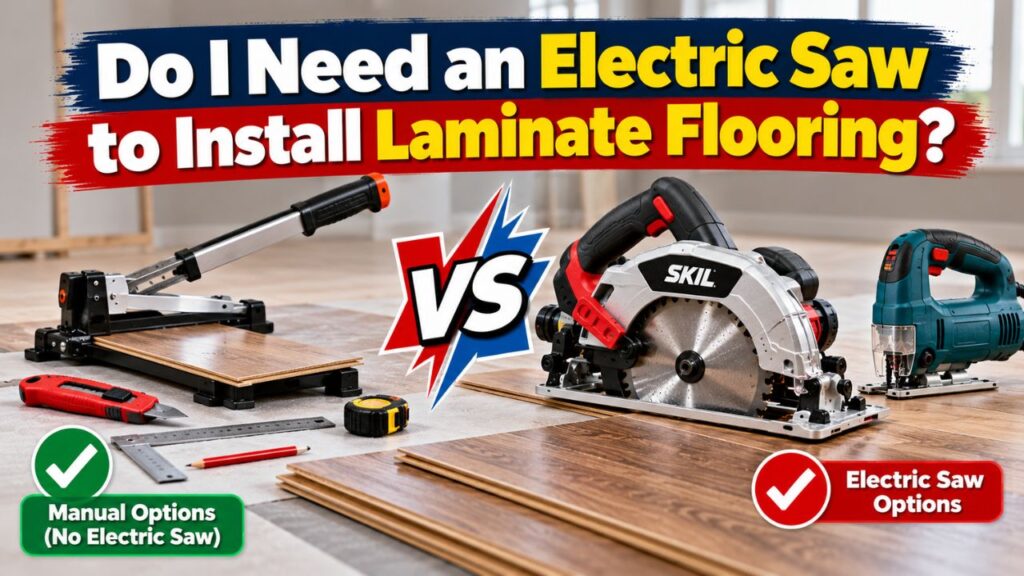
You can install laminate flooring without an electric saw, but whether that is practical depends on the size and complexity of the job.
A typical laminate installation requires several types of cuts.
You will need to shorten planks at the end of rows, which means making crosscuts.
You may need to narrow the first or final row, which requires a long rip cut.
You may also need notches around doorways, cabinets, floor vents, columns, pipes, or other obstacles.
A manual flooring cutter can handle many routine crosscuts very efficiently. Some cutters can also make limited lengthwise cuts, depending on their design.
A hand saw can take care of additional straight cuts.
That means an electric saw is technically optional.
The question is whether you want to trade speed and convenience for a simpler, quieter setup.
When You Probably Do Not Need an Electric Saw
A powered saw may be unnecessary if the room is small, the layout is simple, and you have access to a good laminate cutter.
A basic rectangular bedroom may require mostly straight end cuts.
If the first and last rows do not need major ripping, the number of difficult cuts can be surprisingly small.
For this type of project, a manual cutter plus a fine-tooth hand saw or jigsaw alternative may be enough.
When an Electric Saw Becomes Worthwhile
A power saw is much more useful if you are installing several rooms, working around many doorways, or making numerous rip cuts.
It also makes sense when the laminate is thick, dense, or difficult to cut manually.
The more complicated the floor plan becomes, the more valuable powered cutting becomes.
Key Takeaways:
- An electric saw is convenient but not always required.
- A manual flooring cutter can handle many routine laminate crosscuts.
- Complex rooms and long rip cuts make power tools more useful.
- The best cutting method depends on the laminate product and room layout.
What Cuts Are Required During Laminate Flooring Installation?
Before choosing tools, it helps to understand the cuts you will actually make.
Most laminate installations involve three main categories.
Crosscuts
A crosscut goes across the width of a plank and makes it shorter.
This is the most common cut.
Every time you reach the end of a row, the final plank usually needs to be shortened.
A manual laminate cutter, miter saw, circular saw, flooring saw, or hand saw can all make this type of cut.
Rip Cuts
A rip cut runs along the length of the plank and makes it narrower.
These cuts are commonly needed along the first or last row.
They are also useful along uneven walls.
Rip cuts are one area where an electric saw becomes especially convenient.
A circular saw with a guide, table saw, or flooring saw can make long rip cuts much more quickly than a hand saw.
Notches and Irregular Cuts
These are required around obstacles.
Examples include door frames, cabinets, floor vents, pipes, and corners.
A jigsaw is particularly useful for these shapes.
You can also make them manually with a coping saw, hand saw, or combination of tools, but the work takes longer.
Can You Install Laminate Flooring With Only Hand Tools?
Yes.
A laminate floor can be installed entirely with manual tools if you are willing to spend more time cutting.
A realistic manual-tool setup might include a laminate cutter, fine-tooth hand saw, coping saw or fret saw, utility knife, straightedge, square, tape measure, and tapping tools.
The laminate cutter does most of the repetitive work.
The hand saw handles cuts the cutter cannot make.
The coping saw or fret saw helps with small notches and irregular shapes.
The Main Advantage of Hand Tools
The biggest advantage is the lack of airborne sawdust.
A manual laminate cutter typically shears the plank rather than grinding through it with a rotating blade.
That makes it cleaner and quieter.
You also do not need an electrical outlet, extension cord, battery charger, or outdoor cutting station.
For apartments or occupied homes, that can be very convenient.
The Main Disadvantage
Manual cutting becomes tiring and slow when the project contains many difficult cuts.
You may also have more trouble producing perfectly straight long rip cuts.
That does not mean the finished floor will be worse, but it may require more patience.
Is a Manual Laminate Flooring Cutter Enough?
For many small projects, it can handle most of the cutting.
A flooring cutter works somewhat like a heavy-duty paper cutter.
You position the plank under the blade and pull the handle to shear through the material.
It is particularly useful for straight crosscuts.
Why a Flooring Cutter Is Attractive
It is fast.
It creates relatively little dust.
It is quiet.
It does not require electricity.
For repetitive end-of-row cuts, it can actually be more convenient than a miter saw because there is less noise and cleanup.
Its Limitations
Not every flooring cutter works with every laminate thickness or construction.
Some models are limited in plank width.
Others are not designed for long rip cuts.
Very hard or thick flooring may also require more effort.
Before buying or renting one, check that it is rated for your specific laminate.
Can You Cut Laminate Flooring With a Hand Saw?
Yes.
A fine-tooth hand saw can cut laminate flooring reasonably well.
For occasional crosscuts, it may be all you need.
Choose a saw with relatively fine teeth rather than a coarse framing saw.
The finer tooth pattern helps reduce chipping in the decorative surface.
Support the plank securely and use controlled strokes.
Which Side Should Face Up?
With a traditional hand saw cutting on the push stroke, the cleanest face can depend on the tooth geometry and cutting direction.
The simplest solution is to make a test cut on a scrap plank and inspect both surfaces.
If chipping is visible, try reversing the plank orientation or applying painter’s tape over the cut line.
Hand Saw for Long Rip Cuts
It can be done, but this is where manual cutting becomes much less convenient.
Following a straight line for several feet with a hand saw requires patience and control.
If you only need one final-row rip, it may be perfectly reasonable.
If you have dozens of rip cuts, an electric saw quickly becomes more practical.
Can You Cut Laminate Flooring With a Utility Knife?
Usually not in the same way you cut flexible vinyl flooring.
Most laminate flooring has a dense wood-fiber core that is too thick and rigid to simply score and snap with a utility knife.
A knife is still useful for installation tasks such as trimming underlayment, opening packaging, or carefully scoring a decorative surface before another cutting method.
But it should not be considered the primary cutting tool for normal laminate planks.
This is an important distinction between laminate and many luxury vinyl flooring products.
What Electric Saw Is Best for Laminate Flooring?
If you decide to use power tools, you do not need every type of saw.
One or two carefully chosen tools can cover almost the entire installation.
Circular Saw
A circular saw is the most versatile single power saw for laminate.
It can make crosscuts and rip cuts.
With a straightedge guide, it can make long accurate cuts along the first and last rows.
A fine-tooth carbide blade is generally preferable to a coarse construction blade.
For a homeowner who already owns a circular saw, this is often the easiest option.
Jigsaw
A jigsaw is the best companion tool for irregular cuts.
It handles notches around door frames, vents, pipes, and corners much more easily than a circular saw.
It can also make straight cuts if necessary, although it is slower and usually less accurate over long distances.
Miter Saw
A miter saw is excellent for repeated crosscuts.
During a large installation, it can save time because every plank can be quickly placed against the fence and shortened.
However, it cannot make a full-length rip cut.
That means it normally needs to be paired with another tool.
Flooring Saw
A dedicated flooring saw is designed specifically for installation work.
Many models can make both crosscuts and rip cuts in one compact machine.
This can eliminate the need to move between a miter saw and table saw.
It is particularly useful for contractors or homeowners installing several rooms.
Table Saw
A table saw makes excellent rip cuts.
It is useful for narrowing first and last rows and producing repeated strips of consistent width.
However, it is larger, less portable, and unnecessary for most small DIY laminate installations.
Key Takeaways:
- A circular saw is the most versatile single power saw for laminate flooring.
- A jigsaw is best for notches and irregular shapes.
- A miter saw excels at repeated crosscuts but cannot handle long rips.
- A dedicated flooring saw can combine several functions in one machine.
What Is the Minimum Tool Setup for a Small Laminate Project?
If I were installing a small rectangular room without using a power saw, I would want:
A manual laminate cutter for routine crosscuts.
A fine-tooth hand saw for the cuts the flooring cutter cannot make.
A coping saw or similar fine saw for small notches.
A tape measure, square, pencil, pull bar, tapping block, spacers, and rubber mallet for installation.
That is enough for many straightforward rooms.
If I were willing to use one electric saw, I would replace much of the manual cutting with a circular saw.
If the room had many doorways or irregular obstacles, I would add a jigsaw.
Do You Need a Miter Saw to Install Laminate Flooring?
No.
A miter saw is convenient, but it is not required.
Its biggest advantage is speed on repeated end cuts.
For a large room, that can save a lot of time.
However, a flooring cutter or circular saw can perform the same basic crosscutting job.
If you already own a miter saw, use it with an appropriate fine-tooth blade.
If you do not own one, I would not buy one solely for a small laminate project unless you also expect to use it for trim or future woodworking.
Do You Need a Jigsaw?
Not necessarily, but it is one of the most useful secondary tools.
A perfectly rectangular room may require very few irregular cuts.
In that case, you may not need one.
Once you encounter door jambs, pipes, heating vents, or unusual wall shapes, the jigsaw becomes much more valuable.
Its narrow blade can turn through curves and stop inside notches in ways that a circular saw cannot.
For DIY flooring, a jigsaw often adds more flexibility than a second large saw.
Do You Need a Circular Saw?
No, but if you want only one electric saw, it is probably the one I would choose.
A circular saw can shorten planks and rip them lengthwise.
It is relatively portable and useful for many home-improvement projects beyond flooring.
With a fine-tooth carbide blade and a straight guide, it can handle the first row, final row, and routine crosscuts.
Its main weakness is detailed notching.
That is where a jigsaw or hand saw helps.
Do You Need a Table Saw?
No.
A table saw is useful but unnecessary for most laminate installations.
Its main advantage is producing long, accurate rip cuts.
If you already own one and have space to use it safely, it can be excellent for narrowing rows.
But a circular saw and guide can accomplish the same task with far less equipment.
For one-room DIY projects, the table saw is usually more tool than you need.
Which Blade Should You Use for Laminate Flooring?
If you use a power saw, blade selection matters.
Laminate has a hard decorative wear surface and a dense fiberboard core.
These materials can be abrasive.
A coarse framing blade may cut quickly but leave significant chipping.
A fine-tooth carbide blade generally provides a cleaner result.
For a typical circular saw, around 40 to 60 teeth is a useful general range.
For a miter saw, a fine-finish blade with a higher tooth count is normally preferable.
The exact blade should match both the saw and flooring material.
Laminate Can Dull Blades
Do not be surprised if the blade becomes noticeably dull during a large installation.
Laminate is harder on cutting edges than ordinary softwood.
If cut quality deteriorates or the saw starts requiring much more force, inspect the blade.
Can You Install Laminate Flooring Without Making Much Dust?
Yes.
This is one of the strongest reasons to avoid an electric saw.
A manual laminate cutter produces very little airborne dust compared with a circular saw, miter saw, or table saw.
You can often make most of your cuts inside the room without covering everything in fine fiberboard dust.
If you use a power saw, create a separate cutting area when possible.
A garage, driveway, patio, or well-ventilated work area can keep dust out of the installation room.
Use appropriate eye and respiratory protection and dust extraction where practical.
Is It Faster to Use an Electric Saw?
Usually, yes—especially for complex projects.
A miter saw can make repeated crosscuts extremely quickly.
A circular saw can rip long planks in seconds.
A jigsaw can create complicated notches much faster than a manual coping saw.
However, speed includes setup and cleanup.
For one small bedroom, a flooring cutter may actually be more efficient overall because you do not have to create a power-saw station or clean up large amounts of dust.
For an entire house, powered tools become much more attractive.
Should a Beginner Use an Electric Saw for Laminate?
Only if you are comfortable using the tool safely.
You do not need to learn a powerful circular saw or table saw solely because you think laminate flooring requires one.
A manual cutter is easier for many beginners and reduces both noise and dust.
If you already know how to use a circular saw or jigsaw, there is no reason to avoid them.
The goal is to choose the method that gives you accurate cuts while maintaining good control.
Do Not Rush Because the Flooring Is Thin
A laminate plank may look less intimidating than a thick board, but the saw does not become safer because the workpiece is thin.
Keep your hands away from the blade path.
Support the flooring properly.
Never hold a short offcut close to a spinning blade.
Disconnect power before blade adjustments.
How to Cut the First Row Without a Power Saw
The first row may need to be narrowed if the room dimensions would otherwise leave an extremely thin final row.
This requires ripping planks lengthwise.
A manual flooring cutter capable of rip cuts is the easiest non-powered solution.
If your cutter does not support rips, you can use a fine hand saw.
Mark the required width along the entire plank.
Clamp or support the piece so it cannot move.
Then saw steadily along the waste side of the line.
This is slower than using a circular saw but perfectly possible when only a few boards need to be narrowed.
How to Cut the Final Row Without an Electric Saw
The final row is usually the hardest part of a no-power-saw installation.
Measure the distance between the installed floor and the wall at several points.
Subtract the required expansion gap.
Transfer those measurements to the plank.
If the wall is uneven, you may need a tapered cut rather than a perfectly parallel rip.
A fine hand saw can make the cut.
A manual flooring cutter that supports rip cutting can make the job easier.
Remember to preserve the locking edge needed to connect the final row.
What About Door Frames?
Doorways create some of the trickiest cuts.
It is generally better to undercut door jambs and casings so the flooring can slide underneath instead of trying to cut the laminate perfectly around every contour.
An oscillating multi-tool is very convenient for undercutting jambs, but a manual jamb saw can accomplish the same task without electricity.
Use a scrap piece of flooring plus any required underlayment as a height guide.
This creates enough clearance for the finished floor to slide underneath the trim.
What About Pipes and Vents?
A coping saw, fret saw, or fine hand saw can make these cuts manually.
Mark the exact location first.
For pipes, you may need to drill a starter hole and then cut the surrounding shape.
If you do use a jigsaw, the process becomes faster.
However, there is no requirement that the cut be powered.
The important part is maintaining the manufacturer’s required expansion clearance around fixed objects.
Key Takeaways:
- The hardest manual cuts are long rips and irregular notches.
- Door jambs can be undercut with either powered or manual tools.
- A jigsaw saves time but is not mandatory.
- Maintain the required expansion gap regardless of the cutting method.
Electric Saw vs. Manual Flooring Cutter
The better choice depends on the project.
| Factor | Electric Saw | Manual Flooring Cutter |
| Cutting speed | Very fast | Fast for simple cuts |
| Dust | High | Very low |
| Noise | High | Low |
| Crosscuts | Excellent | Excellent |
| Long rip cuts | Excellent with correct saw | Depends on cutter |
| Irregular cuts | Jigsaw works well | Limited |
| Electricity required | Yes | No |
| Beginner friendliness | Depends on tool | Generally high |
| Cleanup | More | Less |
For a simple room, the cutter has a major advantage in cleanliness.
For a complicated installation, powered saws are more versatile.
What I Would Use for a DIY Laminate Installation
For one small room, I would be comfortable using a good manual laminate cutter plus a fine hand saw.
That keeps the project quiet and produces very little dust.
For a medium or large installation, I would use a circular saw and jigsaw, or a flooring cutter plus jigsaw.
The flooring cutter would handle most crosscuts without dust.
The jigsaw would handle the awkward shapes.
For an entire house, I would consider adding a miter saw or dedicated flooring saw because the time savings become more significant.
The key is not owning the most tools.
It is avoiding unnecessary tool changes while still having a practical method for every cut.
Common Mistakes When Choosing Tools for Laminate Flooring
One mistake is assuming you need a table saw, miter saw, circular saw, and jigsaw before starting.
You do not.
Another mistake is assuming no power tools means no accurate cuts.
A quality flooring cutter can be extremely accurate.
The opposite mistake is trying to force one tool to do everything.
A miter saw is excellent for crosscuts but poor for long rips.
A circular saw is versatile but awkward for tight curves.
A jigsaw is excellent for notches but slower for repetitive straight cuts.
Choose tools according to the cuts rather than trying to use the same machine for every task.
Another frequent mistake is forgetting the flooring manufacturer’s installation instructions. Expansion gaps, acceptable cutting methods, and installation requirements can vary by product.
Is Renting Better Than Buying?
For a one-time flooring project, renting can make sense.
A manual flooring cutter is particularly useful as a rental because you may not need one after the installation.
The same applies to a dedicated flooring saw.
If you already expect to do other remodeling work, buying a circular saw or jigsaw may provide more long-term value because those tools are useful for many projects.
Consider the entire project rather than only the flooring cuts.
FAQs about Do I Need an Electric Saw to Install Laminate Flooring
Do I need an electric saw to install laminate flooring?
No. You can install laminate using a manual flooring cutter, fine-tooth hand saw, and other manual tools. Electric saws mainly make the work faster and easier.
Can I install laminate flooring without any power tools?
Yes. A manual cutter, hand saw, coping saw, jamb saw, measuring tools, spacers, tapping block, pull bar, and mallet can handle many installations.
What is the easiest way to cut laminate flooring without a saw?
A manual laminate flooring cutter is usually the easiest option for straight crosscuts.
Can you cut laminate flooring with a utility knife?
Most standard laminate flooring is too thick and rigid to score and snap like flexible vinyl. A utility knife is useful for underlayment and small installation tasks rather than primary plank cutting.
What is the best electric saw for laminate flooring?
If you want one versatile saw, a circular saw is an excellent choice because it can handle both crosscuts and long rip cuts.
Do I need a jigsaw for laminate flooring?
No, but it is very useful for notches, curves, vents, pipes, and doorways.
Do I need a miter saw for laminate flooring?
No. A miter saw is convenient for repeated crosscuts, but a flooring cutter, circular saw, or hand saw can do the same basic job.
Do I need a table saw?
No. A table saw is useful for rip cuts but unnecessary for most DIY laminate projects.
Can I use a hand saw to cut laminate?
Yes. Use a fine-tooth hand saw and support the plank securely. It is slower than a power saw but works well for occasional cuts.
Is a laminate cutter better than a miter saw?
For simple crosscuts, a laminate cutter is quieter and creates much less dust. A miter saw provides greater versatility for angled cuts and some thicker materials.
What power tools are most useful for laminate flooring?
A circular saw and jigsaw are a very practical combination. A miter saw or flooring saw becomes more useful on larger projects.
Can I cut the last row without a power saw?
Yes. A manual cutter capable of rip cuts or a fine hand saw can narrow the final row.
Is laminate flooring difficult to cut by hand?
Not especially for occasional cuts, although long rip cuts take more effort and patience than powered cutting.
Does an electric saw create a lot of laminate dust?
Yes. Circular saws, miter saws, table saws, and flooring saws can create considerable fine dust. Manual cutters produce much less airborne dust.
Is it worth buying a saw just for laminate flooring?
For one small room, probably not if you can rent or use a manual cutter. For larger projects or future home-improvement work, a circular saw or jigsaw can be a worthwhile purchase.
Conclusion
So, do I need an electric saw to install laminate flooring? No, you do not. A laminate floor can be installed successfully with manual tools, especially if the room is small and the layout is straightforward.
A manual laminate cutter can handle most routine crosscuts quickly and with very little dust. A fine-tooth hand saw can deal with the occasional cut the cutter cannot handle, while a coping saw or jamb saw can help around obstacles and door frames.
Where electric saws become valuable is speed and versatility.
A circular saw makes long rip cuts much easier.
A jigsaw handles notches and irregular shapes.
A miter saw makes repeated crosscuts fast and consistent.
A dedicated flooring saw can combine several of those capabilities in one compact machine.
For a small bedroom, I would not consider a power saw mandatory. A good manual cutter and basic hand tools can be completely sufficient.
For several rooms or an entire house, I would strongly prefer having at least one electric saw because of the time saved on ripping, notching, and repeated cuts.
If you want the simplest powered setup, a circular saw plus a jigsaw covers almost everything. If you want the cleanest and quietest setup, a manual flooring cutter plus hand tools can work very well.
Whichever method you choose, the most important things are accurate measuring, preserving the correct locking edges, maintaining the required expansion gap, supporting the plank properly, and following the flooring manufacturer’s installation instructions.
In other words, an electric saw is helpful rather than essential. Choose it because it makes your particular flooring project easier—not because laminate flooring cannot be installed without one.