How to Use a Back Saw on Thick Large Boards: Complete Guide
If you want to know how to use a back saw on thick large boards, first check whether the board is actually within the saw’s cutting depth. A backsaw can crosscut a wide board accurately, but its rigid spine limits how deeply the blade can penetrate thick stock. When the board is thicker than the usable blade depth, you can often mark the cut around all four faces, saw from one side, turn the board, and complete the cut from the opposite side. If the stock is too thick for the blade to meet in the middle, a larger handsaw is the better tool.
This distinction between a board being wide and being thick is important. A wide board may simply require a longer sawing stroke and better support. A thick board can physically prevent a backsaw from finishing the cut because the reinforced spine eventually contacts the wood.
Backsaws are built for controlled, accurate woodworking rather than fast cutting through large construction lumber. Their fine teeth and rigid blades make them excellent for joinery, precise crosscuts, tenons, miters, and trimming, but those same design features create limitations when stock becomes oversized.
In this guide, I’ll explain how to use a back saw on thick large boards, how to work around the spine when possible, how to mark and support large stock, how to keep opposite cuts aligned, and when switching to a panel saw, handsaw, or another tool will give you a better result.
Can You Use a Back Saw on Thick Large Boards?
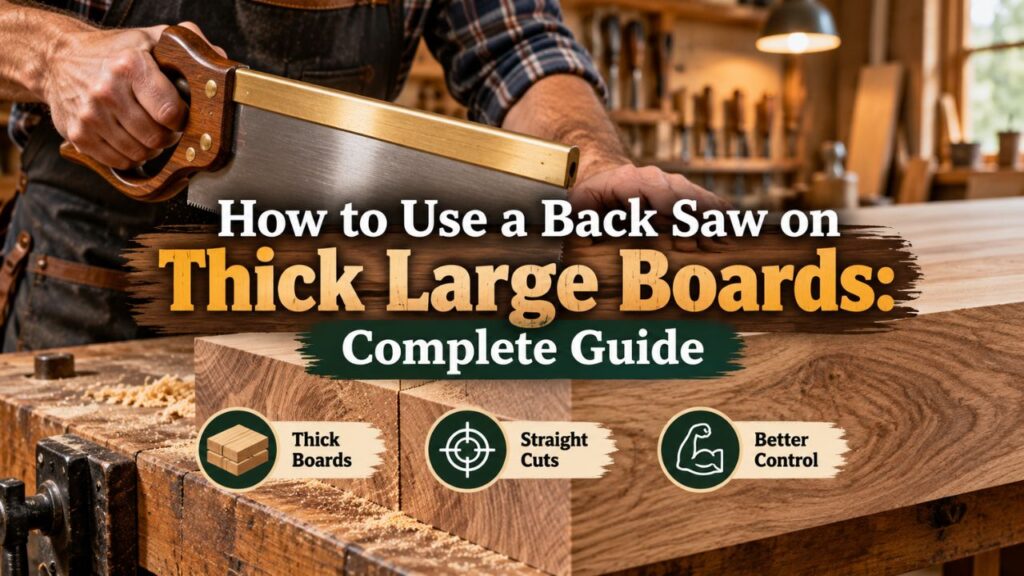
Yes, within limits.
A backsaw can work very well on a large, wide board as long as its thickness does not exceed the usable depth between the teeth and the rigid spine.
For example, imagine a board that is 10 inches wide but only 3/4 inch thick. A backsaw can usually crosscut that board without the back causing any difficulty. The saw simply travels progressively across the board’s width.
Now consider a timber that is 3 inches thick. If your backsaw has only about 2 inches of usable blade depth, the reinforced back can strike the top of the timber before the teeth have cut all the way through.
In that situation, you need to cut from more than one side or select a deeper saw.
| Board Situation | Can a Backsaw Handle It? | Best Approach |
| Wide but relatively thin board | Yes | Saw normally with good support |
| Moderately thick board within blade depth | Yes | Saw through from one face |
| Slightly thicker than blade depth | Often | Cut from opposite faces |
| Thick timber approaching twice blade depth | Sometimes | Mark all faces and align multiple cuts carefully |
| Stock thicker than the saw can reach from both sides | No practical advantage | Use a panel saw, handsaw, or larger joinery saw |
| Long rip cut in a large board | Usually not ideal | Use a rip saw or appropriate power saw |
A backsaw should be chosen for accuracy, not simply because it happens to be available.
If the board is large enough that the saw becomes awkward or physically cannot reach the center, changing tools is usually better than forcing the backsaw.
Key Takeaways:
- A wide board does not automatically exceed a backsaw’s capability.
- Board thickness is the bigger limitation because of the rigid spine.
- If cuts from opposite faces cannot meet, use a deeper saw rather than forcing the backsaw.
Why the Rigid Back Limits Cutting Depth
The feature that gives a backsaw its excellent accuracy is also what limits it on thick lumber.
A traditional backsaw has a relatively thin steel saw plate reinforced along its upper edge with a rigid back, often made from folded steel, brass, or another stiff material.
Without that reinforced spine, the thin blade would flex much more easily.
The back keeps the blade straight, which is why backsaws perform so well on precise joinery.
However, the back cannot pass through the kerf like the thin saw plate can.
Once the rigid spine reaches the top of the workpiece, the teeth cannot go any deeper.
Measure Usable Blade Depth Before Starting
Before cutting thick stock, measure from the tips of the teeth to the bottom edge of the rigid back.
That is approximately your maximum usable depth from one face.
If the distance is 2 1/2 inches and your board is 2 inches thick, you can cut through normally.
If the board is 3 inches thick, you may need to cut partway from one face, flip the board, and finish from the opposite face.
If the board is significantly thicker than twice the usable blade depth, the backsaw simply cannot reach the center from either side.
At that point, another saw is required.
Allow Some Clearance
Do not plan a cut that depends on every fraction of an inch of blade depth.
If the board thickness is exactly equal to the space beneath the rigid back, the back can begin rubbing heavily against the surface before the cut is complete.
A little extra clearance makes sawing easier.
How to Use a Back Saw on a Wide Board
A board can be very wide without being particularly difficult for a backsaw.
The main challenges are keeping the cut straight over a long distance and preventing the board from moving or pinching the blade.
Mark the Cut Carefully
Use a square to establish the cut line.
For a precision crosscut, a marking knife gives you a finer reference than a thick pencil line.
Mark the line across the top face and continue it down both edges.
If the cut is particularly important, mark the underside as well.
These additional lines help you monitor whether the saw is remaining square as it moves through the board.
Support the Board Properly
Large boards need more support than small joinery components.
Place the board on a stable workbench, saw bench, or sturdy support system.
Clamp it when necessary so it cannot slide while you saw.
If part of the board extends far beyond the bench, support that end as well. Otherwise, its weight can cause the wood to flex and pinch the saw blade as the cut gets deeper.
The waste section also needs support near the end of the cut. Allowing a large heavy offcut to break away can tear fibers from the finished edge.
Start the Kerf Gently
Most traditional Western backsaws cut primarily on the push stroke.
Place the teeth near the waste side of your line and begin with a few short, light strokes.
Some woodworkers start at the far corner and gradually lower the saw until more teeth engage the board.
The exact starting position matters less than establishing a clean kerf without forcing the teeth.
Once the blade tracks correctly, lengthen your stroke.
Watch More Than One Reference
On a wide board, concentrating only on the top pencil line can allow the saw to drift vertically.
Glance periodically at the line running down the near edge.
The top line controls where the cut travels across the board, while the edge line helps show whether you are keeping the blade perpendicular to the face.
A relaxed grip usually helps more than excessive force.
Let the saw follow the kerf it has already established.
How to Cut a Thick Board With a Back Saw
When the stock is slightly deeper than the backsaw blade, the best technique is usually to mark the cut around the entire board and approach it from more than one face.
Accuracy in the layout becomes extremely important because separate kerfs need to meet.
1. Square a Line Around All Four Faces
Begin by establishing one reference face and one reference edge if you are doing precision woodworking.
Use a square and marking knife or sharp pencil to transfer the cut location around all four sides.
Ideally, the final line should meet itself exactly when you return to the starting face.
If the marks do not meet, correct the layout before sawing.
A small marking error becomes much more noticeable when two cuts approach one another from opposite sides.
2. Secure the Board
Clamp the board firmly or position it on a saw bench so it cannot shift.
Large stock should not be balanced loosely while you try to make an accurate cut.
Make sure the section being removed is also supported appropriately.
3. Begin the Cut on the First Face
Start gently on the waste side of your line.
Use the top and side layout lines to keep the saw tracking correctly.
Do not immediately try to reach maximum depth.
First establish a clean, straight kerf across the width.
Once the kerf is reliable, deepen the cut with longer strokes.
4. Stop Before the Rigid Back Binds Against the Wood
As the cut deepens, the reinforced spine approaches the board.
Do not force the back into the surface.
Once you reach the practical maximum depth, stop.
The goal is to create one accurate half of the cut, not to force the tool beyond its design.
5. Turn the Board Over
Rotate the workpiece so the opposite face is accessible.
Your layout line should show exactly where the second cut belongs.
Start another careful kerf on the waste side of that line.
The second cut should eventually meet the first.
As you get close, reduce pressure and monitor the kerf carefully.
6. Support the Offcut During the Final Strokes
A heavy waste piece can break away before the final fibers are severed.
Support it with your free setup, a second support, or a helper where appropriate.
Finish with light controlled strokes.
If your marking and sawing were accurate, the two kerfs should meet with little or no step between them.
Key Takeaways:
- Mark all four faces before cutting thick stock from multiple directions.
- Establish each kerf accurately before deepening it.
- Stop when the rigid spine reaches the workpiece instead of forcing the saw.
What If the Two Cuts Do Not Line Up?
This is the main difficulty when sawing thick material from opposite sides.
One cut may be slightly to the left while the other is slightly to the right, leaving a ridge or step where they meet.
Minor misalignment can usually be corrected with normal woodworking cleanup.
A sharp chisel, plane, file, or sanding block may be appropriate depending on the cut and project.
However, major misalignment indicates that the layout or sawing technique needs improvement.
Use the Same Reference Face
When laying out precision components, take measurements from one established reference face whenever possible.
This reduces accumulated errors.
Use a Knife Line
For joinery, a marking knife gives the teeth a physical reference and makes it easier to begin accurately.
A pencil line can be perfectly adequate for general work, but a knife line is preferable when the two cuts must meet closely.
Do Not Saw Away the Line Immediately
Saw on the waste side.
If you leave the line visible, you have a reference throughout the cut and can make final adjustments afterward.
Removing your layout line too early makes it harder to judge whether the saw is drifting.
How to Keep a Backsaw Square on a Large Board
Keeping a saw square over a long crosscut requires more than simply looking at the blade.
Your stance, grip, and board position all affect the cut.
Stand so your sawing arm can move naturally in line with the intended cut.
If your body forces the arm to swing sideways, the blade is more likely to drift.
Keep your wrist reasonably straight.
Use smooth strokes rather than pushing hard.
A backsaw should feel guided rather than forced.
Use a Square to Check Progress
Before the kerf gets too deep, stop occasionally and check the blade orientation against a square if necessary.
Do not place your hand where the teeth can contact it.
You can also look at both layout lines as you work.
If the saw is touching the line correctly on the top but moving away from the side line, adjust gradually.
Avoid twisting the blade sharply inside a deep kerf. Small corrections made early are much easier than large corrections made late.
Should You Use a Bench Hook for Large Boards?
A bench hook is one of the best accessories for backsaw work, but traditional bench hooks are mainly suited to relatively small stock.
If your board is only moderately wide, a large bench hook can still provide excellent support.
For truly large boards, a saw bench or sturdy workbench with clamps is usually more practical.
The same principle applies: the work needs a solid reference and should not move under the sawing force.
If you frequently crosscut wide boards by hand, building a larger dedicated bench hook can be worthwhile.
What Type of Backsaw Is Best for Thick Stock?
“Backsaw” describes a family of saws rather than one exact size.
The best version depends on the work.
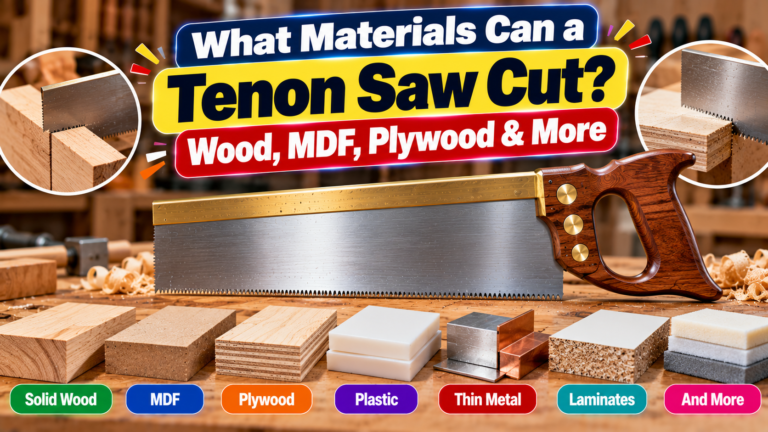
Tenon Saw
A tenon saw is usually the backsaw I would choose for larger joinery and thicker stock.
It generally has a larger blade and deeper cutting capacity than a dovetail saw.
Tenon saws can be filed rip, crosscut, or with a hybrid tooth pattern depending on their intended purpose.
For large tenons, the extra plate depth and length make a noticeable difference.
Carcass Saw
A carcass saw is usually smaller than a full-size tenon saw and excels at accurate crosscuts in furniture components.
It can handle moderately sized boards but may run out of blade depth sooner than a large tenon saw.
Dovetail Saw
A dovetail saw is designed for fine joinery and relatively shallow cuts.
Its small size and fine teeth make it excellent for dovetails but inefficient for substantial boards.
I would not choose a small dovetail saw for thick stock simply because it belongs to the backsaw family.
Miter Saw
A traditional hand miter backsaw can be relatively long and is designed for accurate crosscuts, often in conjunction with a miter box.
It can handle wider material efficiently, although the rigid back still creates a depth limit.
When a Regular Handsaw Is Better
There is a point where using a backsaw becomes unnecessary.
If the board is thick construction lumber and you simply need a crosscut, a full-size crosscut handsaw can be faster and easier.
A traditional panel or hand saw has no reinforced spine along the back, which means the entire plate can move through the kerf.
That removes the cutting-depth limitation.
For example, if you need to crosscut a 4×4 timber, a sufficiently large backsaw may technically manage the job from opposite faces.
But if precision joinery is not required, a sharp crosscut handsaw is usually the more practical tool.
For thick rip cuts along the grain, use a rip-filed saw or an appropriate power saw rather than forcing a fine backsaw through the entire length.
Key Takeaways:
- A large tenon saw is the most suitable type of backsaw for thicker joinery stock.
- Small dovetail and carcass saws are better suited to shallower precision work.
- For stock beyond the backsaw’s depth capacity, a full-size handsaw is normally the better choice.
Can You Use a Back Saw on a 2×4?
Usually, yes, depending on the backsaw.
A nominal 2×4 is approximately 1 1/2 inches thick and 3 1/2 inches wide.
Many medium or large backsaws have enough plate depth to cut through the 1 1/2-inch thickness in a normal crosscut.
A small dovetail saw may have limited clearance, while a tenon saw is normally more comfortable.
For occasional precise crosscuts in a 2×4, a backsaw works.
For repeatedly cutting construction lumber, however, a general crosscut saw or power saw is faster.
Can You Use a Back Saw on a 4×4?
Possibly, but this is where the rigid back becomes a significant limitation.
A nominal 4×4 is approximately 3 1/2 inches thick.
Many backsaws cannot reach completely through that depth from one face.
If your usable blade depth is more than half the timber thickness, you can mark the cut around all faces, saw partway from one side, turn the timber over, and complete the cut from the opposite side.
Alignment needs to be accurate.
If the saw is very shallow, using a normal crosscut handsaw is easier.
Unless the 4×4 cut needs backsaw-level joinery precision, I would normally choose the larger unrestricted saw.
Can You Use a Backsaw for a Large Tenon?
Yes, and this is where a large tenon saw earns its name.
For substantial tenons, lay out the shoulder and cheek lines accurately on every relevant face.
A rip-filed tenon saw is particularly suitable for cutting the cheeks because those cuts generally follow the grain.
Shoulder cuts run across the grain, so a crosscut saw or a tenon saw with suitable tooth geometry may produce a cleaner shoulder.
On very large timber-frame-style joinery, a conventional cabinetmaker’s tenon saw may still be too shallow.
Larger timber framing saws, full-size handsaws, or specialized tools become more practical.
What If the Board Is Too Wide for Comfortable Sawing?
Width itself does not stop the teeth from progressing through the board, but an extremely wide crosscut can be difficult to keep straight.
Instead of trying to watch the entire cut from one position, establish the kerf carefully and work progressively.
You can also turn the board around and approach from the opposite edge if that makes it easier to control the line.
Again, mark the complete line first so both cuts have a common reference.
For very wide sheet goods, however, a backsaw is rarely the most efficient tool.
A panel saw, circular saw, or track saw is generally more appropriate.
Common Mistakes When Using a Back Saw on Thick Boards
A common mistake is starting without checking blade depth.
Once the rigid back hits the wood halfway through, you may discover that your intended method cannot finish the cut.
Measure first.
Another mistake is marking only one face before flipping the board. Without a continuous layout line, aligning the second kerf becomes guesswork.
Excessive pressure also causes trouble. Pushing harder can make a thin backsaw plate deflect, jam the teeth, or move the kerf away from your line.
Poor support is another major problem. A large unsupported offcut can bind the saw or tear wood fibers when it falls.
Finally, do not assume every backsaw is intended for the same cut. A small dovetail saw, a crosscut carcass saw, and a large rip-filed tenon saw have very different strengths.
Safety When Sawing Large Boards by Hand
Inspect reclaimed or used boards for hidden nails, screws, staples, or other metal before cutting.
A backsaw is designed for wood. Striking metal can damage the fine teeth and make the saw jump.
Secure the board so it cannot roll, rock, or slide.
Keep your free hand out of the cutting path and avoid positioning your body where a slipping saw could strike you.
Eye protection is sensible, particularly when cutting brittle material or working around damaged wood.
If the board is heavy, do not allow the offcut to fall uncontrolled.
Use additional support or a second person when necessary.
Most importantly, do not force a saw that is obviously too small for the work. Choosing a larger saw is safer and usually produces a better cut.
FAQs About How to Use a Back Saw on Thick Large Boards
Can a backsaw cut thick wood?
Yes, as long as the wood is within the usable depth of the blade. If the stock is slightly thicker, you may be able to cut from opposite faces so the kerfs meet.
How thick can a back saw cut?
The maximum depth from one face is approximately the distance between the tooth line and the rigid spine. Exact capacity varies by saw.
Can I flip a thick board and finish the cut from the other side?
Yes. Mark the cut around all four faces first, saw accurately from one face, flip the board, and align the second cut with the same layout line.
How do I make both cuts meet accurately?
Use a square to mark around the entire board, saw on the waste side of the same line, and avoid removing the layout marks until the kerfs meet.
Can a backsaw cut a wide board?
Yes. Board width does not create the same physical limitation as thickness. However, very wide boards require good support and careful tracking across the long cut.
Can a back saw cut a 2×4?
Most medium and large backsaws can crosscut a 2×4 because the actual thickness is about 1 1/2 inches. Check your specific blade depth.
Can a back saw cut a 4×4?
Some can do it by cutting from opposite faces, but many backsaws are not ideal for 3 1/2-inch-thick stock. A full-size crosscut handsaw is usually easier.
What is the best backsaw for thick boards?
A large tenon saw is usually the best backsaw option because it has a longer and deeper blade than smaller dovetail or carcass saws.
Why does my backsaw stop halfway through the board?
The reinforced spine is probably contacting the surface and preventing the teeth from going deeper. Turn the stock and continue from another face if the remaining material is within reach.
Should I force the saw when the back touches the board?
No. The spine is a physical depth limit. Forcing it against the board will not allow the teeth to cut significantly deeper and can damage the work or saw.
Is a backsaw good for construction lumber?
It can cut construction lumber, but it is designed primarily for accurate woodworking. A general-purpose crosscut handsaw or power saw is often faster for rough construction work.
Can I use a backsaw for ripping a long thick board?
It is normally not the best choice. A rip saw, panel saw, table saw, bandsaw, or circular saw is more efficient for long rip cuts.
Why is my backsaw drifting off the line?
Possible causes include forcing the blade, starting the kerf inaccurately, poor body alignment, a dull or unevenly sharpened saw, or attempting to correct the blade too aggressively after the kerf has become deep.
Should I use a pencil or marking knife?
A pencil is fine for general cutting. For precision joinery, a marking knife produces a finer line and can help the saw start exactly where intended.
How should I support a large board?
Use a stable workbench, saw bench, trestles, or other sturdy support. Support both the main board and heavy offcut so the kerf does not close and pinch the saw.
What should I use if the board is too thick for my backsaw?
A full-size handsaw, panel saw, appropriate timber saw, or suitable power saw is usually the better choice.
Conclusion
Knowing how to use a back saw on thick large boards starts with understanding the tool’s main physical limitation: the rigid back that keeps the blade straight also limits how deeply it can enter the wood.
For a large board that is wide but relatively thin, a backsaw can work extremely well. Support the board securely, mark a square cutting line, establish the kerf gently, and use controlled strokes while monitoring both the top and side layout lines.
For thicker lumber, measure the usable blade depth before beginning. If the board is slightly deeper than the saw can reach from one face, mark the cut around all four sides, saw to the blade’s practical limit, turn the workpiece, and finish from the opposite face. Accurate layout is what allows those two kerfs to meet cleanly.
If the stock is so thick that opposite cuts still cannot reach the center, I would not try to force the backsaw. A larger crosscut handsaw, panel saw, timber saw, or suitable power saw is the correct tool.
For large precision joinery, a deep tenon saw is generally the best backsaw choice. For rough construction cuts in thick lumber, a normal handsaw is often faster and easier.
The practical rule is simple: use the backsaw when its rigid blade gives you a precision advantage, but switch tools as soon as the board’s thickness exceeds the saw’s useful reach. That approach produces straighter cuts, protects the saw, and makes working with large stock much easier.