What Materials Can a Tenon Saw Cut? Wood, MDF, Plywood & More
If you are wondering what materials can a tenon saw cut, the answer is primarily solid wood and wood-based materials such as softwood, hardwood, plywood, MDF, and some hardboard. A tenon saw can also cut certain thin plastics when used carefully, but it is fundamentally a woodworking saw and is not the right tool for metal, masonry, ceramic tile, glass, or other very hard materials.
A tenon saw belongs to the backsaw family. Its relatively fine teeth produce controlled cuts, while the rigid metal or reinforced spine along the top of the blade helps keep the saw straight. These characteristics make it particularly useful for accurate joinery, including cutting tenons, shoulders, dowel stock, small boards, trim, and other pieces where a clean, square cut matters more than cutting speed.
The material itself is only part of the decision. Tooth configuration, tooth count, blade depth, material thickness, grain direction, and the quality of the saw can all change how well a tenon saw performs.
In this guide, I’ll explain exactly what materials a tenon saw can cut, how it performs on softwood, hardwood, plywood, MDF, particleboard, plastic, and other materials, what it should not be used for, and how to choose the right cutting method for cleaner and more accurate results.
What Materials Can a Tenon Saw Cut?
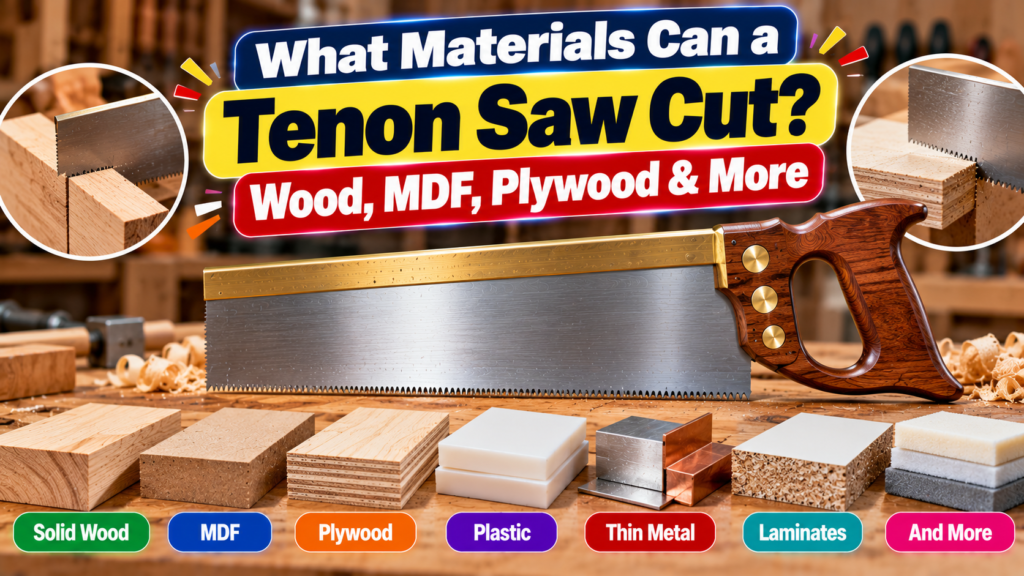
A tenon saw is designed mainly for woodworking materials. It performs best when making short, accurate cuts in solid wood or relatively thin manufactured wood products.
Here is a practical overview.
| Material | Can a Tenon Saw Cut It? | Practical Suitability |
| Softwood | Yes | Excellent |
| Hardwood | Yes | Excellent when properly supported |
| Plywood | Yes | Very good |
| MDF | Yes | Good |
| Hardboard | Yes | Good when reasonably thin |
| Particleboard | Yes | Possible, but edges may crumble |
| OSB | Yes | Possible, but not an ideal precision material |
| Wood veneer | Yes, with support | Good for carefully supported pieces |
| Laminate flooring | Sometimes | Possible, but blade wear/chipping can be an issue |
| PVC/plastic trim | Sometimes | Suitable for some thin pieces |
| Acrylic | Possible but not ideal | Use a plastic-specific saw when available |
| Aluminum | No, not recommended | Use a hacksaw or metal saw |
| Steel | No | Use a metal-cutting saw |
| Ceramic tile | No | Use tile-cutting equipment |
| Brick/concrete | No | Use a masonry tool |
| Glass | No | Requires glass-specific tools |
The best way to think about a tenon saw is simple: if the job is precision woodworking, the saw is probably useful; if the material is metal, masonry, glass, or another hard non-wood material, choose another saw.
Key Takeaways:
- Tenon saws are primarily designed for solid wood and manufactured wood products.
- Softwood, hardwood, plywood, and MDF are among the most practical materials to cut.
- Some plastics can be cut, but metal, masonry, tile, and glass require different tools.
Can a Tenon Saw Cut Softwood?
Yes. Softwood is one of the easiest materials to cut with a tenon saw.
Common softwoods include pine, spruce, fir, cedar, and redwood. These woods are frequently used for furniture, trim, framing components, woodworking practice, and general DIY projects.
Because softwood fibers are relatively easy for the teeth to sever, a well-sharpened tenon saw can produce fast, controlled cuts without requiring much downward pressure.
This makes softwood particularly good for beginners practicing joinery.
You can use a tenon saw for jobs such as cutting tenon shoulders, sizing small pieces of lumber, making square crosscuts, and cutting components for furniture or boxes.
Watch for Tear-Out in Very Soft Wood
Softwood is easy to cut, but that does not automatically mean the edge will always be perfect.
Some inexpensive pine and similar lumber can splinter around the exit side of the cut.
Marking the cut with a sharp marking knife before sawing can help sever surface fibers and create a cleaner edge.
A bench hook also makes a noticeable difference because it keeps the workpiece supported while helping you guide the blade squarely.
Can a Tenon Saw Cut Hardwood?
Yes. A properly sharpened tenon saw can cut hardwood very effectively.
Common examples include oak, maple, walnut, cherry, beech, ash, and mahogany.
Hardwood normally takes more effort than softwood because the material is denser. However, accurate joinery is one of the areas where a tenon saw performs particularly well.
A sharp saw should not need to be forced.
Start the kerf carefully, use smooth strokes, and allow the teeth to do the cutting.
If the saw constantly binds or requires excessive pressure, check whether the blade is dull, damaged, or inappropriate for the direction of cut.
Dense Hardwood Requires Patience
Very dense woods can slow the cutting process considerably.
Rather than using aggressive force, maintain a controlled stroke and make sure your workpiece is securely supported.
Forcing the blade can cause it to wander away from the layout line, defeating one of the main reasons for using a tenon saw in the first place.
For precision woodworking, a slightly slower accurate cut is usually preferable to a fast cut that needs extensive correction afterward.
Can a Tenon Saw Cut Plywood?
Yes. A tenon saw can cut plywood, especially when you are working with relatively small panels or pieces.
The fine teeth can produce a cleaner edge than many coarse construction saws.
Plywood is therefore suitable for tasks such as cutting small project components, trimming plywood pieces to length, making model parts, or performing precise crosscuts where power equipment is unnecessary.
However, a tenon saw is not normally the best choice for breaking down a full 4 × 8-foot sheet of plywood.
Its short blade, fine teeth, and rigid back are designed for controlled bench work rather than long cuts through large sheet goods.
A circular saw, track saw, table saw, or panel saw is generally more efficient for large plywood sheets.
How to Reduce Plywood Splintering
Plywood has thin outer veneers that can splinter if the cut is rough.
A sharp blade helps considerably.
You can also mark the cutting line with a knife before sawing, particularly on high-quality cabinet plywood where the finished edge will remain visible.
Support the plywood close to the cut so the panel does not vibrate excessively.
Cutting slowly as you approach the far edge can also reduce breakout.
Can a Tenon Saw Cut MDF?
Yes. A tenon saw can cut medium-density fiberboard, or MDF.
MDF has no natural grain direction, so its cutting resistance is relatively consistent. A fine-tooth tenon saw can therefore create an accurate cut in smaller MDF components.
The primary disadvantage is dust.
MDF produces fine dust when cut, particularly with power tools but also when hand sawing. Work in a well-ventilated area and use appropriate respiratory protection when dust exposure is significant.
The edges of MDF can also be somewhat fragile.
Avoid applying excessive pressure near the end of the cut because unsupported corners can break away.
Is a Tenon Saw the Best Tool for MDF?
For small precision cuts, it can be.
For long cuts across a large MDF sheet, no.
The saw’s rigid spine limits its cutting depth, and its fine teeth make long sheet cuts unnecessarily slow.
Use a suitable power saw or panel saw when processing large boards.
Can a Tenon Saw Cut Hardboard?
Yes. Thin hardboard is another material that a tenon saw can cut.
Hardboard is denser than its thin appearance might suggest, so a sharp blade is important.
Because the sheets are often flexible, support the material close to the cutting line.
A fine-tooth saw generally produces a neater edge than an aggressive coarse saw, although thin hardboard can still chip or fray if it vibrates during cutting.
For small templates, backing panels, and craft components, a tenon saw can be perfectly practical.
Can a Tenon Saw Cut Particleboard?
Yes, but particleboard is not an ideal material for precision hand-sawing.
The material consists of wood particles bonded with resin. Its edges can crumble or chip more easily than plywood or solid wood.
A tenon saw will physically cut through it, but the quality of the edge depends on the board and blade condition.
Use smooth strokes and support the board carefully.
If the particleboard has a decorative melamine surface, chipping becomes a bigger concern.
Scoring the cut line first can help, although a saw specifically chosen for laminated panels may produce better results.
Can a Tenon Saw Cut OSB?
Yes, although there is rarely a strong reason to choose a tenon saw for large OSB panels.
Oriented strand board contains relatively large wood strands bonded into a structural sheet.
A tenon saw can cut smaller pieces, but its fine teeth may not offer a major advantage because OSB itself does not normally require furniture-grade cut quality.
For construction work and large sheets, a circular saw or general-purpose handsaw will usually be faster.
If you only need to trim a small OSB component and a tenon saw is already on the bench, it can do the job.
Key Takeaways:
- A tenon saw handles hardwood and softwood extremely well when the blade is sharp.
- It can also cut plywood, MDF, hardboard, particleboard, and OSB.
- Large sheet goods are normally better cut with a circular saw, track saw, table saw, or panel saw.
Can a Tenon Saw Cut Wood Veneer?
Thin veneer can be cut with a tenon saw, but the material needs support.
A loose sheet of veneer is extremely thin and can split or tear easily.
For very delicate veneer work, a veneer saw or knife is often a better choice.
If you do use a tenon saw, sandwiching or supporting the veneer against a stable backing board can help prevent movement.
This is a good example of a material being technically cuttable without necessarily making the tenon saw the ideal tool.
Can a Tenon Saw Cut Laminate Flooring?
Sometimes.
Many laminate flooring products contain a high-density fiberboard core topped with a hard decorative wear layer.
A tenon saw can cut through the wood-based core, but the surface coating can be abrasive and may dull woodworking teeth faster than ordinary lumber.
Chipping is also possible.
For one or two small cuts, a tenon saw may be adequate.
If you are installing an entire room of laminate flooring, a miter saw, jigsaw, circular saw, flooring cutter, or other appropriate installation tool is generally faster.
Remember that laminate composition varies. Always consider the manufacturer’s cutting recommendations before selecting the saw.
Can a Tenon Saw Cut Plastic?
A tenon saw can cut some plastics, but I consider this a secondary use rather than a primary one.
A fine-tooth blade can work on certain PVC trim pieces, plastic moldings, and relatively thin plastic sheet.
The key is to use controlled strokes and support the material well.
PVC Trim
PVC trim can often be cut with woodworking saws because its machining characteristics resemble wood in some respects.
A fine-tooth tenon saw can be useful for small pieces where you want a controlled hand cut.
The plastic may leave residue on the blade, so clean it after use if necessary.
Acrylic
Acrylic is less forgiving.
A fine-tooth blade may cut thin acrylic, but the material can crack or chip if poorly supported.
For repeated acrylic work, I would choose a blade or tool specifically recommended for plastics rather than using a woodworking tenon saw.
Why Plastic Can Be Difficult
Plastic does not behave like wood fibers.
Some plastics are brittle, while thermoplastics can soften when friction creates heat.
Because a hand tenon saw moves relatively slowly, heat is less of an issue than it is with high-speed power tools, but tooth shape can still cause grabbing or chipping.
If the plastic project matters cosmetically, test the saw on scrap first.
Can a Tenon Saw Cut Metal?
A conventional tenon saw should not be used as a general metal-cutting saw.
Tenon-saw teeth are designed primarily for wood and wood-derived materials.
Trying to cut steel, aluminum, or other metal can rapidly dull or damage the teeth.
For metal, use a tool designed specifically for the job, such as a hacksaw.
What About Thin Aluminum?
A woodworking saw may physically scratch or even cut very thin soft aluminum, but that does not make it a good practice.
Aluminum can load the tooth gullets and damage an expensive woodworking saw.
If your project involves metal, I recommend preserving your tenon saw for wood and using an inexpensive metal-cutting blade instead.
Steel Is Definitely a Different Job
Do not use a tenon saw for steel bar, steel sheet, bolts, nails, or structural metal.
A hacksaw, metal-cutting bandsaw, abrasive cutoff tool, or another metal-specific cutting method is much more appropriate.
Can a Tenon Saw Cut Drywall?
Technically, the blade can pass through gypsum board, but I would avoid using a good tenon saw for drywall.
Gypsum is abrasive and produces dust that is unnecessary wear on a woodworking blade.
Drywall also does not need the accuracy or stiff-backed design of a tenon saw.
Use a drywall saw, utility knife, or other appropriate drywall-cutting tool instead.
Preserving the sharpness of a quality tenon saw for actual woodworking makes much more sense.
Materials You Should Not Cut With a Tenon Saw
A tenon saw is versatile within woodworking, but its range should not be exaggerated.
Concrete, Brick, and Stone
These materials are far too abrasive and hard for ordinary tenon-saw teeth.
Use masonry-specific cutting equipment.
Ceramic and Porcelain Tile
Tile can chip, crack, and rapidly damage a woodworking saw.
Use a tile saw, scoring cutter, carbide tool, or diamond cutting equipment depending on the job.
Glass
A tenon saw is completely inappropriate for glass.
Glass requires specialized scoring and cutting techniques.
Steel and Other Hard Metals
As explained earlier, choose a metal-cutting saw.
Cement Board
Cement-based backer board is highly abrasive.
Even when a woodworking blade can initially scratch through it, blade wear can be extremely rapid.
Use a scoring tool, carbide blade, fiber-cement cutting tool, or another method recommended for the product.
Fiberglass and Abrasive Composites
Some composite materials can quickly wear fine woodworking teeth.
Before cutting an unfamiliar engineered material, check its manufacturer’s recommended cutting method.
Key Takeaways:
- Some PVC and other thin plastics can be cut with a tenon saw, but woodworking remains its main purpose.
- Do not use a quality tenon saw as a substitute for a hacksaw or masonry saw.
- Abrasive materials such as cement board can damage the fine teeth even if the saw appears capable of cutting them.
Why a Tenon Saw Is Best for Wood
A tenon saw combines several design features that are specifically useful in woodworking.
The first is its stiffened back.
A reinforced spine prevents the relatively thin blade from flexing excessively. That helps the saw remain straight while you follow a layout line.
The second is its relatively fine teeth.
Fine teeth remove less material with each stroke, making the cut easier to control and generally leaving a cleaner surface than a coarse construction saw.
The third is the saw’s manageable size.
It is large enough to cut substantial joinery but small enough to control accurately at a workbench.
These advantages explain why tenon saws remain useful even in workshops filled with power tools.
A table saw or miter saw may cut faster, but a sharp tenon saw can make a precise joint quietly, safely, and without complicated setup.
Does Tooth Configuration Change What a Tenon Saw Can Cut?
Yes.
Not every tenon saw has exactly the same tooth geometry.
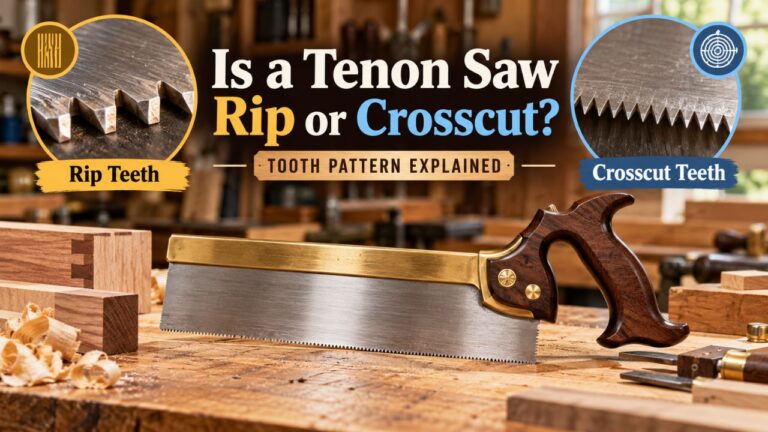
Some are filed primarily for rip cutting, meaning the teeth are optimized for cutting along the grain.
Others use crosscut or hybrid tooth patterns that work well across the grain.
Traditional joinery can require both types of cut.
For example, the cheeks of a tenon generally involve cutting approximately along the grain, while the shoulders are cross-grain cuts.
Manufacturers therefore offer different tooth patterns depending on the intended work.
For the average user, the main lesson is to match the saw to your cutting direction rather than assuming every tenon saw performs identically.
Tooth Count Matters Too
Finer teeth generally create smoother, more controlled cuts but remove material more slowly.
Coarser teeth cut faster and can handle thicker stock more efficiently, but the resulting surface may be rougher.
Very thin material benefits from relatively fine teeth because several teeth should ideally remain engaged in the workpiece rather than having one large tooth repeatedly catch the edge.
How Thick Can a Tenon Saw Cut?
Unlike a normal handsaw with an unrestricted blade, a tenon saw has a rigid spine along its upper edge.
That spine limits how deeply the blade can enter the workpiece.
Therefore, the maximum cutting depth is determined largely by the distance between the tooth line and the bottom of the spine.
Different saws have different blade depths, so there is no single maximum thickness that applies to every tenon saw.
Before cutting a thick board, compare its thickness with the usable blade depth.
If the stiffened back contacts the top of the board before the teeth finish the cut, the saw cannot pass completely through in the normal way.
This is one reason tenon saws are best suited to joinery and moderately sized stock rather than very deep lumber.
How to Get a Cleaner Cut With a Tenon Saw
The quality of your technique matters almost as much as the material.
Start by marking the cut accurately.
For precision joinery, a marking knife creates a much more exact reference than a thick pencil line. The scored line also severs surface fibers, helping reduce tear-out.
Place the workpiece securely on a bench hook or clamp it so it cannot move.
Begin with a few light strokes to establish the kerf.
Once the blade tracks correctly, use longer smooth strokes.
Avoid pushing downward aggressively.
A sharp saw should cut with moderate pressure.
Near the end of the cut, support the waste piece so it cannot break away and tear fibers from the finished component.
Let the Saw Track Naturally
One of the most common beginner errors is constantly twisting the handle to correct the cut.
If the kerf has been started accurately, the saw often tracks better when you relax your grip slightly and allow the blade to follow its established path.
If you need major correction, stop and reassess rather than forcing the blade sideways.
Tenon Saw vs. Other Saws for Different Materials
Understanding the limitations becomes easier when you compare a tenon saw with other common tools.
Tenon Saw vs. Hand Saw
A general-purpose hand saw is better for quickly cutting larger boards.
The tenon saw is better for small, accurate joinery and cleaner cuts.
Tenon Saw vs. Coping Saw
A coping saw has a narrow flexible blade that can cut curves.
A tenon saw has a wider rigid blade intended mainly for straight cuts.
If you need a curved shape, choose the coping saw.
Tenon Saw vs. Fret Saw
A fret saw has an extremely fine narrow blade and deep frame.
It excels at intricate curves and internal cutouts.
A tenon saw is much better for straight joinery cuts.
Tenon Saw vs. Hacksaw
A hacksaw is designed for metal and some plastics.
If your project involves steel or aluminum, choose the hacksaw rather than sacrificing the teeth on your tenon saw.
Tenon Saw vs. Miter Saw
A powered miter saw is faster for repeated crosscuts and trim work.
A tenon saw requires almost no setup, creates less noise and dust, and provides excellent control for small pieces and traditional joinery.
Best Materials for Beginners Learning to Use a Tenon Saw
If you are learning hand-saw technique, I recommend beginning with a reasonably straight piece of pine or another medium-soft wood.
It is easy enough to cut without demanding excessive effort but solid enough to show whether you are following your layout line accurately.
Practice making square crosscuts first.
Then try cutting to a knife line and using a bench hook.
Once you can consistently produce square cuts, move to harder woods and actual tenon joints.
Starting with expensive hardwood can make learning unnecessarily stressful, while extremely soft or damaged construction lumber sometimes behaves unpredictably.
Safety When Cutting Different Materials
A tenon saw is a hand tool, but it can still cause serious cuts.
Keep the workpiece stable before beginning.
Use a bench hook, vise, or clamp rather than holding small material directly in front of the blade.
Keep your free hand out of the cutting path.
Some woodworkers initially guide the blade with the thumb or knuckle of the non-sawing hand. If you use that traditional technique, maintain a controlled starting stroke and keep your fingers away from the teeth.
Eye protection is sensible when cutting brittle or composite materials that may produce chips.
Dust protection becomes more important with MDF and other manufactured boards.
Also inspect your material for hidden screws, nails, staples, or other metal before sawing reclaimed wood. Striking metal can damage the teeth and cause the saw to jump unexpectedly.
Important Tip: If you suddenly encounter unusually hard resistance while cutting wood, stop and check for a hidden fastener rather than forcing the saw through it.
Common Mistakes When Choosing Materials for a Tenon Saw
The first mistake is assuming that because the saw has steel teeth, it can cut steel materials. The blade material and the material it is designed to cut are completely different things.
Another mistake is using a tenon saw for large sheet goods. It may technically cut plywood or MDF, but a stiff-backed joinery saw is unnecessarily slow for long cuts.
People also sometimes use high-quality woodworking saws on abrasive materials such as cement board. That can destroy the sharp edge much faster than ordinary wood.
Finally, do not force the saw because a hardwood seems slow to cut. Slow progress usually calls for a sharper or more suitable saw, not dramatically more pressure.
FAQs About What Materials Can a Tenon Saw Cut
What materials can a tenon saw cut besides wood?
A tenon saw can cut several wood-derived materials such as plywood, MDF, hardboard, particleboard, and OSB. Certain thin plastics can also be cut carefully, although the saw is primarily intended for woodworking.
Can a tenon saw cut hardwood?
Yes. Tenon saws are excellent for hardwood joinery. Dense hardwood simply requires a sharp blade and controlled cutting technique.
Can a tenon saw cut softwood?
Yes. Pine, spruce, cedar, fir, and similar softwoods are easy to cut and are excellent materials for learning tenon-saw technique.
Can a tenon saw cut plywood?
Yes. It works particularly well for small, precise plywood cuts. A circular saw or track saw is generally better for cutting large sheets.
Can a tenon saw cut MDF?
Yes. A fine-tooth tenon saw can cut MDF accurately, although you should take appropriate precautions against fine MDF dust.
Can a tenon saw cut particleboard?
Yes, but particleboard edges may chip or crumble. Support the material and use smooth strokes.
Can a tenon saw cut OSB?
Yes, but a general-purpose or powered saw is usually faster for large construction panels.
Can a tenon saw cut plastic?
Some plastics, including certain PVC trim products, can be cut with a fine-tooth tenon saw. Brittle plastics such as acrylic require extra care and may be better cut with a plastic-specific blade.
Can a tenon saw cut PVC?
Yes, many small PVC pieces and trim products can be cut with a fine-tooth woodworking saw. Support the material well and use controlled strokes.
Can a tenon saw cut metal?
A conventional woodworking tenon saw is not recommended for metal. Use a hacksaw or another metal-cutting tool.
Can a tenon saw cut aluminum?
It is not recommended. Although soft aluminum may physically be cut by some saw teeth, doing so can damage or prematurely dull a woodworking tenon saw.
Can a tenon saw cut steel?
No. Use a saw designed specifically for steel, such as a hacksaw or metal-cutting bandsaw.
Can a tenon saw cut laminate flooring?
It can cut some laminate flooring, but the hard wear layer may dull the blade and chip. Other flooring-cutting tools are usually more practical for large projects.
Can a tenon saw cut drywall?
It can physically cut drywall, but I would not use a good woodworking tenon saw for it. A drywall saw or utility knife is the appropriate tool.
Can a tenon saw cut cement board?
It should not be your first choice. Cement board is highly abrasive and can rapidly damage fine woodworking teeth.
Can a tenon saw cut curves?
Not effectively. Its wide blade and rigid spine are designed for straight cuts. Use a coping saw, fret saw, jigsaw, or bandsaw for curves.
Can a tenon saw make rip cuts?
Yes, particularly if the teeth are filed for rip cutting. Some tenon saws use crosscut or hybrid teeth, so check the saw’s intended tooth configuration.
Is a tenon saw good for cutting a tenon joint?
Yes. That is one of its primary purposes. Its rigid back and fine teeth help create straight, accurate cuts for tenon cheeks and shoulders.
How thick can a tenon saw cut?
The maximum depth depends on the distance from the teeth to the stiffened back of the blade. Once the spine contacts the workpiece, the blade cannot cut significantly deeper in the normal manner.
Conclusion
So, what materials can a tenon saw cut? It is primarily designed for softwood, hardwood, plywood, MDF, hardboard, and other wood-based materials, especially when you need a straight and accurate cut for joinery.
Softwoods such as pine are easy to cut and excellent for beginners. Hardwoods such as oak, walnut, and maple take more effort but are perfectly suitable for a sharp tenon saw. Plywood and MDF can also be cut successfully when the pieces are reasonably sized and properly supported.
Some thin plastics, particularly PVC trim, can be cut with a fine-tooth tenon saw when necessary. However, I would keep a quality tenon saw away from steel, aluminum, concrete, brick, ceramic tile, cement board, and other materials that can rapidly damage its woodworking teeth.
The rigid spine that makes the saw so accurate also limits cutting depth, which means it is not intended for thick timber or large sheet goods. For those jobs, a general-purpose hand saw, circular saw, track saw, or another appropriate tool will usually be more efficient.
My recommendation is to treat the tenon saw as what it does best: a precision woodworking saw for straight, controlled cuts. Use it on solid wood and suitable wood composites, keep the teeth sharp, support the workpiece correctly, and switch to a material-specific saw when the project moves beyond woodworking.