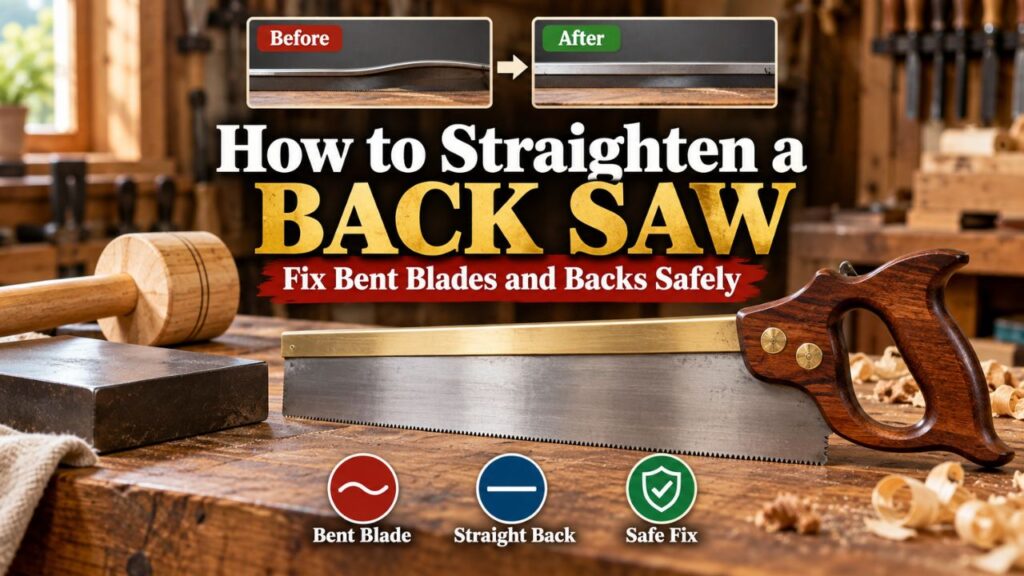
How to Straighten a Back Saw: Fix Bent Blades and Backs Safely
If you want to know how to straighten a back saw, first determine whether the problem is a flexible bend in the saw plate, a permanent kink, or a misaligned metal back. Minor alignment problems can sometimes be corrected by carefully repositioning the back and gently flexing the blade, but a sharply kinked, cracked, or badly deformed saw plate may be difficult or unsafe to repair. The key is to diagnose the cause before trying to force the blade straight.
Back saws—including tenon saws, dovetail saws, carcass saws, and some miter saws—are different from ordinary hand saws because a rigid spine runs along the top edge of the blade. That back keeps the thin saw plate under control and improves accuracy, but it also means a crooked saw can result from more than the plate itself.
Sometimes the blade looks bent because the brass or steel back has shifted. Sometimes the plate has been twisted through poor storage or rough handling. In other cases, the saw is perfectly straight but pulls during a cut because the teeth have uneven set or sharpening.
Straightening the wrong component can make the saw worse, so do not begin by hammering or aggressively bending the blade.
In this guide, I’ll explain how to diagnose a crooked back saw, straighten minor bends and twists, correct a misaligned spine, identify problems that are actually caused by the teeth, and decide when professional saw repair or replacement makes more sense.
How to Straighten a Back Saw Correctly
The safest approach is to work from the least aggressive correction to the most invasive.
Start by cleaning and inspecting the saw. Sight down the blade from several angles and determine whether the entire blade is bowed, twisted, locally kinked, or simply sitting crooked in the back.
Then check whether the problem disappears when the blade is lightly flexed.
A thin spring-steel saw plate can bend during handling and return naturally to shape. If it does not return, the plate or spine may have taken a permanent set.
Before making any adjustments, establish which of these conditions you have:
| Problem | What You May See | Likely Solution |
| Light temporary bend | Blade straightens when flexed | Usually no major repair needed |
| Back shifted on blade | Entire plate leans or bows consistently | Carefully reset the back |
| Gentle permanent bow | Smooth curve along much of blade | Controlled flexing may help |
| Blade twist | Toothline and back are not in same plane | Gentle counter-twist may help |
| Sharp kink | Localized crease or abrupt bend | Difficult repair; replacement may be better |
| Saw pulls only while cutting | Blade looks straight when sighted | Check tooth set and sharpening |
| Cracked or damaged plate | Visible crack or severe distortion | Replace or seek professional repair |
Do not assume that every saw that cuts crooked has a bent blade.
That distinction can save you from damaging a perfectly usable saw.
Inspect the Saw Before Trying to Bend Anything
Place the saw in good lighting and clean enough of the blade that you can clearly see reflections and edges.
Hold the handle at eye level and sight along the toothline.
Then turn the saw over and inspect it from the other side.
You are looking for changes in alignment rather than scratches or discoloration.
Check the Toothline
A properly aligned backsaw should have a toothline that appears reasonably straight from heel to toe.
A slight intentional curvature may exist on some saws, so do not automatically treat every non-flat toothline as damage.
What you are looking for is an unwanted sideways bend.
If the toothline veers left and then suddenly returns, you may have a kink.
If it curves gradually along a large portion of the saw, you may have a bow caused by the plate or back.
Check the Spine
Now look directly down the brass or steel back.
The back itself should not snake from side to side.
If the back is visibly curved, twisted, or sitting unevenly on the saw plate, correcting the spine may straighten the entire saw.
This is particularly important with traditional folded backs.
A folded brass or steel back grips the upper edge of the saw plate. If it has been knocked or shifted, it can place uneven tension on the plate and cause the toothline to bow.
Check for a Twist
Hold the saw so you can compare the toe and heel.
If the toe appears rotated relative to the heel, the plate may be twisted.
A twisted blade can make a saw feel unpredictable even if the toothline looks fairly straight from one angle.
A straightedge can help, but your eye is surprisingly useful when sighting along a polished saw plate.
Reflections also make twists easier to spot because a distorted reflection can reveal areas that are no longer in the same plane.
Key Takeaways:
- Determine whether the problem is the plate, back, or teeth before attempting a repair.
- A smooth bow, twist, and sharp kink require different approaches.
- If the saw looks straight but cuts crooked, inspect the tooth set before bending the blade.
Clean the Blade Before Straightening It
A dirty or rusty saw is harder to inspect accurately.
Remove loose dirt, dried resin, and light surface rust before judging whether the plate is truly deformed.
You do not need to polish the blade like a mirror.
The goal is simply to make its outline, reflection, and contact with the back easy to see.
For light dirt, a suitable cleaner and cloth may be enough.
For surface rust, fine abrasive material used carefully with an appropriate lubricant can help, provided you avoid damaging etched markings or decorative details on a valuable saw.
Dry the saw completely afterward and apply a very light protective coating appropriate for hand tools.
Cleaning will not straighten the blade, but it helps prevent you from misinterpreting rust buildup or grime as a deformation.
How to Straighten a Slightly Bent Back Saw Blade
A smooth, mild bend is the easiest type of deformation to address.
The saw plate is typically made from hardened spring steel. It can flex considerably during normal use without permanently bending.
If it has taken a mild set, careful flexing in the opposite direction may help.
Use Controlled Hand Pressure
Hold the saw securely by the handle.
Support the blade with your other hand well away from the teeth.
Flex the blade gently in the direction opposite the bow.
Use only a small amount of movement at first.
Release the pressure and sight down the blade again.
The key is gradual correction.
Do not attempt to reverse a visible curve in one dramatic bend.
Spring steel can suddenly kink if forced too far.
Several small corrections are safer than one aggressive attempt.
Work Over a Broad Area
If the bend extends over much of the blade, apply corrective force over a broad section rather than concentrating all the pressure at one tiny point.
Localized force can create a new crease.
Think of the goal as encouraging the plate back into alignment, not folding it in the opposite direction.
Recheck Frequently
After every correction, stop and inspect.
Do not keep flexing based on how the blade felt.
It is easy to overcorrect a thin saw plate.
If the curve changes direction and the blade begins bowing the opposite way, you have gone too far.
Important Tip: Wear gloves if appropriate for handling the blade, but do not allow bulky gloves to reduce your control. The saw teeth remain sharp even when the tool is not moving.
How to Correct a Twisted Back Saw
A twist is different from a simple sideways bow.
With a twist, one portion of the saw plate is rotated relative to another.
This can happen if the saw was stored under sideways pressure, dropped, or forced in a cut.
A minor twist may be corrected with careful counter-twisting.
Secure the handle and support the plate with your other hand.
Apply very light rotational pressure in the direction opposite the twist.
Then release and inspect.
Again, the movements should be small.
Do not clamp the saw aggressively in a vise and wrench the blade around unless you fully understand how the plate and back are constructed.
A backsaw blade is thin, and a vise can easily create a localized bend.
Correct the Cause, Not Only the Symptom
If the twist originates at the back, twisting the plate alone may not solve the problem.
Inspect how the spine sits on the blade.
If the back itself is visibly rotated or uneven, address that alignment instead.
This is especially important on vintage saws with folded backs.
How to Straighten a Back Saw With a Misaligned Spine
A misaligned back is one of the most important backsaw-specific problems.
The spine does more than make the saw rigid.
On many traditional saws, the back also influences the tension and alignment of the plate.
A shifted back can pull the saw plate into a bow.
How to Tell if the Back Is Causing the Bend
Sight along both the toothline and the spine.
If they curve together, the back may be responsible.
Another clue is a bend that appears smooth and consistent instead of being concentrated around a damaged spot.
Look at how deeply and evenly the plate enters the back from heel to toe.
If one section appears seated differently from the rest, the back may have moved.
Resetting a Folded Back
Traditional folded brass and steel backs can sometimes be carefully repositioned.
This is a delicate operation.
The basic principle is to move the back rather than trying to bend the thin plate around it.
Place the saw on a stable wooden surface that will not damage the tool.
Using a wooden block or other non-marring intermediary, apply very light corrective taps to the back where adjustment is needed.
A small hammer may be used against the block, but avoid striking the brass or steel spine aggressively or directly with a hard hammer.
Small changes can have a surprisingly large effect on the blade.
After a few light adjustments, sight down the saw again.
Do not continue tapping automatically.
Why This Technique Requires Caution
Moving one part of a folded back changes tension in nearby sections.
You may straighten one area while creating a curve somewhere else.
Older saw backs can also be brittle, cracked, or previously repaired.
If the saw is valuable, antique, or unfamiliar, professional saw restoration is safer than experimenting with heavy hammer blows.
Slotted or Bonded Backs
Not all backsaws use a traditional folded metal back.
Some modern saws have slotted, molded, bonded, or otherwise mechanically different spines.
Do not assume a tapping method intended for a folded brass back can be used on a modern composite or permanently bonded spine.
Check how your saw is constructed before trying to reposition anything.
Key Takeaways:
- A shifted or twisted back can make an otherwise good saw plate look bent.
- Traditional folded backs may sometimes be adjusted with very light, controlled tapping.
- Do not use a folded-back repair method on a modern bonded or molded spine unless the construction allows it.
Can You Hammer a Bent Saw Blade Straight?
Hammering a saw plate is possible in skilled saw restoration, but I would not recommend it as the first DIY method.
Saw smiths can use controlled hammering to tension and straighten saw plates, but the technique requires an understanding of how hammer blows stretch steel.
An incorrect strike can make the distortion significantly worse.
Why Hammering Is Risky
A hammer blow does not merely push steel flat.
It can stretch the metal locally.
That changes internal stresses in the plate.
If you stretch the wrong area, you may create oil-canning, waviness, or a permanent buckle.
Thin backsaw plates are especially unforgiving.
For a mild household-tool bend, controlled hand correction or resetting a shifted back is usually safer.
If the blade requires actual hammer tensioning, professional saw repair is often the better choice.
What to Do With a Kinked Back Saw Blade
A kink is a sharply localized bend.
Unlike a broad bow, the metal has taken a distinct crease.
This is much harder to repair.
You may be able to reduce a very mild kink through careful controlled bending, but restoring the plate perfectly is difficult because the steel has already yielded at that point.
Signs of a Serious Kink
Sight down the toothline.
If it changes direction abruptly over a very short distance, you probably have a kink rather than a smooth bow.
You may also see a crease or localized reflection change in the plate.
Running a straightedge along the plate can help reveal it.
Should You Keep Using a Kinked Saw?
A small kink may still allow usable rough work.
For fine joinery, however, it can continually steer the kerf away from your line.
Trying to force the saw straight during each stroke will make accurate work frustrating.
If the plate is replaceable, replacing it may make more sense than spending hours trying to correct severe damage.
For a valuable vintage saw, a specialist may be able to restore it.
For an inexpensive modern saw, replacement is often the practical option.
What if the Saw Is Straight but Still Cuts Crooked?
This is extremely common.
A saw that consistently pulls left or right is not necessarily bent.
Uneven tooth set is often the real cause.
What Is Tooth Set?
Saw teeth are bent alternately slightly left and right.
This creates a kerf wider than the saw plate so the blade does not bind in the cut.
If one side has more set than the other, the saw may naturally steer toward one side.
For example, excessive set on one side can make the saw track unevenly even though the plate itself is perfectly straight.
Uneven Sharpening Can Also Cause Pulling
If teeth on one side are sharper, larger, or shaped differently, they can remove wood unevenly.
The result feels like a crooked blade.
Before bending a saw because it pulls during cuts, inspect the toothline and test it in scrap wood.
If the saw looks physically straight when sighted but repeatedly drifts the same direction under light pressure, sharpening or set deserves investigation.
Do Not Fix Tooth Problems by Bending the Blade
This can create two problems instead of one.
Correct the tooth geometry rather than deforming an otherwise straight saw.
If you do not sharpen hand saws yourself, a professional saw sharpener can usually identify uneven set very quickly.
How to Test a Back Saw After Straightening
Do not immediately use the repaired saw on an important joint.
Test it on straight-grained scrap.
Mark a square line across the face and edge.
Place the work securely in a vise or on a bench hook, depending on the cut.
Start with light strokes and let the saw follow its natural kerf.
Do not deliberately steer it sideways to compensate for previous problems.
After the cut, inspect the result with a square.
Check the Blade Again
The saw may look straight while sitting still but behave differently once cutting pressure is applied.
After several test cuts, sight down the plate again.
If the bend returns, the underlying back or plate tension may still be incorrect.
If the saw remains straight but cuts to one side, turn your attention to tooth set, sharpening, and technique.
How Your Sawing Technique Can Look Like a Bent-Saw Problem
Not every crooked cut comes from the tool.
Body position matters.
If your shoulder, elbow, and wrist do not move in line with the cut, you may push the saw sideways.
Gripping the handle too tightly can also make you twist the blade.
Use a Relaxed Grip
Hold the saw securely but not aggressively.
Your index finger can point forward along the handle if the design makes that comfortable.
This helps orient the saw and encourages a straight stroke.
Align Your Body With the Cut
Stand so your sawing arm can move forward and backward naturally.
If your arm swings across your body, the saw may gradually drift sideways.
Avoid Excessive Downward Pressure
A sharp backsaw needs very little downward force.
Pushing hard increases friction and magnifies any sideways force from your hand.
If the saw only cuts when you press aggressively, sharpening may be more important than straightening.
Key Takeaways:
- A saw that pulls during cutting may have uneven tooth set rather than a bent plate.
- Test a repaired saw on scrap before using it for important joinery.
- Grip, stance, and excessive downward pressure can also create crooked cuts.
Should You Remove the Back to Straighten the Saw?
Usually not.
Removing the back is a more advanced restoration operation.
A traditional folded back may grip the plate tightly, and removing it can alter the saw’s tension, damage the plate, or make reassembly difficult.
On some vintage saws, the back may also contribute significantly to keeping the blade properly tensioned.
Unless you are restoring a valuable saw and understand the construction, try less invasive corrections first.
If the spine is severely deformed and cannot be corrected while installed, professional repair may be warranted.
For an inexpensive saw, replacement may be more economical than a complete disassembly.
Can You Straighten a Brass Back?
A brass back can sometimes be corrected if it has only a mild bend.
Brass is softer than hardened saw steel, but that does not mean it should be hammered aggressively.
Support the back properly and make small corrections.
A wooden block between the hammer and brass helps reduce marking.
Be aware that old brass can crack, especially around existing stress points.
If the back has a sharp crease, split, or significant distortion, stop before making the damage worse.
A vintage tool specialist is better equipped to assess whether the back can be restored.
Can You Straighten a Steel-Backed Saw?
Yes, minor steel-back alignment problems may sometimes be corrected in much the same way as a folded brass back.
However, steel backs can be harder and less forgiving.
The exact repair depends on whether the back is folded, slotted, welded, bonded, or part of a modern molded assembly.
Do not assume all steel-backed saws are constructed like traditional backsaws.
How to Prevent a Back Saw From Bending Again
Good storage is easier than straightening.
Do not throw a backsaw loose into a toolbox where heavier tools can press against the blade or spine.
Store it in a saw till, rack, protective sleeve, or other location where the plate cannot be bent sideways.
Avoid hanging the saw in a way that puts continuous pressure on the blade.
Keep the blade clean and dry to prevent rust, particularly around the junction between plate and back.
When sawing, do not force a blade that has become trapped in the kerf.
If the saw binds, stop and determine why.
Twisting the handle sideways while the plate is trapped can permanently distort a thin backsaw.
Transport the Saw Carefully
A backsaw carried loose in a vehicle or jobsite tool box can easily be damaged.
Protect the toothline and prevent the saw from being crushed under heavier tools.
A simple wooden or plastic blade guard also protects both the teeth and anyone reaching into the tool box.
When Should You Replace a Bent Back Saw?
Straightening is worthwhile when the saw is good quality, historically valuable, easy to correct, or equipped with a plate that can reasonably be restored.
Replacement makes more sense when the damage is severe and the saw is inexpensive.
I would seriously consider replacement if the saw has a cracked plate, multiple sharp kinks, badly distorted non-serviceable spine, loose or damaged handle combined with blade damage, or extensive corrosion that has substantially weakened the steel.
Also consider the cost of professional restoration.
Restoring a high-quality vintage tenon or dovetail saw can be worthwhile.
Paying specialist restoration costs for a low-cost disposable hard-point saw usually does not make financial sense.
Common Mistakes When Straightening a Back Saw
The biggest mistake is using too much force too quickly.
Thin spring steel can go from “slightly bent” to “permanently kinked” in an instant.
Another mistake is assuming the plate is responsible when the back has actually shifted.
Likewise, bending a straight plate to compensate for uneven tooth set can ruin an otherwise good saw.
Avoid clamping thin sections of the blade tightly between bare steel vise jaws. The jaws can introduce localized creases or scratches.
If support or clamping is necessary, use appropriate wooden jaw protection and spread the load over a larger area.
Finally, do not expect every damaged saw to return to factory-perfect condition.
Sometimes the safest and most practical repair is to reduce the defect enough for reliable use.
FAQs about How to Straighten a Back Saw
Can a bent back saw be straightened?
Yes, many mildly bent backsaws can be corrected.
The success of the repair depends on whether the problem is a smooth blade bow, twist, shifted back, or permanent kink.
How do I know whether the blade or back is bent?
Sight along both the toothline and spine.
If the entire blade follows the curve of a visibly misaligned back, the spine may be causing the problem.
A localized bend in the plate away from the spine is more likely to be plate damage.
Can I bend the blade back by hand?
A mild smooth bend can sometimes be corrected with careful hand pressure in the opposite direction.
Make small adjustments and inspect after each one.
Do not sharply fold the blade.
Should I hammer a bent saw blade?
Not as a first repair method.
Hammer straightening and tensioning saw plate is a specialist technique that can make the distortion worse if done incorrectly.
Can you straighten a kinked saw?
Sometimes a minor kink can be reduced, but a sharp permanent crease is difficult to restore completely.
Replacement or professional restoration may be the better solution.
Why does my backsaw keep cutting to one side?
Uneven tooth set, uneven sharpening, poor technique, or blade deformation can all cause pulling.
If the plate looks straight, inspect the teeth before trying to bend anything.
Can the brass back of a tenon saw be straightened?
Minor bends in a traditional folded brass back can sometimes be corrected carefully.
Use small adjustments and avoid aggressive direct hammer blows.
How do you straighten a tenon saw?
Diagnose whether the tenon saw has a bowed plate, twist, misaligned spine, or tooth-set problem.
Minor plate bends may respond to controlled flexing, while a shifted folded back may need careful repositioning.
Can I straighten a dovetail saw the same way?
The basic diagnostic principles are similar because a dovetail saw is also a backsaw.
However, its plate may be thinner, making aggressive bending even more likely to cause damage.
Why does my saw blade look wavy?
A wavy plate may have uneven internal tension, multiple bends, corrosion damage, or previous poor repair.
This condition is more complicated than one smooth bow and may require professional tensioning.
Can I use a vise to straighten the blade?
A vise can provide support, but clamping a thin saw plate directly between hard jaws can create new damage.
If a vise is used, protect the blade with wooden jaws and avoid localized excessive pressure.
Should a tenon saw blade be perfectly rigid?
No.
The back makes the saw much stiffer than an ordinary unsupported thin blade, but the exposed saw plate still has some flexibility.
Flexibility itself is not evidence of damage.
How can I tell if a saw is straight enough?
Sight along the toothline and back, then test the saw on scrap.
If it follows a marked line naturally without persistent pulling and produces a square cut, minor cosmetic irregularities may not matter.
Can rust make a saw bend?
Surface rust alone generally does not bend the blade, but severe corrosion can weaken and pit the plate.
Heavy corrosion around the back can also complicate restoration.
Is it worth repairing an old back saw?
A quality vintage saw with good steel, a solid handle, and resharpenable teeth can absolutely be worth repairing.
A severely damaged low-cost modern saw may be cheaper and more practical to replace.
Conclusion
Learning how to straighten a back saw starts with diagnosing the problem correctly. A saw that looks or cuts crooked may have a gently bowed plate, a twist, a shifted brass or steel back, a localized kink, or simply uneven tooth set.
For a mild smooth bend, I recommend starting with controlled hand pressure and making only tiny corrections. Inspect the blade after every adjustment instead of trying to bend it straight in one attempt.
If the entire blade follows a crooked traditional folded back, the spine may need careful repositioning. Very light adjustments using a non-marring block can sometimes restore alignment, but aggressive hammering can quickly create more damage.
A sharply kinked, cracked, or badly distorted plate is a different problem. Those defects are difficult to repair reliably, and professional restoration or replacement may make more sense.
Most importantly, do not bend a saw simply because it cuts to one side. If the plate and back look straight, check tooth set, sharpening, and your sawing technique first. A correctly sharpened, properly aligned backsaw should track naturally with little downward force, and fixing the true cause will produce a much better result than forcing a straight blade into a new bend.