What Saw Is Best for Cutting Laminate Flooring? Full Guide
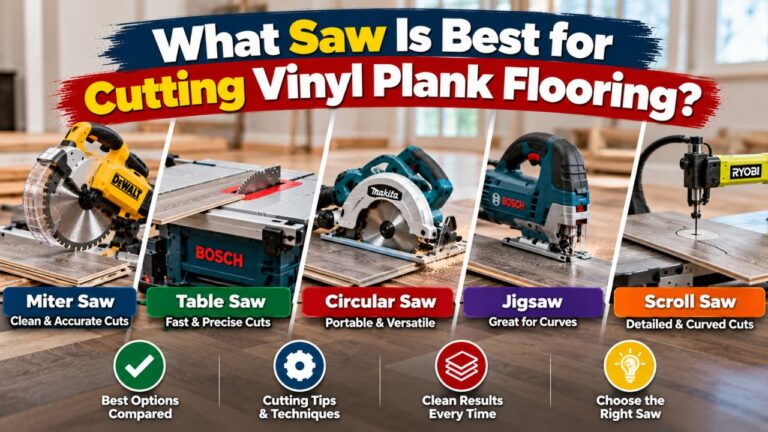
If you are wondering what saw is best for cutting laminate flooring, a miter saw is the best choice for fast, clean crosscuts, while a circular saw is the most versatile single saw for an entire installation. A jigsaw is better for curved cuts and notches, and a table saw or track saw is excellent for long rip cuts. For most DIY projects, I recommend using a miter saw for shortening planks and a jigsaw or circular saw for the cuts a miter saw cannot make.
Laminate flooring looks similar to wood, but it behaves differently when cut. Its hard wear layer can be abrasive on saw blades, and the decorative surface can chip if you use a coarse or dull blade. Choosing the correct saw is therefore only half of the equation. You also need an appropriate blade and the correct cutting technique.
No single saw is perfect for every flooring cut. During one installation, you may need to shorten planks, rip the first and last rows lengthwise, cut around pipes, make notches at doorways, and occasionally follow an irregular wall. Each of those jobs favors a different tool.
In this guide, I’ll explain which saw is best for cutting laminate flooring, compare miter saws, circular saws, jigsaws, table saws, and track saws, and show you which tool makes the most sense for each type of cut. I’ll also cover blade selection, chip prevention, plank orientation, and the setup I recommend for a complete DIY installation.
What Saw Is Best for Cutting Laminate Flooring?

For the most common flooring cut—shortening a plank across its width—a miter saw is the best overall choice.
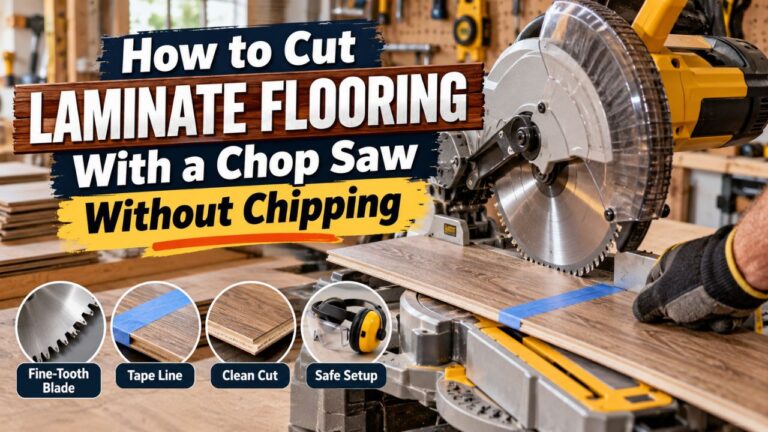
It makes fast, accurate, repeatable crosscuts and can also make angled end cuts when walls are not square. A sliding miter saw is particularly useful because modern laminate planks can be too wide for the crosscut capacity of a small non-sliding model.
However, a miter saw cannot make a long rip cut down the entire length of a plank. That means it cannot handle every task in a typical flooring installation.
If you want to buy only one saw, I would choose a circular saw instead. It can make both crosscuts and long rip cuts, and it is less expensive and more portable than many miter or table saws. You simply need a straightedge guide when accuracy matters.
A jigsaw is the best specialist tool for curved and irregular cuts. It is especially useful around door frames, heating pipes, vents, corners, and other obstructions.
Best Saw by Type of Laminate Flooring Cut
| Type of Cut | Best Saw |
| Normal straight crosscut | Miter saw |
| Repeated plank crosscuts | Sliding miter saw |
| Long rip cut | Table saw, track saw, or circular saw |
| One-saw DIY setup | Circular saw |
| Curves and irregular shapes | Jigsaw |
| Pipe or vent cutouts | Jigsaw |
| Angled end cuts | Miter saw |
| Professional straight rip cuts | Track saw or table saw |
| Occasional cuts without power | Fine-tooth handsaw |
There is no need to own every tool in the table. A circular saw plus a jigsaw can handle an entire room. Adding a miter saw mainly makes repeated crosscuts faster and easier.
Key Takeaways:
- A miter saw is best for the repeated crosscuts required during most laminate installations.
- A circular saw is the best single all-purpose saw if you want to use only one main power saw.
- A jigsaw is the best complementary tool for curves, notches, and other irregular cuts.
Why Laminate Flooring Needs the Right Saw and Blade
Laminate is not simply a piece of soft wood with a printed finish.
Most laminate flooring has a dense fiberboard core topped with a decorative layer and a durable wear surface. That wear layer is intentionally designed to resist abrasion from foot traffic, dirt, furniture, and everyday use.
Unfortunately, the same durability that makes laminate flooring long-lasting can make it hard on cutting tools.
A coarse blade may cut through the plank quickly but leave chips along the decorative edge. A dull blade can make those chips worse and may also produce excessive heat or require more feed pressure.
For that reason, a good flooring setup combines the right saw with a sharp, fine-cutting blade.
Clean Cuts Matter Even When Trim Covers the Edge
Many perimeter cuts eventually disappear underneath baseboard, shoe molding, or transition trim. A tiny amount of chipping in those locations may never be visible.
However, cleaner cuts are still preferable.
A clean edge is easier to fit accurately, particularly around transitions, doorways, and other exposed areas. It also reduces the chance of damaging the click-lock profile near the cut.
You do not need furniture-grade perfection on every hidden edge, but you should avoid tearing chunks out of the decorative surface.
Miter Saw: Best for Laminate Flooring Crosscuts
A miter saw is my first choice for cutting laminate planks to length.
During installation, nearly every row requires an end plank that must be shortened. This can mean dozens of crosscuts in a single room.
A miter saw turns those repetitive cuts into a quick operation.
Measure the required length, mark the plank, place it against the saw fence, align the blade, and make the cut. There is no need to clamp a guide for every board.
Why a Sliding Miter Saw Is Even Better
Laminate planks are available in many widths.
A non-sliding miter saw can cut only as far across a plank as the blade and pivoting mechanism allow. A sliding miter saw moves along rails and therefore has considerably greater crosscut capacity.
If you are buying a saw specifically for flooring and expect to work with wider planks, I would favor a sliding model.
It is also useful for other home-improvement work such as cutting baseboard, door trim, and molding after the floor is installed.
Can a Miter Saw Make Angled Cuts?
Yes, and this is one of its main advantages.
If a wall meets the flooring at an angle, rotate the saw table to the required miter setting and make an accurate angled crosscut.
Always measure the actual angle rather than assuming every corner in a house is exactly square. Small deviations are common.
Limitation of a Miter Saw
A miter saw cannot make a full-length rip cut.
When the final flooring row needs to be reduced from, for example, 7 inches wide to 3½ inches wide along the entire plank, you need another tool.
A circular saw, table saw, or track saw is better for that job.
Circular Saw: Best Single Saw for a DIY Installation
If someone told me I could take only one power saw to a laminate-flooring project, I would take a circular saw.
It is not as convenient as a miter saw for repeated crosscuts, but it is significantly more versatile.
A circular saw can shorten a plank, rip it lengthwise, make angled straight cuts, and trim wide planks that exceed a small miter saw’s capacity.
It is also relatively affordable and easy to transport.
Using a Circular Saw for Crosscuts
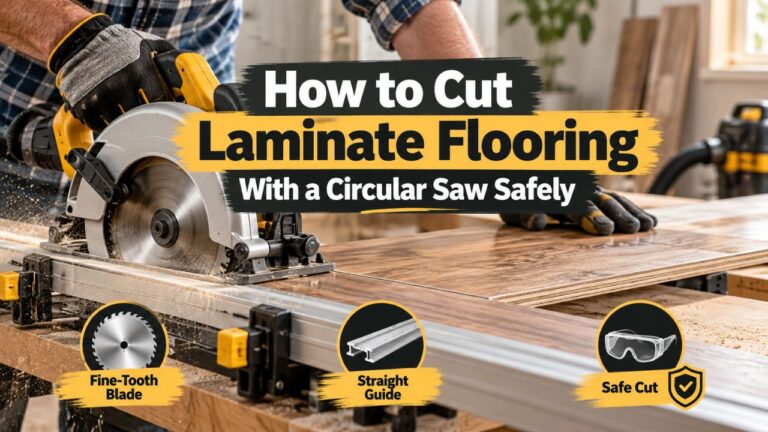
For a simple plank crosscut, mark the cut line with a square and guide the saw across it.
For greater precision, clamp a straightedge or square to the flooring and let the saw base ride against it.
This is slower than placing each plank on a miter saw, but the result can be equally accurate.
Using a Circular Saw for Rip Cuts
This is where the circular saw becomes especially valuable.
The first and last flooring rows often need to be narrowed lengthwise. Clamp a straightedge parallel with your cut line and guide the saw along it.
Remember that the edge of the circular-saw base is offset from the blade. Measure that offset before positioning the guide.
With a properly placed straightedge, a circular saw can produce a long, straight rip without a table saw.
Circular Saw Face Orientation
With a conventional handheld circular saw, the blade generally cuts upward through the plank.
Because splintering tends to occur where the teeth exit the material, the decorative face is commonly placed down when using a standard circular saw.
Blade designs vary, so test a scrap piece before making important cuts.
This orientation is different from a conventional miter saw, where the decorative surface is normally placed face up.
Key Takeaways:
- Choose a miter saw when your priority is speed and repeated crosscuts.
- Choose a circular saw when you need one tool capable of both crosscuts and rip cuts.
- Blade rotation affects which side of the plank should face up or down.
Jigsaw: Best for Curves, Corners, Pipes, and Notches
A jigsaw is one of the most useful secondary tools during a laminate-flooring installation.
It is not my first choice for long straight cuts, but a circular or miter saw cannot easily duplicate what a jigsaw does around obstacles.
The narrow blade allows you to change direction during the cut.
That makes a jigsaw ideal for fitting flooring around heating pipes, floor vents, door openings, columns, irregular walls, and other shapes.
Cutting Around Pipes
Measure the center of the pipe carefully and transfer the position to the plank.
Depending on the installation, you may use a hole saw for the round opening and then make an additional cut from the plank edge to the hole, or use the jigsaw for the complete shape.
Remember to provide any clearance required by the flooring manufacturer’s installation instructions.
A pipe escutcheon or trim piece can conceal the final expansion space.
Cutting Rectangular Openings
For a vent or similar opening, mark the shape carefully.
Drill a starter hole large enough for the jigsaw blade if necessary, then cut along the marked lines.
Do not try to plunge an ordinary jigsaw blade into the middle of a plank unless the saw and blade are specifically intended for that technique.
Jigsaw Blade Direction Matters
Most standard jigsaw blades have teeth that cut on the upward stroke.
That can chip the upper decorative surface.
With a standard up-cut blade, placing the decorative side down usually gives the visible surface a cleaner edge.
Another option is a reverse-tooth or down-cut blade, which is designed to reduce chipping on the upper surface when cutting face up.
Down-cut blades can feel different because the cutting force tends to push the saw away from the workpiece. Keep the saw firmly controlled and follow the blade manufacturer’s directions.
For laminate, I recommend a fine-tooth blade designed for clean cuts in laminate, hardwood, or similar material.
Table Saw: Best for Repeated Rip Cuts
A table saw is excellent for cutting laminate flooring, but I would not call it the best tool for every homeowner.
Its biggest advantage is making long, straight, repeatable rip cuts.
If you need to narrow an entire row of planks to the same width, set the fence once and pass each plank through the saw.
That can be much faster than measuring and clamping a circular-saw guide repeatedly.
When a Table Saw Makes Sense
A table saw is especially useful for contractors, frequent remodelers, or homeowners who already own one.
It is also helpful when the first and last rows require several identical width cuts.
However, buying a full-size table saw solely for one laminate floor usually does not make sense.
A circular saw and straightedge can perform the same basic rip-cutting job for far less money and storage space.
Table Saw Safety With Narrow Flooring
Long, narrow flooring planks require careful control around a table saw.
Use appropriate push devices, guards, and the riving knife according to the saw manufacturer’s instructions.
Never place your hands close to the blade merely because the workpiece is relatively small.
Laminate flooring can also produce fine dust, so use dust extraction where possible and appropriate respiratory protection.
Track Saw: Best for Premium Straight Cuts
A track saw is arguably the nicest portable tool for long laminate flooring rip cuts.
It combines the portability of a circular saw with a dedicated guide rail.
The track makes it easy to create extremely straight cuts, and many track-saw systems include effective splinter-control features.
For professional installers or homeowners already invested in a track-saw system, it is an excellent flooring tool.
Is a Track Saw Better Than a Circular Saw?
For straight guided cuts, generally yes.
It is faster to align, less likely to wander, and usually produces a cleaner edge.
But it costs considerably more than a basic circular saw.
For a single bedroom or living-room project, I would not buy a premium track saw solely to cut laminate unless you also expect to use it for cabinetry, plywood, doors, or other projects.
A circular saw with a well-clamped straightedge can produce an excellent flooring cut.
Can You Use a Handsaw for Laminate Flooring?
Yes.
Laminate flooring can be cut with a suitable fine-tooth handsaw.
This method is inexpensive, quiet, and produces very little airborne dust compared with power cutting.
For a small repair or a few planks, a handsaw can be a sensible option.
For an entire room, however, it becomes slow and tiring.
You may need to make dozens of cuts, and maintaining square, clean results by hand requires practice.
If you choose a handsaw, secure the plank well, mark the line accurately, and begin with short controlled strokes before lengthening the stroke.
What About a Manual Laminate Flooring Cutter?
A manual flooring cutter deserves consideration even though it is technically a cutter rather than a saw.
These tools use leverage to shear laminate flooring rather than cutting it with a rotating blade.
Their biggest advantage is low dust and low noise.
That makes them attractive for indoor work where carrying every plank outdoors to a saw station would be inconvenient.
However, compatibility varies significantly by flooring product. Some laminate manufacturers or particular products do not recommend certain cutters, especially with thick or unusually hard planks.
Check whether the cutter is approved for the exact flooring you are installing.
A manual cutter is also much less versatile than a saw. Irregular notches and some precision angled cuts still require another tool.
What Blade Is Best for Cutting Laminate Flooring?
No matter which powered saw you choose, the blade has an enormous effect on cut quality.
For miter and circular saws, use a sharp fine-tooth carbide finishing blade or a blade specifically designed for laminate and other abrasive flooring products.
For a typical 10-inch miter saw, approximately 60 to 80 teeth is a practical fine-finish range. Specialized laminate blades may use different tooth designs or materials, so the manufacturer’s intended application matters more than chasing a specific tooth count.
For a jigsaw, use a fine-tooth laminate or clean-cut blade.
Why Laminate Dulls Blades
Laminate’s wear surface is intentionally abrasion resistant.
That means it can wear conventional woodworking blade edges more quickly than ordinary softwood.
During a large installation, pay attention to changing cut quality.
If the same setup suddenly begins chipping, burning, or requiring much more pressure, your blade may be losing its edge.
A dull fine-tooth blade can produce a worse cut than a sharp blade with a slightly lower tooth count.
How to Avoid Chipping Laminate Flooring
A sharp blade is your most important defense against chipped decorative edges.
The next factor is plank orientation.
For a standard downward-cutting miter saw, I generally start with the finished side up.
For a conventional circular saw whose teeth travel upward through the material, I generally start with the finished side down.
With a jigsaw, orientation depends on whether the blade cuts on the upstroke or downstroke.
Because blade geometry varies, always make a test cut with your exact flooring and saw.
Painter’s tape placed across the cut line can also support the decorative surface and make pencil marks easier to see.
For especially important exposed cuts, you can lightly score the finish along the cut line with a sharp utility knife before sawing.
Do not rush the cut. Let the blade do the work rather than forcing it aggressively through the flooring.
Key Takeaways:
- A sharp fine-tooth blade matters as much as the saw itself.
- Test the decorative-side orientation before cutting expensive full planks.
- Painter’s tape and controlled feed speed can further reduce small chips.
What Saw Setup Do I Recommend for an Entire Laminate Floor?
For a typical DIY installation, my preferred setup is a miter saw plus a jigsaw.
The miter saw handles the large number of straight end cuts quickly. The jigsaw takes care of doorways, pipes, vents, and odd shapes.
You still need a solution for lengthwise rip cuts along the first or last row.
If you own a circular saw, that completes an extremely capable three-saw setup.
If you do not own one, you can often make the limited number of rip cuts with a jigsaw and straightedge, although the result takes more patience.
Best Budget Setup
For someone starting from scratch and trying to keep expenses down, I would buy or borrow:
A circular saw and a jigsaw.
The circular saw handles straight cuts in either direction, while the jigsaw handles irregular cuts.
You sacrifice some of the speed of a miter saw, but you can still complete the entire flooring installation.
Best Convenience Setup
For a larger room or multiple rooms, I prefer:
Sliding miter saw + circular saw + jigsaw.
You can keep the miter saw at a dedicated cutting station for fast crosscuts and use the other two tools only when necessary.
Best Professional Setup
For repeated installations, a sliding miter saw combined with a track saw or table saw and a jigsaw provides excellent speed and accuracy.
Professional installers may also use a compatible manual flooring cutter indoors to reduce dust.
Which Saw Should a Beginner Choose?
For a beginner who only wants one tool, the circular saw provides the best combination of price and versatility.
However, a miter saw is arguably easier to use for repeated crosscuts because the workpiece stays on a fixed table and the blade follows a controlled path.
If the installation already has access to a miter saw and you only need a handful of rip cuts, use the miter saw rather than buying a different tool just because a circular saw is technically more versatile.
The best tool is often the one that safely performs the cuts you actually need.
Which Saw Is Best for Wide Laminate Planks?
For crosscutting wide planks, use a sliding miter saw or circular saw.
Before assuming your miter saw can handle the flooring, check its specified crosscut capacity at 90 degrees.
Do not force a plank into a saw that cannot cut through its full width.
Trying to make half a cut, flip the plank, and finish from the opposite side can produce a misaligned edge unless your setup is extremely accurate.
For exceptionally wide planks, a guided circular saw is simple and effective.
Which Saw Is Best for the First and Last Rows?
The first and last rows often require lengthwise cuts.
A table saw, track saw, or guided circular saw is the best choice.
If the wall is crooked and the width varies significantly along the plank, a jigsaw can be useful because it can follow an irregular scribed line.
Remember to include the expansion clearance specified by the flooring manufacturer.
Do not cut the final row to fit tightly against the wall simply because the baseboard will cover it.
Common Mistakes When Choosing a Saw for Laminate Flooring
One common mistake is buying a saw based solely on one type of cut.
A miter saw may look like the obvious answer until you reach the final row and discover that it cannot rip a 4-foot plank lengthwise.
Another mistake is spending heavily on the saw while using the cheapest coarse blade available. For laminate, blade quality can have a larger effect on chipping than upgrading from one competent saw to another.
Some installers also try to make long, straight cuts with a jigsaw because it is the only saw available. A jigsaw can do it, but maintaining a perfectly straight line over the full plank length is harder.
Finally, avoid using a metal-cutting abrasive chop saw simply because it resembles a miter saw. A wood-cutting miter saw with an appropriate toothed blade is the proper tool.
Safety When Cutting Laminate Flooring
Power saws used for flooring can cause severe injuries, so use each tool according to its manufacturer’s instructions.
Wear eye protection and keep guards installed.
Hearing protection is appropriate when making repeated power-saw cuts.
Laminate cutting can create substantial fine dust. Use dust collection where practical and appropriate respiratory protection, particularly if you are making many cuts indoors.
Support long planks securely so they cannot tilt or pinch the blade.
Never reach for an offcut while the blade is moving.
With a miter saw, allow the blade to stop before raising the saw head when practical. With circular and track saws, wait for the blade to stop before setting the tool down.
FAQs about What Saw Is Best for Cutting Laminate Flooring
What is the best saw for cutting laminate flooring?
For repeated crosscuts, a miter saw is the best choice. For overall versatility, a circular saw is the best single saw because it can make both crosscuts and rip cuts.
Is a miter saw good for laminate flooring?
Yes. A miter saw is excellent for quickly shortening laminate planks and making angled end cuts.
A sliding miter saw is especially useful for wide planks.
Is a circular saw good for laminate flooring?
Yes. A circular saw is one of the most versatile flooring saws and can make both crosscuts and long lengthwise cuts when used with a guide.
Can I cut laminate flooring with a jigsaw?
Yes. A jigsaw is the best choice for curves, pipe cutouts, vents, notches, and irregular shapes.
It can make straight cuts too, but other saws are usually faster and more accurate for long lines.
What blade is best for laminate flooring?
Use a sharp fine-tooth carbide finishing blade or a specialized laminate/flooring blade.
For jigsaws, use a fine-tooth blade designed for clean laminate or wood cuts.
How many teeth should a laminate saw blade have?
For a typical 10-inch miter saw, a fine-finish blade in approximately the 60–80+ tooth range is a practical choice.
Blade design and intended material are more important than tooth count alone.
Should laminate face up or down when cutting?
It depends on the saw.
With a standard miter saw, finished side up is generally preferred. With a conventional handheld circular saw, finished side down often produces a cleaner decorative edge.
Make a test cut first.
Can I use a table saw for laminate flooring?
Yes. A table saw is particularly good for long rip cuts and repeated planks that need to be reduced to the same width.
Can I use a track saw for laminate flooring?
Yes. A track saw produces very straight rip cuts and is an excellent option when clean, guided cutting is a priority.
What saw should I use around pipes?
A jigsaw is generally the most useful saw for cuts around pipes and other irregular obstacles.
A hole saw may also be useful for producing a clean round opening.
What saw should I use for the last row of laminate flooring?
Use a table saw, track saw, or circular saw with a straightedge when the cut is straight.
A jigsaw can follow an irregular wall profile.
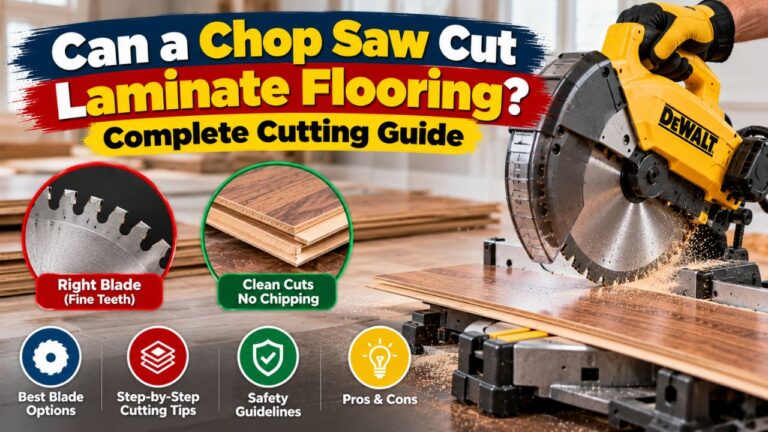
Can I use a chop saw for laminate flooring?
If by chop saw you mean a wood-cutting miter saw, yes.
Do not use an abrasive metal chop saw for laminate flooring.
Can I cut laminate flooring with a handsaw?
Yes. A fine-tooth handsaw can cut laminate and is useful for small jobs.
It is much slower than power saws during a full-room installation.
Do I need a table saw to install laminate flooring?
No.
A circular saw can perform the long rip cuts normally assigned to a table saw. A miter saw and jigsaw can handle the other common flooring cuts.
What is the best saw setup for a beginner?
For the fewest tools, I recommend a circular saw and jigsaw.
For maximum convenience, add a sliding miter saw for the repeated crosscuts.
Conclusion
So, what saw is best for cutting laminate flooring? For the most common flooring task—cutting planks to length—I recommend a miter saw, preferably a sliding model if you are working with wide planks. It makes fast, square, repeatable crosscuts and can easily handle angled end cuts.
If you want only one saw for an entire installation, I would choose a circular saw. With a straightedge guide, it can make both crosscuts and the long rip cuts needed for the first and last rows.
A jigsaw is the best secondary tool for pipes, vents, doorways, curves, and other irregular shapes. A table saw or track saw becomes worthwhile when you need many accurate rip cuts, but neither is essential for a typical DIY laminate floor.
Whatever saw you choose, do not overlook the blade. A sharp fine-tooth carbide or laminate-specific blade will usually make a much larger difference to edge quality than simply buying a more expensive saw.
For most homeowners, my ideal combination is a miter saw for crosscuts, circular saw for rip cuts, and jigsaw for detail work. If your budget allows only two tools, a circular saw and jigsaw can handle virtually the entire project.
Match the saw to the cut, test your blade orientation on scrap flooring, and let a sharp blade do the work. That approach produces cleaner cuts, less wasted flooring, and a much easier installation.