Can an Oscillating Saw Cut Laminate Flooring? Complete Guide
Yes, an oscillating saw can cut laminate flooring, and it is especially useful for plunge cuts, notches, vent openings, door-jamb work, trimming installed flooring, and other detailed cuts. However, an oscillating multi-tool is usually not the best choice for repeatedly cutting full planks across their width or making long lengthwise rip cuts because a miter saw, jigsaw, circular saw, or table saw can perform those jobs faster and often straighter.
An oscillating tool cuts differently from a circular or reciprocating saw. Its blade moves rapidly through a very small side-to-side arc rather than rotating continuously. This lets you make controlled plunge cuts in places where many conventional saws cannot reach.
That control is particularly valuable during laminate-floor installation. You can cut a rectangular opening for a floor vent, trim a small section beside a cabinet, undercut a door casing, or remove part of an already installed plank without needing a large saw.
The blade matters, though. Laminate flooring has a hard, abrasive wear layer over a dense core, so an unsuitable blade can dull quickly, produce heat, or leave a rough edge. A sharp fine-tooth blade rated for laminate, wood composites, or similar flooring materials is the better choice, with carbide or durable bi-metal options making sense for more demanding work.
In this guide, I’ll explain when an oscillating saw is a good choice for laminate flooring, which blades work best, how to make clean plunge and straight cuts, when another saw is better, and how to avoid damaging the floor or anything hidden underneath it.
Can an Oscillating Saw Cut Laminate Flooring Effectively?
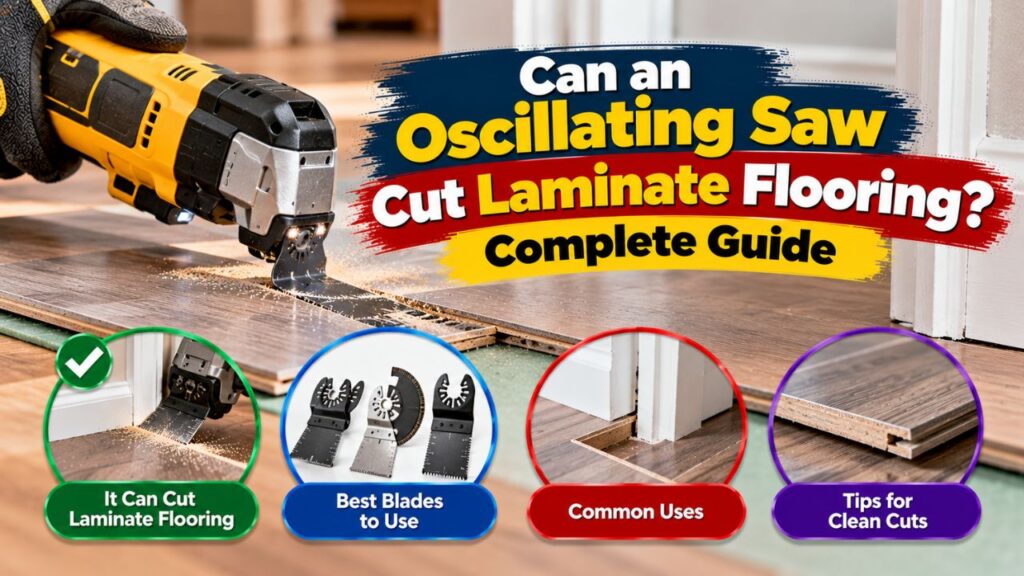
An oscillating saw—more accurately called an oscillating multi-tool—can cut laminate flooring very effectively when the cut is relatively short or detailed.
Manufacturers produce oscillating blades specifically intended for wood, laminate, vinyl, plastic-coated boards, and flooring applications. Some blades are marketed for tasks such as cutting register openings directly into laminate flooring, which is exactly the kind of job where an oscillating tool performs particularly well.
Its greatest strength is access.
A miter saw requires you to bring the plank to the saw. A table saw requires the material to pass through a rotating blade. An oscillating tool can instead be brought directly to a plank that is lying on a workbench or already installed on the floor.
That makes it useful for both installation and repair.
Where an Oscillating Tool Works Best
I would reach for an oscillating tool when I need to make a small notch, plunge directly into the middle of a plank, finish an inside corner, enlarge a floor-register opening, trim flooring next to a fixed object, or make a controlled repair cut in an installed floor.
It is also excellent for undercutting door trim so laminate can slide underneath rather than being awkwardly shaped around the casing.
Where It Is Less Efficient
If you need to shorten 50 flooring planks at the ends of rows, an oscillating tool will do the job far more slowly than a miter saw or flooring cutter.
Likewise, ripping a 48- or 60-inch plank lengthwise with a 1- or 2-inch oscillating blade would be unnecessarily difficult.
The tool can technically continue cutting along a long line, but its strengths are precision and accessibility rather than high production speed.
Key Takeaways:
- An oscillating saw can cut laminate flooring and works particularly well for short, detailed, and plunge cuts.
- It is not the most efficient tool for repetitive full-width crosscuts or long lengthwise rips.
- The correct blade is essential because laminate’s hard surface can wear unsuitable blades quickly.
What Cuts Can You Make in Laminate With an Oscillating Saw?
Understanding the tool’s strengths makes it much easier to decide when to use it.
Plunge Cuts
A plunge cut begins in the middle of the material rather than at an exposed edge.
This is where the oscillating saw has a major advantage.
Its straight plunge blade can be positioned on the marked line and carefully pushed downward into the laminate.
This is useful when creating openings for floor registers or removing a damaged section of installed flooring.
A circular saw can also make certain plunge cuts, but its large rotating blade makes small rectangular openings more difficult and creates considerable overcut at the corners.
An oscillating blade provides much more control.
Rectangular Floor Vent Openings
Suppose a laminate plank covers part of an HVAC register.
After measuring and marking the opening, you can use an oscillating blade to plunge along each side.
Because the blade is relatively narrow, you can stop much closer to the corner than you could with a circular blade.
If necessary, finish the last small amount carefully from the adjoining direction.
This is one of the applications where I would actively choose an oscillating multi-tool over a larger saw.
Notches Around Cabinets and Fixed Objects
Flooring often needs to fit around cabinetry, stair components, trim, or other obstacles.
A jigsaw is excellent for many of these shapes, but an oscillating tool is useful when access is restricted or when only a small amount of flooring needs removal.
You can mark the notch and make controlled short cuts without moving the entire plank through a stationary machine.
Cutting Installed Laminate Flooring
This is another major advantage.
An oscillating tool can cut flooring after installation because the blade can plunge vertically into the surface.
That makes it useful for repair work or controlled removal.
You do need to know what is underneath the laminate before doing this. More on that later.
Undercutting Door Jambs and Casing
Sometimes the best flooring cut is not a cut in the flooring at all.
For a professional-looking doorway, it is often preferable to cut the bottom of the door casing or jamb and slide the laminate underneath.
An oscillating tool is one of the best tools for that job.
Place a scrap of flooring together with the underlayment beside the casing to establish the finished floor height. Rest an appropriate oscillating blade flat on the scrap and cut through the trim.
This creates clearance at essentially the correct height.
What Blade Should You Use for Laminate Flooring?
Blade choice has a major effect on both speed and durability.
Laminate flooring is not simply ordinary wood.
The surface includes a hard wear layer designed to resist scratches and abrasion. Beneath that is typically a decorative layer and a dense fiberboard core.
That hard surface is one reason laminate can dull saw blades relatively quickly.
Fine-Tooth Wood and Laminate Blades
For light-duty cutting, a fine-tooth oscillating blade rated for wood and laminate can work very well.
These blades are particularly suitable for clean cuts in normal laminate flooring and trim.
Fine tooth geometry gives you more control and generally produces a cleaner edge than a coarse aggressive blade.
Bi-Metal Blades
A bi-metal blade combines a flexible blade body with more durable cutting teeth.
This construction can provide improved durability, especially when there is some chance of contacting small metal fasteners or when you need the blade to survive more flooring work.
However, do not intentionally cut unknown nails simply because the blade says bi-metal.
Hidden fasteners can still damage blades and create sparks or other hazards.
Carbide Blades
For abrasive materials or frequent laminate cutting, carbide-tooth oscillating blades can offer better wear resistance.
They tend to cost more, but they can make sense when you are cutting a significant amount of dense flooring.
If I had a large laminate repair project, I would generally prefer a good blade specifically rated for abrasive flooring rather than using inexpensive wood blades one after another.
Segment Blades
A semicircular or segment-style oscillating blade can be useful for longer shallow cuts.
Its wider cutting area can make it easier to follow a straight line along the surface.
A narrow plunge blade is better when you need to enter the flooring at a specific point or cut into a tight corner.
The best blade therefore depends on the cut rather than simply the flooring.
Oscillating Blade Types for Laminate Flooring
| Blade Type | Best Use on Laminate | Main Advantage |
| Fine-tooth plunge blade | Notches and plunge cuts | Precision and control |
| Wide plunge blade | Short straight cuts | Faster material removal |
| Segment blade | Longer shallow cuts | Easier line following |
| Bi-metal blade | General flooring cuts | Good durability |
| Carbide-tooth blade | Abrasive laminate and frequent use | Longer cutting life |
Always make sure the mounting system is compatible with your oscillating tool. Starlock, OIS, universal-fit, and proprietary systems are not automatically interchangeable.
How to Cut Laminate Flooring With an Oscillating Saw
The process is simple, but a few details improve both accuracy and safety.
1. Measure and Mark the Cut
Measure the opening or section that needs removal.
Use a square for straight cuts and clearly mark the waste side.
For an installed floor, double-check the measurement before cutting because replacing a damaged plank can be much more difficult than recutting a loose one.
If you are cutting around an object, remember to maintain any expansion clearance required by the laminate manufacturer.
2. Select the Appropriate Blade
Install a sharp fine-tooth blade rated for laminate or similar flooring materials.
For a narrow plunge cut, use a straight plunge blade.
For a wider or somewhat longer line, a broader blade or segment blade may be easier.
Make sure the accessory is firmly locked into the tool according to its instructions.
3. Support a Loose Plank
If the flooring has not yet been installed, place it on a stable workbench or sacrificial surface.
Clamp it when necessary.
The board should not bounce while cutting.
Vibration reduces accuracy and can contribute to rough edges.
4. Start at a Moderate Speed
If your oscillating tool has variable speed, you do not necessarily need to begin at maximum.
Start at a controlled setting and see how the blade behaves with your particular laminate.
Excessive speed combined with heavy pressure can generate unnecessary heat.
Let the blade’s teeth do the work.
5. Establish the Cut Gently
Position the blade carefully on your line.
For a plunge cut, begin with light pressure while keeping the blade aligned.
Do not immediately force it to full depth.
Allow the teeth to create a shallow kerf before increasing pressure.
Once the blade is tracking correctly, continue gradually.
6. Keep the Blade Square
A narrow oscillating blade can flex if you press sideways.
Keep the tool aligned with the cut and avoid twisting it.
If you want a vertical cut through the plank, watch that the blade remains perpendicular to the flooring surface.
7. Stop at the Corners
When creating a rectangular opening, do not keep cutting well past each corner simply to make the center piece fall out.
Make each side carefully and stop as close as practical to its intersection with the next line.
Finish any remaining material from the adjoining side.
This minimizes unnecessary damage outside the opening.
8. Let the Blade Cool When Necessary
Oscillating blades can become very hot.
If cutting performance decreases or the blade becomes excessively hot, stop and allow it to cool naturally.
Do not touch the blade immediately after a long cut.
Key Takeaways:
- Use light pressure and let the oscillating teeth gradually establish the kerf.
- Keep the blade square rather than forcing it sideways through the flooring.
- A narrow plunge blade works best for detailed openings, while wider or segment blades are useful for somewhat longer cuts.
How to Make a Clean Cut Without Chipping the Laminate
Laminate’s decorative surface can chip if the blade is dull or the material vibrates.
The easiest improvement is simply using a fresh, appropriate blade.
Mark the Cut Clearly
A precise line helps you control the blade.
Painter’s tape over the cutting area can make pencil marks easier to see on dark flooring and may provide some surface support, though it should not be expected to compensate for a poor blade.
Cut on the Waste Side
The blade removes a small amount of material.
Keep the cut primarily on the waste side of the line so the finished piece remains at the intended size.
This is particularly important with tight notches.
Support Loose Flooring Firmly
A plank vibrating against a workbench can chip more than one held flat and securely.
Clamp it if necessary, keeping the clamp out of the blade path.
Avoid Excessive Pressure
Pushing harder does not necessarily make an oscillating tool cut faster.
It can make the blade flex, heat up, and wear prematurely.
A moderate feed allows the teeth to repeatedly clear material.
Can You Cut a Full Laminate Plank With an Oscillating Tool?
Yes, but I usually would not.
If you have only an oscillating tool and need to make one crosscut, it can get the job done.
Mark a straight line and carefully work across it.
A wider blade can make controlling the line easier.
But if you have dozens of planks to shorten, the oscillating tool quickly becomes inefficient.
A miter saw, circular saw, jigsaw, flooring cutter, or table saw is better suited to production cutting.
Best Tool for Crosscuts
For repeated straight crosscuts, I prefer a miter saw or flooring cutter.
A jigsaw also works very well and is much easier to transport.
Best Tool for Long Rip Cuts
For narrowing the first or last row lengthwise, use a table saw, track saw, or circular saw with a straight guide.
Trying to guide a narrow oscillating blade several feet down a plank makes it unnecessarily difficult to maintain a truly straight edge.
Oscillating Saw vs. Jigsaw for Laminate Flooring
A jigsaw and oscillating tool overlap in some applications, but their strengths differ.
A jigsaw is faster for cutting an entire plank and much better for long curved shapes.
An oscillating tool offers better access in tight areas and can start a plunge cut without first drilling a starter hole.
If I needed to make a large curved notch in a loose plank, I would choose the jigsaw.
If I needed to enlarge a vent opening in installed laminate, I would choose the oscillating tool.
The two tools complement each other very well during flooring work.
Oscillating Saw vs. Miter Saw
The miter saw is dramatically faster for repetitive crosscuts.
Place the plank against the fence, align the mark, lower the blade, and the cut is finished.
An oscillating tool cannot compete with that production rate.
However, the miter saw cannot make a controlled rectangular plunge cut in the middle of an installed floor.
That is where the oscillating tool becomes the better tool.
Think of the miter saw as the production cutter and the oscillating saw as the detail and repair tool.
Oscillating Saw vs. Circular Saw
A circular saw can make long crosscuts and rip cuts much faster.
With a straightedge guide, it can also make extremely straight cuts.
The oscillating tool wins when access is restricted or when you need to start and stop the cut at exact points.
Circular blades naturally overcut beneath the surface at inside corners because they are round. An oscillating plunge blade creates much tighter corners.
For large straight cuts, choose the circular saw.
For detailed plunge cuts, choose the oscillating tool.
Oscillating Saw vs. Table Saw
A table saw is the clear choice for narrowing multiple planks to the same width.
The fence makes repeated rip cuts straightforward.
The oscillating tool has no comparable long straight reference.
However, a table saw cannot cut a plank that is already installed in the middle of the room.
The oscillating tool can.
This illustrates why asking whether one tool is “better” is often the wrong question. They are designed for different tasks.
Can You Use an Oscillating Saw to Cut Installed Laminate?
Yes, and this is one of its best applications.
However, cutting installed flooring introduces risks you do not have with a loose plank.
You need to know what is under the laminate.
A floating laminate floor may sit over foam underlayment and plywood, OSB, concrete, or another subfloor.
There could also be radiant heating equipment or other concealed systems.
Control the Blade Depth
Do not plunge the entire blade into the floor simply because it is long enough.
Mark the depth on the blade if necessary or use a depth-stop accessory when your oscillating tool supports one.
You want to cut the flooring without unnecessarily penetrating deeply into the subfloor.
Watch for Fasteners
Most floating laminate itself is not nailed down, but surrounding trim, transitions, previous repairs, or other flooring layers may contain nails, screws, or staples.
Know what you are cutting before plunging into an unknown area.
Check for Radiant Floor Heating
If the floor has electric heating cables or hydronic tubing below it, avoid making a plunge cut until you know the system’s location and depth.
An oscillating blade can damage hidden heating elements.
Repairing them may require opening a much larger section of floor.
Important Tip: When cutting flooring that is already installed, determining what lies below the cut is just as important as choosing the correct blade.
Can You Cut Laminate Around a Floor Vent With an Oscillating Saw?
Yes. This is one of the jobs an oscillating multi-tool handles especially well.
Measure the vent opening carefully and transfer the dimensions to the laminate.
If the flooring is loose, it is usually easier to make the opening before installation when possible.
For an installed plank, mark the opening accurately and verify that no duct components or other materials will be damaged by the blade.
Use a plunge blade to cut along each side.
Do not make the opening larger than necessary just to make cutting easier.
The vent flange may cover the edges, but excessive gaps can reduce support around the opening.
Can an Oscillating Tool Undercut Door Jambs for Laminate?
Yes, and this may be the single most useful flooring application for the tool.
Trying to cut a complicated shape into laminate so it perfectly wraps around casing often leaves visible gaps.
Undercutting the casing allows the floor to slide underneath it.
Use a scrap section of the actual laminate plus its intended underlayment as a height spacer.
Place the blade flat on top of that spacer and cut the casing.
The resulting opening should closely match the finished floor height.
Do not cut higher than necessary because a large gap under the casing can become visible.
Will an Oscillating Saw Damage Laminate Flooring?
Not when used correctly.
However, several mistakes can damage the visible surface.
Allowing the body of the tool or blade mount to rub against the decorative layer can leave marks.
A dull blade can overheat and create rough edges.
Forcing the blade sideways can widen the cut.
The vibrating blade can also scratch the flooring if you allow its side to bounce against a finished area you intended to preserve.
Protect adjacent surfaces when necessary and keep the blade precisely on the waste side.
How Long Does an Oscillating Blade Last on Laminate?
There is no reliable universal number of cuts.
Blade life depends on the blade material, laminate wear layer, core density, blade width, cutting speed, pressure, and whether the blade contacts metal.
Laminate is abrasive, so ordinary wood blades can wear more quickly than they do in soft lumber.
Signs that a blade is becoming dull include slower cutting, increasing heat, greater pressure required to make progress, and rougher edges.
When those signs appear, replacing the blade is often better than forcing it.
For frequent laminate work, paying more for a durable blade may actually be cheaper than rapidly consuming several basic blades.
Dust and Safety When Cutting Laminate Flooring
An oscillating tool produces less dramatic debris than some high-speed circular saws, but it still produces fine laminate dust.
Wear suitable eye protection.
Use hearing protection because oscillating multi-tools can be surprisingly loud, particularly when cutting hard composite materials.
Appropriate respiratory protection and dust extraction are sensible when making many cuts.
Secure Loose Planks
Do not hold a small plank in your hand while cutting toward your fingers.
Clamp the flooring to a stable surface.
Keep the blade path clear.
Remove the Battery Before Changing Blades
For a cordless tool, remove the battery when installing or repositioning a blade unless your manufacturer’s instructions provide another safe procedure.
For a corded tool, unplug it.
Oscillating blades are sharp enough to cause injury even when stationary.
Remember That the Blade Gets Hot
Do not grab the blade immediately after cutting.
Friction can heat both the blade and mounting area significantly.
Allow it to cool before changing accessories.
Key Takeaways:
- Installed flooring requires controlled blade depth and awareness of anything hidden beneath it.
- Wear eye, hearing, and appropriate respiratory protection, and secure loose planks before cutting.
- Oscillating blades can become very hot, so allow them to cool before handling.
Common Mistakes When Cutting Laminate With an Oscillating Saw
The most common mistake is expecting the tool to replace every other flooring saw.
It is excellent for detail work but inefficient for production crosscuts and long rips.
Another mistake is using a dull general-purpose blade and increasing pressure when cutting slows down.
That creates more heat and makes control worse.
Use a blade designed for the material.
A third mistake is plunging too deeply into installed flooring.
The blade only needs to cut through the material you intend to remove.
Anything deeper may be part of the subfloor or another building system.
Users also sometimes attempt to follow a very long straight line without a reference. A narrow oscillating blade can gradually wander.
If straightness is critical over several feet, a guided circular saw, track saw, or table saw is a better tool.
Finally, do not forget the flooring manufacturer’s expansion requirements. When cutting a notch beside a wall, cabinet, or other fixed object, leave the appropriate clearance where the installation instructions require it.
What Is the Best Saw for Laminate Flooring Overall?
There is no single best saw for every flooring cut.
For an entire installation, I would choose tools according to their strengths.
A miter saw or flooring cutter is excellent for repetitive crosscuts.
A table saw is excellent for long rip cuts.
A circular or track saw can handle straight crosscuts and rips while remaining portable.
A jigsaw is the best all-around choice for irregular cuts in loose planks.
The oscillating tool is the specialist for plunge cuts, installed-floor repairs, door jambs, tight corners, and detail work.
If you already own an oscillating multi-tool and are installing a small amount of laminate, you can certainly use it for several parts of the project. Just do not feel obligated to make every cut with it.
FAQs about Can an Oscillating Saw Cut Laminate Flooring
Can an oscillating saw cut laminate flooring?
Yes. An oscillating saw can cut laminate flooring, especially for plunge cuts, short straight cuts, notches, floor vents, doorway work, and repairs to installed flooring.
What oscillating blade should I use for laminate flooring?
Use a sharp fine-tooth blade specifically rated for laminate, wood composites, flooring, or similar materials. Bi-metal and carbide options can provide additional durability for demanding work.
Can I cut an entire laminate plank with an oscillating tool?
Yes, but it is slow compared with a miter saw, jigsaw, or flooring cutter.
I would use an oscillating tool for full crosscuts only when another suitable saw is unavailable or access makes it necessary.
Can an oscillating saw make a lengthwise cut in laminate flooring?
Technically yes, but it is inefficient for long rips.
A table saw, track saw, or guided circular saw will produce a straighter and faster lengthwise cut.
Is an oscillating tool good for cutting installed laminate?
Yes. Its ability to plunge directly into the surface makes it excellent for repairs and localized removal.
Control cutting depth carefully and determine what is beneath the floor first.
Can I use an oscillating tool for floor vent openings?
Yes. It is one of the best tools for creating or enlarging rectangular register openings because a plunge blade can start directly in the flooring.
Can an oscillating tool cut door jambs for laminate installation?
Yes. Undercutting door jambs and casing is one of the most common flooring applications for an oscillating multi-tool.
Will an oscillating saw chip laminate?
It can if the blade is dull, inappropriate for the material, or forced aggressively.
A sharp fine-tooth blade, stable workpiece, and controlled feed help minimize edge damage.
Can a wood oscillating blade cut laminate?
Many fine-tooth wood blades are also rated for laminate and can work well.
Because laminate is abrasive, a more durable bi-metal or carbide blade may last longer when making numerous cuts.
Is a carbide oscillating blade better for laminate?
It can be, particularly when durability is important.
Carbide teeth generally tolerate abrasive materials better, although a quality blade specifically rated for your laminate is more important than choosing solely by blade material.
Is a jigsaw better than an oscillating saw for laminate flooring?
For cutting entire planks or large curved shapes, usually yes.
For plunge cuts, tight spaces, door-jamb work, and installed-floor repairs, the oscillating tool is often better.
Can I use an oscillating tool instead of a miter saw?
You can for occasional crosscuts, but it will be significantly slower.
A miter saw is better for repeatedly shortening planks during a full-floor installation.
Can I score laminate flooring instead of sawing it?
Some flooring products can be cut with scoring or dedicated flooring cutters, while others require sawing.
Follow the instructions for the specific laminate product.
Does an oscillating tool create much dust?
It still produces laminate dust, although the cutting action is localized.
Use dust control and appropriate personal protective equipment, particularly during repeated cutting.
Can I cut laminate over radiant floor heating?
Do not plunge into installed flooring until you know where the heating elements are located and how deep they sit.
Damaging heating cables or tubing can require extensive repair.
Conclusion
Can an oscillating saw cut laminate flooring? Yes, and it is one of the most useful tools you can own for detailed laminate-flooring work. It can make plunge cuts, notches, floor-register openings, repair cuts, and precise cuts in areas that are difficult or impossible to reach with a larger saw.
I particularly recommend an oscillating multi-tool for undercutting door jambs and for cutting flooring that is already installed. Those are applications where its small blade and controlled plunge action offer a real advantage.
Use a sharp fine-tooth blade rated for laminate or similar flooring materials. A good bi-metal blade is a versatile option, while carbide can make sense when you need additional wear resistance against abrasive laminate.
For repetitive full-width crosscuts, however, I would use a miter saw, jigsaw, or flooring cutter. For long lengthwise rips, a table saw, track saw, or guided circular saw is much faster and easier to keep straight.
The practical approach is to treat the oscillating saw as a precision and access tool rather than your primary production flooring saw. Use it where its plunge-cutting ability and compact size provide an advantage, and switch to a larger saw when speed and long straight cuts matter more.