What Is a Hand Panel Saw? Types, Uses & How It Works
If you are wondering what is a hand panel saw, it is a traditional hand-operated woodworking saw with a wide, flexible blade, a handle at one end, and no rigid metal spine along the top. It is primarily used for cutting boards, solid wood, plywood, and other wood-based panels by hand. Panel saws may be filed for crosscutting across the grain, ripping along the grain, or general-purpose cutting.
A traditional panel saw resembles the familiar Western-style handsaw used by carpenters for generations. In stricter woodworking terminology, a panel saw is often somewhat shorter and more manageable than a full-size handsaw, making it especially convenient for bench work, furniture making, and cutting boards to rough dimensions.
The term can be confusing because a powered panel saw is a completely different machine. Commercial woodworking shops often call large vertical or horizontal sheet-cutting machines “panel saws.” A hand panel saw, by contrast, has no motor, requires no electricity, and is moved entirely by the user’s arm.
Unlike a tenon saw or other backsaw, a hand panel saw has no stiff spine running along the top of its blade. That allows it to cut much deeper into wide or thick material because there is no back limiting the depth of cut.
In this guide, I’ll explain what a hand panel saw is, how it works, the difference between rip and crosscut panel saws, typical sizes and tooth counts, what materials it can cut, and how it compares with regular handsaws, backsaws, and powered panel saws.
What Is a Hand Panel Saw?
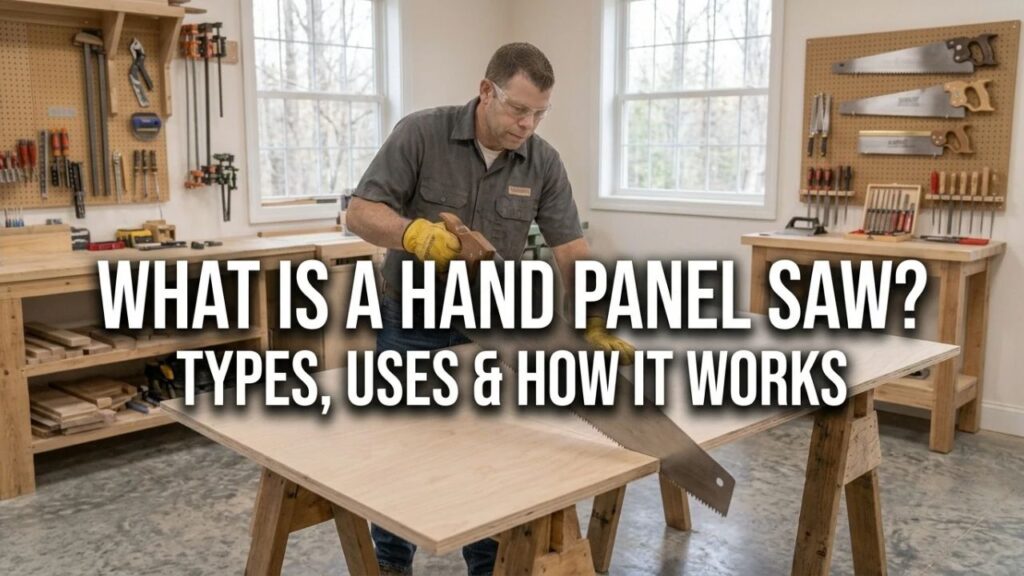
A hand panel saw is an open-backed woodworking handsaw designed for manually cutting boards and panel-shaped pieces of wood.
Its basic construction is simple.
It has a steel saw plate with teeth along one edge and a handle attached to the heel of the blade.
Unlike a backsaw, nothing reinforces the upper edge of the blade.
This open-backed construction gives the saw considerable cutting depth.
You can continue a cut through a wide board without a metal spine eventually hitting the top surface of the workpiece.
Depending on the saw’s tooth geometry, it may be optimized for cutting:
Across the wood grain, known as crosscutting.
Along the wood grain, known as ripping.
Or it may use a compromise tooth pattern intended for both.
Why Is It Called a Panel Saw?
Historically, the term “panel saw” was associated with a manageable hand saw used for cutting relatively thin boards and panels.
Traditional woodworking tool chests often contained smaller panel saws because they were easier to store and use around a workbench than a very long full-size handsaw.
Today, terminology is not completely standardized.
Some people use “panel saw” broadly for almost any ordinary Western handsaw.
Others reserve the term for a shorter traditional handsaw, commonly somewhere around 20 to 24 inches long, although smaller and larger examples exist.
The important characteristics are not a precise length measurement but the overall form:
A broad hand-saw blade, no reinforced back, and teeth designed for woodworking.
Parts of a Hand Panel Saw
Understanding the parts makes it easier to compare a panel saw with other hand saws.
Saw Plate
The thin steel body is commonly called the plate or blade.
It needs enough stiffness to track straight while still being flexible enough for a practical handsaw.
Traditional high-quality saws may have taper-ground plates, where the steel becomes slightly thinner toward the back to reduce friction.
Teeth
The lower edge contains the cutting teeth.
Tooth shape, size, rake, fleam, and set determine how the saw behaves.
Two panel saws of identical length can feel completely different if one is filed aggressively for ripping while the other has fine crosscut teeth.
Toe
The front end of the saw is called the toe.
Some traditional saws use slightly smaller teeth near the toe to make starting a cut easier.
Heel
The heel is the rear portion of the blade near the handle.
Handle
Traditional panel saws commonly use a wooden closed-grip handle, although modern inexpensive versions often use molded plastic or composite handles.
A good handle lets you control the blade without squeezing excessively.
Saw Nuts or Screws
Traditional handles are usually attached to the blade with saw nuts or screws.
These fasteners allow the handle to be removed for repair or restoration.
Key Takeaways:
- A hand panel saw is an open-backed manual woodworking saw.
- It can be filed for rip cuts, crosscuts, or general-purpose use.
- Because it has no rigid spine, it can make much deeper cuts than a typical backsaw.
Is a Panel Saw the Same as a Hand Saw?
Sometimes the terms are used interchangeably, but there can be a useful distinction.
“Hand saw” is a very broad term.
Technically, any saw powered by your hands rather than a motor could be described as a hand saw, including:
Panel saws, tenon saws, dovetail saws, coping saws, fret saws, Japanese pull saws, and bow saws.
In everyday carpentry language, however, “handsaw” often refers specifically to the familiar wide-bladed Western push saw.
A panel saw belongs to that family.
Traditional Size Difference
In traditional Western woodworking terminology, a full-size handsaw was often longer, while a panel saw was a shorter and more convenient version.
A large traditional hand rip saw might have a plate around 26 inches or more.
Panel saws were often closer to approximately 20–24 inches, although historical and modern definitions vary.
The shorter length makes the panel saw easier to control at a workbench and easier to fit in a tool chest.
It sacrifices some stroke length and cutting speed compared with a long handsaw.
Don’t Rely on Length Alone
There is no universal rule stating that a 24-inch saw is always a panel saw while a 26-inch saw is always a handsaw.
Manufacturers and woodworkers use the terms differently.
Blade construction and intended use are more informative than an exact cutoff point.
Hand Panel Saw vs. Powered Panel Saw
These tools share a name but are fundamentally different.
| Feature | Hand Panel Saw | Powered Panel Saw |
| Power source | Human-powered | Electric motor |
| Blade | Straight toothed steel plate | Usually circular saw blade |
| Main material | Boards and wood panels | Large sheet goods |
| Portability | Very portable | Usually stationary |
| Best for | Manual woodworking and carpentry | Production sheet cutting |
| Electricity required | No | Yes |
| Typical cost | Low to moderate | Much higher |
| Cutting speed | Relatively slow | Fast |
A powered vertical panel saw commonly holds a 4×8 sheet against a large frame while a motorized circular saw moves through the material.
A horizontal panel saw or beam saw performs a similar sizing function with a different machine arrangement.
A hand panel saw is simply held in your hand.
If someone asks you to “use the panel saw” in a cabinet shop, they may very well mean the large powered machine.
If a traditional woodworker mentions a 20-inch crosscut panel saw, they mean the hand tool.
Hand Panel Saw vs. Backsaw
One of the most important comparisons is with a backsaw.
A backsaw has a rigid brass or steel spine attached along the upper edge of the saw plate.
Examples include:
Tenon saws, dovetail saws, carcass saws, and many miter-box saws.
The back stiffens the thin saw plate and makes it easier to produce controlled, precise cuts.
The Panel Saw Has No Back
A hand panel saw leaves the top edge of the blade completely open.
That makes the blade less rigid, but it removes the depth restriction.
Suppose you are cutting through a 10-inch-wide board.
A backsaw may begin normally but eventually its metal spine hits the top of the board and prevents the blade from going any deeper.
A panel saw can continue through the entire cut.
Which Is More Accurate?
A good backsaw is generally easier to control for small joinery work.
That is why dovetail and tenon saws have rigid backs.
A skilled woodworker can still make extremely accurate cuts with a panel saw, but its main advantage is versatility and unrestricted depth rather than maximum joinery precision.
Key Takeaways:
- “Handsaw” is a broad term; a panel saw is one type of traditional handsaw.
- Panel saws are often shorter than full-size traditional handsaws, but there is no universal length boundary.
- A backsaw is stiffer and better suited to joinery, while an open-backed panel saw can cut much deeper.
What Is a Crosscut Panel Saw?
A crosscut panel saw is filed specifically for cutting across the wood grain.
Crosscut teeth act somewhat like a row of small cutting knives.
Their angled cutting edges sever the wood fibers at each side of the kerf.
The remaining waste is then removed as the saw advances.
This tooth geometry generally produces a cleaner cut across grain than a coarse rip-filed saw.
When to Use One
A crosscut panel saw is ideal when you need to:
Shorten boards, cut parts to rough length, break down long stock, cut plywood across its width, or make general carpentry crosscuts.
For a woodworker who already uses machines for ripping but wants a handsaw for trimming boards to length, a crosscut panel saw can be especially useful.
What Is a Rip Panel Saw?
A rip panel saw is designed for cutting parallel with the wood grain.
Its teeth behave more like tiny chisels.
They cut and remove wood fibers along the grain rather than slicing them across the way crosscut teeth do.
Rip teeth can be relatively aggressive, particularly on coarse saws intended for rapidly breaking down stock.
When to Use One
A rip panel saw is useful for:
Narrowing a board, splitting wide stock lengthwise, roughing solid wood before planing, or working in a shop without a table saw.
Ripping a long hardwood board by hand takes effort, but a properly sharpened rip saw can be surprisingly efficient.
Trying to perform the same job with a fine crosscut saw is considerably slower.
Can One Panel Saw Rip and Crosscut?
Yes, especially if it uses a general-purpose or hybrid tooth pattern.
Many modern hardware-store handsaws are designed to perform reasonably well in both directions.
That makes sense for homeowners who want one saw rather than separate rip and crosscut saws.
However, a dedicated traditional saw usually performs its intended cut better.
A proper rip saw is faster along the grain.
A proper crosscut saw generally leaves a cleaner result across the grain.
For occasional DIY work, one general-purpose panel saw is usually enough.
For serious hand-tool woodworking, owning separate rip and crosscut panel saws can be worthwhile.
What TPI Does a Hand Panel Saw Have?
TPI means teeth per inch.
You may also see traditional saws described by points per inch, or PPI. The two measurements are closely related but technically not identical because PPI counts tooth points rather than the spaces between teeth.
Panel saw tooth counts vary based on intended work.
A coarse rip saw might have relatively few teeth per inch.
A fine crosscut panel saw may have considerably more.
As a general concept:
| Tooth Pattern | Typical Character |
| Coarse, low TPI | Faster cut, rougher surface |
| Medium TPI | Balanced general work |
| Fine, high TPI | Slower cut, smoother surface |
Many practical woodworking panel saws fall somewhere around the middle single digits to low teens in points or teeth per inch, but there is no single correct number.
More Teeth Are Not Automatically Better
A very fine saw can cut cleanly but slowly.
In thick softwood, tiny gullets may also struggle to carry sawdust out of the cut.
A coarse saw removes material rapidly but leaves a rougher edge.
Choose tooth count based on the material thickness and finish quality you need.
How Long Is a Hand Panel Saw?
Traditional panel saws are generally shorter than the longest full-size handsaws.
Approximately 20 to 24 inches is a useful traditional range to keep in mind, but examples outside that range are common.
Some modern sources and manufacturers describe 16- to 20-inch saws as panel saws as well.
The lack of a universal definition means you should evaluate a saw by its intended purpose rather than becoming overly focused on one length number.
Why Shorter Saws Are Useful
A shorter plate is easier to control when working at a bench.
It also fits more easily inside a traditional tool chest.
For furniture parts and ordinary boards, you may not need the full stroke length of a 26- or 28-inch carpenter’s saw.
Why Longer Saws Still Cut Faster
Longer saws allow a longer stroke.
A skilled user can engage more teeth and remove more material with each movement.
For breaking down large quantities of rough lumber, that efficiency is useful.
What Materials Can a Hand Panel Saw Cut?
A traditional hand panel saw is primarily a woodworking tool.
It is well suited to:
Solid softwood, solid hardwood, plywood, MDF, particleboard, OSB, hardboard, and similar wood-based sheets.
Performance depends on the specific tooth pattern and material.
Solid Wood
This is where a traditional sharpenable panel saw performs best.
Choose rip teeth when cutting along the grain and crosscut teeth when cutting across it.
Plywood
A panel saw can cut plywood, but use a relatively fine crosscut or general-purpose tooth pattern if edge quality matters.
The alternating grain direction in plywood means a coarse rip saw may leave substantial splintering.
MDF and Particleboard
A sharp panel saw can cut these materials.
However, engineered panels can be abrasive and may dull traditional saw teeth faster than ordinary solid wood.
Their dust is also very fine, so appropriate dust precautions remain important even with a hand saw.
Plastics
Some general-purpose hand saws can cut certain plastic sheet or pipe products, but a traditional woodworking panel saw is not always the best choice.
The tooth pattern needs to suit the plastic thickness to avoid cracking or grabbing.
Metal
A normal woodworking panel saw should not be used to cut metal.
Its tooth geometry and hardness are intended for wood.
Use a hacksaw or another metal-cutting tool instead.
What Is a Hand Panel Saw Used For?
Its greatest advantage is general-purpose stock preparation.
Before powered circular saws became common, a panel saw was one of the fundamental ways woodworkers and carpenters converted rough boards into usable components.
It remains useful today.
Breaking Down Boards
You can use a panel saw to cut a long board into manageable sections before further machining or hand-tool work.
This is especially convenient when the board is too long or awkward to carry safely to a stationary machine.
Rough Furniture Work
Traditional furniture makers often use panel saws to bring boards close to finished size.
A plane, shooting board, or joinery saw can then refine the part.
The panel saw does not necessarily need to leave a furniture-ready surface because later operations remove the saw marks.
Jobsite Carpentry
A modern general-purpose handsaw performs the same broad role on a construction site.
It can cut lumber without electricity, extension cords, batteries, or setup time.
Sheet Goods
Although powered circular or track saws are much faster for full sheets, a hand panel saw can cut plywood and similar material when only a few cuts are required.
It is quiet, portable, and creates no motor noise.
Key Takeaways:
- Crosscut panel saws cut across the grain; rip panel saws cut along it.
- Lower tooth counts cut faster, while finer teeth generally leave smoother edges.
- A hand panel saw is primarily intended for solid wood and wood-based sheet material.
How Does a Hand Panel Saw Work?
Most Western panel saws cut primarily on the push stroke.
When you push the blade forward, the teeth enter the wood and remove small chips or sever fibers.
The return stroke generally does little cutting.
This is opposite to many Japanese saws, which cut on the pull stroke.
Why the Blade Doesn’t Bind
Saw teeth are normally “set,” meaning alternating teeth lean slightly left and right.
This creates a kerf slightly wider than the saw plate itself.
The wider kerf gives the body of the blade clearance so it can move without excessive friction.
If the teeth lose their set or are sharpened incorrectly, the blade may bind.
Too much set, on the other hand, makes an unnecessarily wide kerf and requires more work.
How to Use a Hand Panel Saw
Secure the workpiece so it cannot move unexpectedly.
Mark the desired cut with a pencil, knife, or square.
Position yourself so your arm can move naturally in line with the intended cut.
Start With Short Strokes
Place the saw teeth just on the waste side of your line.
Use your thumb as a guide beside the blade if you are comfortable doing so, keeping it safely away from the teeth.
Begin with a few short, light strokes.
Do not push aggressively.
Once a shallow kerf is established, extend your strokes and use more of the blade.
Let the Teeth Do the Work
Excessive downward force makes a saw harder to control.
A sharp panel saw should cut with moderate pressure.
Try to keep your forearm aligned with the blade.
If you constantly twist the handle sideways to correct direction, the kerf may become wider and less accurate.
Support the Waste
As you approach the end of a crosscut, support the offcut.
Otherwise, its weight can split the final wood fibers and tear a chunk from the good side of the board.
Use shorter, lighter strokes to complete the cut cleanly.
Can a Panel Saw Make Accurate Cuts?
Yes.
A skilled user with a sharp, properly set saw can cut very close to a layout line.
However, a hand panel saw is often used for rough dimensioning rather than final joinery.
Traditional woodworking commonly separates those operations.
You might saw a board slightly oversized and then bring it exactly to length with a shooting plane.
For precision tenons, dovetails, and other joints, a backsaw usually provides greater control.
Accuracy Depends on More Than the Saw
Good results depend on:
Sharp teeth, correct tooth geometry, proper saw set, good body position, a clear layout line, and secure workholding.
A premium panel saw will not track accurately if you force it sideways.
Likewise, an inexpensive sharp saw can perform surprisingly well when used with good technique.
Traditional Sharpenable Panel Saw vs. Modern Hardened-Tooth Saw
Traditional panel saws normally have teeth that can be sharpened repeatedly with a triangular saw file.
This gives them potentially very long service life.
A quality traditional saw can remain useful for generations if its plate and handle stay in good condition.
Many modern inexpensive handsaws use impulse-hardened teeth.
These teeth stay sharp for a long time but are generally too hard to sharpen with ordinary saw files.
Once they become dull, the saw is typically replaced.
Which Is Better?
For occasional DIY work, hardened-tooth saws offer excellent convenience and value.
For dedicated hand-tool woodworking, a resharpenable saw gives much greater control over tooth shape and long-term maintenance.
You can also have a traditional saw sharpened specifically for the work you perform.
Hand Panel Saw vs. Japanese Saw
Japanese saws commonly cut on the pull stroke.
Because pulling places the blade in tension, the saw plate can be thinner than many Western push saws.
That produces a narrow kerf and can require less physical effort.
A traditional Western panel saw cuts on the push stroke and generally uses a thicker, stiffer plate.
Neither system is universally better.
Japanese saws are often praised for thin, clean cuts and easy starting.
Western panel saws can be highly efficient for breaking down stock and are easily resharpened when made with traditional tooth steel.
Choice often comes down to woodworking style and personal preference.
Hand Panel Saw vs. Tenon Saw
A tenon saw is a backsaw specifically intended for joinery.
Its rigid spine keeps the blade straight and provides excellent control when cutting tenon cheeks and shoulders.
A panel saw has no back and can cut much deeper.
If you need to crosscut a 12-inch-wide board, use the panel saw.
If you need to cut a precise tenon, the tenon saw is normally the better choice.
Many traditional woodworking tool kits contain both because they perform complementary jobs.
Advantages of a Hand Panel Saw
A hand panel saw requires no power source.
You can use it anywhere without batteries, cords, or fuel.
It is also quiet compared with a circular saw or powered panel saw.
Setup time is minimal.
For one or two cuts, grabbing a handsaw can actually be faster than setting up a power tool.
The tool is also relatively inexpensive, easy to transport, and capable of both rough carpentry and careful woodworking.
Traditional versions can be sharpened and maintained for decades.
Limitations of a Hand Panel Saw
The obvious disadvantage is speed.
If you need to rip twenty full sheets of plywood, a hand panel saw would be an inefficient choice.
It also requires technique.
Keeping a long manual cut perfectly straight takes practice.
Physical effort becomes significant when ripping thick hardwood or making many cuts.
Finally, the surface left by a hand saw may require planing or sanding when a very precise finished edge is needed.
How to Choose a Hand Panel Saw
Start by deciding which direction you cut most frequently.
For furniture work where you mainly shorten boards, a crosscut panel saw is an excellent first choice.
If you regularly prepare rough stock completely by hand, eventually add a dedicated rip saw.
Choose a Comfortable Length
A saw around 20–24 inches is a practical traditional panel-saw size for many woodworkers.
Shorter versions may be more comfortable in a small shop.
Longer saws can cut more rapidly when you have room to use a full stroke.
Consider Tooth Count
Choose coarser teeth for rapid stock removal and finer teeth for smoother cuts.
There is no perfect TPI for every task.
If you want one saw for general woodworking, a moderate tooth count is the safest compromise.
Check the Handle
Handle comfort matters more than many beginners expect.
Your hand should fit naturally without excessive pressure at individual fingers.
A poorly fitted handle can make long sawing sessions tiring and can reduce control.
FAQs About What Is a Hand Panel Saw
What is a hand panel saw?
A hand panel saw is a traditional manually operated woodworking saw with a broad toothed blade and no rigid back. It is used for cutting boards and wood-based panels.
Is a panel saw just a handsaw?
A panel saw is a type of handsaw. In traditional terminology, panel saws are often somewhat shorter than full-size handsaws.
How long is a hand panel saw?
Many traditional examples are approximately 20–24 inches long, although shorter and longer versions exist and terminology varies.
Does a panel saw have a spine?
No. A traditional panel saw is open-backed, unlike tenon, dovetail, and other backsaws.
Can a panel saw make rip cuts?
Yes. A rip-filed panel saw is specifically designed for cutting parallel with wood grain.
Can a panel saw crosscut wood?
Yes. Crosscut panel saws use teeth designed to sever fibers cleanly across the grain.
Can one panel saw rip and crosscut?
A general-purpose tooth pattern can perform both jobs, although dedicated rip and crosscut saws normally perform their specific cuts better.
What materials can a hand panel saw cut?
It primarily cuts solid wood, plywood, MDF, particleboard, OSB, and similar wood-based materials.
Can a hand panel saw cut metal?
A normal woodworking panel saw is not intended for metal. Use an appropriate hacksaw or metal-cutting saw.
What is the difference between a panel saw and a tenon saw?
A tenon saw has a rigid back for precise joinery and limited cutting depth. A panel saw has no back, so it can make much deeper cuts.
Is a powered panel saw the same tool?
No. A powered panel saw is a large electric sheet-cutting machine. A hand panel saw is a simple manual handsaw.
What TPI should a panel saw have?
It depends on the job. Coarser teeth cut faster, while finer teeth generally produce a smoother cut. Traditional panel saws span a broad range.
Does a hand panel saw cut on the push or pull stroke?
Traditional Western panel saws primarily cut on the push stroke.
Can you sharpen a panel saw?
Traditional non-hardened saw teeth can be sharpened repeatedly with suitable saw files. Many modern hardened-tooth saws are intended to be replaced when dull.
Is a hand panel saw worth having?
Yes, especially if you want a portable, quiet, inexpensive tool for general woodworking and board preparation without depending on power equipment.
Conclusion
So, what is a hand panel saw? It is a traditional manual woodworking saw with a broad steel blade, teeth along one edge, and no reinforcing spine across the top.
That simple open-backed design makes the panel saw particularly versatile. Unlike a tenon saw or dovetail saw, its cutting depth is not restricted by a rigid back, allowing it to crosscut or rip wide boards and sheet material.
Panel saws can be configured differently depending on the work. Crosscut teeth are designed to sever fibers across the grain, while rip teeth act more like tiny chisels cutting along the grain. General-purpose tooth patterns provide a compromise when you want one saw for both operations.
Traditional panel saws are commonly somewhat shorter than full-size carpenter’s handsaws, often in roughly the 20- to 24-inch range, although there is no universal size definition. Their more compact proportions make them comfortable for workbench use and easy to store in a tool chest.
The term should not be confused with a powered panel saw. A large vertical or horizontal panel saw used in a cabinet shop is a motorized machine for sizing sheet goods. A hand panel saw requires nothing more than a sharp blade and the person operating it.
For general woodworking, a crosscut panel saw is an excellent first choice because shortening boards is such a common operation. If you prepare solid lumber entirely by hand, adding a dedicated rip panel saw can make lengthwise cuts much faster.
The main advantages are simplicity, portability, low noise, unrestricted cutting depth, and the ability of traditional versions to be sharpened repeatedly.
Ultimately, a hand panel saw is one of the most fundamental woodworking tools: a compact, open-backed handsaw designed to turn boards and panels into usable parts with nothing more than hand power.