What Is a Panel Saw?
If you are wondering what is a panel saw, a panel saw is a machine designed primarily for cutting large sheet materials such as plywood, MDF, particleboard, OSB, melamine, and laminated panels into smaller, accurately sized pieces. It supports the sheet while a circular saw blade moves through the material, or while the material moves past the blade, depending on the type of machine.
Panel saws are common in cabinet shops, furniture factories, woodworking businesses, sign shops, building-material stores, and other places where full-size sheet goods need to be cut quickly and repeatedly.
The biggest advantage of a panel saw is material handling.
A standard 4 × 8-foot plywood sheet can be awkward to control on a conventional table saw because the entire panel must be supported horizontally and pushed accurately past the blade. A panel saw is specifically built around large sheets, making the job easier, faster, and often more repeatable.
There are two major categories: vertical panel saws and horizontal or sliding panel saws. Both are used to cut sheet material, but they work differently and suit different shop environments.
In this guide, I’ll explain what a panel saw is, how it works, the main types, what materials it can cut, what it is used for, and how it compares with table saws, track saws, and circular saws.
What Does a Panel Saw Do?
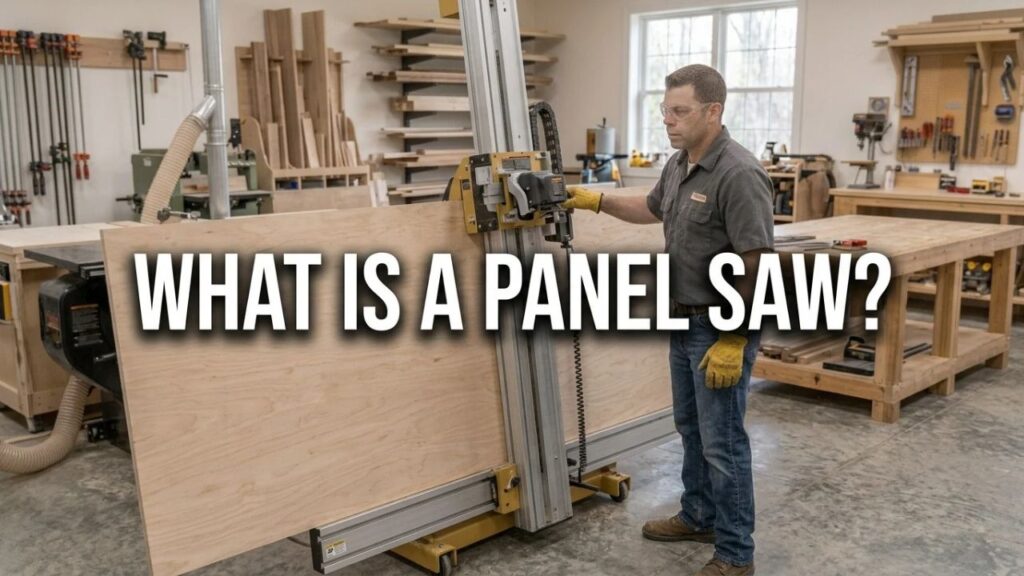
A panel saw breaks large sheets into smaller sections.
For example, a cabinet shop may start with a full 4 × 8-foot sheet of plywood and need pieces for cabinet sides, shelves, backs, doors, or partitions.
Instead of struggling to guide the entire sheet through a small saw, the panel saw supports most of the material.
The operator then makes straight rip cuts or crosscuts according to the required dimensions.
Panel saws are especially useful when the same types of cuts are made repeatedly.
A shop might use one to cut dozens of sheets into identical widths before moving those pieces to another machine for final machining.
Typical Panel Saw Jobs
A panel saw is commonly used to:
Break down full plywood sheets.
Cut MDF for cabinets and furniture.
Size particleboard.
Cut melamine panels.
Cut OSB and other construction sheets.
Prepare laminate-faced boards.
Produce repetitive cabinet components.
Trim large panels to final size.
The machine is primarily a sheet-goods saw, rather than a general-purpose woodworking saw for every kind of material.
Why Is It Called a Panel Saw?
The name comes from the materials it is designed to process.
Large flat sheet materials are often referred to as panels.
Examples include plywood panels, MDF panels, laminated panels, and particleboard panels.
A panel saw is therefore simply a saw specifically designed to handle panels efficiently.
The term can refer to several different machine designs, but they all share the same basic goal: supporting and cutting large sheet materials accurately.
Main Types of Panel Saws
The two most common types are vertical panel saws and horizontal sliding panel saws.
They perform similar jobs but use very different layouts.
What Is a Vertical Panel Saw?
A vertical panel saw holds the workpiece almost upright against a large frame.
The sheet rests on bottom rollers or supports.
A circular saw is mounted on a carriage that travels along the frame.
For a typical crosscut, the sheet stays in place while the saw carriage moves vertically through it.
For a rip cut, many vertical machines allow the saw head to rotate into a horizontal position so the sheet can be moved across the frame through the blade.
Advantages of a Vertical Panel Saw
A major advantage is floor-space efficiency.
Because the sheet stands vertically rather than lying flat, the machine occupies much less shop space than a large horizontal panel saw.
It also makes loading full sheets relatively easy.
This is why vertical panel saws are commonly seen in lumberyards and home-improvement stores.
Employees can place a full plywood sheet against the machine and quickly cut it to customer dimensions.
Limitations of Vertical Panel Saws
Vertical panel saws are excellent for breaking down sheets, but they are not always the best choice for extremely high-precision finished cabinetry.
Depending on the machine, blade, frame alignment, and material support, a sliding table saw or industrial beam saw may offer even greater precision and production speed.
However, a well-calibrated vertical panel saw can still produce very accurate cuts.
Key Takeaways:
- A vertical panel saw supports sheets in an upright position.
- It uses relatively little floor space.
- It is excellent for breaking down large plywood, MDF, and similar panels.
What Is a Horizontal Panel Saw?
A horizontal panel saw supports the workpiece flat.
The best-known woodworking version is the sliding table saw or sliding panel saw.
The workpiece sits on a large sliding carriage beside the blade.
Instead of trying to push a huge panel freehand across a small stationary table, the operator places it on the sliding table and moves the entire carriage past the blade.
This provides excellent support and control.
Where Horizontal Panel Saws Are Used
Sliding panel saws are extremely common in professional cabinet and furniture shops.
They are particularly useful for cutting:
Cabinet plywood.
Melamine.
Laminated particleboard.
MDF.
Veneered panels.
Plastic-faced sheet goods.
High-end machines may include scoring blades that cut a shallow groove in the lower surface before the main blade passes through.
This greatly reduces chipping on melamine and laminated boards.
Horizontal Panel Saw Advantages
Horizontal panel saws can provide excellent precision.
The operator can use fences, stops, crosscut arms, and measurement systems to produce highly repeatable parts.
They are especially well suited to finished cabinet components where edge quality matters.
The main disadvantage is size.
A sliding panel saw requires substantial floor space because both the machine and the moving sheet need room.
What Is an Industrial Beam Saw?
A beam saw is another type of panel-cutting machine used in larger manufacturing environments.
Instead of an operator manually pushing the sheet past the blade, an automated system clamps and positions one or more panels.
The saw blade then travels beneath or through the material.
Beam saws can cut stacks of sheet material very quickly.
They are common in high-volume cabinet, furniture, and panel-processing factories.
Computer-controlled versions can optimize cutting layouts automatically to reduce waste.
For most small woodworking shops, a beam saw is far more machine than necessary.
How Does a Panel Saw Work?
The exact mechanism depends on the type.
However, every panel saw uses a guided cutting system designed to keep the blade moving in a straight line relative to the sheet.
Vertical Panel Saw Operation
On a vertical saw, the sheet is positioned against the frame.
The saw carriage rides on guide rails.
During a crosscut, the carriage moves vertically through the sheet.
During a rip cut, the saw head may be rotated and locked while the sheet moves horizontally.
Sliding Panel Saw Operation
On a horizontal machine, the sheet lies flat on a large sliding carriage.
The operator positions the panel against a fence.
Then the carriage and sheet move together past the blade.
Because the material is fully supported, the cut is easier to control than pushing a full sheet over a conventional table saw.
What Is the Difference Between a Panel Saw and a Table Saw?
A table saw and panel saw can both cut plywood.
The biggest difference is how they support and control large sheets.
A conventional table saw has a stationary table and blade.
You push the workpiece across the table.
This works very well for solid lumber and smaller sheet components.
However, a full-size plywood sheet can be awkward because much of the sheet hangs beyond the table.
A panel saw is specifically designed to support that large material.
| Feature | Panel Saw | Table Saw |
| Primary purpose | Large sheet goods | General woodworking |
| Full-sheet handling | Excellent | Can be difficult |
| Solid lumber work | Limited on many models | Excellent |
| Rip cuts | Yes | Yes |
| Crosscuts | Yes | Yes with proper setup |
| Floor space | Depends on design | Moderate |
| Sheet support | Built in | Often requires extensions/helpers |
| Cabinet sheet production | Excellent | Possible but less convenient |
A cabinetmaker may own both.
The panel saw breaks down full sheets.
The table saw handles smaller parts, ripping, joinery, and other general woodworking tasks.
Panel Saw vs. Track Saw
A track saw performs many of the same sheet-breaking tasks but is portable.
The saw rides along a straight guide rail placed directly on the workpiece.
A sheet can be laid on a workbench, sawhorses, or rigid foam insulation.
The track is aligned with the cut line, and the saw moves along it.
When a Track Saw Is Better
A track saw makes sense if you:
Have a small workshop.
Work on job sites.
Only cut sheets occasionally.
Need portability.
Cannot justify a dedicated stationary machine.
A quality track saw can produce extremely accurate, clean cuts.
When a Panel Saw Is Better
A panel saw is generally better when you process many sheets every day.
Once properly set up, it is much faster for repetitive production.
You do not need to reposition and align a guide rail for every cut.
Panel Saw vs. Circular Saw
A circular saw can also break down plywood, but it normally needs a straightedge or guide.
Without a guide, long cuts can wander.
A panel saw keeps the blade constrained by a built-in guide system.
That makes repetitive straight cuts much easier.
A circular saw wins on cost and portability.
A panel saw wins on speed, material support, and production efficiency.
What Materials Can a Panel Saw Cut?
Panel saws are primarily intended for sheet materials.
Common materials include:
Plywood.
MDF.
OSB.
Particleboard.
Melamine.
Hardboard.
Veneered panels.
Laminate-faced boards.
Some plastics.
Certain composite sheets.
The exact machine and blade determine what is safe.
Can a Panel Saw Cut Solid Wood?
Some panel saws can cut solid boards, but this is generally not their main purpose.
A table saw, miter saw, or radial arm saw may be more appropriate for many solid-wood jobs.
Vertical panel saws in particular are designed around flat sheet material.
Do not assume any piece of lumber that fits physically is suitable.
Can a Panel Saw Cut Metal?
Only if the machine is specifically rated for it and equipped with the correct blade.
A standard woodworking panel saw should not automatically be used for aluminum or steel.
Blade speed, guarding, sparks, chip control, and motor design all matter.
Can a Panel Saw Cut Plastic?
Some panel saws can cut acrylic, polycarbonate, PVC sheet, and similar plastics when used with an appropriate blade.
Plastic cutting often requires different tooth geometry than woodworking.
Improper blades can chip, melt, or crack the material.
What Is a Panel Saw Used for in Cabinetmaking?
Cabinetmaking is one of the most common applications.
Most modern cabinets contain large amounts of sheet material.
A base cabinet, for example, may require plywood or melamine for:
Side panels.
Bottom panels.
Shelves.
Back panels.
Dividers.
Doors.
A panel saw can break full sheets into accurately sized rectangles very quickly.
Those pieces can then move to edgebanders, routers, CNC machines, drills, or assembly stations.
Why Accuracy Matters
A cabinet box relies on square parts.
If one side panel is tapered or slightly out of square, assembly becomes more difficult.
Doors and drawers may not align correctly.
That is why professional shops maintain and calibrate panel saws carefully.
What Is a Panel Saw Used for in Home Improvement Stores?
Large building-material stores often use vertical panel saws to cut sheet goods for customers.
For example, a customer may buy a full sheet of plywood but need it cut into two smaller panels for easier transport.
The employee loads the sheet onto the vertical saw and makes the requested cuts.
A vertical design is particularly practical in retail stores because it uses relatively little floor space while handling full sheets.
Can a Panel Saw Make Rip Cuts?
Yes.
A rip cut runs along the longer dimension or generally parallel to the material’s grain direction.
On a horizontal sliding panel saw, the sheet is guided through the blade using a fence or carriage.
On many vertical panel saws, the saw head is rotated into a horizontal cutting position and locked at the desired height.
The sheet is then moved horizontally through the blade.
The exact procedure varies by machine.
Can a Panel Saw Make Crosscuts?
Yes.
Crosscutting is one of its primary functions.
On a vertical panel saw, the saw carriage generally moves vertically through a stationary panel.
On a sliding panel saw, the sheet moves past the blade on the sliding carriage.
Both methods provide much more support than trying to crosscut a full sheet on a small conventional table saw.
How Accurate Is a Panel Saw?
A properly set up professional panel saw can be very accurate.
However, accuracy depends on several factors:
Machine rigidity.
Guide alignment.
Fence calibration.
Blade quality.
Carriage condition.
Material support.
Operator technique.
A poorly maintained panel saw can cut out of square just like any other machine.
Calibration Matters
Professional users regularly check whether the blade path is square to the support system.
Measurement scales and stops should also be verified.
If the machine is moved or adjusted, recalibration may be necessary.
A panel saw should not be assumed accurate simply because it has a built-in ruler.
What Kind of Blade Does a Panel Saw Use?
Most woodworking panel saws use carbide-tipped circular saw blades.
The exact blade depends on the material.
A general plywood blade may use a moderate-to-high tooth count.
Melamine and laminate often benefit from finer teeth and specialized tooth geometry.
MDF also cuts best with a sharp carbide blade designed for composite materials.
The machine manufacturer specifies the required:
Blade diameter.
Arbor size.
Maximum RPM.
Kerf range.
Never install a blade simply because it physically fits on the arbor.
What Is a Scoring Blade?
A scoring blade is a small blade used on some professional horizontal panel saws.
It runs ahead of the main blade.
Its job is to make a shallow cut in the bottom surface of the panel.
Then the main blade cuts through the full thickness.
This greatly reduces chipping on materials such as melamine and laminated particleboard.
High-end cabinet shops often value scoring systems because both faces of the panel may need a clean finished edge.
Why Are Panel Saws Good for Plywood?
Plywood sheets are large, flexible, and awkward.
A panel saw supports the sheet across a large area.
This reduces the amount of balancing and physical control required from the operator.
The built-in guide also keeps the cut straight.
For a business cutting many plywood sheets every day, these advantages save a significant amount of time.
Advantages of a Panel Saw
The biggest advantage is efficient sheet handling.
You can process large panels without building an enormous outfeed setup around a conventional table saw.
Cuts are also highly repeatable once stops and scales are calibrated.
A vertical panel saw saves floor space.
A horizontal sliding saw provides excellent precision and finish quality.
Production speed is another major advantage.
A cabinet shop making hundreds of rectangular components can process material far faster than it could with a handheld circular saw and straightedge.
Disadvantages of a Panel Saw
Panel saws are specialized machines.
They do not replace every other saw in a woodworking shop.
A vertical panel saw is not ideal for cutting narrow solid lumber or making most joinery.
A large horizontal panel saw requires substantial floor space.
Professional machines can also be expensive.
Blade and alignment maintenance are important.
Another limitation is mobility.
Unlike a track saw, a full-size panel saw is normally fixed in one location.
For a hobbyist who cuts three sheets per year, the machine may not be worth the investment.
Is a Panel Saw Safe?
A panel saw can make large sheet handling safer and more controlled, but the blade itself is still extremely dangerous.
The machine must be operated according to the manufacturer’s instructions.
Important safety principles include:
Keeping hands out of the blade path.
Using all factory guards.
Supporting large offcuts.
Waiting for the blade to stop before adjustments.
Using the correct feed direction.
Keeping the work area clear.
Disconnecting power before blade changes or service.
Do not disable guards to make material fit.
If a particular workpiece cannot be cut with the guarding in place, use another method.
Key Takeaways:
- Panel saws reduce the difficulty of controlling large sheet goods.
- They are still powerful circular-saw machines and require full guarding and safe hand position.
- Correct feed direction and material support are essential.
Do You Need Dust Collection With a Panel Saw?
Strongly recommended.
Plywood produces significant dust.
MDF can produce extremely fine particles that spread easily throughout a shop.
Many professional panel saws include dust ports around the blade or carriage.
Connecting a suitable dust extractor improves visibility, keeps the machine cleaner, and reduces airborne dust.
Respiratory protection may still be appropriate depending on the material and dust-control system.
Who Should Buy a Panel Saw?
A panel saw makes the most sense for someone who regularly cuts full sheets.
Examples include:
Cabinetmakers.
Furniture builders.
Commercial woodworking shops.
Sign makers.
Lumberyards.
Home improvement stores.
Closet manufacturers.
Panel-processing businesses.
A home woodworker with limited space may be better served by a track saw and table saw combination.
But if breaking down sheet goods is a major part of your work, a dedicated panel saw can dramatically improve workflow.
Is a Vertical or Horizontal Panel Saw Better?
Neither is universally better.
Choose based on your priorities.
Choose a Vertical Panel Saw If:
Floor space is limited.
You mainly break down full sheets.
You want easy loading.
You value a compact shop layout.
Choose a Horizontal Sliding Panel Saw If:
Maximum precision is important.
You produce finished cabinet parts.
You cut melamine regularly.
You want scoring capability.
You have sufficient floor space.
A large production shop may even use both types for different stages of processing.
Panel Saw vs. CNC Router
A CNC router can cut sheet material into extremely complex shapes.
A panel saw primarily produces straight rectangular cuts.
If you need cabinets with many drilled holes, curved components, dados, pockets, and complex part nesting, CNC can automate far more operations.
However, a panel saw is simpler and faster for straightforward straight-line sizing.
Many shops still use a panel saw even when they own CNC equipment.
How Much Space Does a Panel Saw Need?
A vertical panel saw has a relatively narrow footprint, but you still need room on both sides to load and move full sheets.
A horizontal sliding panel saw requires much more floor space.
The sliding carriage may extend several feet beyond the main machine body.
You also need clear material-loading space.
Before purchasing one, measure the complete operating envelope rather than only the machine dimensions.
What Size Sheets Can a Panel Saw Cut?
Many woodworking panel saws are designed around standard 4 × 8-foot sheets.
Larger commercial machines may handle oversized sheets.
Maximum sheet size depends on:
Frame width.
Frame height.
Maximum crosscut capacity.
Rip capacity.
Carriage travel.
Never assume every panel saw can process every oversized board.
Check the manufacturer’s rated capacity.
Can You Make Finish-Quality Cuts on a Panel Saw?
Yes, with the right machine and blade.
Cut quality depends heavily on blade selection and setup.
For unfinished plywood, a general high-quality carbide blade may be sufficient.
For melamine or veneered panels, a fine-tooth blade and scoring system can produce much cleaner edges.
A dull blade will create chipping regardless of how expensive the machine is.
Common Panel Saw Mistakes
One mistake is using the wrong blade.
Another is assuming the built-in measurement scale is perfectly calibrated.
Operators also sometimes force large sheets instead of allowing the supports and guides to control the material.
Improper feed direction is dangerous, especially on vertical machines in rip mode.
Another common mistake is trying to use a panel saw as a universal woodworking machine.
Use it for the work it was designed to perform.
For joinery, narrow rips, small parts, or solid lumber, another tool may be more appropriate.
FAQs About What Is a Panel Saw
What is a panel saw?
A panel saw is a woodworking machine designed to cut large sheet materials such as plywood, MDF, particleboard, OSB, and melamine into smaller pieces.
What is a panel saw used for?
It is mainly used for breaking down and sizing full sheets quickly and accurately.
What are the two main types of panel saw?
Vertical panel saws and horizontal sliding panel saws are the two most common types.
What is a vertical panel saw?
It is a machine that supports sheet goods almost upright against a vertical frame while a guided circular saw cuts the material.
What is a sliding panel saw?
It is a horizontal saw with a large sliding table that supports the panel as it moves past the blade.
Is a panel saw the same as a table saw?
No.
A panel saw is optimized for large sheet goods, while a table saw is a more general-purpose woodworking machine.
Is a panel saw better than a table saw for plywood?
For frequent full-sheet processing, usually yes.
A panel saw provides much better built-in support.
Is a track saw a panel saw?
No.
A track saw is a portable guided circular saw, while a panel saw is typically a stationary sheet-processing machine.
Can a panel saw rip plywood?
Yes.
Most panel saws are designed to make both rip cuts and crosscuts.
Can a panel saw crosscut plywood?
Yes.
Crosscutting sheet materials is one of its main functions.
Can a panel saw cut MDF?
Yes, with the appropriate blade and dust collection.
Can a panel saw cut melamine?
Yes.
A fine-tooth blade, and ideally a scoring system on some professional machines, helps reduce chipping.
Can a panel saw cut OSB?
Yes, provided the machine and blade are rated for standard wood-based panels.
Can a panel saw cut plastic?
Some can when equipped with an appropriate blade.
Check the machine specifications.
Can a panel saw cut metal?
Only if the saw is specifically designed or approved for that material.
Do not assume a woodworking panel saw can cut metal safely.
Can a panel saw cut solid lumber?
Some models can, but sheet goods are their primary purpose.
What size plywood can a panel saw handle?
Many are designed for standard 4 × 8-foot sheets, though capacity varies by model.
Why do cabinet shops use panel saws?
They make it fast and accurate to cut full sheets into cabinet sides, shelves, doors, backs, and other rectangular parts.
Why do home improvement stores use vertical panel saws?
Vertical machines take up relatively little floor space and allow employees to cut full plywood sheets easily for customers.
Are panel saws accurate?
Yes, when properly aligned, calibrated, maintained, and fitted with a good blade.
What is a scoring blade on a panel saw?
It is a smaller blade that pre-cuts the lower face of laminated material to reduce chipping before the main blade cuts through.
Is a panel saw safer than a table saw?
It can make large sheets easier to control, but neither machine is inherently safe without proper operation, guarding, and hand positioning.
Do panel saws need dust collection?
Dust collection is highly recommended, especially when cutting MDF and composite panels.
Is a panel saw worth it for a small workshop?
It can be if you process sheet goods frequently. For occasional use, a track saw may provide better value and take up less space.
Conclusion
So, what is a panel saw? A panel saw is a specialized woodworking machine designed to support and cut large sheet materials such as plywood, MDF, particleboard, OSB, melamine, and laminated panels quickly and accurately.
Its biggest advantage is not simply that it has a circular blade.
It is the way the machine supports the entire panel.
That support makes a full 4 × 8-foot sheet much easier to control than it would be on a small conventional table saw.
There are two main designs.
A vertical panel saw holds the sheet almost upright and is excellent when floor space is limited or full sheets need to be broken down quickly.
A horizontal sliding panel saw supports the material flat on a large moving carriage and is widely used in cabinet and furniture shops where precision and edge quality are especially important.
Panel saws can make both rip cuts and crosscuts.
They can also process a wide range of sheet materials when fitted with the correct blade.
However, they are specialized tools rather than complete replacements for table saws, track saws, miter saws, or CNC machines.
If you only cut plywood occasionally, a track saw may be simpler and less expensive.
If your work involves processing full sheets every day, a panel saw can dramatically improve speed, accuracy, material handling, and production efficiency.
The simplest way to think about it is this: a panel saw is a machine built specifically to make large panels easier to cut.