Are Old DeWalt Radial Arm Saws Good? Models, Pros & Buying Guide
Are old DeWalt radial arm saws good? Yes. Many vintage DeWalt radial arm saws—particularly the heavily built models from the 1940s through the 1970s—are exceptionally durable, accurate machines when they are mechanically sound and properly aligned. Their heavy cast components, rigid columns, machined carriage ways, and rebuildable construction are major reasons some examples are still doing accurate woodworking 60 or 70 years after they were manufactured.
That does not mean every old DeWalt is automatically a great purchase.
Condition matters enormously. A complete 1950s saw with smooth carriage bearings, unworn arm tracks, a healthy motor, functioning locks, and proper guards may be a fantastic permanent crosscut machine. A neglected example with worn ways, damaged wiring, missing guards, a bad motor, and excessive mechanical play can become an expensive restoration project.
Model also matters. Smaller DeWalt machines such as the MBF are popular because they are compact and accurate, although their relatively modest motors limit heavy cutting. The GWI is particularly sought after because it combines heavy construction with more power. Later models such as the 1030 and 7790 can also make excellent woodworking machines. Large GA and GE industrial saws take the same basic concept to a completely different level of size, weight, and cutting capacity.
Vintage DeWalt radial arm saws also have an unusual advantage over many discontinued machines: some replacement and compatible parts remain available today because Original Saw Company inherited the DeWalt radial-arm-saw design lineage and still supports parts for certain older models.
In this guide, I’ll explain are old DeWalt radial arm saws good, which vintage models are most desirable, what commonly wears out, how accurate they can be, whether replacement parts are available, and what to inspect before buying one.
Why Old DeWalt Radial Arm Saws Have Such a Good Reputation
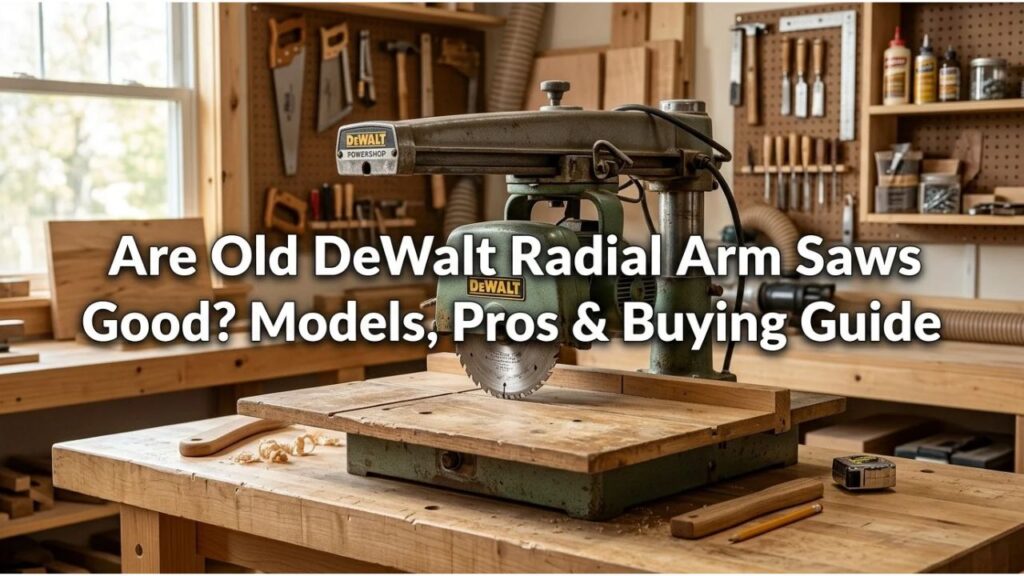
Raymond DeWalt developed the radial arm saw in the 1920s, so DeWalt was not simply another company producing a copy of an existing tool.
The radial arm saw is central to the company’s early history.
Over the following decades, DeWalt developed machines ranging from compact homeowner saws to massive industrial units.
Many earlier machines were built during a period when stationary woodworking equipment relied heavily on machined castings and substantial steel components.
A typical vintage DeWalt can therefore feel very different from lightweight consumer machinery.
Heavy Cast Construction
Many desirable vintage DeWalts use substantial cast-iron radial arms and heavy columns.
The additional material increases rigidity.
That matters because the entire motor and blade carriage moves along the arm.
If the arm flexes or twists, the blade cannot follow a perfectly repeatable cutting path.
A rigid structure allows the carriage to travel through a cut without substantial deflection.
Machined Carriage Ways
On many respected older models, the rollerhead bearings run along precisely machined surfaces inside the radial arm.
When these surfaces and bearings remain in good condition, the carriage can move exceptionally smoothly while having very little lateral play.
That is one reason a properly restored old DeWalt can produce remarkably consistent crosscuts.
Rebuildable Design
Many vintage machines were designed to be adjusted, serviced, and repaired rather than discarded.
Bearings can be replaced.
Carriages can be adjusted.
Tables and fences can be rebuilt.
Motors can sometimes be professionally repaired.
Electrical switches and wiring can be modernized when appropriate.
A machine that looks tired cosmetically may therefore still have excellent mechanical potential.
Key Takeaways:
- Many old DeWalt radial arm saws were built with unusually heavy and rigid components.
- Properly adjusted rollerhead bearings and machined arm ways can produce excellent carriage accuracy.
- Mechanical condition matters more than paint condition or age alone.
Are Old DeWalt Radial Arm Saws Accurate?
A good one can be extremely accurate.
The radial arm saw sometimes gets a reputation for constantly going out of adjustment, but that criticism applies much more strongly to certain lighter or worn machines than to every radial arm saw ever produced.
A heavy vintage DeWalt with good bearings and properly functioning locks can hold its setup remarkably well.
The key is correct alignment.
For an accurate 90-degree crosscut, several relationships must be correct:
the radial arm needs to index square to the fence, the blade must stand 90 degrees to the table, the blade needs to travel without heel, and the carriage must move along the arm without looseness.
Once these relationships are established on a mechanically sound machine, repeatable crosscuts can be excellent.
Using One as a Dedicated Crosscut Saw
Many modern owners get the best results by aligning an old DeWalt carefully at 90 degrees and using it primarily as a permanent crosscut station.
This reduces the need to repeatedly rotate and reconfigure the machine.
Install it in a long bench with a straight fence and length stops, and it becomes an exceptionally convenient machine for cutting long stock.
You can still use the miter and bevel functions when necessary, but a dedicated setup takes advantage of the machine’s strongest capability.
Which Old DeWalt Radial Arm Saws Are Good?
There are far too many DeWalt models to declare one universal winner, but several model families have particularly strong reputations among vintage-tool enthusiasts.
DeWalt MBF
The MBF is one of the most popular small vintage DeWalt radial arm saws.
It was produced during the 1950s and is commonly associated with a 9-inch blade and a relatively modest motor.
Its strongest qualities are compact size, rigid construction for its class, and accuracy.
An MBF can be an excellent choice if you have limited workshop space and primarily cut ordinary furniture and woodworking stock.
Its main weakness is power.
Compared with a large contractor machine, an MBF can feel underpowered when cutting thick hardwood or using wide dado tooling.
For normal crosscutting with a sharp blade, however, that does not prevent it from being an excellent saw.
DeWalt GWI
The GWI is one of the vintage DeWalt models most frequently sought by radial-arm-saw enthusiasts.
It combines the desirable heavy round-top-arm construction with a substantially stronger motor than the smaller MBF.
The result is a machine that still fits reasonably well in a serious home woodworking shop but has enough rigidity and power for much more demanding work.
If I were choosing a vintage DeWalt for a permanent woodworking crosscut station and found a complete GWI in excellent mechanical condition, it would be very attractive.
DeWalt 925
The 925 represents a transition toward later DeWalt designs.
It is smaller than some contractor machines but can still be a useful, accurate saw.
Its size can actually be an advantage for a compact shop.
As with an MBF, the question is whether its capacity and power match the work you intend to perform.
DeWalt 1030
The 1030 series is another well-regarded choice.
These machines combine good capacity with relatively substantial construction and can make excellent general-purpose shop radial arm saws.
A clean 1030 is worth examining if you want something larger and more powerful than a small homeowner model without moving all the way into huge industrial machinery.
DeWalt 7790
The 7790 is one of the later DeWalt radial arm saws that still receives positive attention.
It provides larger capacity and more power than many small vintage machines.
It can be a particularly useful choice for someone who wants a later saw but still wants the advantages of traditional DeWalt radial-arm construction.
DeWalt GA and GE
Large GA and GE models belong in another category.
These are serious industrial machines.
Depending on configuration, they may use very large blades and powerful motors.
They are enormously capable but can also be extremely heavy and may require commercial electrical power.
A large industrial DeWalt can be outstanding if you actually need its capacity.
For a small garage workshop, it may simply consume too much space and require too much effort to move and power.
Quick Comparison of Popular Vintage DeWalt Models
| Model/Series | General Character | Best For |
| MBF | Compact, accurate, lower power | Small home shop |
| GWI | Heavy, powerful, highly regarded | Serious woodworking |
| 925 | Compact later design | Limited-space shop |
| 1030 | Good general-purpose capacity | Furniture/cabinet work |
| 7790 | Larger later machine | Bigger crosscut work |
| GA | Heavy-duty industrial | Commercial work |
| GE | Very large industrial class | Heavy production |
These classifications are deliberately general because DeWalt offered numerous variations over several decades.
Always identify the exact machine and motor rather than buying based only on the family name.
Round-Arm vs Flat-Top DeWalt Radial Arm Saws
Vintage DeWalt enthusiasts often distinguish between the older round-top-arm machines and later flat-top designs.
The older round-arm machines are particularly prized because of their heavy cast construction.
Models such as the GWI exemplify the style.
Later flat-top machines can still be very good, but certain versions were designed with greater attention to production cost and may not feel as massive as the earlier machines.
That does not make a flat-top DeWalt bad.
A clean later machine with unworn components can be a much better purchase than an abused earlier model simply because the older one has a more desirable casting.
Buy condition first and reputation second.
How Long Can an Old DeWalt Radial Arm Saw Last?
Potentially for many decades.
There are still DeWalt radial arm saws from the 1940s and 1950s in working shops today.
Their longevity comes partly from the simplicity of the design.
A traditional machine consists largely of:
a rigid frame and column, an adjustable radial arm, roller carriage, yoke, motor, bearings, locks, and relatively simple electrical components.
There are no electronic displays or complex digital position systems required for basic operation.
If the major castings and machined ways remain good, many wear components can potentially be serviced.
Age Is Not the Biggest Problem
A 65-year-old machine that spent its life in a careful home workshop can be in substantially better condition than a 35-year-old industrial saw that made thousands of cuts every week.
Look at wear rather than the calendar.
Key Takeaways:
- MBF, GWI, 1030, and 7790 models are among the vintage DeWalts commonly considered desirable.
- Earlier heavy round-arm machines are especially respected, but condition is still more important than age.
- Industrial GA and GE models can be exceptional machines but may be impractical for a small shop.
What Usually Goes Wrong With an Old DeWalt Radial Arm Saw?
The basic machines are durable, but decades of use can wear important components.
Worn Rollerhead Bearings
The carriage rides along the radial arm on bearings.
If the bearings are badly worn, seized, or incorrectly adjusted, the carriage may feel rough or develop side-to-side movement.
Replacement rollerhead bearings remain available for some older DeWalt applications, which is good news for restorers.
However, you should still inspect the existing carriage before buying.
A carriage that travels smoothly and remains rigid is a very positive sign.
Worn Arm Ways
This is a more serious concern.
The roller bearings run against machined tracks inside or along the radial arm.
An industrial saw that spent decades making repetitive cuts can develop wear in the most frequently used portion of those tracks.
If you adjust the bearings tightly enough for the worn section, the carriage may bind elsewhere.
If you adjust for the unworn section, the carriage can become loose in the worn area.
Severe track wear can require professional machining or replacement components.
That can turn a cheap saw into an expensive project.
Motor Problems
Listen for noisy bearings and allow the motor to reach full speed if you are inspecting an operational machine safely.
Look for excessive vibration, burning smells, unusual electrical noise, or slow starting.
Some old DeWalt motors can be rebuilt by a competent motor shop.
But rewinding or extensively repairing a proprietary vintage motor may cost considerably more than the purchase price of the saw.
Electrical Wiring
Wiring insulation becomes brittle with age.
Power cords get damaged.
Old switches can wear.
Previous owners may also have performed questionable modifications.
A 60-year-old woodworking machine deserves an electrical inspection before regular use, even when the motor appears to run.
Missing Guards and Hardware
This is one of the most important problems when shopping for a vintage radial arm saw.
Machines are often sold without original blade guards, anti-kickback components, arbor hardware, carriage stops, handles, or other pieces.
A $75 saw can stop being cheap if essential safety components are impossible or expensive to replace.
Completeness matters.
Can You Still Get Parts for Old DeWalt Radial Arm Saws?
Some parts, yes.
This is one area where vintage DeWalt machines have an advantage over many discontinued woodworking tools.
The radial arm saw designs eventually passed through Lancaster Machinery and then to Original Saw Company, which continues manufacturing modern industrial radial arm saws based on the same design lineage.
Original Saw currently supports various replacement components and states that some of its parts are compatible with older DeWalt machines.
Examples can include certain:
rollerhead bearings, bearing shafts, motor/arbor components, switches, and safety-related hardware.
Compatibility varies significantly by model.
Not Every Vintage Part Is Available
Do not interpret this to mean you can order every casting, motor component, handle, or guard for a 1954 DeWalt from a current parts catalog.
Some parts require used replacements, fabrication, rebuilding, or specialist suppliers.
Before buying an incomplete machine, determine whether the missing component is actually obtainable.
That is particularly important for model-specific motor parts and guards.
Are Vintage DeWalt Radial Arm Saws Better Than New Ones?
That depends on what “better” means.
A good old DeWalt can offer tremendous mechanical quality for very little money.
Heavy cast components and decades-long service life are difficult to argue with.
However, modern industrial radial arm saws provide current guarding, current electrical systems, manufacturer support, and new-machine reliability.
A vintage machine also requires you to evaluate decades of wear.
Better Value?
Often, yes.
Used radial arm saw demand is relatively low because modern sliding miter saws dominate the home market.
That means a substantial vintage DeWalt can sometimes be purchased very cheaply relative to its original construction quality.
The problem is that the purchase price is only part of the cost.
A saw needing:
motor work, bearings, wiring, new guards, a replacement table, and extensive restoration
can quickly consume far more time and money than expected.
Are Old DeWalt Radial Arm Saws Safe?
They can be operated safely when complete, properly configured, maintained, and used according to appropriate procedures, but radial arm saws have hazards that must be respected.
The main crosscut issue is the self-feeding or climbing tendency of the blade.
During a traditional crosscut, you pull the blade carriage through the workpiece.
Blade rotation can encourage the saw head to move in the same direction.
If the saw is fitted with an aggressive positive-hook blade, this effect can become much stronger.
Use the Right Blade
For radial arm crosscutting, a blade with a low or negative hook angle is generally preferred.
This produces a less aggressive feed characteristic and gives the operator better control.
A blade designed primarily for fast ripping on a table saw may be a poor choice even if its diameter and arbor hole fit perfectly.
Keep the Carriage Under Control
Never allow the cutting head to race through the material.
Pull smoothly and deliberately.
Return the carriage to its rear position when the cut is complete.
Avoid Treating Old Manuals as Modern Safety Standards
Vintage radial arm saw manuals sometimes promoted an extraordinary number of operations.
Historical marketing showed radial arm saws being used for ripping, shaping, sanding, molding, routing-like work, and many unusual accessory operations.
Some of those procedures would not be considered desirable by modern woodworking safety standards.
Owning a versatile vintage machine does not mean you need to perform every operation that was demonstrated decades ago.
I would primarily use an old DeWalt for the jobs where it is genuinely excellent—especially controlled crosscutting and appropriately guarded joinery work.
Is an Old DeWalt Good for Ripping?
Many DeWalt radial arm saws were specifically designed to perform rip cuts.
When properly configured, the motor/yoke rotates and the workpiece feeds past the blade.
However, ripping is not the reason I would buy one today.
A modern table saw provides a more intuitive dedicated ripping setup with a riving knife, rip fence, guards, and push devices engineered specifically around that operation.
If you own both tools, using the DeWalt as a dedicated crosscut machine and the table saw for ripping creates a very efficient workshop arrangement.
Are Old DeWalts Good for Dadoes?
Yes, and this is one of their strongest specialty applications when the specific model and guarding permit approved dado tooling.
Because the workpiece remains stationary against the fence while the cutter travels across it, cross-grain dadoes can be easy to position.
A long cabinet side, shelving component, or furniture rail can remain supported along the bench while the dado cutter travels to the exact layout location.
A dedicated radial arm dado station can therefore be extremely productive.
Use only dado cutters and widths approved for the exact saw.
Are They Better Than a Sliding Miter Saw?
For many everyday users, no.
A modern sliding compound miter saw is simpler, more portable, easy to set for angles, and supported by current accessories and replacement parts.
But an old DeWalt can have advantages.
A permanent DeWalt station can provide a very long fence, excellent long-stock support, wide crosscut capacity, and the ability to perform controlled joinery cuts that a typical miter saw cannot.
The answer depends on the shop.
If you need a saw that travels to jobsites, buy a miter saw.
If you have a dedicated workshop and want a permanent precision crosscut station, a well-restored DeWalt becomes much more compelling.
What to Check Before Buying an Old DeWalt Radial Arm Saw
Start with the machine unplugged.
Move the carriage across the arm.
It should move smoothly without obvious lateral play.
Check the radial arm and column for cracks or damage.
Operate the arm, yoke, miter, and bevel locks.
They should engage securely.
Raise and lower the arm.
The elevation system should work without excessive binding.
Inspect the motor and arbor for unwanted play.
Check that the guard is complete.
Look closely at the electrical cord, switch, and wiring.
Finally, identify the model and serial number before buying so you know exactly what you are dealing with.
Mechanical Condition Matters More Than Cosmetics
Do not reject a saw simply because its paint is ugly.
Surface rust, dirty paint, and a damaged wooden table are relatively manageable restoration problems.
Be more concerned about:
severely worn arm tracks, cracked castings, missing proprietary parts, major motor problems, and mechanical components that will not lock securely.
A wooden tabletop can be replaced.
A badly worn precision arm is a different matter.
Key Takeaways:
- Smooth carriage movement with no unwanted play is one of the most important buying checks.
- Missing safety and proprietary parts can cost more to correct than cosmetic problems.
- Surface rust and an old table are much less concerning than damaged ways, castings, or a bad motor.
How Much Is an Old DeWalt Radial Arm Saw Worth?
Used prices are often surprisingly low.
Radial arm saws occupy substantial space, are difficult to transport, and have been displaced from the mainstream home market by sliding miter saws.
As a result, an excellent machine can sometimes sell for much less than its construction quality might suggest.
Small home-shop machines can appear for well under a few hundred dollars.
Large industrial machines may be inexpensive relative to their original cost but can be difficult to move and power.
Condition, local demand, model, completeness, electrical configuration, and accessories have a much larger effect on value than age alone.
Rare Does Not Automatically Mean Valuable
An old machine can be historically interesting without having a large resale market.
Shipping a 300- or 700-pound saw across the country is expensive.
Local buyers therefore have enormous influence on actual market value.
Buy an old DeWalt because you want to use or restore it, not because you assume every vintage example will become a valuable collectible.
Is an MBF Worth Buying?
Yes, if you understand what it is.
The MBF is attractive for a small shop because it delivers much of the solid vintage-DeWalt construction in a compact package.
It can make accurate crosscuts and is easier to accommodate than industrial machines.
The tradeoff is motor power and capacity.
If you regularly cut thick hardwood or heavy construction timber, look for a more powerful machine.
For furniture stock and general woodworking, a clean MBF can be an excellent choice.
Is a GWI Worth Buying?
A sound GWI is one of the more desirable vintage DeWalt finds.
Its heavy construction and stronger motor make it versatile enough for serious home-shop use.
The usual buying rules still apply.
A worn-out GWI is not better than a pristine smaller saw merely because the model is more desirable.
But if condition and price are both good, the GWI is a strong candidate for a permanent radial arm saw station.
Is a 7790 Worth Buying?
Yes, it can be.
The 7790 is a later design and provides useful capacity and power.
Some enthusiasts favor earlier round-arm DeWalts for their extremely heavy construction, but that does not make the 7790 a poor saw.
A complete, mechanically sound 7790 can be a very capable shop machine.
Again, test carriage smoothness, locking mechanisms, motor condition, and available parts before purchasing.
Should You Restore an Old DeWalt Radial Arm Saw?
If the important mechanical components are good, restoration can be very worthwhile.
A typical restoration may involve:
cleaning and rust removal, replacing bearings where needed, rewiring deteriorated electrical components, rebuilding the table and fence, adjusting the carriage, lubricating approved points, and completing a full alignment.
Cosmetic repainting is optional.
Accuracy and safety should come first.
Once restored and correctly adjusted, an old DeWalt can provide decades more service.
FAQs about Are Old DeWalt Radial Arm Saws Good
Are old DeWalt radial arm saws good?
Yes. Many are exceptionally well-built, durable, and accurate machines.
Condition and model are more important than age alone.
What is the best old DeWalt radial arm saw?
There is no universal best model, but the GWI is especially respected among vintage DeWalt enthusiasts.
The MBF, 1030, and 7790 are also popular choices for different shop requirements.
Is the DeWalt MBF a good saw?
Yes.
It is compact and capable of excellent accuracy, although its relatively modest motor limits heavy cutting.
Is the DeWalt GWI good?
Yes.
It combines heavy construction with greater motor power and is often considered one of the most desirable vintage homeowner/contractor DeWalts.
Are old DeWalt radial arm saws accurate?
A mechanically sound and correctly aligned example can be extremely accurate, especially when used as a dedicated crosscut machine.
Do old DeWalt radial arm saws hold alignment?
Good heavy DeWalt machines can hold alignment very well when their bearings, arm ways, locks, and column are in good condition.
Can you still get parts for an old DeWalt radial arm saw?
Some parts are still available or compatible through Original Saw Company and vintage-tool suppliers.
Availability depends on the model and component.
Are old DeWalt radial arm saws dangerous?
They have specific hazards and require correct guarding, blade selection, setup, and operating technique.
Use a suitable low- or negative-hook blade for controlled crosscutting and keep the carriage under control.
What blade should an old DeWalt radial arm saw use?
Use the diameter and arbor specified for the exact model.
For crosscutting, a low or negative hook-angle blade designed for radial arm or sliding-saw use is generally preferable.
Are old DeWalt radial arm saws better than Craftsman?
Many heavy vintage DeWalt models are more highly regarded for rigidity and long-term alignment than common consumer Craftsman machines, but individual condition matters more than the brand label alone.
Are round-arm DeWalt saws good?
Yes.
Many early round-top-arm DeWalt machines are especially valued for their substantial cast construction.
Is an old DeWalt better than a modern miter saw?
For portability and quick angle changes, generally no.
For a permanent long-stock crosscut station, a good vintage DeWalt can be outstanding.
Can an old DeWalt cut dadoes?
Many models can use approved dado tooling, making cross-grain dado work one of their useful capabilities.
Check the exact model manual for permitted tooling.
Should I use an old DeWalt radial arm saw for ripping?
Appropriately equipped models were designed to rip, but a modern table saw is generally the more convenient dedicated ripping machine.
How do I know whether a used DeWalt radial arm saw is worn out?
Check for excessive carriage play, uneven movement along the arm, damaged machined ways, loose locks, arbor play, motor problems, and missing safety components.
How old are vintage DeWalt radial arm saws?
DeWalt has produced radial arm saw designs since the 1920s, and many machines found on today’s used market date from the 1940s through the 1980s.
Are old DeWalt radial arm saws valuable?
Some models are desirable, but resale values are often modest because the machines are heavy, large, and difficult to transport.
Mechanical quality does not necessarily translate into high collector value.
Is an old DeWalt worth restoring?
Usually yes if the major castings, motor, carriage ways, and locking mechanisms are sound and important parts are present.
Conclusion
So, are old DeWalt radial arm saws good? Yes—many are exceptionally good machines.
Vintage DeWalt radial arm saws earned their reputation through heavy construction, rigid cast arms and columns, precision carriage systems, and a design that can be adjusted and rebuilt rather than treated as disposable equipment.
Some of the most interesting models include the compact MBF, the highly regarded GWI, and later machines such as the 1030 and 7790. Large GA and GE models offer industrial capability but require far more floor space, power, and moving equipment.
A properly restored DeWalt can make an outstanding permanent crosscut station. Build it into a long bench with a straight fence and stops, fit the correct low- or negative-hook crosscut blade, align the carriage carefully, and it can provide fast, repeatable cuts for long lumber.
But age and the DeWalt name alone do not make a saw worth buying.
Before purchasing one, concentrate on the expensive and difficult-to-repair components. The carriage should travel smoothly without lateral play. The machined arm ways should not be badly worn. The motor and arbor should operate smoothly. The arm, yoke, and bevel mechanisms should lock securely. Important guards and hardware should be present.
A dirty tabletop or ugly paint is relatively unimportant.
Severely worn precision surfaces, missing proprietary parts, damaged castings, or major motor problems are much bigger concerns.
Parts availability is another reason these machines remain attractive. Original Saw Company carries on the historical DeWalt radial-arm-saw design lineage and still offers some components compatible with older DeWalt machines, including parts for saws dating back many decades. That does not guarantee every vintage component is available, so identify the exact model before committing to a restoration.
My recommendation is simple: if you find a mechanically sound, complete old DeWalt radial arm saw at a reasonable price and have space for a permanent crosscut station, it can be an excellent woodworking machine even today.
For a small shop where portability matters or for someone buying a first crosscut saw, a modern sliding miter saw is usually more practical.
But judged purely as precision stationary machinery, a good old DeWalt deserves its reputation. Many of these saws were built to a standard that has allowed them to remain accurate and useful for half a century or more—and a properly restored example can still be one of the most satisfying crosscut machines in a woodworking shop.