Is ToolKraft 910A Radial Arm Saw Any Good? Review & Buying Guide
If you are wondering is ToolKraft 910A radial arm saw any good, my answer is yes—a complete, unworn, properly adjusted ToolKraft 910A can still be a useful vintage radial arm saw, especially for crosscutting, but I would buy one based almost entirely on its present mechanical condition rather than the ToolKraft name. It is a genuine older woodworking machine with a substantial adjustable radial-arm design, but obsolete parts, aging guards, carriage wear, electrical condition, and alignment can make one example excellent and another nearly worthless.
The 910A is not simply an unidentified generic saw. A surviving 25-page ToolKraft 910A operating-instructions and parts manual documents the machine, including setup, adjustment, and operating procedures. Period ToolKraft advertising also shows the company selling 10-inch radial arm saws during the early 1960s.
What makes the purchase complicated is age. You are evaluating a vintage machine rather than comparing two new saws with warranties. The motor may still be excellent while the carriage bearings are worn. The arm may be rigid while the original table is destroyed. One machine may still have its guards and controls while another has been modified repeatedly by previous owners.
There are also documented variations among surviving 910A machines. One owner examining a carriage clearly marked 910A found a bearing arrangement that differed from the drawings and parts list, which illustrates why sourcing parts and following generic adjustment instructions can sometimes be difficult.
For the right buyer, those limitations may be acceptable. For someone who simply wants an easy, modern saw for cutting boards to length, a sliding compound miter saw is usually a more convenient purchase.
In this guide, I’ll explain whether the ToolKraft 910A is a good radial arm saw, what it does well, where it falls short, what to inspect before buying one, and how it compares with vintage DeWalt, Craftsman, and modern saws.
Is ToolKraft 910A Radial Arm Saw Any Good Overall?
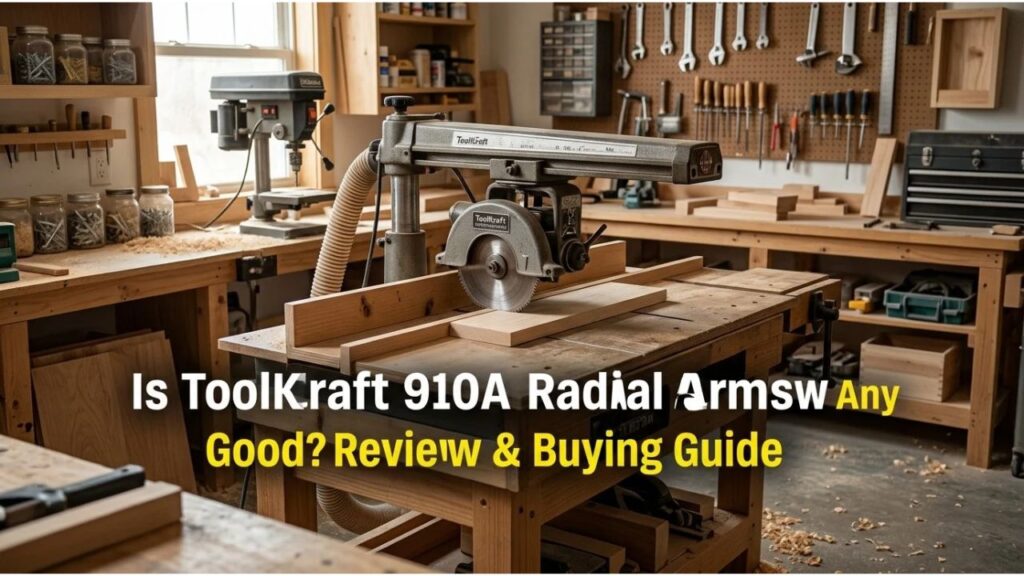
I would rate the ToolKraft 910A as a potentially good vintage home-shop radial arm saw rather than a must-buy classic.
Its greatest strength is its traditional radial-arm construction.
The motor carriage moves along an overhead arm for wide crosscuts, while the arm and motor assembly can be repositioned for other operations. Surviving 910A documentation describes adjustment and positioning systems typical of the multipurpose radial arm saw era, and another surviving manual description notes 360-degree arm rotation and multiple yoke and bevel adjustments.
That gives the 910A far more versatility than a basic chop saw.
However, versatility is not the same as precision.
How accurately a 60-plus-year-old radial arm saw cuts today depends on bearing condition, arm rigidity, locking mechanisms, motor arbor condition, table quality, and calibration.
An excellent example can hold useful crosscut accuracy.
A worn example may never stay square for long.
My Short Verdict
If the machine is complete, the carriage feels tight and smooth, the motor runs quietly, the locks hold firmly, and the blade can be aligned without excessive play, the 910A can be worth restoring and using.
If the machine has a sloppy carriage, damaged arm tracks, missing guards, bent arbor, weak motor, cracked castings, or missing model-specific components, I would pass unless you specifically enjoy vintage machinery restoration.
Key Takeaways:
- The ToolKraft 910A can be a capable vintage crosscut saw when mechanically sound.
- Condition matters much more than the ToolKraft badge.
- Parts availability and machine age are its biggest disadvantages today.
Who Made the ToolKraft 910A?
The model is associated with ToolKraft and surviving documentation is cataloged under Darra-James / ToolKraft.
ToolKraft produced a variety of stationary and benchtop woodworking machines, and vintage documentation still exists for saws, drill presses, jointers, sanders, lathes, and radial arm saws. The 910A itself has a surviving dedicated operating manual and parts list.
ToolKraft machines also have historical connections with some Montgomery Ward Powr-Kraft equipment, which can create confusion when identifying old saws.
Do not assume every Powr-Kraft saw is identical to a 910A, however.
Vintage manufacturers frequently changed details over production runs or sold related machines under different labels.
The model plate and actual construction should always take priority over visual similarity.
Is the ToolKraft 910A a 10-Inch Radial Arm Saw?
The 910A belongs to ToolKraft’s vintage 10-inch radial-arm-saw era, and period material from 1962 advertises a ToolKraft 10-inch radial arm saw. Surviving auction and manual records also identify the 910A specifically as a radial arm saw.
If you own one, however, check the data plate and manual before buying a blade.
Vintage machinery can be modified over decades.
Someone may have fitted an incorrect blade, arbor hardware, or accessory.
Use the blade diameter, arbor dimensions, and maximum speed appropriate to your exact machine.
How Well Is the ToolKraft 910A Built?
Compared with inexpensive modern portable tools, an intact 910A feels substantial.
Vintage radial arm saws generally used heavy columns, cast or machined carriage components, and serviceable adjustment systems because they were expected to remain permanently set up in a workshop.
The ToolKraft 910A follows that older-school philosophy.
Its carriage uses rolling bearings along the arm rather than simply sliding on an inexpensive plastic mechanism.
One documented surviving 910A carriage had five ball bearings and one roller bearing, along with adjustments for controlling fit against the arm track.
That is good from a serviceability standpoint.
It means play can potentially be corrected rather than immediately condemning the machine.
But it also creates another issue: adjustment must be done correctly.
A carriage adjusted too loosely can wobble.
A carriage adjusted too tightly can bind.
Either condition hurts cut quality.
Is It Built Like an Industrial DeWalt?
I would not automatically put it in the same category as the most desirable heavy vintage DeWalt industrial radial arm saws.
One longtime woodworking discussion compared an older ToolKraft/Montgomery Ward saw with a vintage DeWalt and described the DeWalt as substantially better in precision, although the owner also acknowledged that setup knowledge affected the ToolKraft experience. That is individual experience rather than laboratory testing, but it reflects the general hierarchy many vintage-tool users perceive.
The 910A can still be good without being the ultimate radial arm saw.
Is the ToolKraft 910A Accurate?
It can be.
Accuracy depends on whether the machine can maintain several relationships at the same time.
The arm must lock square to the fence.
The carriage must travel straight.
The blade must remain parallel to carriage travel.
The motor/yoke must hold its adjustment.
The table must be flat.
And the fence must be straight.
If those conditions are met, the machine can make very respectable crosscuts.
The Carriage Is the First Thing I Would Check
Unplug the saw.
Grab the motor carriage and gently try to rock it vertically and sideways.
A tiny amount of mechanical feel is different from obvious movement.
If you can visibly change the blade position by rocking the carriage, precision will suffer.
Now slide the carriage across the arm.
It should move smoothly through the full stroke without binding.
The surviving 910A carriage documentation is particularly useful here because it shows that bearing fit was adjustable, but it also warns against making certain factory-type alignment changes unless actually necessary.
Test It With a Real Cut
If you are buying a functioning machine, do not judge accuracy from the angle pointer alone.
Use a straight board.
Make a 90-degree crosscut.
Check it with a trustworthy square.
Then make several more cuts.
A saw that cuts square once but drifts after rotating and relocking the arm has a repeatability problem.
Repeatability matters more than whether you can painstakingly adjust it square once.
What Is the ToolKraft 910A Best Used For?
I think its best modern role is dedicated crosscutting.
Set it up carefully at 90 degrees, install a suitable blade, build a good flat table and fence, and use it as a stationary crosscut station.
That avoids much of the constant reconfiguration that gave radial arm saws their reputation for being difficult to keep aligned.
Wide Board Crosscuts
Radial arm saws can crosscut stock wider than a traditional fixed-head miter saw because the entire motor carriage travels along the arm.
That remains useful for shelving, cabinet stock, framing material, and wide furniture components.
Repetitive Cuts
With a long fence and stop block, the 910A can be useful for cutting multiple parts to consistent length.
A permanent radial arm station can be very efficient in a workshop.
Dado and Specialty Operations
Vintage radial arm saws were historically marketed for much more than ordinary crosscuts.
The surviving ToolKraft literature and manuals reflect this multipurpose approach.
But I would be selective today.
Just because a machine was marketed for a particular operation decades ago does not mean you need to perform that operation now.
Modern routers, table saws, planers, sanders, and track saws often provide a simpler workflow.
Key Takeaways:
- The 910A makes the most sense today as a dedicated, well-aligned crosscut saw.
- Bearing condition and repeatable locking determine whether it can remain accurate.
- You do not have to use every vintage accessory or operation simply because the machine was designed to accept it.
Is the ToolKraft 910A Good for Ripping?
Historically, radial arm saws were designed to rip as well as crosscut.
The motor/yoke can be repositioned so the blade becomes parallel with the fence and the wood is fed through the machine.
However, ripping is not the reason I would buy a ToolKraft 910A today.
Radial arm saw ripping requires the correct blade orientation, fence position, work feed direction, guard, and anti-kickback arrangement.
An incorrect setup can allow the blade to grab and propel the workpiece.
A modern table saw with a riving knife and guard or a track saw is usually easier to configure for ripping.
If you already have one of those tools, I would leave the 910A calibrated for crosscuts.
What Blade Should You Use on a ToolKraft 910A?
Assuming your particular machine is configured for the original 10-inch blade size, choose a quality crosscut blade appropriate for a radial arm saw or sliding miter saw.
I strongly prefer a low or negative hook angle.
That tooth geometry reduces the blade’s tendency to aggressively pull the carriage toward the operator.
A strongly positive-hook ripping blade may make a radial arm saw feel far more eager to self-feed.
For general woodworking, a 60- to 80-tooth carbide blade can provide clean crosscuts.
The correct blade must also match the machine’s arbor and RPM requirements.
Do not use a blade merely because it is 10 inches in diameter.
Does the ToolKraft 910A Have a Self-Feeding Problem?
Any traditional radial arm saw can exhibit self-feeding behavior.
It is a consequence of the way blade rotation interacts with carriage direction during a crosscut.
The blade can try to pull the saw carriage through the wood faster than you intend.
That does not necessarily indicate a defective ToolKraft.
However, an aggressive blade, poor alignment, dull teeth, excessive carriage play, or forcing the cut can make the effect worse.
Control the carriage firmly and use an appropriate blade.
What Common Problems Should You Look For?
Because of the 910A’s age, I would expect inspection and maintenance rather than plug-and-play operation.
Worn or Misadjusted Carriage Bearings
This may be the most important mechanical issue.
Look for looseness, rough movement, or inconsistent resistance.
A surviving 910A example also demonstrates that bearing arrangements may not always exactly match surviving parts drawings, complicating restoration.
Worn Arm Tracks
Bearings need a sound surface to run on.
Deep wear, corrosion, impact damage, or grooves in the arm track can be much harder to correct than simple bearing adjustment.
Motor Bearing Noise
Run the motor without cutting and listen.
It should accelerate smoothly.
Grinding, rumbling, or significant vibration can indicate worn bearings or arbor problems.
An electric-motor shop may be able to rebuild a good vintage motor, but factor that cost into the purchase.
Blade or Arbor Runout
With the machine unplugged, check for obvious shaft play.
When running with a known-good blade, there should not be visible lateral wobble.
A bent or badly worn arbor can make the machine unsuitable for precision work.
Faulty Locks
Test the arm, yoke, bevel, and elevation locks.
Every mechanism should move when released and remain firmly fixed when locked.
A radial arm saw with an unreliable yoke or arm lock is not ready for use.
Damaged Wiring
Inspect the cord, switch, strain relief, and motor wiring.
A machine from this era may have had electrical repairs decades ago.
Brittle insulation and homemade wiring changes deserve attention before the saw is energized.
Missing Guard
I would not dismiss this as a cosmetic issue.
Vintage radial arm saws expose a large rotating blade and bring the carriage toward the operator during a crosscut.
A missing or badly damaged guard should affect whether you buy the saw.
Replacement guard availability for an uncommon vintage model can be difficult.
Damaged Table and Fence
This is comparatively easy to solve.
Radial arm saw tables are consumable surfaces.
If the motor, arm, carriage, and locks are excellent but the wooden table is destroyed, that is not necessarily a reason to reject the saw.
You can reproduce an appropriate flat table and straight fence while preserving the original geometry.
Are Parts Still Available for the ToolKraft 910A?
This is probably the machine’s biggest weakness.
You should not expect a modern dealer network where you can type “ToolKraft 910A carriage assembly” into an online catalog and receive a new replacement.
The original machine is old, and current documentation is mostly preserved through vintage manual archives and enthusiast resources.
Standard components such as bearings, electrical cable, switches, and certain fasteners may be replaceable by specification.
Unique castings, knobs, yoke components, arbor parts, guards, and proprietary linkage can be much harder.
Buy the Most Complete Saw You Can
A missing table is manageable.
A missing proprietary yoke casting is not.
A rusty stand is manageable.
A cracked arm is much more serious.
When buying an obscure vintage machine, completeness can be more valuable than cosmetic appearance.
Is the Manual Available?
Yes.
A 25-page ToolKraft 910A operating-instructions and parts-list manual is preserved online. That is a substantial advantage when restoring one because it provides model-specific setup and parts information rather than forcing you to rely entirely on generic radial-arm-saw instructions.
I would obtain and read the manual before doing major adjustments.
Vintage radial arm saws can have alignment screws that look like ordinary fasteners.
Randomly loosening them can turn a moderately misaligned machine into a frustrating restoration project.
Is the ToolKraft 910A Safe?
It can only be considered suitable for use after the individual machine has been inspected and correctly configured.
The basic radial arm saw design requires more operator understanding than a modern chop saw.
The carriage moves toward the operator.
The motor/yoke can rotate.
Multiple locks control the cutting geometry.
The blade may self-feed.
And vintage guards are generally less sophisticated than those on many modern saws.
I Would Not Operate One Until These Are Verified
The blade guard should be complete and functional.
The motor and arbor should run without abnormal vibration.
The carriage should be tight.
The arm and yoke locks should hold.
The electrical wiring should be sound.
The table and fence should be stable.
A correct radial-arm-saw blade should be installed.
If any of those are questionable, repair the machine first.
Is the ToolKraft 910A Part of the Craftsman Radial Arm Saw Recall?
No evidence indicates that the ToolKraft 910A itself is part of the well-known Emerson/Craftsman radial arm saw recall.
That recall involved specified Craftsman saws, not every vintage radial arm saw made by every manufacturer.
However, not being part of that recall does not automatically prove a ToolKraft guard is adequate by modern standards.
Evaluate the actual guard installed on your machine.
ToolKraft 910A vs. Vintage DeWalt Radial Arm Saw
If both machines were in equally good condition and similarly priced, I would generally choose a desirable heavy vintage DeWalt.
DeWalt radial arm saws have a much larger enthusiast following.
Documentation and restoration knowledge are easier to find.
Some models also have an excellent reputation for rigidity and precision.
The ToolKraft’s advantage is price.
Because it is less famous, you may find one inexpensively even when the machine itself is mechanically sound.
That can make the 910A a good value.
ToolKraft 910A vs. Craftsman Radial Arm Saw
This comparison depends heavily on the Craftsman model.
Craftsman sold many radial arm saws across several decades.
Some are better regarded than others.
The ToolKraft has the appeal of relatively heavy vintage construction, but an excellent Craftsman in known safe configuration may have easier access to used parts and community knowledge.
Again, buy the individual machine rather than the badge.
ToolKraft 910A vs. Modern Sliding Miter Saw
For most homeowners, the modern sliding miter saw wins.
It is easier to transport.
It requires less calibration.
Current blades, guards, and replacement parts are readily available.
It handles ordinary crosscutting and miter work very well.
The ToolKraft 910A makes more sense if you appreciate vintage machinery, want a permanent wide-crosscut station, and are comfortable maintaining and aligning it.
Is the ToolKraft 910A Worth Restoring?
Yes, if the important mechanical pieces are healthy.
I would consider restoration worthwhile when:
the arm is sound, the carriage bearings and tracks are serviceable, the motor is healthy or economically rebuildable, the arbor is straight, the locks work, and important guards and proprietary hardware are present.
Cosmetic rust, chipped paint, a bad table, and a worn power cord are much less concerning.
When I Would Walk Away
I would pass on a 910A with a cracked arm or yoke.
I would also be cautious about severe carriage-track wear, major arbor damage, missing proprietary components, or an incomplete guard system that cannot reasonably be replaced.
These problems can turn an inexpensive saw into a long search for unobtainable parts.
Key Takeaways:
- Standard maintenance parts may be replaceable, but unique ToolKraft components can be difficult to find.
- A complete but dirty saw is often a better restoration candidate than a cleaner incomplete one.
- Prioritize motor, arbor, arm, carriage, locks, and guard condition over paint.
How Much Is a ToolKraft 910A Worth?
There is no reliable national market price.
Vintage radial arm saw values are highly local because the machines are large, heavy, expensive to ship, and less popular than modern miter saws.
Recent listings demonstrate that spread: a current Austin-area listing has advertised a ToolKraft 910A at $250, while another untested 10-inch ToolKraft radial arm saw sold at an Ohio auction for only a few dollars. Those numbers should not be treated as definitive appraisals; they mainly demonstrate how inconsistent the market is.
I would value the machine based on usability rather than rarity.
A fully functioning, complete, accurately aligned machine is obviously worth more than an untested estate-sale example.
But I would not pay a large collector premium for a 910A.
At higher prices, better-known vintage DeWalt machines and modern sliding miter saws become strong alternatives.
What to Check Before Buying a ToolKraft 910A
If you are standing in front of one at a garage sale or marketplace pickup, unplug it first and inspect systematically.
Slide the carriage.
It should move smoothly and should not rock excessively.
Release and lock the arm.
Check whether it returns firmly to the 90-degree position.
Rotate the yoke and test its lock.
Check the bevel adjustment.
Turn the elevation mechanism.
Inspect the arbor for movement.
Look at the motor cord and switch.
Confirm that the guard is present.
Then run the motor if the electrical condition appears safe.
Listen for bearing noise and vibration.
Finally, make a test cut if the seller allows it.
A machine that passes those checks is much more interesting than one that merely “turns on.”
Is the ToolKraft 910A Good for a Beginner?
Not really.
A beginner can learn to use one, but it would not be my first stationary saw recommendation.
A modern miter saw requires fewer adjustments.
A radial arm saw asks the operator to understand carriage control, self-feeding, blade hook angle, arm alignment, yoke position, ripping direction, and multiple mechanical locks.
If you already understand stationary woodworking machines and enjoy restoring older tools, the 910A is far more appealing.
Can the ToolKraft 910A Still Be Used Professionally?
Possibly for a dedicated operation, but it would not be my first recommendation for a modern production shop.
Downtime matters professionally.
If a unique 910A component breaks, sourcing a replacement may take days or may require machining a custom part.
A current-production industrial radial arm saw, commercial miter saw, or dedicated crosscut station offers better parts support.
For a hobby workshop, that is less important.
FAQs about Is ToolKraft 910A Radial Arm Saw Any Good
Is ToolKraft 910A radial arm saw any good?
Yes, a mechanically sound ToolKraft 910A can be a good vintage radial arm saw, particularly for crosscutting. Condition and completeness are more important than the brand name.
Is the ToolKraft 910A a good quality saw?
It has substantial vintage construction and serviceable adjustment mechanisms, but it is not automatically equal to the most desirable heavy industrial radial arm saws.
What size blade does a ToolKraft 910A use?
The 910A is associated with ToolKraft’s 10-inch radial arm saw line. Verify your exact machine and manual before purchasing a blade.
Is a ToolKraft 910A accurate?
It can be accurate if the carriage, arm, yoke, table, fence, and blade are correctly adjusted and free from excessive wear.
Why does my ToolKraft 910A carriage feel loose?
The carriage bearings may be worn or out of adjustment. Surviving 910A examples show an adjustable bearing system.
Are ToolKraft 910A parts available?
Some standard bearings and electrical components may be replaceable, but unique castings, guards, controls, and other model-specific parts can be difficult to source.
Can I still get a ToolKraft 910A manual?
Yes. A 25-page operating-instructions and parts-list manual has been preserved online.
Is ToolKraft the same as Darra-James?
Surviving documentation frequently groups the brands as Darra-James / ToolKraft, reflecting their historical relationship.
Is ToolKraft the same as Montgomery Ward Powr-Kraft?
Some ToolKraft machinery has historical connections with Powr-Kraft-branded machines, but you should not assume all models are identical.
Is the ToolKraft 910A better than a Craftsman radial arm saw?
It depends on the exact machines and their condition. A tight ToolKraft can be better than a badly worn Craftsman, while a well-maintained Craftsman may have easier parts support.
Is a vintage DeWalt better than the ToolKraft 910A?
If condition and price are equal, I would generally favor a well-regarded heavy vintage DeWalt because of its reputation and stronger restoration community.
Can you rip wood with a ToolKraft 910A?
The traditional radial arm saw design can be configured for ripping, but I prefer a table saw or track saw for routine modern ripping.
What blade is best for a ToolKraft 910A?
Use a quality blade with the correct size, arbor, and RPM rating. A low- or negative-hook crosscut blade is preferable for controlled radial-arm-saw use.
Is the ToolKraft 910A dangerous?
Like any radial arm saw, it can be dangerous if improperly configured, missing guards, badly aligned, or operated with an unsuitable blade.
Is the ToolKraft 910A worth restoring?
Yes, if the arm, tracks, motor, arbor, carriage, locks, and major proprietary parts are in good condition.
How much should I pay for a ToolKraft 910A?
There is no consistent national value. Local prices vary widely, so condition and completeness should determine what you are willing to pay.
Conclusion
So, is ToolKraft 910A radial arm saw any good? Yes—if you find a complete, mechanically tight example, the 910A can still make a useful and interesting vintage woodworking machine.
Its strongest modern role is as a dedicated crosscut saw.
Set the arm accurately at 90 degrees, build a flat table and straight fence, install a suitable low- or negative-hook blade, adjust the carriage correctly, and a good 910A can handle wide board crosscuts very effectively.
The machine’s biggest weakness is not necessarily its original design. It is age and parts availability.
A saw this old may have worn carriage bearings, damaged wiring, missing guards, loose locks, arbor wear, or modifications made by several previous owners. Some surviving 910A machines even show differences from published carriage parts information, so restoration can require more detective work than restoring a better-documented model.
If I were considering one, I would ignore cosmetic paint condition and concentrate on five things: carriage play, arm and yoke locks, motor/arbor condition, guard completeness, and whether the saw repeatedly returns to a square cut.
If those are good and the price is reasonable, I would consider the ToolKraft 910A a worthwhile vintage saw.
If major proprietary parts are missing or the machine cannot hold alignment, I would pass and look for a better-condition vintage DeWalt, another well-supported radial arm saw, or a modern sliding miter saw instead.