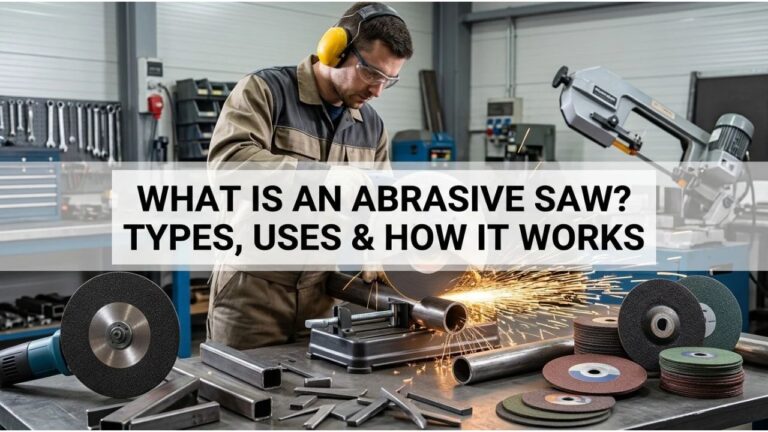
How to Use an Abrasive Cut-Off Saw
If you want to know how to use an abrasive cut-off saw, first install the correct abrasive wheel, inspect it for cracks or damage, secure the metal firmly in the saw’s vise, position the material so sparks travel into a safe area, let the wheel reach full speed, then lower it into the work with steady pressure without forcing the cut. Keep your hands away from the wheel, never cut unsupported material, and always wait for the wheel to stop completely before removing the workpiece.
An abrasive cut-off saw, often called a chop saw, is one of the most common tools for cutting steel tubing, angle iron, flat bar, rebar, pipe, and similar metal stock.
Unlike a cold saw or carbide metal-cutting saw, it does not remove metal with sharp carbide teeth. Instead, it uses a reinforced abrasive wheel that wears away as it grinds through the material.
That cutting process creates substantial heat, sparks, noise, and abrasive dust.
For that reason, correct setup and workholding are just as important as the actual cut.
A poorly clamped workpiece can move and pinch the wheel. Excessive pressure can overheat or damage the disc. Cutting near sawdust, gasoline, solvents, or other combustible materials can create a fire hazard.
In this guide, I’ll explain how to use an abrasive cut-off saw step by step, how to choose and inspect the wheel, how tightly to clamp the workpiece, how to reduce binding, how to make square and angled cuts, and which mistakes to avoid.
What Is an Abrasive Cut-Off Saw?
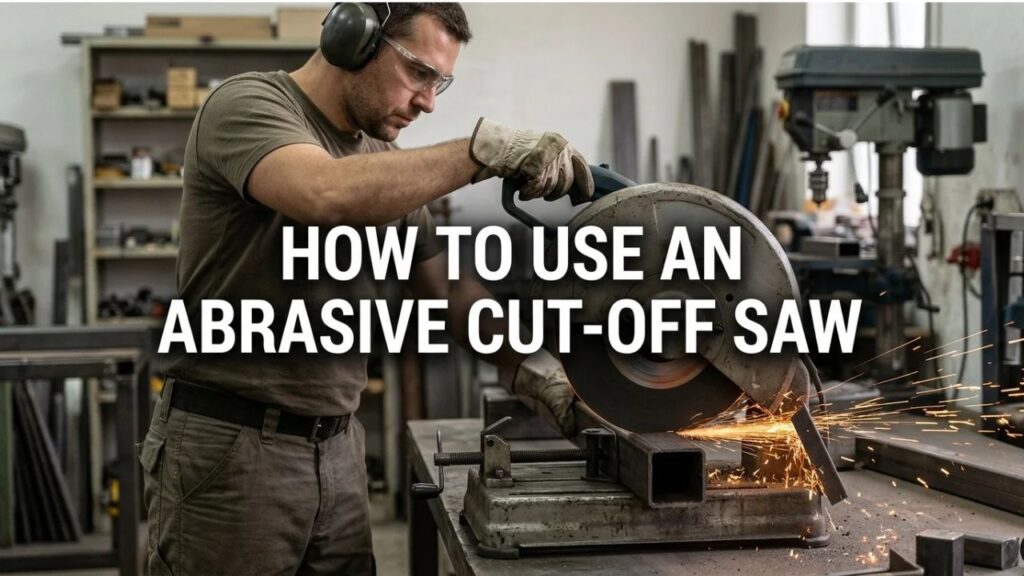
An abrasive cut-off saw is a stationary or semi-portable power saw designed primarily for cutting metal.
It typically consists of:
A high-speed electric motor.
Pivoting saw arm.
Reinforced abrasive wheel.
Fixed base.
Material fence.
Workpiece vise.
Blade guard.
The operator places the material on the base, clamps it against the fence, starts the saw, and lowers the rotating abrasive wheel into the metal.
As the disc contacts the workpiece, abrasive grains remove small particles of metal.
The wheel gradually becomes smaller as it wears.
What Can You Cut With an Abrasive Cut-Off Saw?
Abrasive chop saws are commonly used for:
Mild-steel tubing.
Angle iron.
Flat bar.
Square tubing.
Round tubing.
Steel pipe.
Rebar.
Threaded rod.
Channel.
Certain stainless-steel sections when the wheel is rated for them.
The exact material depends on the wheel.
Do not assume one abrasive disc is suitable for every metal.
Can It Cut Aluminum?
Some abrasive wheels are specifically designed for aluminum and other non-ferrous metals, but a general-purpose steel wheel may load up when cutting softer aluminum.
Aluminum can clog the abrasive surface and increase heat.
Use a wheel specifically rated for the material.
Can It Cut Wood?
No.
Abrasive metal-cutting saws are not intended for wood.
Do not install a conventional woodworking blade unless the saw manufacturer explicitly approves that configuration.
The guard, spindle speed, fence, and cutting geometry may not be suitable.
Abrasive Cut-Off Saw vs. Metal Chop Saw
The terms are often used interchangeably, but there are two broad types of metal chop saw.
An abrasive chop saw uses a bonded abrasive disc.
A dry-cut or carbide metal saw uses a toothed blade.
Abrasive saws are usually inexpensive and can cut many steel sections.
However, they create:
More sparks.
More heat.
More abrasive dust.
More burrs.
A less precise finished edge.
Carbide metal saws often cut cooler and cleaner, but their blades cost more and require correct application.
Before Using the Saw
Do not start by putting metal into the vise.
Inspect the machine first.
Check the power cord.
Make sure the blade guard moves freely.
Inspect the vise and fence.
Verify that the saw pivots smoothly.
Make sure the wheel is correct for the material.
Check that the wheel’s maximum RPM is equal to or greater than the saw’s rated spindle speed.
Never install a wheel with a lower RPM rating than the machine.
Wear the Right Personal Protective Equipment
Abrasive cutting throws hot sparks and small metal particles.
Use safety glasses with side protection.
A face shield can provide additional protection but should not replace safety glasses.
Wear hearing protection because abrasive saws are extremely loud.
Long sleeves made from appropriate non-melting material can help protect against sparks.
Avoid loose clothing.
Tie back long hair.
Remove jewelry.
Wear sturdy footwear.
Gloves can help when handling sharp metal before and after cutting, but keep gloved hands well away from the rotating wheel.
Keep the Area Free of Flammable Material
This is extremely important.
Abrasive cut-off saws create a large stream of sparks.
Do not operate the saw near:
Sawdust piles.
Wood shavings.
Gasoline.
Paint thinner.
Aerosol cans.
Oily rags.
Cardboard.
Paper.
Dry grass.
Plastic fuel containers.
Wood dust collectors.
If you use the saw in a mixed woodworking and metalworking shop, clean the cutting area first.
Hot sparks can remain dangerous after they land.
Key Takeaways:
- Abrasive saws create heat, sparks, and abrasive dust.
- Keep combustible material well away from the cutting area.
- Always match the wheel type and RPM rating to the saw and material.
Step 1: Disconnect Power Before Changing the Wheel
Unplug the saw before changing or adjusting the abrasive wheel.
Do not rely on the trigger switch.
A wheel change puts your hands directly next to the spindle.
Use the saw’s spindle lock or specified wrench method.
Never press the spindle lock while the motor is running.
Step 2: Inspect the Abrasive Wheel
Before installation, look carefully at the disc.
Do not use it if you see:
Cracks.
Chips.
Missing sections.
Heavy edge damage.
Water contamination.
Severe warping.
Damage around the arbor hole.
A damaged abrasive wheel can break at high speed.
Discard questionable wheels.
The cost of a new disc is insignificant compared with the risk of a wheel failure.
Step 3: Confirm Wheel Size and RPM
Check the saw nameplate and wheel label.
The wheel must have:
Correct diameter.
Correct arbor hole.
Correct thickness.
Correct wheel type.
Adequate RPM rating.
For example, if the saw operates at 3,800 RPM, the wheel must be rated for at least that speed.
Never enlarge an arbor hole manually.
Never stack multiple wheels together.
Never use a wheel designed for a handheld grinder on a chop saw unless it is specifically approved for that machine.
Step 4: Install the Wheel Correctly
Place the wheel between the proper factory flanges.
Reinstall the outer flange and spindle bolt or nut in the correct orientation.
Tighten according to the saw manufacturer’s procedure.
Do not overtighten.
Excessive clamping force can damage an abrasive wheel.
After installation, rotate the wheel carefully by hand with the saw unplugged.
Make sure it clears the guard.
Step 5: Perform a No-Load Wheel Test
After installing a new wheel, stand out of the wheel’s direct plane.
Turn the saw on and let it run at full speed without touching material.
Watch and listen for:
Severe vibration.
Wobble.
Scraping.
Unusual noise.
If anything appears abnormal, switch the saw off and inspect the installation.
Do not begin cutting with a wheel that vibrates heavily.
Step 6: Measure and Mark the Material
Mark the desired cut position with:
Marker.
Soapstone.
Scribe.
Chalk.
Measure carefully.
Remember that the abrasive wheel has a relatively wide kerf.
The material removed by the wheel may be wider than a carbide metal saw cut.
Place the wheel on the waste side of the layout line if the finished length matters.
Step 7: Position the Workpiece Against the Fence
The workpiece should sit flat and stable on the saw base.
Push it firmly against the rear fence.
Do not hold material at an angle unless you intentionally set the fence for a miter cut.
If the stock is round, make sure it cannot rotate.
If necessary, use additional supports or fixtures.
Step 8: Clamp the Workpiece Securely
Tighten the saw’s vise until the material cannot move during the cut.
This is one of the most important steps.
Do not simply hold steel tubing with your hand.
A rotating abrasive wheel can grab the workpiece and pull it unexpectedly.
The vise should hold the work securely without crushing thin-wall tubing.
Support Long Material
Long pipe, tubing, or bar must be supported so it remains level with the saw table.
If a long section hangs down, it can tilt during the cut.
That may pinch the wheel.
Use roller stands, sawhorses, or other stable supports.
Support both the stock and the offcut when necessary.
Step 9: Position the Work for Efficient Cutting
The way the wheel enters a hollow metal section affects cutting speed.
For tubing and angle iron, you generally want to avoid having the wheel grind through a very wide flat surface for the entire cut if the part can be safely oriented differently.
For example, some square tubing cuts more efficiently when positioned so the wheel initially contacts a corner rather than a broad flat face.
However, stability takes priority.
Do not rotate a workpiece into a position that makes it difficult to clamp securely.
Step 10: Check the Spark Direction
Before starting, imagine where the sparks will travel.
Most abrasive saws throw sparks toward the rear or downward, but exact direction depends on design and workpiece position.
Make sure sparks will not hit:
People.
Vehicles.
Glass.
Electrical cords.
Fuel containers.
Painted surfaces.
Combustible materials.
Move flammable objects before cutting rather than trying to block sparks afterward.
Step 11: Start the Saw With the Wheel Clear of the Metal
Hold the saw handle securely.
Make sure the abrasive wheel is not touching the workpiece.
Turn the saw on.
Allow the motor and wheel to reach full speed before beginning the cut.
Starting with the wheel already touching the work can cause a sudden load and increase the chance of binding.
Step 12: Lower the Wheel Smoothly Into the Workpiece
Bring the wheel down gradually.
Once it begins cutting, maintain steady pressure.
Do not slam the wheel into the metal.
Do not lean your full body weight on the handle.
Abrasive cutting works best when the wheel is allowed to grind at a controlled rate.
How Much Pressure Should You Use?
Enough pressure to make steady progress without causing the motor to slow dramatically.
If the wheel is glowing heavily, slowing, flexing, or the motor sounds overloaded, reduce pressure.
Too much force can:
Overheat the wheel.
Damage the wheel.
Overload the motor.
Increase binding.
Create a crooked cut.
Step 13: Maintain a Steady Cut
Try to keep the wheel engaged continuously.
Repeatedly lifting and dropping it into the same cut can create impacts.
A smooth feed generally produces a straighter cut and less wheel damage.
If the motor starts to bog down, ease off slightly.
If the cut suddenly becomes much harder, stop and check whether the material is pinching the wheel.
Step 14: Do Not Twist the Wheel
An abrasive cut-off wheel is designed primarily for straight cutting.
It does not tolerate strong side loading.
Do not steer the saw sideways through the cut.
Do not use the side of the disc to grind burrs.
Side pressure can weaken or break the wheel.
If the cut is drifting, stop and inspect the clamping and wheel condition rather than pushing sideways.
Step 15: Finish the Cut Carefully
As the wheel reaches the final section of metal, resistance may suddenly decrease.
Maintain control of the handle.
Do not let the saw slam into the base.
Once the material is completely cut, raise the saw arm slowly.
Then release the trigger.
Wait until the abrasive wheel stops completely before reaching near the workpiece.
Step 16: Let the Metal Cool
Freshly cut steel can become extremely hot.
The cut edge may look harmless but can burn your hand.
Do not grab the cut end immediately.
Use pliers or allow the part to cool.
The edge may also have sharp burrs.
Deburr it before handling or assembly.
How to Make a Square Cut
For a square 90-degree cut, the fence should be set perpendicular to the abrasive wheel.
Check alignment with a machinist square or combination square while the saw is unplugged.
Place the square against the fence and wheel plate—not against a damaged edge of the abrasive disc.
If cuts consistently come out angled, the fence may need adjustment.
Also check that the material is not moving in the vise.
How to Make an Angled Cut
Most abrasive chop saws allow the rear fence to pivot for miter cuts.
Unplug the saw.
Loosen the fence adjustment.
Set the required angle.
Tighten the fence firmly.
Then clamp the material against it.
Make a scrap test cut before cutting an important finished piece because the printed angle scale may not be perfectly accurate.
Why Is My Abrasive Saw Cutting Crooked?
Several problems can cause angled or curved cuts.
The workpiece may be loose.
The abrasive wheel may be worn unevenly.
Excessive feed pressure can flex the wheel.
The fence may be out of square.
The spindle bearings may have play.
Long material may be poorly supported.
Check these issues before assuming the saw itself is defective.
Why Does the Wheel Bind?
Binding occurs when the workpiece closes on the abrasive disc or shifts sideways.
Common causes include:
Poor clamping.
Unsupported stock.
Internal stress in the metal.
Crooked feed.
Wheel flex.
A worn or damaged wheel.
Offcut movement.
If binding begins, release pressure immediately.
Turn the saw off if necessary.
Do not force a trapped disc through the material.
Why Does the Motor Slow Down?
Some slowing under load is normal, but severe bogging is not.
Possible causes include:
Too much downward pressure.
Dull or glazed wheel.
Wrong wheel type.
Low voltage.
Undersized extension cord.
Very thick stock.
Motor problems.
Let the wheel do the cutting.
Forcing the handle usually makes performance worse rather than faster.
What Is Wheel Glazing?
An abrasive wheel can become glazed when its surface becomes smooth and less aggressive.
Instead of fresh abrasive grains cutting the metal, the surface begins rubbing.
Symptoms include:
Slow cutting.
More heat.
More sparks.
Higher feed pressure.
Discoloration.
If the wheel is glazed or badly worn, replace it with the correct disc.
Do not attempt to restore a cut-off wheel using improvised grinding methods.
How Long Does an Abrasive Wheel Last?
Wheel life varies enormously.
It depends on:
Material type.
Material thickness.
Wheel quality.
Wheel hardness.
Feed pressure.
Saw RPM.
Cutting angle.
Number of cuts.
As the wheel wears, its diameter becomes smaller.
That reduces cutting depth.
Eventually, the disc may no longer reach fully through the material.
Replace it before it becomes too small to perform safely.
Can You Use a Smaller Worn Wheel?
Only within the saw and wheel manufacturer’s usable limits.
As the wheel diameter shrinks, the saw’s effective cutting capacity decreases.
Do not lower the machine, remove guards, or modify the base simply to keep using a worn disc.
A new wheel is the correct solution.
Can You Use the Side of the Wheel for Grinding?
No.
A typical abrasive cut-off wheel is designed for radial cutting loads, not side grinding.
Using the side can damage the reinforcement and create a wheel failure hazard.
Use a bench grinder or angle grinder with the correct grinding wheel for deburring.
Can You Cut Stainless Steel?
Yes, if you use an abrasive wheel specifically rated for stainless steel.
Stainless can create significant heat and may cut more slowly than mild steel.
Use steady pressure.
Avoid contaminating stainless with inappropriate ferrous-metal tools if surface corrosion resistance is important.
Can You Cut Rebar?
Yes.
An abrasive cut-off saw is commonly used for rebar.
Clamp it securely.
Round rebar can rotate if it is not held properly.
Do not hold it by hand close to the wheel.
Can You Cut Steel Pipe?
Yes.
Use the vise to prevent the pipe from rolling.
Large pipe may require additional supports.
For repeated production cuts, a horizontal bandsaw or cold saw may provide cleaner results.
Can You Cut Square Tubing?
Yes.
Square tubing is one of the most common abrasive-saw materials.
Clamp it firmly against the fence.
If the wall is thin, avoid overtightening the vise enough to deform it.
Can You Cut Angle Iron?
Yes.
Orient the angle so it is stable and fully supported.
A good setup minimizes vibration while maintaining strong clamping.
Do not hold one leg of the angle loosely and allow the other to vibrate.
Can You Cut Hardened Steel?
It depends on the specific material and abrasive wheel.
Hardened steels may cut slowly and generate substantial heat.
Check the wheel manufacturer’s approved applications.
For high-hardness material, another cutting process may be more appropriate.
Should You Use Cutting Fluid?
Most abrasive chop saws are designed for dry cutting.
Do not pour coolant or oil onto the wheel unless both the saw and wheel manufacturer specifically approve wet use.
Liquid can affect certain bonded abrasive wheels and may create electrical hazards on a machine not designed for coolant.
Should You Use an Extension Cord?
Avoid one if possible.
If you must use an extension cord, it needs to be appropriately sized for the saw’s current draw and cord length.
An undersized extension cord can cause voltage drop.
That makes the motor run hotter and lose power.
If the saw seems unusually weak only when used on a long extension cord, voltage drop may be the problem.
Abrasive Saw vs. Angle Grinder
An angle grinder is more portable and useful for:
Small cuts.
Installed material.
Notches.
Field repairs.
An abrasive chop saw is better for:
Straight cuts.
Repeatable lengths.
Bench work.
Tubing and bar stock.
The vise and pivoting arm provide better control than freehand grinder cutting.
Abrasive Saw vs. Horizontal Bandsaw
A horizontal bandsaw cuts more slowly but typically produces:
Less heat.
Fewer sparks.
Less abrasive dust.
A narrower kerf.
Cleaner cuts.
For frequent fabrication, a horizontal bandsaw can be a major upgrade.
However, an abrasive saw is cheaper and faster for many occasional cutting tasks.
Abrasive Saw vs. Carbide Dry-Cut Saw
A dry-cut carbide saw uses a toothed blade specifically designed for metal.
It often produces cooler, cleaner cuts with fewer sparks.
The downside is blade cost and the possibility of damaged carbide teeth if used incorrectly.
For frequent precision fabrication, I often prefer a dry-cut saw.
For inexpensive general steel cutting, the abrasive saw remains useful.
Key Takeaways:
- Use steady feed pressure rather than forcing the handle.
- Never twist or side-load the abrasive disc.
- Secure the workpiece before every cut.
- Wait for both the wheel and metal to cool before handling.
Common Abrasive Cut-Off Saw Mistakes
One of the most common mistakes is cutting unclamped material.
Even large steel pieces can move when contacted by the wheel.
Another is forcing the saw downward.
More pressure does not necessarily produce a faster cut.
Another mistake is using the wrong wheel for the material.
A wheel made for steel may not perform correctly on aluminum, stainless, masonry, or other materials.
Using a damaged wheel is especially dangerous.
Do not convince yourself that a small crack is acceptable.
Operating around wood dust is another serious mistake.
A shower of sparks and combustible dust should never share the same workspace without proper cleanup and control.
Finally, never remove the guard to gain more cutting capacity.
If the material does not fit safely under the saw’s guard, use a larger or more appropriate machine.
How to Maintain an Abrasive Cut-Off Saw
Maintenance is relatively simple.
Keep abrasive dust out of the motor ventilation openings.
Clean the base and vise periodically.
Inspect the power cord.
Check the fence bolts.
Inspect the spindle flanges when changing wheels.
Make sure the guard returns and moves correctly.
Check brushes if your saw uses a brushed motor and the manufacturer provides a service procedure.
Do not blow large quantities of abrasive dust directly into the motor with high-pressure compressed air.
A vacuum and brush are often better for general cleanup.
FAQs About How to Use an Abrasive Cut-Off Saw
How do you use an abrasive cut-off saw?
Clamp the metal firmly against the fence, start the wheel clear of the work, let it reach full speed, then lower it through the material with steady controlled pressure.
Do you need to clamp the workpiece?
Yes.
A secure vise reduces movement, binding, and loss of control.
Should you push hard on the saw?
No.
Use enough pressure for steady cutting without significantly bogging the motor.
Should the wheel touch the metal before starting?
No.
Start the saw with the wheel clear of the workpiece and let it reach full speed first.
Can abrasive wheels explode?
A damaged, incorrectly installed, or overspeeded wheel can fail violently.
Inspect every wheel and respect its RPM rating.
Can you use a cracked abrasive wheel?
No.
Discard it.
Can you cut steel tubing?
Yes.
Steel tubing is one of the most common materials for an abrasive chop saw.
Can you cut angle iron?
Yes.
Clamp it in a stable orientation and support it properly.
Can you cut rebar?
Yes.
Use the vise so the round material cannot rotate.
Can you cut stainless steel?
Yes, with a wheel specifically rated for stainless steel.
Can you cut aluminum?
Only with a wheel rated for aluminum or non-ferrous metal.
Can you cut wood?
A standard abrasive metal chop saw should not be used as a woodworking saw.
Can you cut masonry?
Some abrasive machines and wheels can cut masonry, but only use that combination if the saw and wheel are rated for it.
Why are there so many sparks?
The abrasive grains remove hot metal particles as they grind through the workpiece.
Are sparks dangerous?
Yes.
They can burn skin and ignite combustible material.
Why does the metal get hot?
Abrasive cutting creates substantial friction.
Freshly cut steel may remain hot enough to cause burns.
Why does my saw cut slowly?
The wheel may be glazed, worn, incorrect for the material, or you may have low supply voltage.
Why does the wheel flex?
Excessive pressure, side loading, or an unsuitable wheel can cause deflection.
Why is the cut crooked?
Likely causes include loose work, wheel flex, uneven wheel wear, poor fence alignment, or excessive pressure.
Should I use the side of the wheel to deburr?
No.
Use a tool designed for grinding.
Do abrasive wheels wear smaller?
Yes.
The wheel gradually loses diameter as it cuts.
When should I replace the wheel?
Replace it if it is cracked, damaged, excessively glazed, badly worn, or too small to make the required cut safely.
Should I wear a face shield?
A face shield is useful additional protection, especially from sparks and fragments, but wear safety glasses underneath it.
Can I use an abrasive saw in a woodworking shop?
Only after controlling sawdust and other combustibles. Sparks and wood dust create a serious fire hazard.
Can I use coolant?
Most abrasive chop saws are dry-cut machines. Do not add coolant unless the manufacturer specifically allows it.
What is better than an abrasive chop saw?
For cleaner and cooler cuts, a carbide dry-cut saw, cold saw, or horizontal bandsaw may be better depending on the work.
Conclusion
Learning how to use an abrasive cut-off saw is mostly about controlling three things correctly: the wheel, the workpiece, and the sparks.
Start by choosing a reinforced abrasive wheel specifically rated for both your material and the saw’s operating speed.
Inspect the wheel before every installation.
Never use one that is cracked, chipped, or otherwise damaged.
Place the metal flat against the saw’s fence and clamp it firmly in the vise.
Long stock should be supported at table height so its weight cannot tilt the workpiece and pinch the wheel.
Before starting, make sure the spark path is clear of sawdust, solvents, paper, fuel, vehicles, people, and anything else that could burn or be damaged.
Start the saw with the wheel clear of the metal.
Let it reach full speed.
Then lower the wheel gradually and use steady, controlled pressure.
Do not force it.
Do not twist the disc sideways.
Do not use the side of a cut-off wheel for grinding.
Once the cut is complete, raise the saw, switch it off, and wait for the wheel to stop fully before reaching near the workpiece.
Remember that the freshly cut steel and the offcut may still be extremely hot and have razor-sharp burrs.
An abrasive chop saw is not the cleanest or most precise metal-cutting machine available, but it is inexpensive, powerful, and highly effective for general fabrication.
Used with the correct wheel, solid clamping, proper PPE, and careful spark control, it remains one of the simplest tools for cutting steel tubing, angle iron, rebar, pipe, and structural metal stock.