Can a Tenon Saw Cut Metal? What It Can and Cannot Cut
Can a tenon saw cut metal? Technically, its teeth may scratch or even slowly cut very thin, soft metal, but a standard tenon saw should not be used for cutting metal. Tenon saws are designed primarily for precise woodworking, with tooth geometry, tooth set, blade construction, and sharpening optimized for cutting wood rather than steel, aluminum, or other metals.
Trying to cut metal with a normal tenon saw can quickly dull or damage the teeth, make the saw cut poorly when you return to woodworking, and potentially damage the blade if it binds or twists. Even when the metal is soft enough to make some progress, the result is usually slower, rougher, and less controlled than using a hacksaw or another purpose-built metal-cutting tool.
The confusion is understandable because a tenon saw has a relatively rigid steel blade and often looks capable of cutting harder materials. However, the fact that the blade itself is made of steel does not mean its teeth are designed to saw steel.
In this guide, I’ll explain what happens if you try to cut metal with a tenon saw, whether it can handle aluminum or thin sheet metal, why tooth design matters, which saws are better for different metals, and what materials a tenon saw is actually designed to cut.
Can a Tenon Saw Cut Metal Safely?
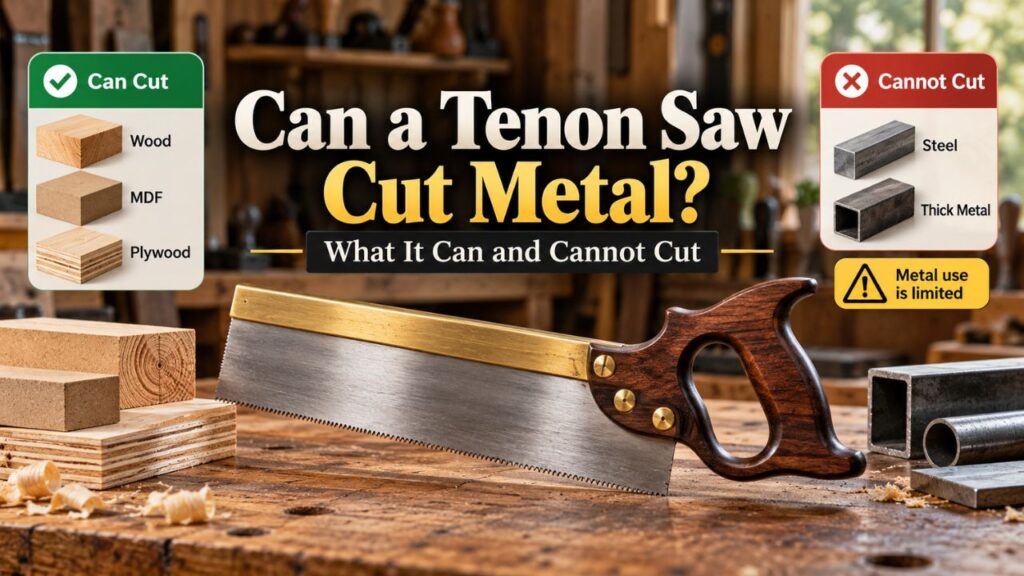
For normal use, no. A tenon saw is not a metal-cutting saw.
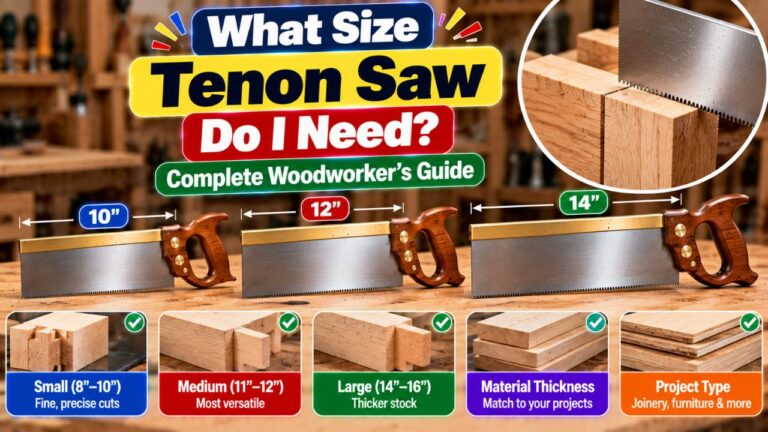
It belongs to the backsaw family and is designed for controlled, accurate cuts in wood. Its rigid back keeps the thin blade from flexing excessively, while the relatively fine teeth create clean cuts suitable for joinery.
A typical tenon saw is commonly used for operations such as cutting tenon shoulders and cheeks, crosscutting small pieces of lumber, cutting joinery, and making precise bench cuts.
Metal presents a very different cutting environment.
Wood fibers are relatively soft and can be severed by teeth shaped and spaced for woodworking. Metals resist cutting much more strongly and usually require smaller teeth, different rake angles, different tooth hardness, and different blade characteristics.
If you place a woodworking tenon saw against a steel bar, you may initially create a scratch or shallow groove, but the cutting edges can wear rapidly.
What Could Happen If You Try?
The exact result depends on the metal and the saw.
With steel, the saw will typically cut extremely poorly and may quickly lose its sharpness.
With very thin aluminum, copper, or another soft metal, the teeth may remove material, but that does not mean the tool is appropriate.
Possible consequences include damaged tooth tips, dulled teeth, distorted tooth set, binding, blade kinking, and a rough or inaccurate cut.
If you care about maintaining the tenon saw for accurate woodworking, I would avoid using it on metal.
Key Takeaways:
- A standard tenon saw is a woodworking tool, not a metal-cutting saw.
- It may scratch or slowly cut some soft metals, but doing so can damage its teeth.
- A hacksaw or another dedicated metal-cutting saw is a much better choice.
Why a Tenon Saw Is Designed for Wood
The easiest way to understand why a tenon saw is poor at cutting metal is to look at its tooth geometry.
Saw teeth are not all shaped alike.
A saw designed for wood may be sharpened primarily for crosscutting, ripping, or a hybrid of the two. The rake, fleam, tooth size, and set are chosen according to how the teeth need to sever wood fibers.
Metal saws use very different tooth arrangements.
Tooth Pitch
Tenon saws generally have relatively fine teeth by woodworking standards, but those teeth can still be coarse compared with the teeth used for many metal-cutting applications.
A hacksaw blade intended for metal may have 18, 24, or 32 teeth per inch, depending on material thickness and the job.
That fine pitch helps keep several teeth engaged with thin metal at once.
If too few teeth engage thin metal, individual teeth can catch aggressively.
This can damage teeth or make the blade jump.
Tooth Shape
A tenon saw tooth is designed to cut wood fibers efficiently.
Metal-cutting teeth are generally shaped to scrape or shear harder material while surviving much greater resistance at the cutting edge.
That difference is fundamental.
Changing only the blade material does not make the tooth geometry suitable for metal.
Tooth Set
The teeth on a woodworking saw are alternately set slightly left and right. This creates a kerf wider than the saw plate so the blade can move through wood without binding.
Metal saw blades also use tooth set, but the pattern and amount are optimized differently.
A tenon saw’s existing set can be damaged if its teeth are forced into a material much harder than intended.
Tooth Hardness
Some modern tenon saws use hardened teeth that stay sharp for a long time but are difficult or impossible to resharpen with an ordinary saw file.
Traditional tenon saws often use steel that can be sharpened and reset.
Either way, neither design means the saw is intended for metal.
A hardened woodworking tooth can still chip or become damaged if used against unsuitable material.
Why a Hacksaw Cuts Metal Better Than a Tenon Saw
A hacksaw looks simpler than a traditional backsaw, but its blade is specifically engineered for metal.
The teeth are small, numerous, and shaped for cutting metal efficiently.
Hacksaw blades are also replaceable, which matters because metal cutting eventually wears them out.
If a hacksaw blade becomes dull, you replace a relatively inexpensive blade.
If you destroy the teeth on a quality tenon saw, you may need to resharpen, reset, or even replace part of a much more valuable woodworking tool.
Tenon Saw vs. Hacksaw
| Feature | Tenon Saw | Hacksaw |
| Primary material | Wood | Metal and some plastics |
| Typical tooth pattern | Woodworking geometry | Fine metal-cutting teeth |
| Blade support | Rigid back | Tensioned frame |
| Replaceable blade | Usually no | Yes |
| Good for steel | No | Yes |
| Good for aluminum | Not recommended | Yes |
| Joinery work | Excellent | Poor |
| Metal tubing | Poor choice | Excellent |
| Sheet metal | Poor choice | Suitable with correct blade |
| Main purpose | Accurate woodworking | General metal cutting |
For almost any hand-cutting job involving metal, I would choose the hacksaw.
Can a Tenon Saw Cut Aluminum?
Aluminum is much softer than steel, so a tenon saw may physically cut into it.
That still does not make it the right tool.
A tenon saw can potentially remove material from thin aluminum because the metal is relatively soft. However, aluminum can clog between unsuitable teeth, create a rough cut, and place unnecessary wear on the saw.
A hacksaw fitted with a suitable blade is a much better choice.
For thicker aluminum stock, a metal-cutting bandsaw, appropriate power saw with the correct blade, or other dedicated metal-cutting equipment may be more efficient.
What About Very Thin Aluminum Sheet?
Thin sheet introduces another problem.
If the teeth are too coarse, they can grab the sheet rather than cut smoothly.
This can bend or tear the material.
A fine-tooth hacksaw blade, aviation snips for appropriate sheet metal, or another tool designed for thin metal is generally more suitable.
Even though the tenon saw might technically create a cut, there is little advantage in sacrificing a woodworking edge for the job.
Can a Tenon Saw Cut Steel?
A standard tenon saw should not be used for steel.
Steel is much harder and more abrasive to the cutting edge than wood.
Trying to cut steel with ordinary woodworking teeth can dull them very quickly and may damage individual teeth.
A hacksaw is the standard manual choice for many small steel-cutting jobs.
For larger stock, a metal-cutting bandsaw, abrasive cut-off tool, reciprocating saw with a metal blade, or other appropriate equipment may make more sense.
What About Thin Steel Sheet?
I would still avoid the tenon saw.
Thin sheet metal can catch between coarse teeth, making the saw chatter or snag.
Depending on the sheet thickness and shape, better choices may include a fine-tooth hacksaw, aviation snips, a jigsaw with a metal-cutting blade, or power shears.
Key Takeaways:
- Aluminum is soft enough that a tenon saw might cut it, but the saw is still the wrong tool.
- Steel can rapidly damage woodworking saw teeth.
- Matching the tooth design to the metal is more important than simply using any steel-bladed saw.
Can a Tenon Saw Cut Copper or Brass?
Copper and brass are softer than many steels, so the blade may be physically capable of biting into them.
However, I still recommend using a hacksaw.
Copper pipe, for example, is much easier to cut with a tubing cutter or fine-tooth hacksaw.
A tubing cutter has the added advantage of making a relatively clean, square cut without sending a saw back and forth through the pipe.
For brass rod, bar, or tubing, a fine-tooth hacksaw provides much better control.
Using a tenon saw simply consumes a woodworking edge unnecessarily.
Why Soft Metal Can Still Damage the Saw
“Soft” is relative.
Aluminum, brass, and copper are softer than hardened steel, but they are still very different from wood.
They can load the tooth gullets, increase friction, and wear a finely sharpened woodworking edge.
A tenon saw that was previously capable of leaving a clean joinery surface may feel noticeably dull afterward.
Can You Put a Metal-Cutting Blade on a Tenon Saw?
Normally, no.
A traditional tenon saw is not a blade-holder in the same sense as a hacksaw.
Its saw plate is permanently or semi-permanently assembled with a rigid back and handle.
Some modern saw designs may offer replaceable plates, but those replacements are still designed around the specific saw system.
You generally cannot buy a hacksaw blade and install it in a normal tenon saw.
If your goal is to cut both wood and metal, owning separate saws is the practical solution.
A basic hacksaw takes little storage space and protects your woodworking saws from unnecessary damage.
Could You Resharpen a Tenon Saw for Metal?
In theory, saw tooth geometry can be modified.
In practice, converting a proper tenon saw into a metal-cutting saw makes very little sense.
You would need to consider tooth pitch, rake, hardness, set, and whether the plate material itself is suitable.
A normal tenon saw is also far more valuable as a precision woodworking tool than as an improvised metal saw.
If the saw has large enough teeth to be filed by hand, changing the geometry would also sacrifice its original woodworking performance.
A dedicated hacksaw blade costs much less and is designed specifically for the task.
I would therefore never recommend modifying a good tenon saw solely to cut metal.
Can a Tenon Saw Cut Nails in Wood?
This is a particularly important question because hidden nails are one of the easiest ways to damage a woodworking saw.
No, you should not intentionally cut through nails with a tenon saw.
Old lumber often contains hidden nails, screws, staples, brads, or broken fasteners.
If the saw strikes one, stop cutting immediately.
Do not assume the saw can simply continue through because the nail is small.
Even a small steel nail can dull or damage several saw teeth.
What to Do If You Hit a Nail
Pull the saw backward gently rather than forcing it forward.
Inspect the kerf and determine where the metal is located.
Remove the nail if possible.
If the fastener cannot be removed, change the cut location or use a tool capable of cutting through both wood and metal, such as a reciprocating saw fitted with an appropriate demolition blade.
Then inspect the tenon saw teeth.
A damaged toothline may need sharpening or resetting before the saw cuts accurately again.
Can a Tenon Saw Cut Screws?
No. Screws are generally harder than ordinary wood and can seriously damage saw teeth.
Hardened screws are especially problematic.
If a screw needs to be cut flush or shortened, use a hacksaw, rotary tool with a suitable cut-off wheel, reciprocating saw with a metal blade, or another appropriate method.
Protect nearby surfaces and wear eye protection because cut metal can produce sharp edges or fragments.
What Materials Can a Tenon Saw Cut?
A tenon saw is most useful on wood and some wood-based materials.
Its relatively fine toothline and stiff back make it excellent for joinery and accurate bench work.
Typical applications include solid hardwood, softwood, and selected engineered wood products.
Hardwood
A sharp tenon saw can cut hardwood such as oak, maple, beech, ash, and similar species.
The saw may cut more slowly than it does in softwood, but that is normal.
Softwood
Pine, fir, spruce, cedar, and other softwoods are well within a tenon saw’s intended use.
MDF and Plywood
A tenon saw can cut MDF or plywood, particularly for small accurate cuts.
However, abrasive resins and manufactured materials can dull traditional saw teeth faster than clean solid wood.
For extensive sheet-material cutting, another saw may be more efficient.
Plastic
Some plastics can be cut with a fine-tooth tenon saw in an emergency, but again the result depends heavily on the material.
Acrylic can chip, and some softer plastics can melt or clog teeth because of friction.
A saw designed for plastic is preferable when finish quality matters.
Drywall
A tenon saw could physically cut drywall, but I would not use a quality joinery saw for it.
Gypsum is abrasive and can dull woodworking teeth.
Use a drywall saw or utility knife instead.
Metal
This is the category I would avoid.
The saw simply is not designed for the material.
What Happens to the Teeth When You Cut Metal?
A saw tooth works because its cutting edge is very small and sharp.
That edge can be strong enough to cut thousands of wood fibers while still being vulnerable to a much harder material.
When the tooth strikes metal, several things can happen.
The cutting edge may round over, which makes the saw dull.
A tooth can chip.
Its set may be pushed back toward the blade.
The tooth can bend sideways.
Several neighboring teeth can become damaged at once if the saw hits a steel fastener at speed.
The damage may be subtle at first.
You may only notice that the saw begins requiring more pressure or starts wandering during the next woodworking project.
This is one reason I would not “just try it” on a metal offcut to see whether it works.
What Saw Should You Use to Cut Metal Instead?
For most homeowners and woodworkers, a hacksaw covers a surprising number of metal-cutting jobs.
Hacksaw
Use a hacksaw for steel rod, bolts, screws, metal tubing, aluminum, brass, and many small metal components.
Choose the blade tooth count according to the material thickness.
The goal is generally to have multiple teeth engaged in the material at the same time.
Junior Hacksaw
A junior hacksaw is useful for small pieces, thin tubing, craft work, and restricted spaces.
It is inexpensive and easy to keep beside your woodworking tools.
Reciprocating Saw
A reciprocating saw with an appropriate bi-metal or carbide blade can handle demolition work and thicker metal.
It is particularly useful when speed matters more than a perfectly smooth cut.
Jigsaw
A jigsaw with the proper metal-cutting blade works well for sheet metal and curved cuts.
Use suitable speed settings and support the material to control vibration.
Metal-Cutting Bandsaw
For repeated cutting of bar stock, tubing, and larger sections, a metal-cutting bandsaw is efficient and accurate.
Angle Grinder or Cut-Off Tool
An abrasive or metal-rated cut-off wheel can quickly cut bolts, sheet, rod, and other metal.
This method produces sparks, noise, heat, and debris, so proper eye and face protection, fire precautions, and correct wheel selection are essential.
Choosing the Correct Hacksaw Blade Instead
If you occasionally cut metal, understanding hacksaw tooth count is more useful than trying to repurpose a tenon saw.
Coarser hacksaw blades are generally suitable for thicker material.
Finer blades are better for thin tubing and sheet because more teeth remain engaged at once.
A common range is approximately 18 to 32 teeth per inch.
The exact choice depends on the material thickness and blade manufacturer’s guidance.
For general workshop use, keeping more than one blade pitch available makes sense.
Why Several Teeth Need to Stay Engaged
Imagine cutting a thin-walled tube with extremely coarse teeth.
If only one tooth contacts the metal at a time, that tooth can snag the edge and potentially strip or chip.
A finer blade distributes the load across several teeth and produces a smoother cutting action.
That same principle explains why the tooth pitch of a woodworking tenon saw may be unsuitable even for very thin metal.
Key Takeaways:
- A hacksaw is the best simple hand-tool replacement for most metal cuts.
- Use finer teeth for thinner metal and coarser teeth for thicker sections.
- Dedicated metal blades are inexpensive compared with repairing a damaged tenon saw.
What If You Already Used a Tenon Saw on Metal?
Do not assume the saw is ruined.
Inspect it carefully.
Clean any metal residue from the teeth and sight along the toothline.
Look for chipped, flattened, bent, or unusually shiny tooth tips.
Then make a test cut in straight-grained scrap wood.
If the saw still cuts smoothly and tracks correctly, you may have escaped significant damage.
If it feels noticeably slower, grabs, or pulls to one side, the toothline may need attention.
Traditional Resharpenable Tenon Saw
If your saw has traditional fileable teeth, an experienced user can sharpen and reset them.
This may completely restore performance if the damage is limited.
Hardened-Tooth Tenon Saw
Many modern saws have impulse-hardened or otherwise permanently hardened teeth.
These often cannot be sharpened successfully with an ordinary triangular saw file.
If several hardened teeth are badly damaged, replacing the blade or saw may be the practical solution.
Check the manufacturer’s service options before attempting to file hardened teeth.
Can Cutting Metal Bend a Tenon Saw?
It can.
The primary risk is not necessarily the hardness of the metal itself but binding.
If a tooth catches on the workpiece and you continue pushing, the thin saw plate can buckle or twist.
The rigid back prevents much of the flex that occurs in an ordinary handsaw, but the exposed portion of the plate is still relatively thin.
Once the blade is kinked, restoring perfect alignment can be difficult.
This is another reason a hacksaw is safer for metal: its blade is designed for the cutting forces involved and is easily replaced if damaged.
Safety When Cutting Metal
The correct tool makes metal cutting both easier and safer.
Secure the workpiece firmly in a vise or with suitable clamps.
Do not hold a small piece of metal in one hand while aggressively sawing it with the other.
Cut edges can be extremely sharp.
Wear eye protection because small metal particles, filings, or broken blade pieces can become airborne.
If using a power tool, follow the manufacturer’s requirements for guarding, hearing protection, sparks, and combustible materials.
After the cut, remove sharp burrs with a file or deburring tool where appropriate.
Be particularly careful with tubing and sheet metal because freshly cut edges can cause serious lacerations.
Common Mistakes to Avoid
The most common mistake is assuming that because the tenon saw blade is made from steel, it must be able to cut metal. Blade material and tooth design are separate issues.
Another mistake is testing the saw on aluminum and concluding that it is suitable for all metals. A toothline that scratches soft aluminum may fail almost immediately against steel.
Do not intentionally cut nails or screws hidden in reclaimed timber either. Even a single fastener can damage multiple teeth.
Using excessive force is another problem. If a saw barely cuts the material, pressing harder rarely turns it into the correct tool. Instead, you increase the risk of tooth damage and blade distortion.
Finally, avoid trying to restore a damaged hardened-tooth saw with an ordinary file unless the manufacturer says the teeth are resharpenable.
Is There Ever a Reason to Use a Tenon Saw on Metal?
In practical woodworking, almost never.
There could be an unusual emergency where you need to cut an extremely thin piece of soft aluminum and have no other tool available.
The saw might eventually get through it.
But “possible” and “appropriate” are very different things.
A basic hacksaw is inexpensive, compact, and specifically designed for the task.
I would rather keep my tenon saw sharp for the precise joinery work it was built to perform.
If you regularly work with both wood and metal, keeping separate saws also makes tool maintenance much simpler.
FAQs about Can a Tenon Saw Cut Metal
Can a tenon saw cut thin metal?
It may physically cut very thin soft metal, but I do not recommend it. The tooth geometry is designed for wood and can become dull or damaged when used on metal.
Can a tenon saw cut aluminum?
A sharp tenon saw may bite into soft aluminum, but a hacksaw with an appropriate blade will cut it more efficiently and with much less risk of damaging your woodworking saw.
Can a tenon saw cut steel?
No, a standard tenon saw should not be used for steel. Steel can rapidly dull, chip, or distort woodworking saw teeth.
Can a tenon saw cut copper pipe?
It could potentially cut soft copper, but a tubing cutter or fine-tooth hacksaw is a better tool. Both provide cleaner results without sacrificing the tenon saw’s cutting edge.
Can a tenon saw cut brass?
The saw may cut some brass because it is relatively soft, but it is still not recommended. Use a hacksaw or another suitable metal-cutting saw.
Can a tenon saw cut nails?
You should not intentionally cut nails with a tenon saw. Nails can damage the toothline, particularly on finely sharpened joinery saws.
Can a tenon saw cut screws?
No. Use a hacksaw, appropriate power saw, or cut-off tool instead. Hardened screws can severely damage woodworking saw teeth.
What saw is best for cutting metal by hand?
A hacksaw is the most versatile choice for common hand-cutting tasks involving steel, aluminum, brass, copper, bolts, and tubing.
Why can a hacksaw cut metal but a tenon saw cannot?
A hacksaw uses small teeth specifically shaped, pitched, and hardened for metal cutting. A tenon saw uses woodworking tooth geometry designed to sever wood fibers.
Will cutting aluminum ruin a tenon saw?
Not necessarily after one brief accidental cut, but it can dull or damage the teeth. There is no benefit to taking the risk when a dedicated metal saw is available.
What should I do if my tenon saw hits a hidden nail?
Stop immediately and withdraw the blade carefully. Remove or avoid the fastener and inspect the teeth before continuing to use the saw.
Can I sharpen my tenon saw after hitting metal?
Traditional non-hardened tenon saw teeth can usually be sharpened with the correct saw file and technique. Many modern hardened-tooth saws are not designed for conventional resharpening.
Can a tenon saw cut plastic?
Some plastics can be cut with a fine-tooth tenon saw, although the quality of the cut varies. Brittle plastic may chip, while softer plastic can clog the teeth. A plastic-specific blade is better when accuracy matters.
What is a tenon saw actually used for?
A tenon saw is primarily used for precise woodworking, including cutting tenons, shoulders, small crosscuts, and other joinery where a straight and controlled cut is important.
Is a tenon saw the same as a hacksaw?
No. Both are hand saws, but their design and intended materials are different. A tenon saw is a rigid-backed woodworking saw, while a hacksaw uses a tensioned replaceable blade designed primarily for metal.
Conclusion
So, can a tenon saw cut metal? It may physically scratch or slowly cut certain thin, soft metals, but a standard tenon saw is not designed for metal and should not be used as a substitute for a metal-cutting saw.
The problem is not simply whether the blade is strong enough. Tenon saw teeth have woodworking-specific tooth geometry, pitch, set, and sharpening. Metal creates much greater stress on those cutting edges and can dull, bend, chip, or otherwise damage them.
For steel, aluminum, copper, brass, bolts, screws, and metal tubing, I recommend using a hacksaw with the appropriate blade. It is inexpensive, effective, and protects your tenon saw for the accurate woodworking it was designed to perform.
If your tenon saw accidentally hits a hidden nail or other metal fastener, stop rather than forcing the cut. Inspect the teeth afterward and resharpen or repair them if necessary.
A quality tenon saw is a precision woodworking tool. Keeping it away from metal will help preserve its sharp toothline, straight tracking, and clean cutting performance for the joinery work where it performs best.