What Size Tenon Saw Do I Need? Complete Woodworker’s Guide
What size tenon saw do I need? For most furniture making and general hand-tool woodworking, a 12- to 14-inch tenon saw is the most practical all-around choice, with a 14-inch saw being my preferred starting point if you want one versatile saw. Choose a smaller 10- to 12-inch saw for small joinery and a larger 16-inch saw when you regularly cut deep, wide tenons in furniture, workbenches, doors, or heavier stock.
Blade length is only part of the decision. The usable depth below the saw’s stiff back, tooth configuration, tooth count, blade thickness, balance, and the size of the tenons you normally cut can be just as important.
A saw that is unnecessarily large can feel heavy and awkward when cutting small furniture joints. On the other hand, a compact saw may run out of cutting depth or stroke length when you start making large table, door, bed, or workbench tenons.
There is also some variation in how manufacturers use names such as tenon saw, carcass saw, sash saw, and backsaw. One company’s 12-inch tenon saw may overlap with another company’s larger carcass saw. For that reason, I recommend looking at the actual blade dimensions and tooth pattern rather than buying based only on the name.
In this guide, I’ll explain how to choose the right tenon saw size, including blade length, cutting depth, TPI, rip versus crosscut teeth, small versus large joinery, hardwood versus softwood, and whether a 10-, 12-, 14-, or 16-inch saw is the best fit for your work.
What Size Tenon Saw Do I Need for Most Woodworking?
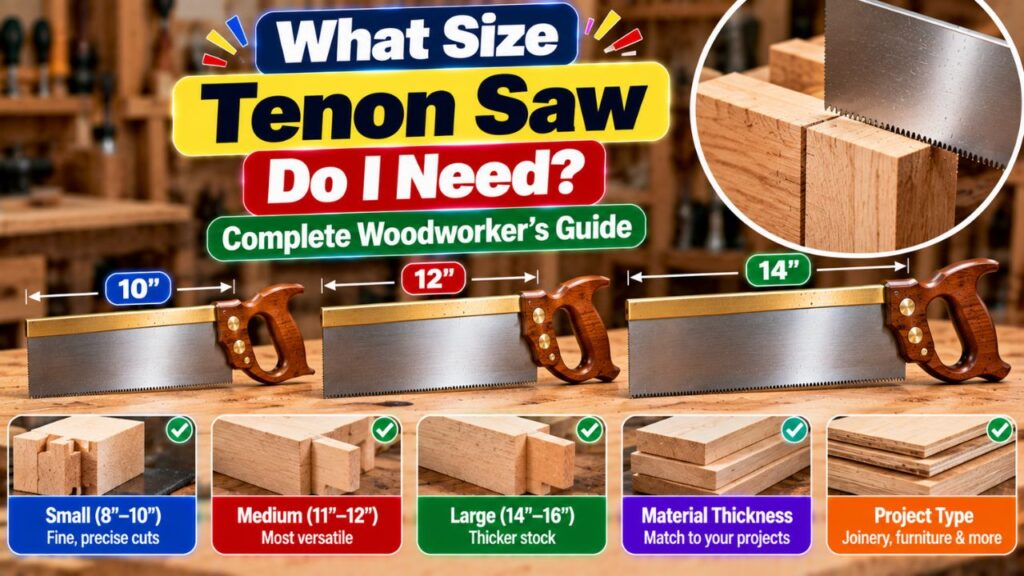
For a woodworker who wants one saw capable of handling a wide variety of ordinary furniture tenons, 12 to 14 inches is a very useful range.
My preference for a first dedicated tenon saw is approximately 14 inches long with enough blade depth for the largest tenons you realistically expect to cut.
A 14-inch saw provides a long enough stroke to cut efficiently without becoming excessively cumbersome. It also tends to have enough blade depth for common furniture joinery while remaining comfortable on relatively small workpieces.
A 12-inch saw is a better choice if most of your projects involve compact furniture, boxes, chairs, small tables, cabinets, or relatively shallow tenons.
A 16-inch tenon saw starts to make more sense when your work becomes larger and deeper. It can be particularly useful for workbenches, substantial tables, doors, beds, timber-like furniture components, and other joinery where greater cutting capacity and longer strokes help.
Quick Tenon Saw Size Guide
| Blade Length | Best Use | General Recommendation |
| 10 inches | Very small joinery and light work | Compact but limited |
| 12 inches | Small to medium furniture joints | Excellent for detailed bench work |
| 14 inches | General furniture and cabinet work | Best all-around size for many users |
| 16 inches | Large and deep tenons | Best for substantial joinery |
| 18 inches and larger | Very large or specialized work | Usually unnecessary for typical DIY furniture |
These categories are guidelines rather than strict rules.
Blade depth, tooth pattern, and saw design can make two saws with the same blade length behave quite differently.
Why Tenon Saw Size Matters
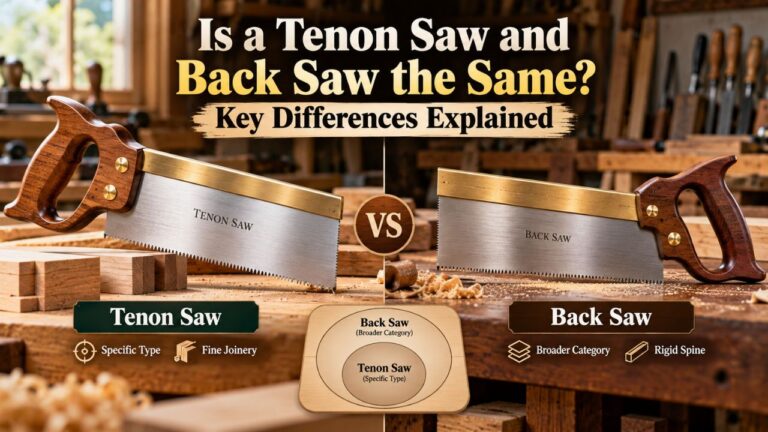
A tenon saw is a backsaw, meaning it has a rigid metal spine along the upper edge of the blade.
The back keeps the blade stiff and helps the saw track accurately. This rigidity is one of the reasons a good tenon saw can create exceptionally straight joinery cuts.
The same back that provides accuracy also limits cutting depth.
Unlike a normal handsaw, you cannot continue cutting indefinitely into the workpiece because the metal spine eventually contacts the wood.
You therefore need a saw with enough space between the teeth and the back for the joints you intend to make.
Blade length also affects the feel of the saw.
A longer blade gives you a longer cutting stroke. This can make a large tenon cut faster and more smoothly because more teeth participate during each stroke.
However, longer saws are generally heavier and can feel oversized when working on a small component.
Choosing the right size is therefore a balance between capacity, speed, control, and comfort.
Key Takeaways:
- A 12- to 14-inch tenon saw suits most normal furniture work.
- I would choose a 14-inch model if buying one versatile general-purpose tenon saw.
- Large 16-inch saws are most useful when you routinely cut substantial or deep joinery.
Is a 10-Inch Tenon Saw Big Enough?
A 10-inch backsaw can certainly cut tenons, but I consider it more appropriate for small-scale joinery than as a universal tenon saw.
It works particularly well when you are making short tenons in relatively thin stock.
Its compact size can provide excellent control because there is less blade and back to maneuver.
A smaller saw may also be easier for someone learning to start accurately on a knife or pencil line.
The limitation becomes apparent when the joint gets larger.
Shorter strokes mean more strokes are required to complete a wide cut. The blade may also have relatively limited cutting depth.
If your projects mostly involve boxes, frames, small cabinets, or fine furniture components, a 10-inch saw can be useful.
If you plan to build large tables, beds, doors, or a workbench, I would buy something larger.
When Is a 12-Inch Tenon Saw the Right Choice?
A 12-inch saw is an excellent choice for small and medium furniture making.
It gives you more cutting capacity than a very small joinery saw without feeling particularly large at the bench.
A quality 12-inch model can handle many common mortise-and-tenon joints found in:
- Chairs
- Cabinets
- Small tables
- Frames
- Shelving
- Light furniture
It can also serve as a fairly versatile backsaw if you do not yet own a complete collection of dedicated joinery saws.
The main question is cutting depth.
If the usable blade below the back comfortably exceeds your typical tenon depth, a 12-inch saw may be all you need.
For a woodworker primarily building small furniture, I would often prefer a comfortable 12-inch saw over buying a large 16-inch model simply because the latter sounds more capable.
Is a 14-Inch Tenon Saw the Best All-Around Size?
For many woodworkers, yes.
A 14-inch tenon saw sits in a useful middle ground.
It provides enough blade length for efficient strokes while remaining manageable on ordinary furniture parts.
Many saws in this class also provide around the amount of depth typically associated with medium-size joinery work, although actual usable depth varies by design.
A 14-inch saw is particularly attractive if your projects vary.
One month you may be building a cabinet, while the next project could be a dining table.
A mid-size saw handles this variety better than either extreme.
Why I Recommend 14 Inches for Many Beginners
Beginners often do not yet know what size joinery they will eventually prefer.
Buying a very small saw can create limitations fairly quickly.
Buying an oversized saw can make learning accurate joinery more awkward than necessary.
A well-balanced 14-inch saw gives you enough capacity to grow without turning every small joint into an exercise in controlling a large, heavy tool.
It is therefore my favorite compromise when someone asks for one traditional tenon saw.
When Do You Need a 16-Inch Tenon Saw?
A 16-inch tenon saw is a true large joinery saw.
The longer blade provides a longer, more efficient stroke, and these saws commonly provide greater cutting depth than smaller backsaws.
This makes them useful for substantial furniture and structural-style joinery.
Consider a 16-inch saw if you frequently build:
- Workbenches
- Large tables
- Doors
- Bed frames
- Heavy chairs or benches
- Large cabinets
- Furniture using thick stock
The size can also help the saw feel stable during a deep cut. A large back adds mass and rigidity, and some woodworkers find that this helps the saw continue straight once the kerf is properly established.
The tradeoff is weight and maneuverability.
A large tenon saw may feel excessive for a 1-inch-deep tenon in narrow stock.
For this reason, experienced hand-tool woodworkers often own more than one backsaw rather than expecting one large tenon saw to perform every joinery task equally well.
Why Cutting Depth Matters as Much as Blade Length
Two 14-inch tenon saws can have very different capacities.
The important measurement is the distance from the tooth line to the lower edge of the saw back.
This determines the maximum practical depth of cut.
Suppose one saw has approximately 2 inches of usable depth and another has approximately 3 inches.
Both may be 14 inches long, but the second saw can cut a substantially deeper tenon cheek before its back contacts the workpiece.
How Much Blade Depth Do You Need?
Look at the deepest joinery you normally make.
Your saw should provide more usable depth than the cut itself.
For example, if your deepest tenon cheek requires a cut approaching 2 inches, buying a saw with exactly 2 inches of usable depth gives you very little clearance.
Some extra capacity is useful.
For ordinary furniture work, a saw offering roughly 2.5 to 3 inches of useful depth can cover a large number of joints.
Woodworkers regularly making larger tenons may prefer roughly 3 to 4 inches of capacity.
Do not automatically choose maximum depth, though.
A very deep blade and heavy back can make a saw larger than necessary for delicate work.
Key Takeaways:
- Blade length determines stroke length, while blade depth limits how deep the saw can cut.
- Make sure the usable depth exceeds your deepest expected tenon.
- Around 2.5 to 3 inches of capacity is versatile for many furniture projects, while larger work may benefit from more.
What TPI Should a Tenon Saw Have?
TPI means teeth per inch.
Tooth count affects how aggressively the saw cuts and how smooth the resulting surface feels.
Generally, fewer teeth per inch create a more aggressive cut.
More teeth per inch provide a finer cut but usually remove material more slowly.
For a general tenon saw, something around the 10- to 12-TPI range is common and practical, although there is no single correct number.
The ideal pitch also depends on the thickness of the wood and whether the saw is filed rip or crosscut.
Coarser Teeth
Coarser teeth are useful when:
- Stock is relatively thick
- Speed matters
- The cut is long
- Large tenons are common
A coarse saw clears sawdust efficiently and can move through thick material quickly.
However, it can be harder to start gently on a precise layout line.
Finer Teeth
Finer teeth can make starting easier and leave a smoother surface.
They work particularly well on smaller joinery and thinner stock.
The tradeoff is slower cutting on large tenon cheeks.
If your woodworking is delicate, you may prefer a finer saw even if the cut takes slightly longer.
Rip-Cut or Crosscut Tenon Saw: Which Do You Need?
This question is just as important as saw size.
A traditional tenon involves two main types of cuts: cheek cuts and shoulder cuts.
The cheeks normally run generally with the wood grain.
The shoulders run across the grain.
That means one tooth geometry is not theoretically ideal for both operations.
Rip-Filed Tenon Saw
For cutting tenon cheeks, I recommend a rip-filed tenon saw.
Rip teeth act more like tiny chisels and are efficient when cutting along the grain.
If your main reason for buying the saw is traditional hand-cut mortise-and-tenon joinery, a rip-filed saw is the natural choice.
Crosscut Saw for Shoulders
A crosscut tooth pattern is designed to sever fibers across the grain cleanly.
For tenon shoulders, many woodworkers use a carcass saw or another fine crosscut backsaw rather than the larger rip tenon saw.
This combination works extremely well:
Rip tenon saw for cheeks + crosscut carcass saw for shoulders
However, a beginner does not necessarily need to purchase two expensive saws immediately.
A well-chosen general-purpose backsaw can handle more than one task while you develop your tool collection.
Tenon Saw vs. Carcass Saw: Which Size Do You Actually Need?
The boundary between saw categories is not perfectly standardized.
In general, a carcass saw is smaller and shallower than a full-size tenon saw.
It is commonly used for:
- Cutting tenon shoulders
- Cutting dados
- Trimming components
- Small and medium joinery
A full-size tenon saw has more blade length and depth, making it better for large cheek cuts.
If your woodworking mostly involves small furniture, you may discover that what you actually need is a good carcass saw rather than a huge dedicated tenon saw.
A medium-size carcass or backsaw can be exceptionally versatile.
If large mortise-and-tenon joints are a regular part of your work, adding a true tenon saw becomes more worthwhile.
Tenon Saw vs. Dovetail Saw
A dovetail saw is even smaller.
It generally has a short, fine blade designed for precision work in thin stock.
Although dovetail saws are often rip filed and technically capable of cutting small tenon cheeks, their limited cutting depth and short blade make them inefficient on larger joints.
For very small tenons in thin furniture components, a dovetail saw may be enough.
For normal table, chair, or cabinet tenons, a larger saw offers more comfortable cutting.
The practical backsaw progression is often:
Dovetail saw → carcass saw → tenon saw
Each increase provides greater blade length and cutting capacity.
Does Wood Thickness Affect the Tenon Saw Size You Need?
Absolutely.
The thicker your stock, the larger the joint is likely to become.
A small cabinet made from 3/4-inch material places very different demands on a saw than a workbench made from 3-inch-thick hardwood.
For thin components, a large saw can feel unnecessarily heavy.
For thick components, a small saw means short strokes and limited depth.
Think about your typical stock rather than the largest piece of wood you might conceivably cut someday.
Small Furniture Stock
For stock around typical cabinet and small furniture dimensions, a 10- to 12-inch backsaw may be sufficient.
Medium Furniture Stock
For tables, chairs, and general furniture components, a 12- to 14-inch saw provides a very useful balance.
Thick Furniture and Bench Work
For thick legs, large aprons, workbench components, and heavy door parts, a 14- to 16-inch saw becomes more attractive.
Does Hardwood Require a Bigger Tenon Saw?
Not necessarily.
Wood species influences tooth selection and cutting effort more than the required blade length.
Dense hardwoods such as hard maple or some tropical species can require more effort to saw than many softwoods.
A sharp, properly filed saw becomes especially important.
You may appreciate a longer saw because the longer stroke allows efficient cutting, but simply buying a larger blade does not automatically make hardwood easy to cut.
Tooth sharpness, rake, set, blade thickness, and your technique all matter.
For dense hardwood joinery, I would prioritize a high-quality, sharp saw with the right tooth geometry over choosing the largest possible size.
Should Beginners Use a Smaller Tenon Saw?
A slightly smaller saw can be easier to control, but going too small creates its own problems.
A 12- or 14-inch saw is generally manageable enough for a beginner while still providing useful capacity.
I would avoid choosing a tiny joinery saw solely because it feels less intimidating.
Learning to use a proper tenon saw is largely about technique.
Start the cut gently, establish the kerf on the layout line, and let the saw’s weight do much of the work.
You should not need to force the blade downward aggressively.
A larger saw with good balance can actually track beautifully once it enters a straight kerf.
Handle Fit and Balance Matter More Than Many Buyers Expect
Blade dimensions attract most of the attention, but the handle determines how the saw feels in your hand.
A handle that is too large or too small can make accurate sawing uncomfortable.
You should be able to grip the saw naturally without squeezing excessively.
Traditional closed handles often allow the index finger to point forward along the side of the handle or back, giving additional directional control.
Balance matters too.
A tenon saw has a heavy back, often made from brass, steel, or another rigid material.
The weight can help the blade settle into the cut, but an unbalanced saw may feel nose-heavy or tiring.
When possible, handle the saw before buying.
If you are purchasing online, pay attention to handle-size options when the manufacturer provides them.
Do You Need a 12- and 16-Inch Tenon Saw?
Not initially.
If you are building a complete traditional hand-tool kit, owning several backsaws eventually makes sense.
A common progression might include a small dovetail saw, a medium crosscut carcass saw, and a larger rip tenon saw.
This gives each tool a clear role.
For someone starting out, though, one versatile saw is more sensible.
I would rather own one well-balanced 12- or 14-inch saw that is sharp and accurately filed than several inexpensive saws that track poorly.
Add a larger 16-inch tenon saw later if your projects reveal that you genuinely need the extra capacity.
Key Takeaways:
- Saw quality, tooth geometry, and balance matter as much as nominal blade length.
- Beginners rarely need several tenon saw sizes immediately.
- Start with a versatile mid-size saw and add specialized backsaws when your projects justify them.
What Size Tenon Saw Is Best for Furniture Making?
For general furniture, 12 to 14 inches is the range I would consider first.
A 12-inch model works particularly well for cabinet-scale and relatively fine furniture.
A 14-inch model gives you additional capacity and a longer stroke without moving fully into large-saw territory.
For dining tables, large chairs, beds, and heavy furniture, a 16-inch saw may be useful if the joints are correspondingly larger.
Do not choose according to the overall size of the finished piece alone.
A large cabinet may still use relatively modest tenons, while a small but heavily built stool could use substantial joints.
Look at the joinery dimensions.
What Size Tenon Saw Is Best for a Workbench?
Workbench joinery tends to be much larger than cabinet joinery.
Thick legs, rails, stretchers, and top components can produce deep cheek cuts.
For this kind of work, I would prefer a 14- to 16-inch tenon saw, with a 16-inch model making particularly good sense if you expect to make large joints frequently.
Make sure the blade has sufficient usable depth.
A long saw that cannot reach the bottom of your cheek cut because its back hits the stock is still too small for the job.
What Size Tenon Saw Is Best for Doors?
Traditional door joinery can involve broad and relatively substantial tenons.
A larger saw provides longer strokes and better capacity.
For serious door-making work, a 14- or 16-inch saw is generally more appropriate than a compact joinery saw.
Again, the precise choice depends on the actual stile, rail, and tenon dimensions.
If door construction will be a major part of your woodworking, I would lean toward the larger option.
What Size Tenon Saw Is Best for Small Boxes and Cabinets?
For compact joinery, a 10- to 12-inch backsaw is usually easier to maneuver.
You may not even need what some manufacturers classify as a full-size tenon saw.
A fine rip carcass saw or larger dovetail-style saw may be enough for very small tenons.
The shorter saw gives you excellent control and takes up less space at a crowded bench.
How Much Should You Spend on a Tenon Saw?
Price should not be the primary sizing factor.
A premium hand saw can be expensive because of materials, sharpening quality, handle work, and manufacturing precision.
However, a modestly priced saw that is straight, sharp, and comfortable can cut excellent joinery.
What matters most is whether the saw:
Tracks straight, starts predictably, has appropriate tooth geometry, holds sufficient tension, and feels comfortable in your hand.
A saw that can be resharpened can also provide decades of service.
Hardened disposable-tooth saws may remain sharp for a long time but generally cannot be sharpened using traditional files once dull.
Choose according to how you intend to maintain the tool.
Common Mistakes When Choosing Tenon Saw Size
One common mistake is buying the largest saw available because it seems more capable.
Extra capacity has no advantage when you never use it.
Another mistake is focusing only on blade length while ignoring cutting depth. The saw’s back determines how deep the blade can travel into a workpiece.
Woodworkers also sometimes buy a crosscut saw expecting it to be ideal for tenon cheeks. It will cut them, but a rip-filed saw is generally more efficient for cuts along the grain.
Finally, do not assume more teeth always mean a better saw. An extremely fine tooth pitch can make a large tenon frustratingly slow.
Match the tooth pattern to the size and direction of the cut.
Safety and Proper Tenon Saw Technique
A tenon saw is safer than many power saws, but careless technique can still cause injury.
Secure the workpiece firmly in a vise or against an appropriate bench appliance before sawing.
Keep your free hand away from the path of the teeth.
Start the cut with light pressure. Once the kerf is established, use smooth, controlled strokes.
Avoid forcing the blade. Excessive pressure can cause the saw to wander and increases the chance of your hand slipping.
A sharp saw is actually easier to control than a dull one because you do not need to push aggressively.
When the cut is almost finished, reduce pressure so you do not tear away the last fibers or lose control as the waste separates.
FAQs about What Size Tenon Saw Do I Need
Is a 12-inch tenon saw big enough?
Yes, for many small and medium furniture projects.
A 12-inch saw is particularly useful for cabinets, chairs, frames, and other relatively compact joinery.
If you regularly make deep or broad tenons, a 14- or 16-inch saw may be more efficient.
Is a 14-inch tenon saw a good all-purpose size?
Yes. For many woodworkers, 14 inches offers an excellent balance of control, stroke length, and cutting capacity.
If you want only one traditional tenon saw, this is the size I would consider first.
Is a 16-inch tenon saw too big?
Not if you make substantial joinery.
A 16-inch saw is useful for workbenches, doors, large tables, bed frames, and other projects using large tenons.
For small cabinetry, it can feel unnecessarily cumbersome.
What depth should a tenon saw be?
It should have enough usable blade below the back to exceed the depth of the largest tenon cheek you expect to cut.
For many general furniture projects, approximately 2.5 to 3 inches of cutting depth is useful, while larger joinery may benefit from more.
What TPI is best for a tenon saw?
Around 10 to 12 TPI is a useful general range for many tenon saws, particularly for medium and larger joinery.
Finer teeth may suit smaller work, while coarser teeth can cut thicker stock faster.
Should a tenon saw be rip or crosscut?
For cutting tenon cheeks, I recommend a rip-filed saw because the cut generally follows the grain.
For the shoulders, a crosscut carcass saw is often the better tool.
Can I cut tenons with a dovetail saw?
Yes, especially very small tenons.
However, the short blade and limited cutting depth make a dovetail saw inefficient for larger furniture joints.
Can a carcass saw cut tenons?
Yes. A rip-filed carcass saw can work very well for small and medium tenon cheeks, while a crosscut carcass saw is excellent for shoulders.
For large tenons, a dedicated larger tenon saw provides more capacity.
Is a longer tenon saw more accurate?
Not automatically.
A longer saw provides a longer stroke and can feel stable during deep cuts, but accuracy depends more on saw quality, sharpening, balance, layout, and technique.
Is a 10-inch tenon saw too small?
Not for fine joinery.
It can be an excellent choice for small components, but it has less cutting depth and stroke length than larger models.
I would not choose it as my only saw if large furniture is part of the plan.
Can one tenon saw cut both cheeks and shoulders?
Yes, but one tooth pattern will usually favor one direction of cut.
A rip-filed saw excels at cheeks, while crosscut teeth produce cleaner shoulder cuts.
Many hand-tool woodworkers eventually own separate saws for these jobs.
Do I need an expensive tenon saw?
No.
You need a straight, sharp saw with suitable dimensions and tooth geometry.
A premium saw can offer excellent balance, sharpening, and handle comfort, but careful technique remains more important than price alone.
What size tenon saw should a beginner buy?
For most beginners interested in furniture making, I recommend a 12- to 14-inch saw.
If you are unsure, a well-balanced 14-inch model provides enough capacity for a wide variety of future projects.
Conclusion
So, what size tenon saw do I need? For most furniture makers and general hand-tool woodworkers, a 12- to 14-inch tenon saw provides the most useful balance of accuracy, cutting capacity, and control. If I were buying only one, I would usually choose a 14-inch saw.
Choose a 10- to 12-inch saw when your work consists mainly of small cabinets, boxes, chairs, frames, and fine joinery. Move toward a 16-inch saw when you frequently make large tenons for workbenches, doors, tables, beds, and other substantial furniture.
Do not make the decision from blade length alone. Check the usable cutting depth below the back, because that dimension determines whether the saw can actually reach the bottom of your tenon cheek. Also consider tooth pitch and filing. A rip-filed blade around the general 10- to 12-TPI range is a practical starting point for many tenon cheeks, while a crosscut carcass saw is often preferable for clean shoulder cuts.
For most beginners, my recommendation is simple: start with a high-quality 12- or 14-inch saw that feels balanced in your hand rather than buying the biggest tenon saw available. Once your projects become large enough that the saw’s stroke length or cutting depth starts limiting you, adding a 16-inch tenon saw will make much more sense.