Are Harbor Freight Table Saws Any Good: Practical Guide and Tips
Yes, Harbor Freight table saws can be good for occasional DIY work, remodeling, and budget-conscious woodworkers, but they are not automatically equal to a premium jobsite or cabinet saw. Their value depends on the specific model, your material, how often you use it, and whether you are willing to inspect, adjust, and maintain the saw.
The easily overlooked issue is not cutting power alone. A table saw can have a capable motor yet still frustrate you if the fence drifts, the stand flexes, the tabletop is inconsistent, or the blade is poorly aligned. Those details affect cut accuracy, safety, noise, and the amount of time spent correcting problems.
This guide explains where Harbor Freight saws perform well, where they commonly compromise, how to evaluate one before buying, and which tasks may exceed their practical limits. By the end, you should be able to decide whether a Harbor Freight table saw fits your workload, identify the adjustments that matter most, and recognize when paying more for a sturdier saw is the wiser choice.
Where Harbor Freight Table Saws Make Sense
Harbor Freight’s table saws generally appeal to buyers who want a functional cutting tool without paying professional-equipment prices. A suitable model can handle common projects such as shelving, workbenches, simple furniture, trim components, shop fixtures, and dimensional lumber used in home repairs.
They are especially practical when the saw will be used occasionally rather than continuously. A homeowner who makes a few straight cuts each month may not benefit enough from a premium saw to justify the added cost, weight, and storage requirements.
Portability is another advantage. Compact and jobsite-style table saws are easier to move through a garage, carry to a renovation area, or store between projects. That convenience can matter more than ultimate precision for users who do not have a permanent workshop.
Budget models can also serve as learning tools. A new woodworker can practice safe feeding, fence setup, blade selection, and stock preparation without making a large initial investment. However, a lower price should not be treated as permission to overlook setup or safety equipment.
What Determines Whether One Is “Good”
“Good” means different things to different users. For one buyer, it means making repeatable cuts in plywood; for another, it means holding a fence accurately through a full day of cabinet production. A Harbor Freight saw may satisfy the first expectation while falling short of the second.
The most important factors are fence stability, blade alignment, table support, motor performance, dust control, and long-term durability. These features influence the finished cut more than a large motor rating printed on the box.
Fence and rip accuracy
The fence should lock firmly and remain parallel to the blade. If it shifts while stock is being fed, the cut can wander, the workpiece can bind, and the saw becomes difficult to use safely.
Many affordable saws require careful fence adjustment before they produce dependable results. That is not necessarily a deal breaker, but buyers should expect to check the fence with a reliable measuring method rather than assuming it is perfect out of the package.
Table flatness and support
A flat table helps material travel smoothly and makes measurement more consistent. A compact saw’s limited surface area can be manageable for narrow boards, but larger plywood sheets may need outfeed or side support.
Insufficient support creates a practical problem: the workpiece can tip, lift, or pull away from the fence as it passes the blade. A sturdy folding stand, roller support, or properly built work surface can improve usability, but it also adds time and expense.
Motor behavior
A typical portable table saw is intended for general-purpose cutting, not unlimited heavy ripping. It may cut construction lumber and sheet goods effectively when the blade is sharp and the operator feeds the material at a controlled rate.
Performance can drop when cutting thick hardwood, wet lumber, dense composite panels, or long pieces without support. A motor that bogs down repeatedly may overheat, produce rough cuts, and shorten the life of the blade and saw components.
Common Strengths of Harbor Freight Models
The clearest strength is cost-to-capability value. A Harbor Freight saw can provide the basic functions of a portable table saw—rip cuts, crosscut support with the proper accessories, bevel adjustments, and blade-height control—at a price that is accessible to many occasional users.
Another benefit is availability. Replacement blades, stands, push sticks, throat plates, and general shop accessories are usually easier to source than specialized parts for an obscure used saw. Store access may also make exchanges or warranty-related questions more convenient, subject to the specific purchase terms.
Portable designs are useful in spaces where a full-size saw would be impractical. They can be moved out of the way after use, carried to a job, or set up temporarily in a driveway or garage. That flexibility is valuable for renters and homeowners with limited shop space.
With a quality blade and careful setup, an affordable saw can produce clean results on many ordinary materials. The saw itself is only one part of the system; blade quality, stock preparation, measurement, and operator technique strongly affect the outcome.
Important Limitations to Expect
Lower-cost table saws commonly use lighter components than professional equipment. The stand, extension surfaces, adjustment mechanisms, and fence may not tolerate the same abuse as heavier machines designed for daily trade use.
Vibration is a frequent concern with portable equipment. Some vibration is normal, but excessive movement can make the cut less consistent and make it harder to guide material smoothly. A level floor, secure stand, properly installed blade, and balanced setup can reduce the problem.
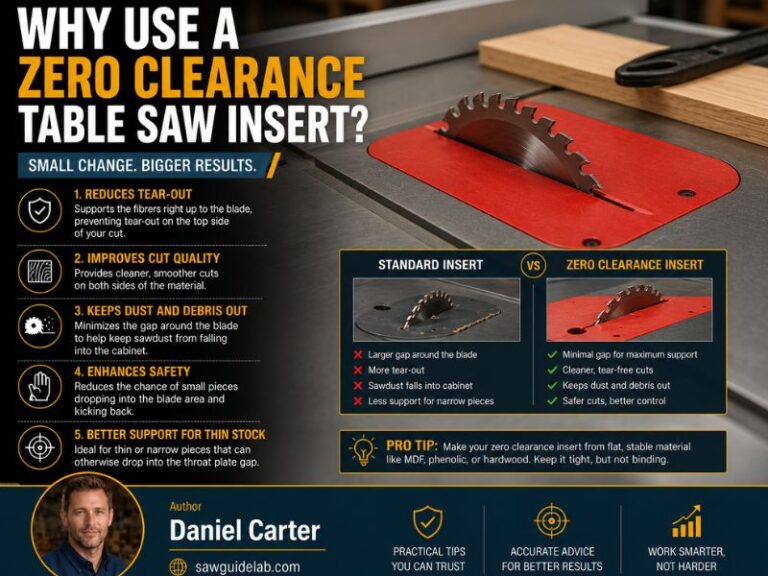
Dust collection may also be limited. Portable saws often discharge fine dust around the blade housing or leave gaps that reduce the effectiveness of a shop vacuum. Good dust control requires the correct adapter, a suitable vacuum, and regular clearing of buildup.
Noise is another consideration. A compact saw can be loud enough to require hearing protection even during short sessions. Hearing protection, eye protection, and appropriate footwear should be treated as standard equipment, not optional upgrades.
Finally, long or wide stock can overwhelm a small table. Without infeed and outfeed support, the material may become difficult to control. That can affect both accuracy and safety, especially near the end of a cut.
Setup Checks That Matter Most
A careful setup can make an inexpensive saw substantially more useful. Before cutting project material, inspect the blade, fence, throat plate, stand, power cord, guards, and adjustment controls.
- Confirm that the saw is on a stable, level surface and that the stand is fully secured.
- Install the blade in the correct direction and tighten it according to the manufacturer’s instructions.
- Check that the blade is parallel to the miter slot and that the fence is parallel to the blade.
- Verify that the blade guard, riving knife, and anti-kickback components are installed and move correctly.
- Test the height and bevel controls to ensure they lock firmly without excessive play.
- Make a test cut in scrap material before beginning an important project.
Use a reliable square or measuring tool rather than relying only on printed scale markings. Factory scales are useful for quick settings, but the actual position of the fence and blade determines the cut.
Check the setup again whenever the saw is moved. Folding stands and portable frames can shift slightly during transport, and a saw that was aligned in the garage may need another inspection at a jobsite.
Blade Choice and Material Limits
The included blade may be adequate for basic construction work, but a sharper, application-appropriate blade can improve cut quality. A combination or general-purpose blade is often more useful for mixed projects than a blade intended only for fast rough ripping.
Use a blade suitable for the material. Plywood, hardwood, pressure-treated lumber, laminates, and composite panels can require different tooth designs and cutting approaches. A dull blade increases resistance and can make the motor work harder.
Do not force stock through the blade to compensate for weak performance. Feed the material steadily while maintaining control, and stop if the motor stalls, the blade binds, or the workpiece begins to twist.
Harbor Freight’s portable saws are generally a better match for moderate-duty cutting than for production work. If your projects routinely involve thick hardwood, large solid-wood panels, repeated narrow ripping, or all-day use, a heavier saw with a more rigid fence and stronger support system may save time and frustration.
Safety Issues That Should Not Be Compromised
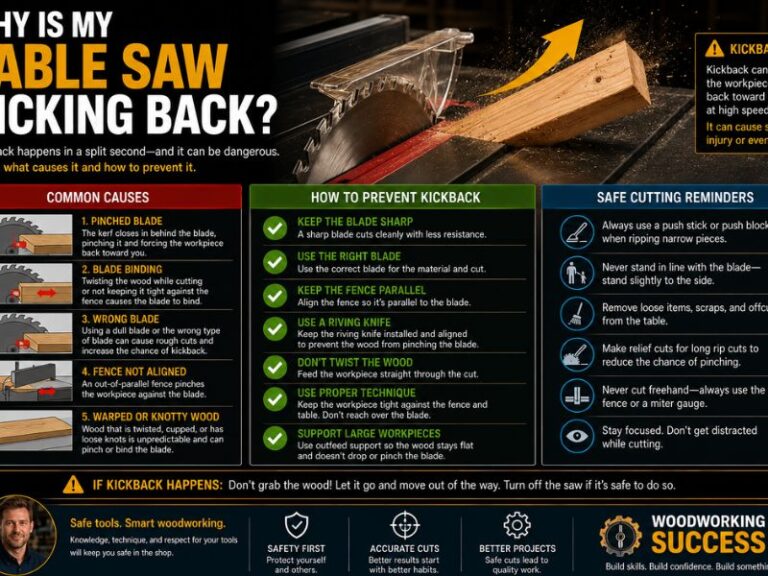
A low price does not reduce the consequences of kickback or accidental contact with the blade. Keep the blade guard and riving knife installed whenever the cut allows, and use a push stick or push block when your hands would approach the blade.
Never reach over or behind a moving blade to retrieve material. Turn the saw off and wait for the blade to stop completely before clearing scraps, making adjustments, or changing the setup.
- Wear eye protection and hearing protection.
- Keep the work area free of loose cords, scraps, and tripping hazards.
- Use support for long, heavy, or wide workpieces.
- Stand slightly to the side of the blade’s possible kickback path.
- Disconnect power before servicing, clearing a jam, or changing a blade.
- Do not use a damaged guard, cracked blade, unstable stand, or frayed cord.
Read the manual for the exact model because guard designs, adjustment procedures, and electrical requirements vary. If a safety component will not stay aligned or operate as intended, stop using the saw until the problem is corrected.
Who Should Buy One—and Who Should Upgrade
A Harbor Freight table saw is a reasonable choice for a DIY homeowner, beginning woodworker, remodeler, or occasional hobbyist who needs portable ripping capability and accepts some setup work. It can be particularly suitable when the budget is limited and the project list consists mainly of moderate-size boards and sheet goods.
It may not be the best choice for a professional carpenter who depends on all-day reliability, or for a furniture maker who needs highly repeatable joinery and a rigid work surface. A buyer who expects excellent out-of-box accuracy, quiet operation, minimal vibration, and effortless large-panel handling may become dissatisfied quickly.
Consider the total cost rather than the shelf price. A stand, better blade, dust adapter, support tables, measuring tools, and replacement accessories can narrow the price gap between a budget saw and a more refined competing model.
Buying used can complicate the decision. A used professional saw may offer better rigidity, but it can also require electrical work, replacement parts, or transportation. A new budget saw with intact safety components and accessible support may be the more practical option for some users.
How to Evaluate a Saw Before Buying
Look at the complete package, not just the motor rating. Check the fence-locking mechanism, extension support, stand rigidity, guard design, bevel scale, blade-height adjustment, and availability of replacement parts.
If examining a display or open-box unit, operate the controls and look for excessive looseness. The fence should lock without requiring unreasonable force, and the blade should raise, lower, and tilt smoothly while remaining secure when locked.
Also consider your largest routine cut. If you frequently break down full sheets, the saw may need substantial side and outfeed support. If your work is mostly narrow boards, portability and quick setup may matter more than table size.
Return policies and warranty terms deserve attention, particularly when buying a budget tool. Keep the receipt, inspect the saw promptly, and test alignment and safety features before the return period ends.
FAQ: Are Harbor Freight Table Saws Any Good?
Are Harbor Freight table saws any good for beginners?
They can be suitable for beginners if the user prioritizes setup and safety. A first-time operator should learn how the guard, riving knife, fence, and push devices work before making project cuts. The saw’s lower price can make it an approachable starting point, but it should not be treated as maintenance-free.
Can a Harbor Freight table saw cut hardwood?
It can cut some hardwood, especially with a sharp, appropriate blade and controlled feed rate. Thick or dense stock places greater demand on a portable motor and may produce slower cuts, more vibration, or rougher results. Repeated heavy hardwood work is a strong reason to consider a sturdier machine.
Are Harbor Freight table saw fences accurate?
Fence accuracy varies by model and setup, so it should be checked rather than assumed. Align the fence parallel to the blade before use and confirm that it locks without shifting. A fence that moves during a cut is both an accuracy problem and a potential safety concern.
Is a Harbor Freight table saw good for plywood?
It can work well for plywood when the sheet is properly supported and the blade is suitable. Full sheets are awkward on a compact table, so use stable infeed and outfeed support. Preventing the sheet from sagging or twisting is as important as the saw’s cutting capacity.
How long will a Harbor Freight table saw last?
Service life depends heavily on workload, storage, maintenance, and how aggressively the saw is used. Occasional cutting with clean material and proper blades is less demanding than daily production work. Keep the saw dry, clear dust from adjustment mechanisms, inspect cords and guards, and avoid forcing stalled cuts.
Should I buy a Harbor Freight table saw or spend
Buy the Harbor Freight option when portability, basic capability, and price are the priorities. Spend more when you need better out-of-box alignment, a more rigid fence, improved dust collection, quieter operation, or dependable all-day performance. Comparing total setup cost can make the decision clearer.
Practical Verdict on Harbor Freight Table Saws
Harbor Freight table saws can be good value for occasional DIY and moderate-duty woodworking, especially when the buyer understands that setup, support, and blade choice affect performance. They are less compelling for demanding production work, thick hardwood, large unsupported panels, or users who expect premium accuracy without adjustments.
The major limitation is the lighter construction and potentially less refined fence, table, and dust-control system. Inspect the specific model, verify its safety components, budget for proper support and a suitable blade, and test alignment before committing to a project.