How to Cut Laminate Flooring With a Jigsaw: Clean Cut Guide
If you want to know how to cut laminate flooring with a jigsaw, use a fine-tooth blade suitable for laminate, mark the cut accurately, support the plank firmly, position the decorative face according to the blade’s tooth direction, and guide the jigsaw slowly without forcing it. With a standard up-cut blade, placing the finished face down usually keeps the cleaner edge on the decorative side; with a reverse-tooth blade, the finished face generally goes up.
A jigsaw is one of the most useful tools for laminate-floor installation because it can make straight crosscuts, lengthwise cuts, angled cuts, notches, and curved openings around pipes, columns, door jambs, and other obstacles. Manufacturers such as Pergo and Quick-Step specifically include a jigsaw among the practical tools for cutting laminate.
The biggest problem is chipping. Laminate flooring has a hard, abrasive decorative wear layer over a fiberboard core, and the wrong blade or cutting direction can tear that surface along the cut. The solution is not to push harder. Blade selection, plank orientation, support, jigsaw settings, and feed speed matter much more.
In this guide, I’ll explain how to cut laminate flooring with a jigsaw step by step, which blade to use, whether the finished side should face up or down, how to prevent chipping, how to make straight cuts, rip cuts, curves, and notches, and how to avoid the mistakes that ruin otherwise good flooring planks.
Can You Cut Laminate Flooring With a Jigsaw?
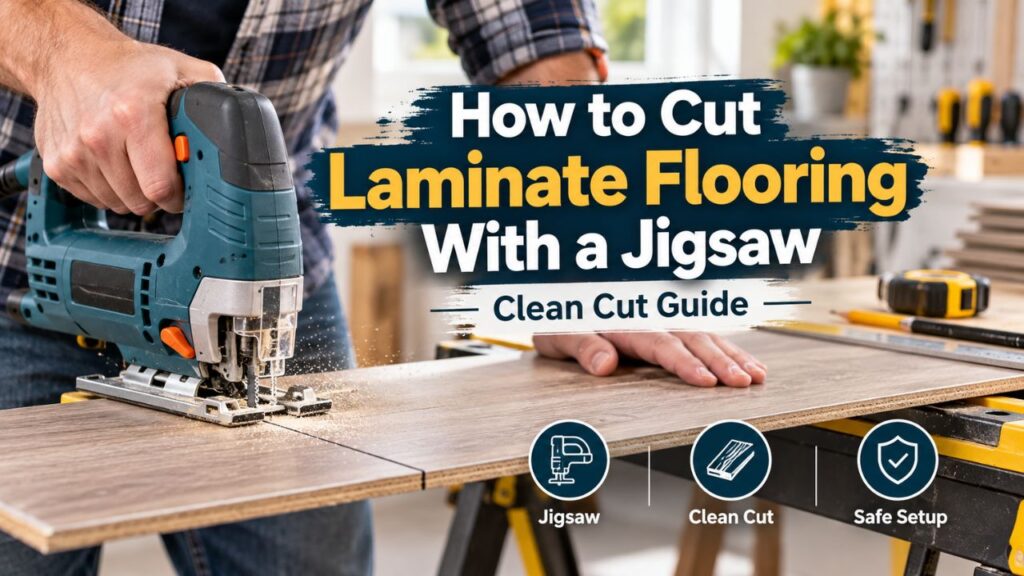
Yes. A jigsaw is an excellent tool for cutting laminate flooring, particularly when the cut is not perfectly straight.
A miter saw or table saw can be faster for repeated straight cuts, but a jigsaw is much more flexible. You can use the same tool to shorten a plank, rip the final row to width, cut around a pipe, follow an irregular wall, or make an L-shaped notch around a door casing.
That versatility makes a jigsaw especially useful for DIY flooring projects where buying several specialized saws may not make sense.
The main limitation is that a jigsaw blade is narrow and flexible. On a long straight cut, it can wander more easily than a circular saw, track saw, or table saw. It can also deflect underneath the plank if you force it through the material.
For short crosscuts and shape cutting, however, it is hard to beat.
Why Laminate Flooring Is Hard on Jigsaw Blades
Laminate flooring is more abrasive than ordinary softwood.
The decorative wear layer is engineered to resist scratches and everyday wear, which also means it can wear cutting edges relatively quickly. A cheap wood blade may start a project cutting cleanly and gradually produce more chipping as its teeth become dull.
That is why a blade made for laminate, hardwood, or abrasive sheet material is worth using when you have many cuts to make.
Some specialized laminate jigsaw blades use bi-metal or carbide cutting edges for greater durability. Others use tooth designs intended to leave a cleaner cut on one or both faces.
You do not necessarily need the most expensive blade available for a small room, but I would not use a coarse demolition blade or an old dull blade simply because it is already in the toolbox.
What Jigsaw Blade Should You Use for Laminate Flooring?
For most laminate flooring, use a fine-tooth jigsaw blade designed for laminate, hardwood, or clean cuts in thin sheet material.
The blade should have enough cutting length to pass completely through the flooring while the jigsaw shoe remains flat on the surface.
A blade in roughly the fine-tooth range is normally preferable to a coarse, aggressive wood blade. Specialized laminate blades may use around the mid-teens teeth per inch, although the correct blade should be selected by its manufacturer-rated material and thickness rather than by TPI alone.
Standard Up-Cut Blade
Most traditional jigsaw blades have teeth pointing upward toward the jigsaw.
They cut primarily on the upstroke.
Because the teeth pull material upward, the upper surface of the workpiece is generally more vulnerable to chipping.
When using this type of blade on laminate flooring, placing the decorative face down generally produces the cleaner visible edge.
That is also why laminate manufacturers commonly instruct installers to cut décor-side down when using a jigsaw with conventional blade geometry.
Reverse-Tooth or Down-Cut Blade
A reverse-tooth blade cuts in the opposite direction.
Its tooth arrangement can leave a cleaner edge on the top surface, allowing you to work with the decorative face upward.
That can be convenient because you can see your layout line directly on the finished surface.
Reverse-tooth blades can feel different in use because their cutting action can push against the jigsaw shoe rather than pulling the workpiece toward it. Keep the shoe firmly against the plank and follow the blade manufacturer’s instructions.
Laminate-Specific Clean-Cut Blade
Some modern laminate blades use specialized tooth geometry that produces a clean cut on both sides.
These are especially useful when both faces matter or when you want to minimize the need to think about up-cut versus down-cut orientation.
Carbide laminate blades also tend to remain sharp longer when cutting abrasive flooring.
Blade Choice at a Glance
| Blade Type | Usual Plank Orientation | Best Use |
| Standard up-cut fine-tooth blade | Decorative face down | General laminate cutting |
| Reverse-tooth blade | Decorative face up | Clean top surface and visible layout line |
| Laminate-specific blade | Follow blade instructions | Repeated clean flooring cuts |
| Carbide laminate blade | Follow blade instructions | Larger jobs and abrasive laminate |
| Coarse wood blade | Not recommended for finish cuts | Too likely to chip or cut roughly |
The safest approach is to make a test cut in a scrap piece before cutting a plank you actually need.
Key Takeaways:
- Use a sharp, fine-tooth blade suitable for laminate.
- Standard up-cut blades usually give a cleaner decorative edge with the plank face down.
- Reverse or specialized blades may require a different orientation, so test the blade first.
How to Cut Laminate Flooring With a Jigsaw Step by Step
A clean jigsaw cut begins before you turn the tool on.
Accurate measuring, correct plank orientation, and solid support are just as important as the actual cutting motion.
1. Measure the Required Plank Length
Install or dry-fit the surrounding planks so you know exactly how much material needs to be removed.
Measure the opening carefully.
If the cut end will terminate beside a wall, remember that floating laminate flooring needs the expansion clearance specified by its manufacturer. Do not cut the plank tightly against the wall simply because that looks neater before the baseboard is installed.
The expansion space is normally concealed by baseboard, shoe molding, or another finishing profile.
2. Mark the Cut Clearly
Transfer the measurement to the laminate plank.
Use a sharp pencil and a square for a 90-degree crosscut.
For irregular walls, angles, or curves, use a contour gauge, template, bevel gauge, or carefully measured reference points.
Make your line easy to see without making it unnecessarily thick. A wide marker line introduces uncertainty about which edge represents the final dimension.
Always identify the waste side before cutting.
3. Determine the Blade’s Tooth Direction
Before positioning the plank, inspect the blade.
Do not assume every jigsaw blade cuts in the same direction.
If the teeth point upward toward the jigsaw and the blade is a conventional up-cut design, place the decorative side down when a clean finished face is your priority.
If you have a reverse-cut blade intended to leave a clean top surface, place the decorative side up.
With a specialized clean-on-both-sides laminate blade, follow its instructions.
If you are unsure, make a test cut in an offcut. This takes less than a minute and can save an entire plank.
4. Support the Laminate Firmly
Place the plank on a stable work surface.
The cut line should be close enough to the support that the plank does not vibrate but far enough away that the blade cannot hit the bench, floor, or sawhorse underneath.
For a crosscut, support the main plank and the waste piece appropriately so neither section flaps around during cutting.
If necessary, clamp the plank gently.
Do not clamp directly onto the decorative surface with an unprotected metal clamp pad. Use a scrap block or protective pad.
5. Set Up the Jigsaw
Install the blade securely and unplug the corded jigsaw or remove the battery while changing blades.
For the cleanest laminate cut, I generally prefer low or no orbital action. High orbital action makes a jigsaw cut faster by moving the blade forward aggressively on the cutting stroke, but it can also increase chipping.
Set the speed according to the blade and jigsaw manufacturer’s recommendations. A reasonably fast blade speed combined with a controlled forward feed often produces a clean cut, but you should not drive the saw forward so quickly that the blade bends.
Make sure the base plate is set to 90 degrees for a square cut unless you intentionally need a bevel.
6. Start the Jigsaw Before Touching the Plank
Hold the jigsaw securely with its shoe positioned to approach the cut.
Start the motor and let the blade reach normal speed before allowing the teeth to contact the laminate.
This reduces the chance of the blade catching the edge and damaging the surface.
Once the saw is running smoothly, ease the blade into the waste side of your line.
7. Guide the Jigsaw Slowly Along the Line
Keep the jigsaw shoe flat against the laminate throughout the cut.
Guide the saw rather than forcing it.
The blade should be doing the cutting. If you have to push hard, your blade may be dull, too coarse, installed incorrectly, or poorly suited to the material.
Watch the cutting line ahead of the blade rather than staring only at the teeth.
For a short crosscut, follow the line steadily until the waste piece separates.
8. Support the Offcut Near the End
As you approach the final inch or two, the waste piece may begin to flex.
If it breaks away early, it can tear the laminate surface at the exit edge.
Support the offcut when practical while keeping your hand safely away from the moving blade.
Reduce your feed pressure and let the last part of the cut finish cleanly.
9. Inspect the Cut Before Installation
Brush or vacuum away the dust and inspect the edge.
A tiny amount of chipping on a cut that will be hidden under baseboard is normally insignificant.
However, check that the locking profile you intended to keep has not been damaged and that the plank fits without being forced against a wall or obstacle.
Do not install a visibly cracked plank just because the damaged area will be partly hidden.
Should Laminate Flooring Face Up or Down When Cutting With a Jigsaw?
This is one of the most common questions about jigsaw cutting.
The correct answer depends on which direction your blade cuts.
With a conventional jigsaw blade whose teeth point upward, the blade pulls chips toward the top of the workpiece. That makes the top surface more likely to chip.
For laminate flooring, place the decorative side down when using this common blade type.
With a reverse-tooth blade, the cutting direction changes, so the decorative side can normally face up.
Some laminate-specific blades use opposing or specialized tooth patterns and are designed to cut cleanly on both faces.
Why You Should Test First
Blade labels can be confusing, especially if you have loose blades from an old package.
Take a scrap piece of laminate and make a short test cut.
Inspect both faces.
Whichever orientation leaves the decorative surface cleanest is the orientation you should use for the project.
This simple test is more dependable than relying on a general rule when you do not know the exact blade design.
How to Prevent Laminate Flooring From Chipping
Chipping happens when the teeth fracture the hard surface layer instead of cutting it cleanly.
You cannot always eliminate microscopic edge damage, but you can make it nearly irrelevant with the right setup.
Use a Sharp Blade
This is the biggest improvement.
A worn blade requires more force and tears at the laminate surface.
If cuts were clean at the start of the project but become progressively rougher, change the blade.
Laminate is abrasive enough that blade condition can deteriorate noticeably during a larger installation.
Reduce Orbital Action
For visible finish cuts, turn orbital action off or use a low setting.
This generally sacrifices some speed but improves control and reduces aggressive tear-out.
Support the Plank Close to the Cut
Vibration encourages chipping.
Keep the plank supported close to the cut without obstructing the blade.
Do Not Push the Saw
Excessive feed pressure causes blade deflection and rough cutting.
If the saw feels as though it needs to be forced, stop and solve the underlying problem.
Masking Tape Can Help With Layout
Painter’s tape over the cut line can make pencil marks easier to see on dark or patterned flooring and may help keep minor surface fragments under control.
However, tape is not a substitute for a sharp, correctly oriented blade.
Blade selection remains much more important.
Key Takeaways:
- Chipping is usually reduced most effectively with the right blade and correct plank orientation.
- Low orbital action and solid support improve finish quality.
- If you suddenly need more pushing force, replace or inspect the blade rather than forcing the jigsaw.
How to Make a Straight Crosscut in Laminate With a Jigsaw
Crosscuts shorten the plank across its width and are among the most common flooring cuts.
Use a speed square, combination square, or framing square to draw a line exactly perpendicular to the long edge.
Support the plank so the line is close to the edge of your bench.
A jigsaw can follow a short square line accurately by hand if you work slowly.
If you struggle to stay straight, clamp a straight piece of scrap wood to the plank as a guide for the jigsaw shoe. Measure the offset between the blade and the edge of the shoe first so the blade lands on the correct side of your cut line.
Do not rely on the guide if the jigsaw shoe or blade is not tracking square. Make a test cut first.
How to Rip Laminate Flooring Lengthwise With a Jigsaw
A rip cut runs along the length of the plank.
You may need one when fitting the first or last row against a wall.
A jigsaw can make this cut, but long straight cuts require more patience because the narrow blade can wander.
Mark the full length of the rip accurately. If the wall is not straight, transfer the wall shape to the plank rather than simply drawing a perfectly straight line.
Support the entire plank well.
Cut slowly while keeping the jigsaw shoe flat.
If the edge will be concealed beneath baseboard, a tiny amount of wandering usually does not matter as long as the plank maintains the required expansion clearance.
For multiple long, perfectly straight rip cuts, a table saw or circular saw with a guide is generally faster and easier.
For one irregular last-row plank, the jigsaw is often the more convenient tool.
How to Cut Curves in Laminate Flooring With a Jigsaw
Curved cuts are where a jigsaw has a major advantage over many other saws.
Use a template or contour gauge to transfer the shape to the plank.
For a relatively tight curve, choose a narrow scrolling-style blade that is also suitable for laminate. A wide blade may resist turning and create a rough, faceted curve.
Move slowly.
Do not twist the jigsaw sideways to force the blade around the curve. Let the blade follow a natural arc.
For extremely tight inside curves, drill a starter hole or use several relief cuts in the waste area to make the shape easier to approach.
Remember to maintain the flooring manufacturer’s required clearance around fixed objects.
How to Cut a Notch in Laminate Flooring
Notches are common around door frames, cabinet details, floor registers, and architectural obstacles.
Measure the notch carefully and mark both legs of the cut.
Cut from the plank edge toward the inside corner along the first line. Then make the second cut until the waste section separates.
Avoid sawing significantly beyond the intersection because an overcut can extend into the visible part of the plank and may create a weak point.
For an inside corner that must be particularly clean, drilling a small relief hole at the corner can prevent the blade from being forced into an impossibly sharp turn.
How to Cut a Hole Inside a Laminate Plank
A jigsaw blade normally needs an opening before it can make a fully enclosed internal cut.
Mark the hole or shape.
Then drill a starter hole inside the waste area large enough for the jigsaw blade to enter without touching the finished cut line.
Insert the stationary blade through the hole, place the shoe flat on the plank, start the jigsaw, and carefully move toward your marked line.
For a simple round pipe opening, a hole saw or appropriately sized drill bit may produce a cleaner result than a jigsaw.
For large or irregular openings, the jigsaw is usually more versatile.
I would avoid improvised plunge cutting through the decorative surface unless your jigsaw manufacturer supports the technique and you are experienced with it. A drilled starter hole is easier to control.
How to Cut Laminate Around Pipes
First determine the pipe location relative to the plank.
Transfer the center point accurately.
The opening needs enough clearance for the floating floor to move according to the flooring manufacturer’s requirements.
For a small round opening, drill the appropriate hole.
If the pipe cannot pass through a closed hole because it is already installed, you may need to make two angled or straight cuts from the edge of the plank to the hole, remove the small section, fit the plank around the pipe, and reinstall or conceal the removed area according to the flooring system’s recommended finishing method.
Pipe covers or trim rings can hide the expansion clearance afterward.
How to Cut Laminate Around Door Frames and Jambs
Flooring installations often look better when the laminate slides underneath properly undercut door casings rather than being awkwardly shaped around every molding detail.
When you still need to shape a plank around a jamb or opening, a jigsaw is extremely useful.
Make a template if the shape is complicated.
Transfer it to the plank and cut slightly conservatively at first. You can remove more material if necessary, but an oversized notch cannot be put back.
Always account for the floor’s required movement clearance.
Jigsaw Settings for Laminate Flooring
There is no universal speed number because jigsaw controls and blade designs vary, but the following approach works well as a starting point.
| Setting | Recommended Starting Point |
| Blade | Fine-tooth laminate or clean-cut blade |
| Orbital action | Off or low for clean finish |
| Speed | Moderate to high, as blade manufacturer allows |
| Feed pressure | Light and steady |
| Shoe angle | 90° for normal square cuts |
| Dust extraction | Use if available |
High blade speed does not mean you should push the saw quickly.
The blade can move rapidly while you feed the jigsaw slowly enough to let each tooth cut cleanly.
Common Mistakes When Cutting Laminate With a Jigsaw
The most common mistake is using the wrong side of the plank for the blade direction.
A conventional up-cut blade with the decorative side facing upward can leave a noticeably chipped top edge.
Another common mistake is using a coarse blade because it cuts wood quickly. Speed is not the priority on laminate flooring. A finer cutting edge usually produces a better finish.
Forcing the jigsaw is equally problematic. A flexible blade can bend backward or sideways, giving you a top cut that looks straight while the underside is noticeably angled.
Poor support causes vibration and can worsen chipping.
Finally, remember the expansion gap. A beautifully cut plank fitted tightly against a wall is still installed incorrectly if the flooring system requires room for movement.
Jigsaw vs. Other Tools for Cutting Laminate Flooring
A jigsaw is versatile, but it is not always the fastest tool.
A miter saw is excellent for repeated straight crosscuts.
A table saw is efficient for long straight rip cuts.
A circular saw with a suitable blade and guide can make both crosscuts and rips.
A laminate cutter can produce many straight cuts with little or no sawdust.
The jigsaw wins when the shape becomes irregular.
| Cut Needed | Tool I Would Prefer |
| Occasional crosscut | Jigsaw |
| Curved opening | Jigsaw |
| L-shaped notch | Jigsaw |
| Irregular wall scribe | Jigsaw |
| Many identical crosscuts | Miter saw |
| Many long rip cuts | Table saw or guided circular saw |
| Dust-free straight cuts | Laminate cutter |
For a typical DIY installation, I would still want a jigsaw available even if another saw handles most of the straight cuts.
Key Takeaways:
- A jigsaw is the most versatile option for irregular shapes, notches, and curves.
- Other saws may be faster for repeated straight cuts.
- A laminate installation often benefits from using the jigsaw for detail work even when another cutting tool handles the bulk cuts.
Safety When Cutting Laminate Flooring With a Jigsaw
Wear eye protection because chips and fine particles can be thrown from the cut.
Laminate flooring also produces fine dust, so use suitable respiratory protection and dust extraction when necessary. Cutting outdoors or in a well-ventilated work area can keep dust out of the finished room.
Keep both hands away from the underside of the plank where the blade travels.
This sounds obvious, but the blade projects below the workpiece where it may not be visible.
Before cutting, confirm that the blade will not strike your workbench, sawhorse, floor, extension cord, or another object below the plank.
Disconnect power or remove the battery before changing blades.
Allow the blade to stop completely before setting the jigsaw down.
Freshly used blades can also become hot, so avoid grabbing one immediately after a long series of cuts.
FAQs about how to cut laminate flooring with a jigsaw
Can you use a jigsaw to cut laminate flooring?
Yes. A jigsaw works very well for laminate flooring and is particularly useful for curves, notches, irregular walls, pipe openings, and short straight cuts.
What jigsaw blade is best for laminate flooring?
Use a sharp, fine-tooth blade specifically rated for laminate or clean cutting in hardwood and laminated materials.
For larger projects, a bi-metal or carbide laminate blade can provide longer cutting life.
How many teeth should a jigsaw blade have for laminate?
There is no single required TPI for every laminate product. Fine-tooth laminate blades are generally preferable, and many purpose-built blades fall around the mid-teens TPI range.
Follow the blade manufacturer’s stated material and thickness range rather than choosing by TPI alone.
Do you cut laminate flooring face up or down with a jigsaw?
With a conventional up-cut jigsaw blade, place the decorative face down for a cleaner visible surface.
With a reverse-tooth blade, the decorative face generally goes up.
Specialized laminate blades may cut cleanly on both sides.
Why does my jigsaw chip laminate flooring?
Common causes include a coarse or dull blade, incorrect plank orientation, excessive orbital action, poor support, vibration, and pushing the saw too quickly.
Can masking tape stop laminate from chipping?
Painter’s tape can help you mark the cut and may control minor surface damage, but it is not the main solution.
A sharp fine-tooth blade and correct cutting orientation make a much larger difference.
Should I turn orbital action off for laminate flooring?
For the cleanest finish, I recommend starting with orbital action off or on a low setting.
Higher orbital action cuts faster but can increase chipping.
How fast should I run the jigsaw?
Use a blade speed appropriate for the blade and your jigsaw, usually moderate to relatively high for a fine laminate blade, while feeding the saw forward slowly.
Do not confuse high blade speed with aggressive forward pressure.
Can I make a long rip cut with a jigsaw?
Yes, especially for a last row that follows an irregular wall.
For numerous perfectly straight rip cuts, however, a table saw or guided circular saw is generally more efficient.
Can I cut curves in laminate flooring with a jigsaw?
Yes. Curves and irregular shapes are among the main reasons a jigsaw is so useful for laminate installation.
Use an appropriate narrow blade and guide the saw slowly.
How do I make an internal cut with a jigsaw?
Drill a starter hole inside the waste area that is large enough for the blade.
Insert the blade into the hole before starting the saw, then work gradually toward your marked line.
Can I cut laminate around a toilet with a jigsaw?
Yes. A jigsaw is well suited to curved and irregular cutouts.
Create an accurate template and maintain the required expansion clearance around fixed objects.
Can I cut laminate around pipes with a jigsaw?
Yes, particularly when you need to connect a pipe opening to the edge of the plank.
For the actual round hole, a drill or hole saw may be cleaner and faster.
How do I stop the jigsaw blade from wandering?
Use a sharp blade, support the plank, keep the jigsaw shoe flat, and reduce forward pressure.
A blade that is being forced can flex and drift away from the layout line.
Can I use a wood jigsaw blade on laminate flooring?
A fine clean-cut wood blade may work for a small number of cuts, but a blade designed for laminate is generally a better choice because laminate is abrasive and prone to chipping.
Can I use a coarse jigsaw blade?
You can physically cut laminate with one, but I would avoid it for finish work.
Coarse teeth remove material aggressively and are more likely to chip the decorative surface.
Is a jigsaw better than a circular saw for laminate?
It depends on the cut.
A circular saw is generally better for long, straight cuts. A jigsaw is better for curves, notches, and complex shapes.
Can I cut an installed laminate plank with a jigsaw?
It is possible in some repair situations, but you must know exactly what lies underneath and control blade depth carefully.
For normal installation, cut planks before installing them whenever possible.
Why is my laminate cut angled underneath?
The jigsaw blade is probably deflecting.
This often happens when you push too quickly, use a dull blade, try to turn too sharply, or use a blade that is too flexible for the material.
Do laminate cut edges need to be perfectly smooth?
Edges hidden beneath baseboard or molding do not need furniture-grade appearance as long as the plank is not cracked and the required clearance is maintained.
Visible transitions and exposed edges require much cleaner, more accurate cutting.
Do I need to leave an expansion gap after cutting laminate?
Yes, when the cut terminates against a fixed wall or object and the flooring manufacturer’s installation system requires perimeter clearance.
Follow the specific laminate manufacturer’s required expansion dimension rather than fitting the cut edge tightly against the obstacle.
Conclusion
If you are learning how to cut laminate flooring with a jigsaw, the most important decisions are blade selection, plank orientation, and cutting technique.
Use a sharp, fine-tooth blade made for laminate or clean finish cutting. With a conventional up-cut blade, place the decorative surface down because the upper face is usually more prone to chipping. With a reverse-tooth blade, the decorative face generally goes up. If you are unsure about the blade, make a test cut in scrap laminate before cutting your finished plank.
Measure carefully, mark the waste side, support the plank firmly, and let the jigsaw reach full operating speed before the teeth contact the flooring. Keep the shoe flat and guide the saw with light, steady pressure rather than trying to force it through the material.
For straight crosscuts, a jigsaw works well when you take your time. For long rips, it is useful when the wall is irregular, although a table saw or guided circular saw is more efficient for repeated straight cuts. For curves, pipe openings, notches, columns, and unusual shapes, the jigsaw is one of the best tools you can have.
My recommendation is to turn orbital action off or keep it low when surface quality matters, change the blade as soon as cutting quality deteriorates, and always maintain the expansion clearance required by your flooring manufacturer.
A jigsaw does not need to produce a cabinetmaker-perfect edge when the cut will disappear beneath baseboard. It does need to produce an accurate, damage-free plank that fits correctly. With the right blade and a controlled feed, you can make clean laminate flooring cuts without chipping away the decorative surface or wasting expensive planks.