How to Clean a Tenon Saw: Remove Rust, Resin, and Dirt Safely
If you want to know how to clean a tenon saw, start by brushing away loose sawdust, wipe the blade with a mild cleaner, remove resin or rust without damaging the teeth, dry every metal surface thoroughly, and finish with a very light protective coating of oil or wax. Clean the handle separately according to whether it is bare wood, finished wood, or plastic, and avoid soaking the saw or flooding the teeth with lubricant.
A tenon saw is a precision backsaw, so cleaning it requires a little more care than simply wiping down a general-purpose hand saw. The thin blade, reinforced metal back, fine teeth, and carefully shaped handle can all be damaged by aggressive abrasives, excessive moisture, or careless handling.
Fortunately, routine cleaning is simple. Most saws need only dust removal, occasional resin cleaning, and a thin layer of corrosion protection. Heavier restoration is necessary only when rust, hardened pitch, or years of workshop grime have accumulated.
In this guide, I’ll explain how to clean a tenon saw step by step, remove rust and sticky residue safely, clean the teeth and reinforced back, care for the handle, and store the saw so it stays clean and ready for accurate joinery.
How to Clean a Tenon Saw Properly
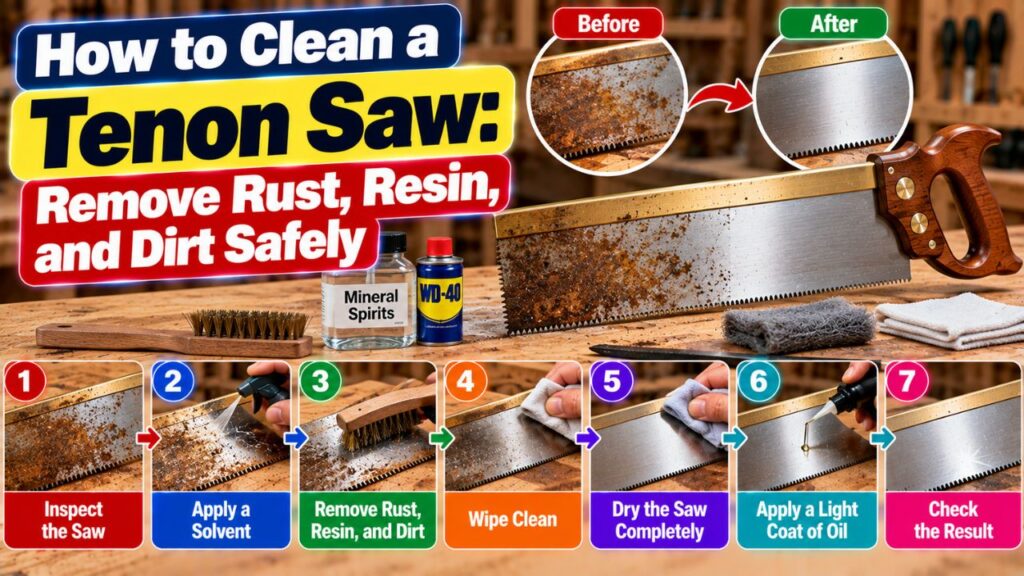
For ordinary workshop maintenance, you do not need to dismantle the saw or use harsh chemicals.
The goal is to remove contaminants without changing the geometry of the blade or teeth.
Start by placing the saw on a stable bench with the teeth positioned where you cannot accidentally brush your hand across them. Wear eye protection if you will be using a brush, rust remover, or anything that could loosen particles.
Remove loose sawdust with a soft brush. Pay particular attention to the teeth, the junction between the blade and saw back, and the area near the handle where dust often collects.
Next, wipe the blade with a clean cloth slightly dampened with an appropriate cleaner. For light workshop grime, a small amount of mild soapy water on the cloth may be enough, but the blade should not be soaked.
For resin, pitch, adhesive residue, or oily dirt, a suitable tool-safe solvent or dedicated blade cleaner can be more effective. Apply the cleaner to the cloth rather than pouring it directly over the saw.
Once the contamination has softened, wipe it away and clean along the blade carefully.
Dry the steel immediately and thoroughly.
If the blade is clean and rust-free, finish with a very thin layer of protective oil or paste wax. Remove any excess so the saw does not transfer oily residue to your next workpiece.
Basic Cleaning Sequence
For routine maintenance, the order is simple:
- Remove sawdust and loose debris.
- Clean dirt or resin from the blade.
- Treat rust only if necessary.
- Dry all metal components.
- Clean the handle.
- Apply light corrosion protection.
- Store the saw in a dry location.
That process handles the vast majority of normal tenon saw maintenance.
Key Takeaways:
- Routine cleaning should be gentle rather than aggressive.
- Keep water and solvent use to a minimum.
- Dry steel immediately after cleaning.
- A thin protective coating helps prevent future rust.
Why a Tenon Saw Needs Regular Cleaning
A tenon saw may look like a simple tool, but dirt can affect how it performs.
Fine sawdust can collect around the teeth and where the blade enters the back. Resinous woods can leave sticky pitch on the steel. Humidity and fingerprints can encourage corrosion.
A dirty blade also creates more friction against the walls of a cut.
This is especially noticeable on a backsaw because the tool is designed for controlled, accurate joinery cuts. Anything that makes the blade drag can reduce the smooth feel that makes a good tenon saw useful.
Resin Can Increase Cutting Resistance
Softwoods and some hardwoods contain natural resins that can adhere to a saw plate.
The buildup may initially appear as a thin brown or amber film.
As more dust sticks to it, the layer can become thicker and rougher.
The saw then feels as though it is binding even when the teeth are still sharp.
Cleaning the plate may restore much of the smoothness without touching the tooth geometry at all.
Rust Can Damage the Saw Plate
Surface rust begins as oxidation on exposed steel.
If it is caught early, it is often little more than discoloration and can be removed with minimal effort.
If corrosion is allowed to deepen, it can form pits.
Pitting is much harder to reverse and may permanently mark the blade.
Rust near the teeth deserves particular caution because aggressive cleaning can alter the tooth shape or set.
Dirt Can Hide Maintenance Problems
A clean saw is easier to inspect.
You can more readily notice:
- Missing or damaged teeth
- A loose handle
- Corrosion around hardware
- A bent blade
- Damage to the spine or back
Regular cleaning therefore serves as an opportunity for inspection as well as appearance.
What You Need to Clean a Tenon Saw
You do not need a large collection of specialist products.
For normal cleaning, I prefer keeping the supplies simple.
A soft workshop brush or old toothbrush is useful for removing sawdust. Clean cotton or microfiber cloths handle most wiping tasks.
For sticky residue, use a cleaner compatible with steel hand tools. Mineral spirits or a dedicated pitch-and-resin cleaner can work well when used carefully.
For light surface rust, very fine synthetic abrasive pads, fine steel wool used cautiously, or a suitable rust-removal product may be appropriate.
You will also need something to protect the blade afterward, such as light machine oil, camellia oil, or paste wax intended for tool surfaces.
Avoid Excessively Aggressive Supplies
I would avoid beginning with coarse sandpaper, grinding wheels, wire wheels, or highly aggressive abrasives.
These can scratch the saw plate, remove markings, alter the finish, or damage the teeth surprisingly quickly.
A tenon saw does not need to look factory-new to work properly.
The priority is removing harmful contamination while preserving the tool.
How to Remove Sawdust From a Tenon Saw
Dry cleaning should come first.
Lay the saw securely on the bench and brush along the blade and tooth line.
Work carefully around the teeth rather than brushing your fingers directly across them.
Use a toothbrush or small detailing brush around the handle joint and saw back.
Compressed air is sometimes used in workshops, but for a hand saw it is rarely necessary. Brushing gives you better control and does not send fine dust around the room.
Pay Attention to the Tooth Gullets
The small spaces between saw teeth can hold compacted dust.
A soft brush will usually remove it.
Do not scrape between teeth with a screwdriver, knife, or other hard metal object. You could damage the tooth tips or alter the set.
If material is stuck firmly around the teeth, soften it with the same cleaner used for the blade and brush gently.
How to Remove Resin and Pitch From a Tenon Saw
Sticky resin is one of the most common reasons a saw starts to feel slow.
Apply a small quantity of suitable cleaner to a cloth and wipe the affected section of blade.
Let stubborn residue soften briefly rather than scrubbing immediately with a coarse abrasive.
Then wipe again.
An old toothbrush can help around the tooth line where residue has collected.
Repeat the process instead of trying to remove everything with excessive force in one pass.
Keep Solvent Away From the Handle When Possible
A traditional tenon saw may have a finished wooden handle.
Strong solvents can dull or soften some finishes.
Apply cleaner directly to your cloth rather than spraying the entire saw.
This gives you far more control.
If solvent reaches a wooden handle, wipe it away promptly and check that the finish has not become tacky or discolored.
Do You Need to Degrease the Entire Blade?
Usually not.
Concentrate on the areas that are actually dirty.
Over-cleaning adds unnecessary work and removes whatever protective oil or wax is already present.
Once the resin is gone, wipe the plate clean and apply a fresh protective film.
How to Remove Rust From a Tenon Saw
Rust removal requires more care than ordinary cleaning.
The correct method depends on how severe the corrosion is.
Light Surface Rust
For a faint orange haze or very light oxidation, start with the gentlest approach.
Apply a small amount of light oil to the rusty area and allow it to sit briefly.
Then rub gently with a very fine synthetic abrasive pad or other nonaggressive rust-removal material.
Work along the length of the blade rather than scrubbing randomly.
Wipe away the residue frequently so you can see your progress.
Stop once the active rust is gone.
There is no need to remove every stain if doing so would require heavy abrasion.
Moderate Rust
For more established rust, a dedicated rust-removal treatment may be useful.
Follow the product directions carefully, especially regarding contact time and compatibility with other parts of the saw.
Try to keep liquid rust removers away from wooden handles unless the product is explicitly suitable for them.
After treatment, clean and dry the metal completely.
Then apply corrosion protection.
Heavy Rust and Pitting
If the blade has deep rust pits, restoration becomes more complicated.
You can remove active corrosion, but pits that have eaten into the steel cannot simply be polished away without removing surrounding metal as well.
I would prioritize stopping further corrosion rather than trying to make a heavily pitted vintage saw cosmetically perfect.
If the rust is concentrated around the teeth and the tooth geometry has been damaged, professional sharpening or restoration may be appropriate.
Important Tip: Do not aggressively sand across the tooth line. Tenon saw teeth are small and carefully shaped, and even minor accidental abrasion can affect cutting performance.
Key Takeaways:
- Treat light rust with the least aggressive method that works.
- Deep pitting cannot be completely removed without removing steel.
- Keep strong rust treatments away from wooden handles when possible.
- Be especially cautious around the teeth.
How to Clean the Teeth of a Tenon Saw
The tooth line deserves delicate treatment.
If the teeth are simply dusty, use a soft brush.
For sticky buildup, apply a small amount of cleaner with a toothbrush or cloth and work gently along the tooth line.
Avoid pulling a cloth aggressively across the teeth because the teeth can catch fibers and the sharp points can easily cut your hand.
I prefer brushing the teeth from the side with the saw securely supported.
Do Not Confuse Cleaning With Sharpening
Cleaning removes contaminants.
Sharpening changes tooth geometry.
If the teeth are clean but the saw still cuts slowly, wanders excessively, or requires much more pressure than it used to, the problem may be dull teeth rather than dirt.
Traditional sharpenable tenon saws can be filed and reset when necessary.
Some modern saws use hardened teeth that are not intended to be resharpened in the conventional way.
Check the saw design before attempting any sharpening.
How to Clean the Brass or Steel Back
A tenon saw has a rigid back, or spine, that keeps the thin blade stiff.
Depending on the saw, this may be brass, steel, or another metal construction.
Brass Back
Brass gradually develops patina.
Whether you remove that patina is mostly cosmetic.
If you like the aged appearance, simply wipe away dirt and protect the surrounding steel.
If you want brighter brass, use a brass-safe polish sparingly.
Be careful around manufacturer markings, joints, and the handle.
Avoid allowing polishing residue to accumulate where the back meets the blade.
Steel Back
Treat a steel spine similarly to the saw plate.
Remove grime, address surface rust gently, dry it thoroughly, and apply a thin corrosion-resistant film.
Do not heavily abrade a blued, plated, painted, or otherwise finished spine simply to make it shiny.
How to Clean a Wooden Tenon Saw Handle
A traditional wooden saw handle should not be soaked.
Start with a dry cloth or soft brush.
If grime remains, wipe the handle with a cloth that is only slightly damp.
For a handle with an intact varnish, shellac, lacquer, or oil finish, mild cleaning is usually enough.
Avoid strong solvents unless you know they are compatible with the finish.
What About an Old Dirty Wooden Handle?
An older saw may have decades of grime around the grip and fasteners.
I would still begin conservatively.
Many vintage handles have developed a smooth patina that does not need to be stripped away.
Aggressive sanding may erase tool marks, soften crisp edges, and remove original finish unnecessarily.
Clean it well enough to be comfortable and sanitary, then decide whether refinishing is actually required.
Cleaning Plastic or Composite Handles
Plastic handles are generally less sensitive to moisture.
A mildly damp cloth and gentle soap usually work well.
Keep water out of joints and around steel hardware, then dry everything before storage.
Should You Take the Tenon Saw Apart to Clean It?
For routine maintenance, no.
Disassembly adds unnecessary risk.
The handle hardware, blade alignment, and back should remain undisturbed unless there is a specific repair problem.
If an antique saw needs major restoration, dismantling may be appropriate, but that is a restoration project rather than ordinary cleaning.
For a working tenon saw that is simply dirty, clean it assembled.
How to Protect the Blade After Cleaning
Cleaning removes dirt, but it can also remove the thin film that was protecting the steel from moisture.
Once the blade is completely dry, apply a tiny amount of corrosion protection.
A drop or two of light oil spread over the plate with a clean cloth is usually enough.
You should not be able to see heavy oil pooling on the blade.
Oil vs. Paste Wax
Both can work.
Light oil is quick and easy.
Paste wax creates a dry-feeling surface once buffed and can reduce friction as the saw moves through wood.
For a precision hand saw, I often prefer a very light coat of wax because it is less likely to leave oily marks on timber.
Whichever product you use, less is better.
Keep Lubricant Off the Teeth as Much as Practical
A trace of protective film on steel is not a problem, but there is no reason to flood the tooth line.
Excess lubricant attracts dust and can transfer to the workpiece.
After applying protection, wipe the blade again with a dry cloth.
How Often Should You Clean a Tenon Saw?
There is no fixed schedule.
Clean according to use and workshop conditions.
If you cut clean, dry hardwood occasionally, brushing the saw after use and protecting the blade periodically may be enough.
If you regularly cut resinous softwood, you may need to remove pitch much more often.
In a humid garage or basement, corrosion prevention deserves extra attention.
A Simple Routine After Use
After a normal woodworking session, inspect the saw.
Brush off visible dust.
If the blade feels sticky, clean the resin before storing it.
Wipe away fingerprints, particularly in humid conditions.
Then return the saw to dry storage.
A full deep cleaning is unnecessary every time you use it.
Key Takeaways:
- Clean based on actual condition rather than a fixed calendar.
- Resinous wood may require more frequent blade cleaning.
- Humid shops need stronger rust-prevention habits.
- Quick post-use care prevents the need for major restoration later.
How to Store a Tenon Saw After Cleaning
Storage has a major effect on how long the saw stays clean.
Keep it somewhere dry and protected from condensation.
A wall-mounted saw till, cabinet, tool chest, or other protected storage system works well.
Avoid leaning the saw in a damp corner where the teeth or plate can contact concrete or masonry.
Protect the Teeth
The fine teeth of a tenon saw can be damaged by contact with other metal tools.
Store the saw so its tooth line does not rub against chisels, planes, files, or other saws.
A suitable tooth guard or dedicated slot in a saw till can provide protection.
Avoid Trapping Moisture
A sealed cover can protect the teeth and blade, but make sure the saw is dry before enclosing it.
Putting a damp steel tool inside a nonbreathable sleeve can trap the very moisture you are trying to avoid.
How to Clean an Old or Vintage Tenon Saw
Older saws often require a different mindset.
The goal should be to make the tool functional and stable, not necessarily to erase every sign of age.
Begin by removing loose dirt and examining the saw carefully.
Check for cracks in the handle, loose hardware, missing teeth, a bent plate, and severe corrosion.
Then clean the blade using progressively stronger methods only as necessary.
Preserve maker’s marks and etching whenever possible.
Heavy sanding can permanently remove these details.
Do Not Automatically Remove Patina
Dark coloration on old steel is not always active rust.
Stable patina can actually be less concerning than fresh orange corrosion.
Similarly, aged brass does not need to be polished to a mirror finish for the saw to work well.
I would remove active rust, dirt, and anything that interferes with use while preserving sound original surfaces.
Why a Clean Tenon Saw May Still Cut Poorly
Cleaning solves friction and contamination problems, but it cannot correct every cutting issue.
If the saw still feels slow after cleaning, inspect the tooth line.
The teeth may be dull, damaged, or improperly set.
A bent blade can also cause binding.
Dull Teeth
A properly sharpened tenon saw should start readily and cut without requiring excessive downward force.
If you find yourself forcing the saw, sharpening may be needed.
Too Much or Too Little Set
The set is the slight alternating bend of teeth that makes the kerf wider than the saw plate.
Too little set can cause binding.
Too much set can produce a rough, unnecessarily wide cut.
Adjusting set is a sharpening operation, not a cleaning procedure.
Bent Saw Plate
A kink or serious bend can make accurate joinery difficult even when the blade is perfectly clean.
Minor issues may be repairable, but careless bending can make the problem worse.
For a valuable saw, professional repair may be worthwhile.
Common Mistakes When Cleaning a Tenon Saw
One of the biggest mistakes is using an aggressive abrasive before trying a mild cleaner.
A saw covered with sticky brown residue may look rusty when much of the discoloration is actually resin and dirt.
Clean first and then assess the steel.
Another mistake is leaving the blade wet after using water-based cleaner.
Even a short period of moisture on bare carbon steel can encourage fresh rust.
Some people also spray large amounts of lubricant over the entire tool. This creates a sticky surface that collects sawdust and can contaminate wood.
Using a motorized wire wheel is another approach I would avoid for normal maintenance. It can damage finishes, round edges, and remove far more material than intended.
Finally, do not handle sharp teeth casually during cleaning. A stationary hand saw can still cause a serious cut.
Can You Use WD-40 to Clean a Tenon Saw?
A water-displacing spray can help loosen light grime or surface rust and provide temporary moisture protection.
However, I would not treat it as the only long-term maintenance product.
After using it for cleaning, wipe the blade thoroughly.
If you want more durable storage protection, apply a light tool oil or wax afterward.
Also keep sprays away from wooden finishes until you know they are compatible.
Can You Use Vinegar to Remove Rust From a Tenon Saw?
Acidic solutions can dissolve rust, but they can also attack clean steel if left too long and may alter the appearance of the blade.
For a common modern tool with significant corrosion, controlled chemical rust removal may be reasonable.
For a valuable vintage tenon saw, I would be much more cautious.
The treatment can affect etching, patina, and surrounding materials.
Use the mildest effective method and never immerse the entire assembled saw simply because the blade is rusty.
Can You Use Sandpaper on a Tenon Saw Blade?
You can use very fine abrasive material carefully on rusted steel, but it should not be the first choice for normal cleaning.
Coarse sandpaper leaves obvious scratches.
It can also remove markings or change the appearance of a vintage saw.
If abrasion is necessary, use a fine grade, lubricate appropriately, and work carefully along the blade rather than aggressively across it.
Stay away from the tooth tips unless you are intentionally performing a sharpening operation.
Should You Oil a Tenon Saw After Every Use?
Not necessarily.
If the blade already has a sound protective film and your shop is dry, brushing off dust may be enough.
In humid conditions, wiping the plate with an extremely light protective coating more frequently is worthwhile.
The important point is that the blade should remain clean, dry, and protected—not dripping in oil.
FAQs about How to Clean a Tenon Saw
What is the best way to clean a tenon saw?
Brush away sawdust, wipe the blade with a mild cleaner appropriate for the contamination, remove any rust gently, dry the tool completely, and apply a thin protective coating of oil or wax.
How do you remove rust from a tenon saw?
Start with light oil and a very fine nonaggressive abrasive for mild surface rust. More severe corrosion may require a dedicated rust remover. Avoid aggressive abrasion around the saw teeth.
How do you remove resin from a tenon saw blade?
Use a suitable blade cleaner or small amount of mineral spirits on a cloth, allow stubborn resin to soften, then wipe it away. Keep strong solvent off wooden handles unless you know the finish is compatible.
Can I wash a tenon saw with water?
A lightly damp cloth can be used when appropriate, but do not soak the saw. Dry the steel immediately afterward to prevent rust.
Should I oil my tenon saw?
A very thin film of light oil can protect carbon steel from corrosion. Paste wax is another useful option that can also reduce cutting friction.
How often should I clean a tenon saw?
Clean it when dust, pitch, or grime accumulates. A quick brush after use and periodic corrosion protection are generally more useful than unnecessary deep cleaning.
Can I use steel wool on a tenon saw?
Very fine steel wool can help with light rust when used cautiously, but keep it away from delicate tooth geometry and be careful around blade markings and finishes.
Can I use sandpaper to remove rust?
Fine abrasive paper can work, but aggressive sanding can scratch the blade and remove markings. Start with a gentler method whenever possible.
How do I clean the teeth of a tenon saw?
Use a soft toothbrush or detailing brush. For resin, apply a small amount of appropriate cleaner and gently brush the tooth line without bending or abrading the teeth.
How do I clean a wooden tenon saw handle?
Wipe it with a dry or slightly damp cloth and avoid soaking it. Strong solvents can damage some finishes, so use them carefully.
Should I polish a brass saw back?
You can if you prefer a bright finish, but polishing is optional. A natural brass patina does not prevent the saw from functioning properly.
Why does my tenon saw still bind after cleaning?
The teeth may be dull or improperly set, the blade may be bent, or the cut may be closing on the saw plate. Cleaning cannot correct these mechanical or sharpening issues.
How do I stop a tenon saw from rusting?
Keep the blade dry, remove fingerprints and moisture, apply a thin corrosion-resistant oil or wax, and store the saw in a dry location.
Can I clean a vintage tenon saw the same way as a modern one?
The general principles are similar, but vintage saws deserve more conservative treatment. Avoid heavy sanding or polishing that could remove original markings, patina, or historical finishes.
Conclusion
Knowing how to clean a tenon saw is mostly about using gentle maintenance before dirt and corrosion become serious problems. Start by brushing away loose sawdust, clean resin and workshop grime with an appropriate mild cleaner, remove rust only as aggressively as necessary, and dry all steel surfaces thoroughly.
For ordinary maintenance, you should not need to dismantle the saw or use harsh abrasives. A tenon saw is a precision hand tool, and preserving its thin blade, fine teeth, back, and handle matters more than making every surface look brand new.
If the blade has sticky pitch, clean that before assuming the saw needs sharpening. Resin can create significant drag and make a sharp saw feel much slower than it really is.
When rust appears, address it early. Light surface oxidation is relatively easy to remove, while deep corrosion can permanently pit the blade. Be especially careful near the teeth because aggressive cleaning can alter their shape.
After cleaning, I recommend applying a very thin coat of light tool oil or paste wax and wiping away the excess. This protects the steel while keeping the blade clean enough for precision woodworking.
The wooden handle should receive similarly conservative treatment. Keep it dry, avoid unnecessarily strong solvents, and preserve a sound original finish rather than stripping it without reason.
Finally, store the saw somewhere dry with the teeth protected from contact with other tools. Regular brushing, occasional resin removal, and simple corrosion protection are usually all a good tenon saw needs.
A few minutes of careful maintenance after dirty or resinous work can keep the blade smooth, the teeth clean, and the saw ready for accurate tenons and other joinery for many years.